“Happy” In The Maghreb: Who Scores On The Pharrell Williams Index?

Tunisia and Egypt are not excluded from the global wave of “Happy” videos.
Pharrell Williams’ song “Happy” first appeared in the soundtrack of “Despicable Me 2” but he’s done a lot with it since. It’s been an global hit, and nominated for an Academy Award for best song.
When he released the single version, he also unveiled the website 24hoursofhappy.com offering “the world’s first 24 hour music video“. This consists of the four-minute song repeated with various people dancing and miming along including a number of celebrity cameos including Steve Carell, Miranda Cosgrove, Jamie Foxx, Magic Johnson, JoJo, Jimmy Kimmel, Sérgio Mendes, Ana Ortiz, Odd Future and Kelly Osbourne. Williams appears every hour, and the minions from “Despicable Me 2” also make multiple appearances.
An official four-minute edit of the video was also released on YouTube.
Making “Happy” Videos
The site, and the 4-minute official video, inspired people around the world to produce their own local versions. “We Are Happy in …” videos have appeared from Moscow, Paris, Krakow, Hong Kong and dozens of other places.
Including the Maghreb.
I first heard about them in Tunisia on PRI. Magharebia News site says the first was shot shot in Bizerte. A quick search on-line revealed additional videos filmed in Tunis, Carthage, Sousse, Monistir, Issep Kef, Nabeul, Beja, and Kairouan.
Here’s the one from Bizerte:
There’s also a Moroccan version:
What about Egypt?
Bread, Freedom and Social Justice in a Sufi Khidma

What can we learn about Tahrir Square by seeing it through the allegory of the khidma?
Here on this blog, and in two forthcoming papers, I have been writing about the spirit of Tahrir Square during the 18-days of uprisings in 2011 using terms from anthropological theory such as antistucture, liminality and communitas, non-space and so forth.
There’s another theoretical tradition in anthropology that seeks to understand phenomena analogously with other phenomena from the same cultural system. This is the approach taken by Amira Mittermaier in a new article in the journal Cultural Anthropology.
Entitled “Bread, Freedom, Social Justice: The Egyptian Uprising and a Sufi Khadima” the article does as the title suggests: seeks to understand Tahrir Square and the spirit of the uprising in terms of the Sufi notion of a khidma, “a space, often close to a saint’s shrine, where food and tea are served and guests find a place to rest or sleep.”
The khidma is not only a model of the kind of qualitative space that Tahrir was, but it also articulates forms of interactivity–sharing, cooperating, seeking justice–that were definitive of Tahrir as a “utopian” cultural space. She argues that
Three Ways Activists in Egypt Use Social Media
What kinds of things are political activists doing with social media in the post-Tahrir era?
Information technology scholar Ramesh Srinivasan published a new article on the ways political activists across the spectrum–from the Muslim Brotherhood to democratic youth groups to pro-military types–are using social media in the post-Tahrir era.
Entitled “What Tahrir Square Has Done for Social Media: A 2012 Snapshot in the Struggle for Political Power in Egypt,” the article has been published in the latest issue of The Information Society.
According to Srinivasan, activists are using social media:
The Wikileaks Theory–Debunked

I want to briefly review a lovely little article that has no empirical connection with Egypt but which resonates with, and links, concepts from two other recent blog posts: first, my reflection on Simon Mabon’s paper about the important of Wikileaks to the Egyptian revolution, and second, my review of Holger Albrecht’s position that the existence of opposition groups actually added structural support for the strength and longevity of the Mubarak regime.
“Wikileaks: From Abbé Barruel to Jeremy Bentham and Beyond (A Short Introduction to the New Theories of Conspiracy and Transparency)” by Juan Domingo Sánchez Estop, basically argues that the many revelations released by Wikileaks failed to fulfill Assange’s revolutionary predictions because his theory about the relationship of transparency and power is fundamentally flawed.
The intent of Wikileaks was to uncover the roots of power abuse by publicly exposing the hidden authoritarian regimes underlying formal democracies. In Egypt, this meant confirming many transgressions against human rights committed by the Mubarak regime through the release of US diplomatic cables, but also revealing the extent to which the US knew that Mubarak was abusing authority, but supported him anyway.
While Simon Mabon plausibly maps out some of the ways the Wikileaks exposes assisted the revolutionary impulse, he acknowledges that they played neither a seminal nor even major supporting role. They were just one arrow in the revolutionary quiver.
The same thing can be said globally. In spite of Assange’s efforts to lay claim to the Tunisian and Egyptian uprisings, among others, the Wikileaks project never achieved the revolutionary effects Assange and his supporters expected (assuming they were telling the truth in their blog posts and interviews).
In this article, Estop suggests that what was wrong with Assange’s prediction was the theory underlying it.
Aliaa’s Naked Body: What Did It Matter Anyway?

Can the debate over Aliaa’s naked body reveal “the reconfiguration of political
dissent—its forms, channels, and actors—and the tensions around national identity
that animate the contemporary Arab public sphere”? A new article says yes.
Aliaa al-Mahdy’s naked body has been an interesting problem for the semiotic study of the revolution. She posted a picture of it on her blog in Nov. 2011 and it received over 1.5 million hits within a week.
I’m blogging about it now because I just read an article on it by Sara Mourad in the Journal of Communication.
With elections looming, it was a tremendous public provocation that ushered in a moral panic. Spokespersons from the salafist and Muslim Brotherhood groups found in it proof of what they feared, that liberals intended the revolution to overturn the nations collective morals. Many spokesmen for liberal political parties sought to ward off this critique by issuing condemnations of her action. The April 6 Youth Movement publicly denied Aliaa was a member.
Many artists and intellectuals–especially abroad–rushed to support Aliaa’s claim that her act “screams against a society of violence, racism, sexism, sexual harassment and hypocrisy”. Women’s groups in Israel, Germany and elsewhere published naked photos of themselves in solidarity.
Egyptians being the humorists they are, parodic images also quickly appeared (I’ve reprinted a few below).
One report claimed she received two million comments, for and against, and several Facebook pages have been created to support or condemn her actions.
Aliaa herself has said her activities are an act of freedom, aimed at demanding freedom:
What Four Photos Can Tell Us About the Egyptian Referendum

This widely circulated image juxtaposing actress Ilham Shaheen with a salafi Sheykh is a fake–but that’s all the more reason for analyzing it.
My previous post described and (loosely) analyzed four recent editorials from Arabic newspapers to get a sense of the possible meanings of the referendum.
There’s a similar effort to describe attitudes toward the referendum by Maged Afifi using four photographs.
In “Four Pictures to describe the Egyptian Referendum” he unpacks pictures of
- Gen. As-Sisi visiting a polling place,
- a Muslim Brotherhood member gesturing in a sign that’s come to refer to the Raabiya al-Adawiya Massacre,
- a girl dancing in front of a polling place, and
- a widely-circulated fake photo of the actress Ilham Shaheen photoshopped next to salafist leader Sheikh Yasser al-Brahimi
It’s a great piece, short, and well worth the read.
You can read it in English on Fikra Forum, or in the original Arabic at Raseef22
What Does The Egyptian Referendum Mean? A Quick Editorial Roundup
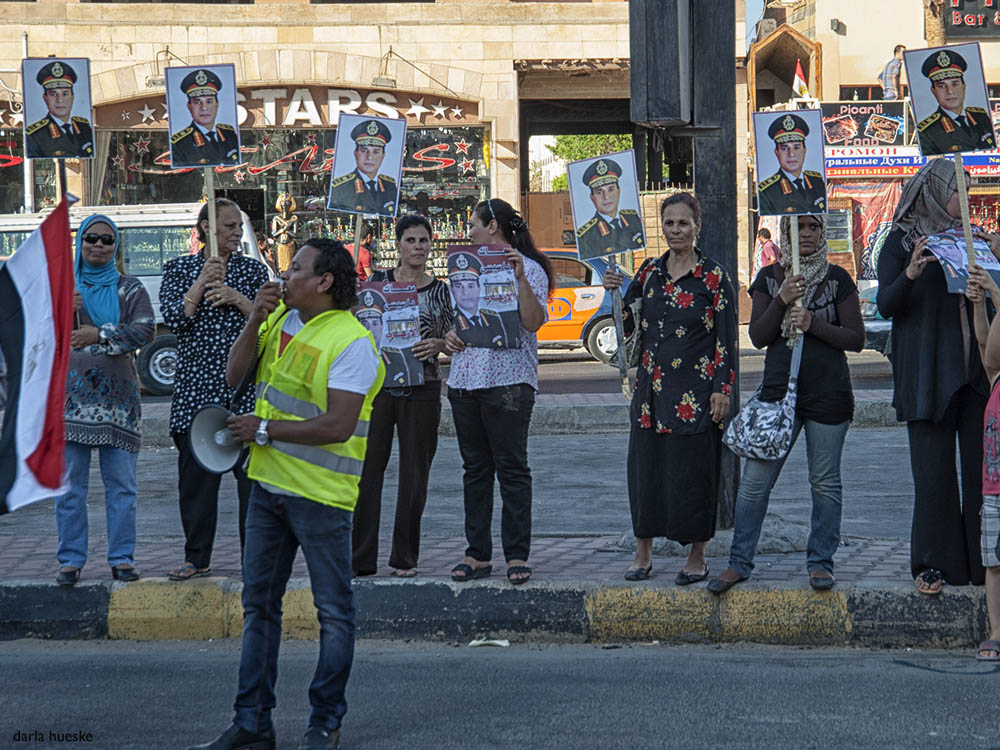
Is this a referendum on a new constitution or on the presidential bid of General As-Sisi? Or are they the same thing? Photo Credit: sierragoddess via Compfight cc
Will the Egyptian constitutional referendum pass? And if so, what will it mean? And what comes next?
Who better to answer such questions than the leading editorialists of the Middle East’s top newspapers? Here’s a brief review of four of them, two Egyptian and two from neighboring places.
Al-Ahram, which has returned to its traditional role as a slavish supporter of whatever regime happens to be in power, assures us through an editorial by Gamil Afifi entitled “Egypt is moving forward and the dogs are barking” that the passage of the referendum is an assured thing because “Our great people” will never fail “to confront those terrorist elements” who want to “turn back the country through a dark tunnel into the eras of ignorance” “under the slogan of religion” but “religion, God and His Prophet have nothing to do with this group.”
I use all those quotations because this editorial is so overwritten one almost wonders if Mr. Afifi is secretly laughing at his audience. The conclusion gives you a feeling for the style of the thing:
Egypt: It’s Jan 14. Do You Know Where Your Voters Are?

It’s referendum time again in Egypt as the unfolding revolution enters its next stage. The key question: how many will turn out to vote? Photo Credit: Kodak Agfa via Compfight cc
Today and tomorrow, Egyptians go to the polls to vote on a referendum approving the newly-drafted constitution.
This will be the third constitutional referendum since protests forced Mubarak to step down in 2011.
During the first referendum in March 2011, a boycott of “No” vote was widely urged by the groups whose protests had led to the revolution because they felt the new limitations it posed for the president were insufficient. This campaign was more or less successful, because while the measure passed 77-23, only 44 percent of the population came out to vote.
The military leadership did not get the mandate they had claimed the referendum would give them. When General Mamduh Shaheen tried to delegitimize the anti-government protests that continued throughout Cairo by claiming “The people chose SCAF,” his claim was laughed off.
A similar thing happened with the constitutional reforms rushed through by the Muslim Brotherhood dominated government in 2012. In spite of reports of sheykhs thundering from the minbar that the new constitution was sanctioned by God, only 33% of voters bothered to turn out, and those that did passed the referendum by a vote of only 64-36.
Castells on the Egyptian Revolution
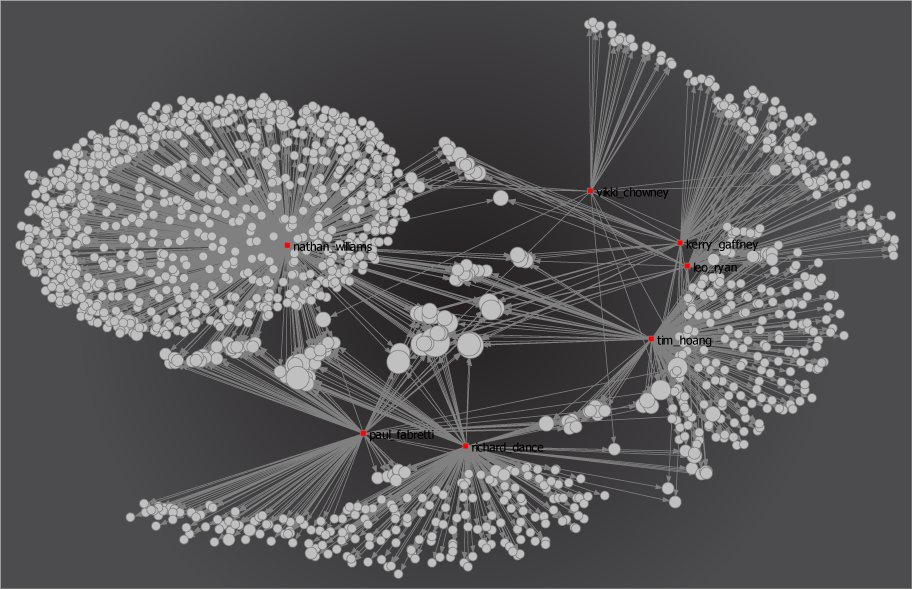
The author of The Network Society offers his analysis of the Egyptian revolution. Photo Credit: Porter Novelli Global via Compfight cc
Manuel Castells, the fifth most highly cited social scientist and the most highly cited communications scholar, has weighed in on the Egyptian revolution–and it is not, I think, his best work.
Egypt is featured in just one chapter of his new book Networks of Outrage and Hope, which also includes chapters on Tunisia and the Arab Spring generally, as well as Iceland, Spain and the US.
While Castells is most famous for his The Information Age trilogy, this new book is based on his more recent Communication Power (2009). Indeed, the first part of the book offers a good precis of that earlier work.
After reviewing social movements in the Middle East, Europe, and the US, Castells overarching conclusions are:

 CONNECTED in CAIRO