New Article on New Media in the Arab Spring
 A new article argues that most debates about the role of new media in political change are based on a false assumption–the notion that social media allows people to avoid authoritarian power structures, which in turn calls into being new egalitarian forms of protest cultures.
The article is entitled “Social media, protest cultures and political subjectivities of the Arab spring” and appears in the latest issue of Media, Culture & Society. It is by Tim Markham, Reader in Journalism and Media in the Department of Media and Cultural Studies at Birkbeck, University of London.
Here’s the abstract:
This article draws on phenomenological perspectives to present a case against resisting the objectification of cultures of protest and dissent. The generative, self-organizing properties of protest cultures, especially as mobilized through social media, are frequently argued to elude both authoritarian political structures and academic discourse, leading to new political subjectivities or ‘imaginaries’. Stemming from a normative commitment not to over-determine such nascent subjectivities, this view has taken on a heightened resonance in relation to the recent popular uprisings in the Middle East and North Africa. The article argues that this view is based on an invalid assumption that authentic political subjectivities and cultures naturally emerge from an absence of constraint, whether political, journalistic or academic. The valorization of amorphousness in protest cultures and social media enables affective and political projection, but overlooks politics in its institutional, professional and procedural forms.
References:
Markham, Tim. 2014. Social media, protest cultures and political subjectivities of the Arab spring. Media, Culture & Society 36(1): 89-104
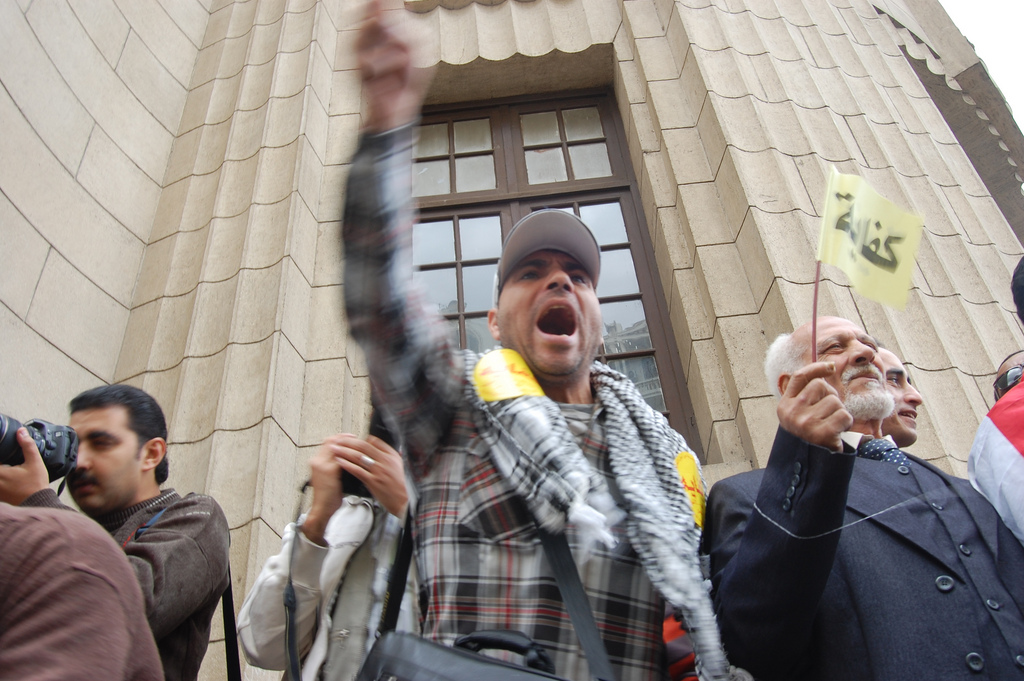
Opposition movements like Kifaya can, paradoxically, work to ensure a regime’s stability, according to a new book.Photo Credit: Sarah Carr via Compfight cc
Could it be that under the right conditions, opposition groups like Kifaya or the Muslim Brotherhood, actually contribute to the stability of the oppressive regimes they seek to challenge overthrow?
In a forthcoming chapter on “New Media and Social Networks in the Middle East” I argue that the use of new media for protest are mostly associated with nonviolent revolutions, and that most successful nonviolent uprisings have taken place in countries where there is an authoritarian ruler who maintains his authority largely by appealing to the democratic values espoused by external patrons (i.e. Mubarak and the U.S.).
I cite Daniel Ritter, who refers to this in his unpublished dissertation as “the iron cage of liberalism” (2010). It applies not only to Mubarak, but to Reza Pahlavi in 1979. Like Mubarak, the Iran of the Shah was an autocrat whose putative commitment to the democratic principles of its patron, the U.S., were continually contradicted by the actual relations between the state and its citizens. While utilizing brutal repressive mechanisms through secret police, such autocrats nonetheless are performing for multiple audiences including their Western patrons and cannot easily order the kinds of measures employed to put down a media revolution by the Iranian state in 2009, which included simply monitoring the Internet, then arresting and torturing thousands of dissidents it found in its monitoring.
I did not cite Holger Albrecht because I had never heard of him, but I have now. Albrecht is the author of a new book that applies this principle specifically to the history of oppression and resistance in the Mubarak regime. Maybe I can stick him into the chapter when I get the galley proofs.
Anyway, Albrecht rejects any teleological movement from authoritarian to democratic. He sees opposition as being at the very heart of the political process in societies like Mubarak’s Egypt, which he calls “liberalized autocracies.” In such autocracies, he argues, the authoritarian regimes allow the populace a certain amount of civil liberty and societal pluralism. Read more…
Dark Ironies of the Egyptian Revolution

The interim government’s New Year’s message: Don’t protest against the government without its permission, don’t resist the security forces who attack you, and don’t report news about any of that stuff, and we’ll get along just fine. Photo Credit: Jonathan Rashad via Compfight cc
The new year starts ominously in Egypt.
In the days leading up to it we’ve had the arrest, trial and sentencing of Ahmed Maher and many other long-time protest leaders; the detention of Al-Jazeera reporters; and the official declaration of the Muslim Brotherhood as a terrorist group.
Interesting from a purely scientific viewpoint–that is, for someone trying to analyze and understand the dramatic political, social and cultural changes unfolding in Egypt.
Disturbing setbacks for those of us wishing for Egypt a more representative government.
Civil Disobedience Without a License
Ahmed Maher, Ahmed Douma, and Mohamed Adel were arrested and sentenced to three years in prison for participating in unauthorized demonstrations–that is, without the Ministry of Interior’s approval as stipulated by a recently passed protest law. This means, of course, that he’s being arrested for continuing to carry out the same activities of civil disobedience that led to the overthrow of both Mubarak and Morsi, paving the way for the current regime.
Top Blog Posts of 2013

Hoping for Egypt a new year of peace, prosperity, and progress. Photo Credit: Earnst Brinkhuis via Compfight cc
This is the third year of the connectedincairo blog. This year saw 32,952 discrete visits, an average of 90 visits per day. This year included my best month ever–April, with 4,178 visits–and my best day ever–Oct. 4, with 501 visits. Most of visitors to the site continue to come from the United States and Egypt, with the UK, Canada and Germany following.
#1. Rethinking Sexual Politics in Egypt
This post from last January offers my review of a seminal paper by Paul Amar, and my smummary of an on-line “conversation” between Paul and three other significant scholars of gender, sexuality and power: Cynthia Enloe, Terrell Carver, Omnia El-Shakry. It was shared 80 times on Facebook, and received 764 visits.
#2. Writing Ethnography in Post-Mubarak Egypt
Another review article–this one was my take on a series of short on-line pieces posted on the Cultural Anthropology web site that dealt with key ethical, metodological and analytical issues of writing ethnography of the uprisings.
The Importance of Wikileaks in the Egyptian Revolution

Assange has claimed that Wikileaks was responsible for the Egyptian revolution; I’ve been pretty skeptical. A new article says Wikileaks mattered–but was hardly determinant. Photo Credit: Iwona Wisniewska via Compfight cc
I’ve been interested in the role of Wikileaks in the Egyptian revolution ever since I was quoted, out of context, on that very subject.
Most accounts of the Egyptian uprisings, even those that focus on the place of media in these uprisings (like mine) do not pay a lot of attention to Wikileaks. This is in stark contrast to accounts of the Tunisian uprising, where they are often treated as very significant in fanning the flames of fury that turned a protest into a demand for regime change.
However, I just read an article entitled “Aiding Revolution? Wikileaks, communication and the ‘Arab Spring’ in Egypt” by Simon Mabon in Third World Quarterly.
He makes a case that Wikileaks fits exactly into the model in which I have been placing other media institutions and practices: very important, but only through the agency of the important social actors, agencies and movements that mobilized the texts and their contents.
The author concludes that there are five ways Wikileaks influenced the Egyptian revolution:
Fixing The ‘Ashwa’iyyat ?

This photo is by another former AUC student. Photo Credit: Hossam el-Hamalawy حسام الحملاوي via Compfight cc
One day when they were about ten or eleven, I took my daughter Madi and her best friend, Aline, to a craftsman in a shop in a working class area of Cairo, just off Mohammed Ali street. I needed an expert to fix Madi’s violin.
The girl, daughter of an Egyptian millionaire, had never been on the metro before, and when we arrived in the neighborhood she looked around wide-eyed and asked “Are we in a slum?”
Alas, no. Mohammed Ali street may have faded from its heyday as the vibrant heart of Egypt’s musical scene, but dwellers in the ‘ashwa’iyyat wish they could live in Mohammed Ali. I tried to explain to her that Manshayet Nasser was as far below Mohammed Ali in living standards as Mohammed Ali was from her neighborhood in Ma’adi.
She could not imagine. And there was no way her dad was going to let me take her to Manshayet Nasser…
I’m reminded of this story because my friend Safaa Marafi was quoted in a story about the problem of Egypt’s ‘ashwa’iyyat (slums) in a recent edition of the English-language Al-Ahram Weekly.
The term ‘ashwa’iyyat can mean a number of things, and has many cultural connotations, but in this case it refers to informal housing areas–sections of the city built by desperate people in defiance of zoning laws, building codes, or legal title, and usually without adequate water, sewage or electricity (much less access to health care or education).
A few facts:
Understanding the Egyptian Revolution As Process
Photo Credit: Interact Egypt – Play Innovation via Compfight cc
Over in the world of media anthropology, were having some energetic discussions about media and social change, all of which will be grist for a planned book on that subject.
I’m thinking about these issues simultaneously through two projects (that’s why my brain has two hemispheres, right?), one in India and the other being the Egyptian ongoing revolution. I have three forthcoming book chapters on this topic.
One of these, based on my Oxford paper, examines the revolution through the lens of Victor Turner’s processual analysis, and considers the problems of contingency and agency is thinking about the revolution as a (series of) social drama(s).
Here’s the introduction:
Revolutions are usually sprawling, unpredictable, inchoate things whose structures become apparent only from a distance as they unfold over time. Certainly this is true of the Egyptian revolution. Beginning as a carefully orchestrated protest by experienced agitators against the police as agents of state oppression, held on the national Police Day holiday, it was seemingly dispersed in an almost routine fashion late at night by police cannons, only to re-emerged as a heroic, disorganized march against the regime, which in turn morphed into a long-term, well-documented seizure of public space. It endured attacks that created martyrs to the cause, spread into other cities from Alexandria to Ismailia to Luxor, and ultimately achieved its most basic goal: the resignation of 30-year president, Hosni Mubarak.
A Quick And Dirty Account of Media in the Egyptian Uprising

Photo Credit: AhmadHammoud via Compfight cc
I have a chapter coming out in a book on the social anthropology of the Middle East. I was asked to write a chapter on “New Media and Electronic Networks.”
While most of the text is about various ways anthropologists (and their colleagues in related disciplines) might think about media in the modern Middle East, I have one section in which I do a brief account or the revolution.
The goal was to write an account that was 1) brief, 2) covered the main events and actions of the revolution, and 3) included media institutions and practices but did not exaggerate their causality.
I thought I might share it here:
Revolutions are extraordinary times that break down pre-existing political, economic and social structures, ushering in periods of creativity and imagination as well as struggles over what new realities will emerge. Media play at least two key roles in this process. On the one hand, their institutional roles — their relations with the state and communities of media users —may be abruptly changed. On the other hand, as social forces media will play transformational roles in the revolutionary process.
In the case of Egypt, the uprisings took place at the end of more than a decade of protests that peaked in 2005 and again in 2010. Although many of these were labor strikes at factories or in small communities disconnected from each other and from larger social movements, many of the urban protests involved closely knit groups of protesters and organizers who learned from experience, from one another, and in some cases, from wider global pro-democratic protest networks. New media technologies played important roles in creating these connections and disseminating lessons. Many of these urban protest leaders also made strong efforts to connect to the less technologically sophisticated labor movements. The 6th of April network, one of the most important mediated social movements in Egypt, began as a simple Facebook page calling on protesters in Cairo to support a planned labor protest in the industrial town of El-Mahalla El-Kubra.
 One of the many things I love and hate about the Internet is its impermanence. The fixedness of texts is always suspect, and there are only limited ways to go back through the changes to discover the palimpsest of transformations by which the text you read three years ago on…say, Wikipedia, is transformed into another.
Okay, I don’t draw that example at random. About three years ago I visited Wikipedia among other sources for a set of notes I was putting together for myself on the concept of “media ecology.” I visited the entry today to discover two major changes:
First, the article now recognizes a “European” version of media ecology that derives from the work of the great Gregory Bateson, among others, which I recognize as cognate to how I use the term.
Second, I’m there. There’s a whole section derived from my paper “Egypt’s media ecology in a time of revolution.”
New Review of Connected In Cairo

I knew I was going to be a writer long before I knew I what kind of stuff I was going to write. In spite of a couple of plays that got produced, it took two lousy unpublished novels, a handful of even lousier unpublished short stories, and a lucky chance that led to a six year stint as a political journalist to make it clear that I was going to write about the people in the world around me, not the messy characters inside my head.
In the many years since my first stab at fiction writing in elementary school, I have spent a lot of time thinking about, and honing my craft as a writer. And I’ve spent a lot of time teaching students to write well.
So when people single out my writing for praise, I am particularly pleased and flattered.
Which is a long, roundabout introduction to say that there is a new review of Connected in Cairo by Gregory Starrett in a recent issue of the journal Contemporary Islam.
Starrett describes the book thus:
This book is an introduction to the way that ‘connectedness’ in its many senses is a key for understanding themarkers of socioeconomic class stratification and what many scholars call ‘neoliberal subjectivity,’ the cluster of aspirations, tastes, and capacities that define the self in terms of its role in the circulation of capital.
He goes on to say:
Pursuing this argument about consumption as a fulcrum balancing cosmopolitanism and authenticity – the argument itself is not a new one, of course, but is laid out here in a style so clear and unaffected that it might serve as a model for good academic writing – leads us through Arabic children’s magazines, the social meanings of computers, Pokemon, shisha and coffee shops, linguistic code-switching, shopping malls, male sociality, international advertising campaigns for condiments, and the cutthroat competition between Cairo’s pizza restaurants.
Wait. Let me repeat that in case you missed it:
“laid out here in a style so clear and unaffected that it might serve as a model for good academic writing “
As someone who made my living as a non-fiction writer before I became an anthropological writer, those are extremely high accolades indeed. It is what I strive for in my scholarly writing.

 CONNECTED in CAIRO