What Happens When Islamist Parties Gain Power?

What kind of government will democratically elected Islamic parties create? Nobody knows yet–including those parties. Photo used by permission of Abdelrahman Mostafa
For decades, Islamic parties have been heavily repressed in most north African states, both by their own governments–Algeria fought a civil war rather than let a legally elected Islamic party come to power–and by the North American and Western European nations who dominate the global economies and world lending institutions.
Now the wave of Arab uprisings–although not initially organized or led by Islamists–has swept these parties into power. The question: What will these new governments look like? is being argued and debated everywhere, including in International Studies classes here at Miami University.
Most Americans I know take for granted that any state governed by Islamic leaders will eventually come to resemble Iran. I’ve always been skeptical of this notion, for reasons I’ve discussed elsewhere.
Now the Carnegie Foundation has released a report based on a series of meetings held with representatives of the newly elected Islamist parties in Egypt, Morocco and Tunisia.
The main finding in “Islamist Parties in Power: A Work in Progress” by Marina Ottaway and Marwan Muasher is that the Islamist parties aren’t certain of how things will turn out either. After decades of isolation, they are trying to figure out how to best lead their countries forward.
Talking About Liminality in Oxford
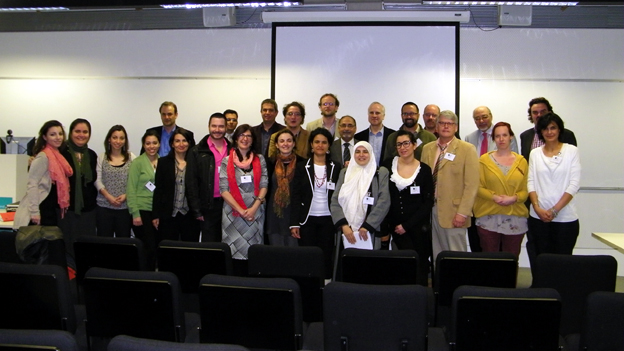
Can you find me amid all the other brilliant people in this picture? (Hint: I’m in the back, fourth from the right)
The international conference ‘The Egyptian Revolution, One Year On: Causes, Characteristics and Fortunes’ which I attended last weekend (May 18 and 19) at the Department of Politics and International Relations ay Oxford University was absolutely great. I met some amazing scholars, some of whom I knew and some I did not, and I learned a great deal from every single panel, and I have a lot to think about.
What struck me most about the conference was that irregardless of our discipline, we all seemed to be struggling with finding languages with which to describe and analyze this tremendous ongoing transformation of the Egyptian polity. So I learned about “horizontalism,” “securitization,” “informalization,” “street politics” and many other glosses for the kinds of social action we are seeing play out in Egypt.
My own paper, entitled “In Search of Antistructure: The Meaning of Tahrir Square in Egypt’s Ongoing Social Drama” borrows not from my usual languages of globalization and practice theory but from the processual analysis of Victor Turner in the 1970s. In particular, I was looking at the notion of liminality.
Egypt’s Thirteen Presidential Candidates

Who will she vote for? None of the 13 candidates are likely to get the required 50 percent of the vote tomorrow and Thursday, so run-off elections are scheduled for next month.
In honor of the Egyptian presidential elections I’ve updated the Who’s Who page with brief bios of those candidates not already listed there. But to save you the trouble of paging through all those entries, I’m posting just the 13 presidential candidates here.
None of the 13 candidates is likely to top 50 percent in voting today or tomorrow, so a runoff vote is scheduled for June 16-17. The new president will be announced June 21.
And the candidates are:
Abul-Futuh, Abdel-Moneim. A doctor, activist, long-time opponent of the Sadat and Mubarak regimes, and ong time member of the Muslim Brotherhood’s guidance council, Abdel Moneim Abul-Futuh, 60, broke with the organization in 2011 when he announced his presidential candidacy. He has run as a middle-of-the-road candidate and attracted the largest number of expatriate votes.
Al-Awa, Mohammed Salim. Former Secretary General of the International Union for Muslim Scholars based in London, and head of the Egyptian Association for Culture and Dialogue, Mohammed Salim al-Awa is a lawyer, jurist, writer and intellectual known for work on the meaning of Islam in the modern world. He is the author of Fil Nizam Al-Siyasi lil Dawla Al-Islamiya (On the Political System of the Islamic State) one of the most important and comprehensive studies of the concept of the Islamic state and governance. On June 14, 2011 he announced his candidacy for president of Egypt.
Talking About the Egyptian Revolution in Oxford

I’m off to Oxford this weekend for an international conference on the Egyptian revolution, so don’t expect many posts.
The conference is entitled ‘The Egyptian Revolution, One Year On: Causes, Characteristics and Fortunes’. The conference will be held on Friday 18 and Saturday 19 May 2012 at the Department of Politics and International Relations, Oxford University.
The abstract reads:
The popular uprising of 25 January 2011 launched a revolution in Egypt that captured the imagination of observers worldwide, and whose reverberations continue to be felt throughout the Middle East, as well as in the world’s major capitals. The year 2012 is seeing many scholarly communities mark the first anniversary of this extraordinary development. This conference aims for Oxford University to be the meeting point, at the juncture of one year on, for a consideration of the causes, characteristics, and fortunes of the January Revolution. The conference stands out for its explicit aim to bring together scholars based inside and outside the Arab world, and for encouraging the participation of scholars on the ground in Egypt.
I will be speaking on Saturday on “In Search of Antistructure: The Meaning of Tahrir Square in Egypt’s Ongoing Social Drama.”
I’m excited. I haven’t been to England in a decade, and haven’t been to Oxford since…jeepers, since 1993! And it’s always fun to be surrounded by, and learning from, people who are smarter than I am.
Five Questions Political Scientists Should Be Asking Themselves in the Wake of the Arab Revolutions
 The Arab spring–or, as he prefers it, “awakening” proves so complex on any close examination that “a fixation with pre-existing fault-lines can blind us to alternative sources of revolutionary energy,” writes Shashank Joshi in his essay “Reflections on the Arab Revolutions” in the May 20, 2011 issue of the RUSI Journal (RUSI, for those who don’t know, is the Royal United Services Institute for Defence and Security Studies, the world’s oldest still-existing military think tank, founded in 1831 by the Duke of Wellington).
What’s more, he says, trying to force our thinking about the Arab uprisings into the same tired categories that have guided Western security policy during the last several decades is likely to
prove misleading as to the post-revolutionary futures that exist beyond the ‘lurking Islamism’ caricature invoked by so many trite public-policy briefs and Arab despots over the past decade of stagnation. The Arab world resists both utopian and dystopian simplifications, and our policy discourse must equally resist the lure of each.
Joshi argues that long-held assumptions about “the Western trilemma in the Middle East – the choice between democracy, stability and pro-Western foreign policy” – must be reevaluated. In particular, five key assumptions must be re-evaluated:
Was the Arab Spring Caused By Global Warming?

As these ancient whale bones in Wadi al-Hitan demonstrate, climate change has played a significant role in North Africa, and continues to, especially through desertification. But was it a contributing factor to the Egyptian uprisings?
When I first read the title of this article by Sarah Johnstone and Jeffrey Mazo “Global Warming and the Arab Spring” I thought it was going to be a bit of clever word play–“warming” alluding to democratic change after the frigidity of authoritarianism.
Nope. They mean global warming the way Al Gore means global warming. Climate change, caused by human activity, leading to environmental catastrophe.
Most of the article is a brisk and superficial analysis of the significant, albeit not determinant, role food prices played in the protests in Egypt and elsewhere. The authors argues that changes in climate are producing food shortages.
In wealthier countries these are expressed in minor rises in prices: tomatoes cost a nickel a pound more, wheat a little more per pound, increasing the price of that loaf of bread.
But in poor countries, the situation is a disaster, since the global capitalist system forces all countries to offer their food on a global market and World Bank and similar institutions keep countries from practicing such “socialistic” practices as feeding themselves first. Egypt’s 2008 bread crisis never really ended, the authors point out, so this helped many support the revolution.
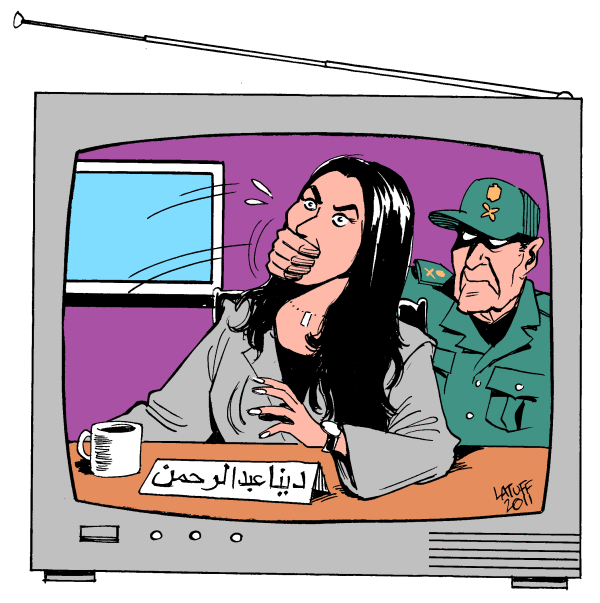
Was the Internet freer from censorship than the news media under Mubarak? And if so, has this influenced the post-Mubarak media? (Cartoon by Carlos Latuff used by permission).
I got an e-mail from a journalist with the German media “Spiegel Online” last week. She was researching an article on tv programs in the Middle East after the Arab Spring and came across my paper on Bassem Youssef.
She asked me two interesting questions:
- Do you think that the new generation used to less censored new media outlets such as YouTube or Facebook are also making itself felt in the programming of (new and private) Middle Eastern tv channels – is it becoming more daring / taboo breaking?
- Did the Arab Spring – or the associated societal upheavals – have an impact on programming? On Producers? Existing Red lines? Target audiences?
Unfortunately, as this was the weekend of my oldest daughter’s graduation from college and my wife’s birthday, I did not receive her e-mail until after her deadline.
For whatever my thoughts are worth (a pfennig?) I do have answers to these questions.
First, I think it is a mistake to suggest that the Internet was less censored. The Internet was censored much the same way independent newspapers and television were censored. It was just less effective, for several reasons.
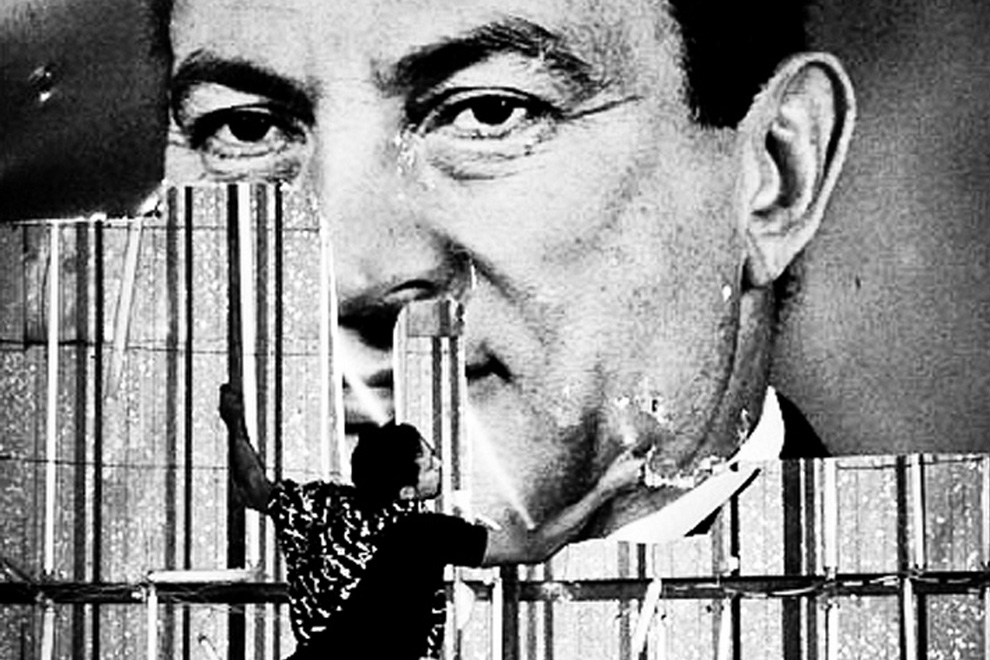
The economic decline, autocratic politics and disempowerment of civil society groups were not three problems but three symptoms of the same problem, writes Hamdy Hassan. And that’s why Mubarak had to go.
There were economic, political, and social problems that Egypt faced under Mubarak, and which were contributing factors to the revolution of 2011. These are summarized by Hamdy Hassan, professor of political science at Zayed University in Dubai in his paper “Civil Society in Egypt under the Mubarak Regime.” There is little new in this paper, but it provides a handy and readable summary of the generally accepted critiques of the Mubarak regime.
Soft State Economics
The problem with the economy, Hassan argues, can be boiled down to the theory that Egypt was a “soft state,” in which the rule of law was not respected by the elites, who were able to enrich themselves through loopholes in the law unavailable to others.
“The privileged people have money and power to protect themselves when they break the law, and the unprivileged protectors of laws are obliged to receive bribes to turn a blind eye on breaching the law.”
Cosmopolitan Dreams, Local Realities in Egypt

Working class men with cosmopolitan aspirations in the barbaershop of the village of Nazlat al-Rayyis, near Alexandria. First of ten images in Samuli Schielke’s photo essay in City & Society.
In Chapter Two of Connected in Cairo I write about two High School aged boys attending two very different kinds of private educational establishments, each living in their own social worlds and defined spaces, with their own relations toward modernity.
Subsequently I describe two young school friends with aspirations toward the cosmopolitan modernity they see in Arabic children’s magazines, but whose lives are beginning to separate as a result of family incomes, educational and leisure practices, and family uses of technologies.
As the book progresses, I follow the wealthy kids, the ones whose families have the means–economic and social–to pursue their cosmopolitan aspirations, and look at the challenges to identity and cultural practice posed by these choices.
But what of these others? What of the youths with aspirations toward cosmopolitanism and global modernity whose incomes do not fit them to pursue these futures in the same ways?
These are the subject of a photo essay by Samuli Schielke in the latest issue of the anthropology journal City and Society entitled “Surfaces of Longing. Cosmopolitan Aspiration and Frustration in Egypt.”
Schielke writes:
One of the most ambiguous outcomes of globalization has been the emergence of a large class of people who subscribe to global trends in religion, consumerism, nationalism, sports and popular culture, without having access to the mobility nor the symbolic capital that are associated with cosmopolitanism. This sense of aspiration is far from ephemeral. It is material, it has shape, surface, and form. This photo essay attempts to connect this sensual presence of images, and materials with the sense of longing and discontent involved in looking out to the world from the vantage point of underprivileged social milieus in Egypt.
Schielke, a research fellow at Zentrum Moderner Orient in Berlin, collects ten photos that capture the spatial and material aspects of cosmopolitan longing in modern Cairo, and offers interesting, readable contextualizations of each.
Hip Deep in Egyptian Music: An Afropop Series
 While we’re on the subject of music, the 5-part, Hip Deep series on Egypt from the acclaimed public broadcasting radio series Afropop Worldwide is now available on the program’s companion web site.
However, the Afropop.org site, while amazing, is not well organized; it’s like browsing through a really cool old record store. In the interests of efficiency, I’ve organized the five-part series on Egypt into a coherent series below.
For each episode you’ll find the title, a brief description, a link to the episode podcast, and a link to the Afropop page for each episode, which includes supplemental goodies like photographs and interviews that didn’t make it into the final broadcast.
Part One: Cairo Soundscape
The series opens with “Cairo Soundscape,” a sonic tour of Cairo from the chatter of car horns on jam-packed streets to the lulling waters of the Nile. “We start with a focus on the city’s spiritual life, the persistent call to prayer broadcast from mosques city wide, Quranic recitation, Coptic hymns sung in ancient churches, and a Zar healing ritual in a working class Cairo neighborhood. This program introduces the themes and central characters for this unique Afropop program series, which takes the pulse of a culturally rich society in the midst of upheaval and historic change.”

 CONNECTED in CAIRO