
Coptic protests outside Cairo's Maspero Building. Al Masry Al Youm photo by Fouad Elgarnousy
The public narrative about sectarian violence continues to evolve, as various stakeholders in Egypt’s unfolding revolution stake out claims.
According to a story in Al-Masry Al-Youm May 16, several members of 25 January revolution youth groups have urged Coptic protesters at the Egyptian state television’s Maspero Building to “suspend their protest and respect the state of law.”
After thugs attacked protesters May 14, resulting in two deaths and multiple injuries, several groups called on the Copts to end their protests. While recognizing the importance of freedom of expression, and insisting that the government (i.e. army) needed to do more to protect the protesters, the Youth for Stability Coalition said in a statement that the high frequency of protests drains the energy of the youth and impedes the creation of a state of law, which is one of the primary demands of revolutionary youth.
The coalition issued a statement saying that the high frequency of protests drains the energy of the youth and impedes the creation of a state of law, which is one of the primary demands of revolutionary youth. Coptic sit-ins provide an opportunity for Muslim and Coptic extremists to abuse the situation and break religious unity, it said.
Amr Hamed, a member of the Revolution Youth Union, explained that the clashes at the television building were premeditated by those who want to use sectarian violence to promote a return to a Mubarak-like authoritarian regime. He called on Copts to end the protest to bolster stability and deprive the “enemies of the revolution” of the chance to spark sectarian violence.
The protests are, of course, signifying events, and the issue here is over the possible interpretations of those events.
From the Coptic perspective, their protests are mimetic–they are doing exactly the same as the 25 January Tahrir protesters (many of whom were Copts): They are demanding political redress and they are willing to take whatever their opposition can dish out, confident that their revolution will be televised, and blogged, and Tweeted, and posted, and that remedy may be offered if their protest remains an active sign.
The position of the 25 January leadership is based on a different semiotic reading. There have been so may protests since Mubarak stepped down–by women, labor movements, syndicates, unions, journalists–that the impact of the original protest movement is getting lost. Moreover, each protest offers an opportunity for counterrevolutionary movements to introduce violence, which tends to signify to viewers that chaos reigns in the absence of the Mubarak regime.
The irony is that some of the leadership of a protest movement that owes its success to a willingness to continue in the face of arrests, assaults, injuries and martyrdoms is calling on a minority group that is demanding that its existing political rights be protected and recommending that they do not do the same, but rather capitulate.
The protests began after riots in the poor Imbaba neighborhood in Cairo left 15 dead, 200 injured and two churches burnt down. Coptic protesters have been demanding the prosecution of those involved, as well as the opening of closed churches and the release of Coptic prisoners detained in previous protests. Many members of 25 January protests are out there in solidarity with the Copts–I know, because some are Facebook friends and are posting about it.
Authorities have since made several arrests in the Imbaba incident and referred suspects to prosecution.

There's an ongoing debate within the Muslim Brotherhood over the proper relationship between Islam and democracy.
Black-and-white thinking–or at least stark either/or discourse–structures many discussions about the future of post-Mubarak Egypt and the post-Arab Spring Middle East generally. In the US, especially, many people seem to think that there is only a choice between a secular democracy, on the one hand, and a Iran-like theocratic state on the other.
In fact, democracy comes in many forms, and there are many possible ways religious ideologies and democratic political institutions can co-exist. Currently, there is a great deal of debate within Egypt’s largest and best organized Islamic group, the Muslim Brotherhood, over just these questions. The continuum stretches from those who take the position that Islam is not compatible with democracy to those who imagine an Islamic political party similar to the Christian Democrat parties in Europe–secular political parties whose platforms are consistent with mainstream theology and clearly rooted in Islamic values (the comparison with the Christian Democrats is not accidental–with its conservative moral platform and progressive social agenda, in countries where it exists it has become the most popular party among European Muslims).
A recent contribution to this debate was an article by Mu’taz Abdel Fattah in the Egyptian Muslim Brotherhood website Amlalommah on April 29th arguing that while Western secularism is not the right approach for Egypt, neither is autocracy.
Abdel Fattah, a political science professor at Cairo University, argues that the claim to divine right of rule is not established by the Qur’an or Hadith but was instituted by men–men like Mu’awiyah Ibn-Abi-Sufyan, the first Umayyad Caliph, who created the first Islamic totalitarian political state; or like Umayyad Caliph Abd-al-Malik Ibn Marwan who claimed his execution of the prior ruler Amr Ibn Sai’d Ibn-al-As “was the will of God”; or Umayyad Caliph Walid Ibn Yazid who claimed that “the Caliphs of God have been appointed by Him.”
“The history of the world asserts that autocracy in the name of religion is old and that existed even before Islam,” he writes. Autocracy is a disease that can emerge within any religion or political ideology, but democracy, properly constituted, is the best way to avoid it:
I believe that democracy with all its institutional and procedural mechanisms, with my due respects to the first three articles of the constitution, constitutes the guarantees which we badly need, and this is not an action that undercuts Islam, as some people would like to portray it, but is a remedy of a disease which we might contract as others contracted autocracy in the name of religion or other beliefs.”
Re-Imagining Youth in the Middle East

"Thank you Egyptian youth Facebook" reads this sign. But who are the "youth" being thanked?
The Egyptian “youth” are credited over and over again with having inspired, planned, organized, and sacrificed for the revolution. What kind of youth are the “youth movement” who inspired and worked tirelessly for Egypt’s liberation?
“Youth” is not simply natural stage in human development. It is also a cultural category, a set of discourses that seeks both to define youth and to articulate the behaviors, activities and values that should be associated with it.
Cultural studies maven Dick Hebdige (1998) observed that modern representations of Western youth tended to fall into one of two categories: “youth as trouble” and “youth as fun.” The images of “youth as fun” emerged amidst post-World War II affluence and the development of the category of the “teenager.” Such images depend on the ability of youth to participate as independent agents in consumer culture and on the growth of market niches targeted at youth. Youth who are marginalized from participation in fun consumption tend to be portrayed as a problem.
In Connected in Cairo I write about affluent Egyptian youth with the money to have fun–and why they are having less fun that they might appear to be having.
Ted Swedenburg’ wrote a great article in 2007 articulating the many ways in which Western observers have tried to describe the Middle East as having a youth problem. For influential political scientists Samuel Huntington, they are “a natural source of instability and violence.” And for ex-Defense Secretary Donald Rumsfeld they are “easy to recruit to radicalism.”
The reality on the ground, as Swedenburg reminds us, is usually much more complicated than the sweeping generalizations of such “authorities”. Ethnographic descriptions reveal very different pictures, in which people can have fun, be angry, create art, express frustrations, and work for change.
If nothing else, the uprising in Egypt and elsewhere suggests we need at least one more category to add to Hebdiges: “Youth as liberator”
References
Hebdige, Dick. 1998. Hiding in the Light. London: Routledge.
Swedenberg, Ted. 2007. Imagined Youths. Middle East Report 245 http://www.merip.org/mer/mer245/imagined-youths
Reading the Tweets of the Revolution
 One of the most interesting aspects of the revolution is how much data historians are going to have to work with. The role of social and other media provides a thick series of ongoing texts being produced moment-by-moment as the uprisings were occurring.
The first book to take advantage of this phenomenon, Tweets From Tahrir: Egypt’s Revolution As It Unfolded in the Words of the People Who Made It Happen (O/R Books, 2011) has just been released. The book is edited by Alex Nunns and Nadia Idle–the latter herself a protester and Tweeter.
The book is pretty much what the title says: a picture of the uprising unfolding in real time through the Twitter accounts of activists heavily involved in its planning and organization. Of course, thousands of people documented on cell phones every stage of the uprising; this book brings together a selection of tweets by key actors redacted to create a compelling narrative. Some Tweeters were “citizen journalists”, using social media to report what was happening. Others were organizers, using social networks to help plan events and activities.
The structure of Twitter–with its limit of 140 characters–shapes the nature of the narrative. News, requests, alarms, outbursts of emotion all occur in short bursts of writing, providing a very different kind of historical resource from those with which social scientists usually work.
Cell phone photographs by the Tweeters provide the book’s illustrations.
You can order the book from Amazon, Barnes and Noble, and other on-line booksellers, or from the publisher:
Any book on social media must have a Facebook page, of course
And here‘s a review and excerpt from The Guardian.
Assessing the Art of the Tahrir Uprisings

"Free People" Photo by Hossam al-Hamalawy, Jan. 30.
The first–or one of the first, who knows?–studies of the art of the Tahrir uprisings has been published. It’s called Signs of the Times: the Popular Literature of Tahrir Protest Signs, Graffiti, and Street Art and was “curated” by Rayya El Zein and Alex Ortiz. Published April 1, 2011, it’s an issue of Shahadat–a visual magazine published by Art ə East, a Middle Eastern art web site.
The web site describes the issue thus:
This issue takes as its focus the popular literature of the Egyptian Revolution. Drawing on protest signs, graffiti, and street art in Tahrir to read the culture of resistance particular to the Egyptian Revolution, the curators examine how protesters changed the political narrative through the use of images, memorials, and expressions of daily life. Featuring examples from an extensive gallery of online images culled from the collections of several prominent Egyptian journalists and activists, the online piece is a visual tour of some of the creative production of Egypt’s Revolution. A collaborative curation project split between New York City and Cairo, this is ArteEast’s first critical look at the cultural production related to recent political developments in the Middle East.
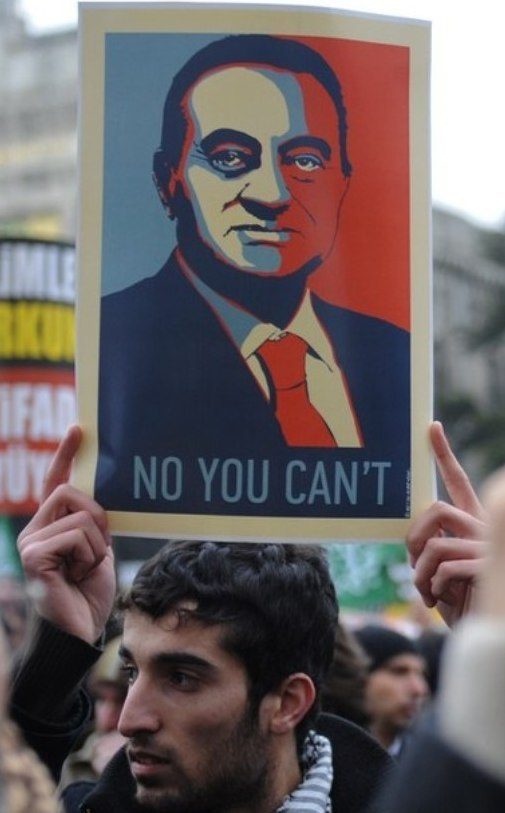 The text consists of 40 images and several short essays. The images are drawn from the online galleries of seven photographers — Kodak Agfa (a name used by Zeinab El-Gindy), Jehan Agha, Sarah Carr, Jano Charbel, Hossam el-Hamalawy, Gilad Lotan, and Ramy Raoof — whose work has been widely circulated and archived on Flickr as well as the artists/activists own blogs.
The essays are excellent–short, evocative and insightful. Each considers the protest images at once as popular literature and visual culture, and explores implications for political and aesthetic understanding.
The first and longest, “Watching the Revolution” by Rayya El Zein, describes the experience of watching the revolution unfold through the medium of the Internet, of being able to integrate watching the revolution into the rhythms of her everyday life in New York, and uses this as a jumping off point for broader rif on the the visual nature of this revolution:
Assessing the framework of how the revolution was watched becomes more grounded when we consider that both Mubarak and protesters seem to have been keenly aware of the potent politics of being seen. The regimes constant and brutal crackdown on journalists and their equipment reflect an anxiety about the infectious power of specifically seeing resistance. And Tahrir protesters were consistently aware of the potential dangers of being seen or remaining hidden.
The second essay, by Alex Ortiz in Cairo, focuses on the challenge of translation–the loss of the poetic rhythms and internal rhymes that make many of the signs and grafitti especially funny, witty or powerful.
Other essays focus on the sheer quantity of images and what that says about the revolution as well as the challenges it poses for curators selecting a few for an on-line magazine, the power of the mundane in creating revolutionary realities, the interweaving of words and images in the texts of the protest, and the place of Arabic, English and other languages.
A longer (and more thoughtful) review by Anthony Alessandrini, replicating many images from the issue but also adding images and videos related to the themes of the issue, can be found on Jadaliyya.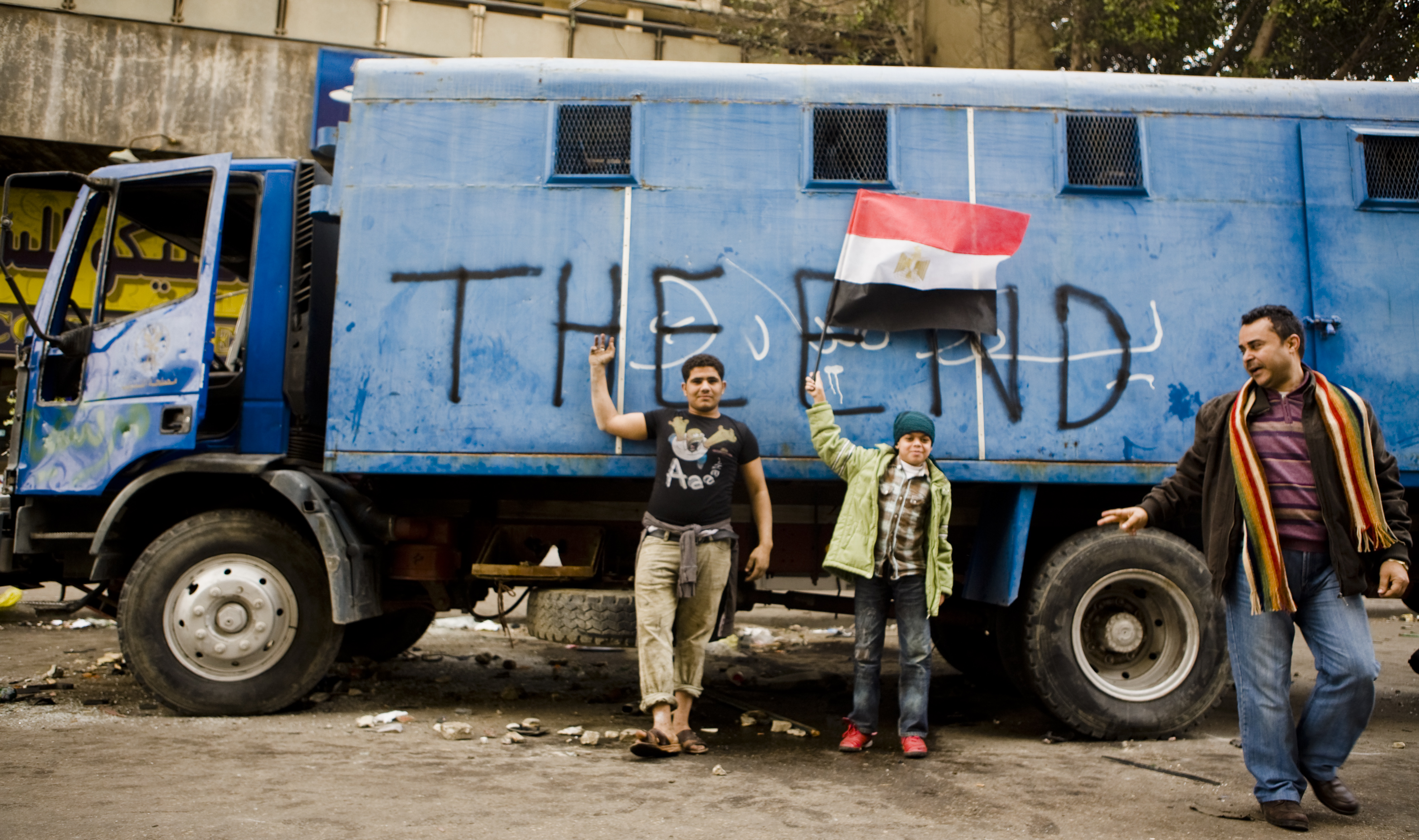
Dictators May Be Bad for the Economy

It may surprise Western economists, but the Egyptians knew it long ago: The "stability" Mubarak provided was not good for the Egyptian economy.
Two recent papers looking at Egypt’s economy under Sadat and Mubarak lead to the inescapable conclusion that while dictators who provide “stability” may be good for U.S. and European economies (and the bank accounts of the dictators), they are hell on their own economies.
The first paper “When Cheap is Costly: Rent Decline, Regime Survival and State Reform in Mubarak’s Egypt (1990-2000)” from the March 2011 issue of Middle Eastern Studies examines the problem of “rents.”
A rent is a fee charged for the use of natural resources. Many countries in the Middle East are “rentier states”–they have little productive economy and their primary international income is derived from selling access to their natural resources.
Normal economic wisdom claims that external rents–in Egypt’s case oil exports, foreign aid and Suez Canal fees–are associated with weak state institutional capacities. Current neolibral theories suggest that steady and consistent decline in rents should reverse this trend and improve state capacity building.
The problem: didn’t happen in Egypt. Between 1990 and 2000, oil revenues declined from 11 percent of GDP to a mere 2 percent, Suez Canal revenues stagnated at 4 percent, and foreing aid declined from 5 percent to nearly 1 percent.
The author of the paper, A.I.A. Adly, sums it up thus:
Despite their consistent decline or stagnation, rents assumed a critical position in state finances… Despite the decline in external rents, exports and state revenues, there was hardly any state capacity building to restructure and diversify non-oil exports.
On the contrary, Adly says, echoing political economist Robert Springborg, “Egypt is de-globalizing.” Why? Because the Mubarak regime was making so much money off these rents they didn’t need to worry about developing economic sectors that didn’t profit them directly.
Whereas in a productive economy many citizens are employed in economic activities, and they are taxed by the state which returns the money to them in the form of infrastructure and services (military, police, schools, roads, libraries, parks, etc), in rentier economies the state sells these resources and redistributes the wealth to the population in the form of infrastructural improvements and services.
Except when they don’t.
Whereas in a productive economy declining economic revenuse lead to decreasing tax revenues which force governments to (try to) do something about it, rentier economies involve only a small sector of the population. These elites may well keep a lot of the rents money. As rents decline, they can merely increase the amount of money they skim and decrease the amount of goods and services the state provides to the populace. From the viewpoint of “the narrowly-defined interests of the agents involved” (as Adly puts it), there’s no strong incentive for actually advancing the development of the country.
This develops eventually into a kind of “crony capitalism” involves the development of a government-business elite that profits enormously from the nation’s resources. Some of this wealth trickles down to the educated elites and technocrats needed to run those parts of the society the elites need, but it brings little or no wealth to the majority of the population.
The problems with “crony capitalism” are evident in the report just released by the Public Funds committee, indicating that Dr. Abdel-Azim Wazir, the former Governor of Cairo, Dr. Abdel-Rahim Shahata, another former governor of Cairo, and three other leaders of the governate, illegally granted large pieces of land around the new Kutamiya development to 31 businessmen in exchange for bribes equalling 10 million Egyptian Pounds, according to a May 12 story in Al-Masry al-Youm
Usurprisingly, then, we learn from the second paper, “Analyzing the fiscal process under a stochastic environment: evidence from Egypt” by Amir Kia and Norman Gardner that the fiscal budgeting process used by the Mubarak regime was unsustainable.
The paper rejected a standard economic measurement that tests whether a government sticks to its budget–Egypt usually doesn’t–as way to determine whether the budgeting process worked. The authors argued that persistent deficits and the accumulation of debt in Egypt does not mean that the debt is unmanageable because governments can always change the way they do things.
It is possible for a government to change the historical pattern it has been following so that it will not continue to borrow and run a ‘Ponzi’ scheme in the future.
Unfortunately, even with this more generous–the authors say “realistic”– assumption, “it was found that the fiscal budgeting process in Egypt is sustainable in neither a stochastic nor a non-stochastic environment.” In fact, the only two measures that had any real impact on helping Egypt fix its disastrous deficits-to-GDP ratio were the austerity budget adopted in 1967 (under Gamal Abdel Nasser) and paying an additional cost of living allowance to government employees since 1975 (instituted under Anwar Sadat).
So the avowedly socialist government of Nasser did more to help the debt than the avowedly neoliberal Mubarak government.
This brings us to the economic woes behind the uprisings. The standard wisdom is that Nasser’s socialism improved the lot of the masses but ran up unmanageable debt. The Mubarak regime has integrated Egypt into the global economy but his liberalizing reforms have been slow due to pupolar protest.
From the perspective of common people, though, Nasser created infrastructure while Mubarak has let it decay. There’s a lot of development–shopping malls, office buildings, gated communities–but these are mostly for the elites, not for everybody. These papers give some analytical insight into the processes by which this occurred before they threw Mubarak out.


Is Al-Jazeera having its own "Arab Spring"?
The so-called “Arab Spring” is not only transforming the relations between people and their government, but it is also transforming regional media in all kinds of interesting ways. The uprisings in Egypt and elsewhere in the Arab world have transformed not only the Egyptian media, but also global Arab news giant Al-Jazeera.
In January, Al-Jazeera began 24-hour news coverage of events in Egypt, followed by round-the-clock on-site coverage of events in Libya, Syria, Yemen and elsewhere. These efforts brought millions of new viewers to Al-Jazeera.
But they came at a cost. The network jettisoned several of the controversial talk shows that had been among its top rated shows in the Arab-speaking world. These include:
- From Washington, hosted by Abdul Rahim Fakara
- In Depth hosted by Ali al-Zhafiri.
- The Opposite Direction, hosted by Faisal al-Qassem
- The Shari’a and Life, hosted by Sheikh Al-Qardawi
- Without Borders, hosted by Ahmad Mansour
The decision to cover the Arab popular revolutions round-the-clock made these programs superfluous, the channel’s general director, Mr. Waddah Khanfar, stated at the time. Al-Jazeera made a decision that its future lay in the offering live news coverage rather than commentary.
It was a decision with major ramifications. These talk shows had sparked controversy and galvanized audiences by covering taboo topics, hosting call-in shows allowing people from regimes with strict censorship an opportunity to speak, broadcasting dissenting views, and putting controversial figures on the air.
But the decision was not made in a vaccum. Al-Jazeera’s success had spawned competitors like Al-Arabiyya (2003), Al-Hurra (2004), and BBC Arabic (2008), which modeled their formats to a large extent on Al-Jazeera’s. But Al-Jazeera had always also cultivated a reputation for gutsy news coverage. The station first gained worldwide attention for this when it was the only channel to cover the US invasion of Afghanistan live from within the country. Its coverage of the Iraq War gave viewers images of the war not available on US television. The Arab uprisings gave Al-Jazeera an opportunity to transform itself by focusing on what it could do better than its competitors.
Moreover, many critics within and without the network claim that the transition to an emphasis on live news coverage is coming at the cost of the channels professionalism and commitment to objectivity.
The last two months have seen in rapid succession the resignations of Hafez al-Mirazi, director of the Washington office, Yosri Fouda, host of Highly Confidential show, Abdul-Aziz Abdul Ghani, director of the Cairo office, Youssef al-Sharif, director of the Istanbul office, Akram Khazam, director of the Moscow office, and anchorwomen Joumana Nammour, Louna al-Shebl and Lina Zahreddin…
The most publicized has been the resignation of Tunisian journalist Ghassan Bin Jiddu, high-profile host of the “Open Dialogue” show and manager of the Beirut office, who came to prominence during coverage of the 2006 Israel-Hezbollah conflict.
All these resignations are signs of perceived changes Al-Jazeera’s positions, but they will also have interesting effects on the world of Arab broadcasting, as the best professionals from Al-Jazeera join the ranks of its rivals–I heard Khazam joined Al-Hurra and Al-Sharif joined Al-Arabiya–or even become the opposition: Bin Jiddu is said to be in negotiations with a number of wealthy Arab businessmen about starting a new Arab channel to rival Al-Jazeera.
Al-Jazeera seems to be having its own “Arab Spring.”
 One of the jobs of political leadership is to look at complex, multifaceted and disorderly events and construct a narrative that simultaneously encompasses the events, provides an explanation for them, and uses that explanation to forward your political agenda.
The news media are complicit in this project, not because they have a political agenda to maintain (although they may have) but because one of the projects of the mass media is to construct narratives that frame and explain complex, multifaceted and disorderly events to an audience. The news media become a social field in which narratives compete until one comes to dominate and be accepted as the true account of events.
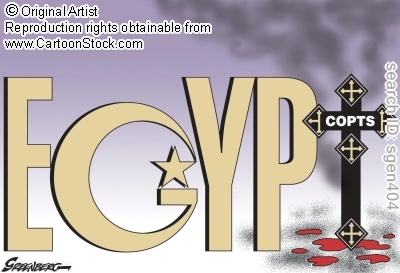
So it is with the current wave of anti-Christian violence. Part of the new political narrative forged in the uprisings is about Christians and Muslims working together to form a better future Egypt. The burning of churches and violence in Imbaba, one of the poorest neighborhoods in Cairo, clearly threaten that account.
In response to the violence, Copts and their supporters rally outside the Maspero Building, which houses the Egyptian state media (and is just a few blocks from Tahrir Square), demanding to know why the interim government is as slow to respond to actions against Copts as the government they replaced.
And nearly every political institution from Al-Azhar to the Church to the Muslim Brotherhood to Salafi leaders to Islamic Jama’a groups to the new political parties all blame remnants of the old regime. In the May 9 issue of Al-Masry Al-Youm, we find the following roundup:
- Calling the events “unbelievable,” Dr. Ali Joma’a, the Republic’s Mufti said that there were “secret hands” working to spread chaos and undermine the state.
But whose hands are they?
- Salafi leaders like Dr. Abdel Men’em al-Shahhat, and Dr. Jamal al-Marakbi insisted that the Salafis were innocent (this time), blaming instead “supporters of the counter revolution”.
- This interpretation is also supported by Sheikh Mohammad al-Shahawi, the Head of the International Sufi Council, certainly no friend of the Salafi movement.
- The Youth Revolution coalition Union likewise declared that the events in Imbaba represent a conspiracy against the revolution.
- Dr. Ahmad al-Tayyeb, the Sheikh of Al-Azhar called on the “Egyptian family” to end sectarian strife.
This emerging narrative was well summarized by Abdel-Beri Atwan, chief editor of the Palestinian newspaper Al-Quds al-Arabi:
[s]ectarian strife is the most prominent invention of the former regime and its men, and is the strongest card they used to terrorize the Egyptian people and force them not to disobey this regime out of fear over national unity and the eruption of national turmoil that could be used as a pretext for the interference of foreign powers that are awaiting this opportunity
therefore
Sectarian strife is now a threat facing Egypt, because it is the only efficient weapon to tear up national unity, thwart the democratic revolution and lead Egypt back to the barn of affiliation with America and Israel, just as it used to be the case – if not worse – during the days of the ousted Egyptian regime led by President Muhammad Hosni Mubarak and the businessmen mafia that constituted the backbone of his corrupt entourage.
In other words, sectarian violence was a tool the regime fostered and used to bolster its political narrative, both within the country and to its allies abroad, that Mubarak, for all his faults, stood between order and chaos. The coming together of Copts and Muslims in democratic protests against the regime signified the falseness of this claim. The current violence thus must be being fomented by counterrevolutionaries, remnants of the old regime who want to see popular revolt and democracy fail.
In his classic work on “moral panics,” Stanley Cohen discusses the ways in which complex social phenomena are converted into fairly straightforward narratives about the breakdown of some set of cultural values. What makes the narrative powerful is its ability to offload the breakdown onto some real or imagined group of people, who serve as “visible reminders of what we should not be” (Cohen 2002:2).
This narrative is particularly plausible because
- the policies of the Mubarak regime were unfair to Copts, from undercounting them in the census to putting almost insurmountable bureaucratic obstacles in the way of getting licenses to build new churches;
- what laws were in place to support Copts were typically been poorly and erratically enforced; and
- there has long been suspicion that some of the anti-Coptic violence was deliberately staged by the regime to achieve political ends.
But it is not the only narrative. In spite of denials by Salafi leaders, many argued, in the words of Dr. Muhammad al-Baradei, that these “religious radicalism and the practices of the middle ages” were clearly carried out by Salafis. This position was echoed May 11 by Ahmad Rahim, Cairo correspondent for the Saudi-owned London-based Al-Hayat daily, who argued that the violence could last for five hours before police arrived suggests they are either sympathetic to the Salafis or just apathetic about crimes against Copts..
This too, is a plausible narrative to most Egyptians. Similar riots occurred in the 1990s that were held by many to be caused by Salafi agaents. The democratic uprisings led to the freeing of many Salafi political prisoners, and the return of many Salafi leaders from exile abroad. Finally, Salafi groups recently attacked a number of Sufi and Shi’ite Muslim shrines.
A third narrative blames the Copts for the violence, labeling the protests and riots in Imbaba as “sectarian sedition.” This is a typical “blame the victim” scenario (William 1971) in which the minority group that suffers most from violent civil strife is blamed for having provoked it. This narrative is plausible to many Egyptians because
- they see the Copts as untrustworthy “aliens among us” and
- Coptic protests in Cairo are often disruptive, blocking traffic and sometimes provoking angry responses.
This scenario is not getting much purchase in the media, though. For example, the independent Lebanese daily As-Safir carried an opinion piece by Sateh Noureddine that said:
When one says that there is a sectarian sedition in Egypt, one would be clearing the Muslims for no reason, and doing injustice to the Christians without any evidence. The civil clash would come to resemble a suspicious process of camouflage of the historic persecution that this tortured Arab minority is being subjected to. [This minority] is now afraid that its Muslim neighborhood would change its ways.
and concludes:
The revolution of January 25 has granted freedom to those Islamists who do not deserve it. Today, they feel that this has been their revolution, and their opportunity to reveal their lowest radicalism and instincts… There is no sectarian sedition in Egypt according to the eastern definition of seditions. There is rather an open persecution against the Egyptian Copts. These are supposed to be partners rather than employees in the Egyptian nation, which is now rebelling against all forms of slavery.
The military continues to use the words “sectarian sedition” in many of its official pronouncements, but they may be preparing to endorse the first scenario. A May 10 story in Al-Masry al-Youm claimed that an anonymous military source had revealed that remnants of the ousted National Party are trying to push Egypt into a civil war by igniting sectarian strife.
References
Cohen, Stanley. 2002. Folk Devils and Moral Panics, 3rd ed. London: Basil Blackwell.
Ryan, William. 1971. Blaming the Victim. New York: Random House
What’s the Status of Egypt’s Revolution?
 The mainstream media is fickle–once the drama stops, it stops covering events. So it has been with Egypt. For those of us deeply engaged with people in that country, the tension and the excitement continue. Every week brings new changes, new anxieties, new hopes and, from an analytical perspective, fascinating new conundrums to think about.
But when the viewers and readers of the mainstream media start turning their attention from Libya and Afghanistan and asking, “Hey, whatever happened to that revolution in Egypt?” their media lets them down. Had they been paying attention, they would realize that
In the weeks since President Hosni Mubarak was forced to resign, on February 11, the same coalition that led the uprising in Tahrir Square has frequently and vigorously taken action to continue the Egyptian revolution. Labor federations, student movements, women’s organizations and new liberal-leaning Islamist youth groups have forced out Mubarak’s allies at television networks and newspapers, shuttered the hated State Security and police ministries, confiscated police files on dissidents, triggered more cabinet resignations and pursued indictments against perpetrators of police brutality, state corruption and religious bigotry. They have established new political parties, fended off attempts to circumscribe women’s rights, expanded the millions-strong independent labor federation, reclaimed university administrations and staged the first truly free elections for university councils, professional syndicates and labor unions in Egypt’s modern history. Mubarak is under arrest in a hospital; his sons languish in Tora prison (Cairo’s Bastille); and a dozen oligarchs have had their assets seized.
Instead,
[T]he New York Times and Western commentators at Al Jazeera have asked “Is the ‘Arab Spring’ losing its spring?” and “Could Egypt’s revolution be stolen?” Hillary Clinton warned that the revolution could end up a mere “mirage in the desert.”
If US readers want a nice summary of what’s been happening in Egypt, they should turn to Paul Amar’s article “Egypt After Mubarak” published in the latest issue of The Nation, from which the above quotations are drawn.
Amar is especially sound when he is explaining that the military and the Muslim Brotherhood are not monolithic entities. That even as the old guard in each attempts to put brakes on some of the changes Egypt is going through (and not always the same ones), these institutions are themselves changing as elements within each gain authority and respond to the ongoing political protests.
Amar concludes:
Rather than abandon hope and write off the revolution as captured by conservative Muslim Brothers and aging army officers, Egypt’s young people are continuing to generate new social policy platforms and organizing strategies. Through this process they are reinventing notions of security and nation, faith and progressivism, and are creating new frameworks for twenty-first-century democracy, not just for Egypt, not just for the Middle East, but perhaps for the world.
No More Kissing in Egypt? (It’s Not True)
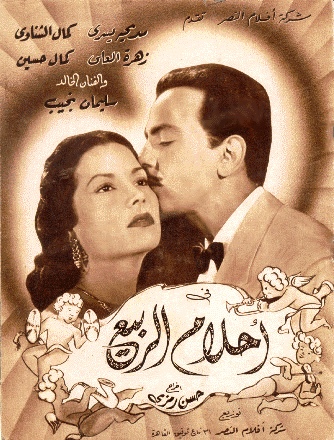
What does no kissing on TV mean, anyway?
Parts of the Egyptian mediascape and blogosphere went wild May 1st when the story went around that Dr. Sami al-Sharif, the head of the Egyptian Radio and Television Union had ordered a ban on kissing and hugging in all movies being shown on television, whether Egyptian or foreign.
Al-Sharif subsequently denied it, saying “I have never and will never adopt such a backward decision, considering that this would be a violation of the freedom to create and a destruction of the heritage of Egyptian cinema” according to the web site of the MBC satellite group.
Until he squelched the rumor, criticisms were coming from every direction. Articles appeared in mainstream news sources like Al-Arabiyya (Arabiyya cites an inteview in Al-Masry Al-Youm as the source of Al-Sharif’s putative comment but a text search of both the Arabic and English editions didn’t turn it up). He was criticized by people like critic Nader Adli and producer Ahmad al-Sabki, as well as in many blogs.
In retrospect, it seems an unlikely story. Al-Sharif was Professor of Radio in the Faculty of Mass Communication , Cairo University, an unlikely candidate for such a proclamation. but people obviously bought it.
Why?

 CONNECTED in CAIRO