Writing About Egypt’s Experimental Moment
 I’ve been writing a great deal lately about media and social change in Egypt (usually when I should be doing other things, like grading final exams).
One of these projects was an essay of 1,000 words or less about media and social change for the web site of a workshop on Media and Social Change being held May 27 2011 at the School of Oriental and African Studies, University of London.
My essay was entitled “Egypt’s Experimental Moment: Contingent Thoughts on Media and Social Change.” The gist of it is:
One way to think about media and social change, then, is to focus on these experimental moments, and describe and analyze the roles media play in them. In so doing, it is useful to draw on two other elements that all three anthropological approaches to social change have in common: a recognition that clear continuities exist between differentiated periods, and a confidence that there are regularities that can be abstracted from the chaos of disrupted social life to help us grasp “the big picture” in social life.
Egypt is currently in just such an experimental moment. It is not merely that social innovators have found many new politically powerful uses for digital media; the mainstream media finds itself in a period in which the political order that governed it for so long in gone, and no firm new order has yet emerged. Many social actors seek to organize a new national mediascape as close as possible to the old, while others seek to innovate, to borrow practices from elsewhere in the global mediascape and localize them. New narratives, and counternarratives of revolution are everywhere, and the shape of the new order remains ambiguous, unpredictable and shaped by the very narratives the various media produce out of their own uncertainty.
Interestingly, within hours of being posted, the essay drew a response from Dr. CSHN Murthy of Tezpur University, India. Among other things, Dr. Murthy suggested that my discussion of media and social change was entirely context sensitive–it applied more or less only to Egypt and not to different situations like Libya or Sri Lanka.
For instance I have noticed that the anthropological angle positing innovation, adaptation and transformation as explained in terms of the developments in Egypt may not fit the jacket of interpretation of developments in Libya. The intervention of US and its allies in Libya prohibits such an interpretation. In other words the division among people including women and the youth, besides part of military guard siding Gaddafi suggests that the same phenomenon of anthropological innovation, adaptation and transformation is yet a dream to realize in Libya.
While I completely agree with Dr. Murthy that the Egyptian and Libyan contexts are dramatically different, I do not agree that general concepts like innovation, adaptation, and transformation are inappropriate to either case:
Innovation and adaptation to the political, social and military interventions of external actors is certainly posited in anthropological theories of social change. They will be very different kinds of innovation and adaptation, but the concepts of adaptation and transformation are not by any means irrelevant.
I can’t be at the conference, unfortunately, but it looks to be lively and interesting.
Cosmopolitans in Egypt’s Uprising
A young woman from Utah State University called me last week to discuss a paper she is writing on the Egyptian uprising. She was struck by how many of the people engaged in the uprisings were cosmopolitans, in the restricted sense of the term I use in my book: affluent, educated, well-traveled people whose management of global cultural styles maintains and justifies their class positions. Blogger/activist Wael Ghoneim seems to fit right in with the people described in my book, as does Gigi Ibrahim, recently seen on The Daily Show:
http://www.hulu.com/watch/235601/the-daily-show-with-jon-stewart-gigi-ibrahim#s-p1-sr-i1
But I warned her to be aware that the youth movements that planned the uprisings and served as a core of its inspiration involved at least two other kinds of cosmopolitans. Cosmopolitanism “involves the capacity to manage the coexistence and juxtaposition of different cultures and to make this capacity part of one’s identity” (p. 11) and there are other cosmopolitan orientations than those described in the book.
The first is that large class of educated, globally sophisticated non-affluent people under thirty. These are the folks with working parents who struggled for years to score high on the national examinations, master foreign languages, and get college educations only to find that Egypt’s version of liberal economic reform has left them shut out. They are unemployed, or underemployed. Not only can they not find work commensurate with their education, many can’t find work of any kind.
The second is the “new Muslim Brotherhood youth” that I have previously blogged about here and which Marc Lynch (2007) has called “young brothers in cyberspace“. These are well-educated, moderately affluent Islamists who see in Islam a relevant and powerful tool for bettering the world’s situation. Globally-oriented, they look to different models of the relationship between Islam and politics than the previous generation, and seek to “put Islam to work” (Starrett 1998), especially in new public spaces not yet dominated by the older religious authorities, like the Internet.
What all these groups had in common last January was education, a cosmopolitan orientation, technological sophistication, and a deep belief that Egypt could be better, much better, than it was. And, after Tunisia, a growing belief that they might be able to have a hand in making it better.
References
Lynch, Marc. 2007. Young Brothers in Cyberspace. Middle East Report 245 <http://www.merip.org/mer/mer245/young-brothers-cyberspace>
Starrett, Gregory. 1998. Putting Islam to Work: Education, Politics and Religious Transformation in Egypt. University of California Press.
What Does Osama bin Ladin’s Death Mean?
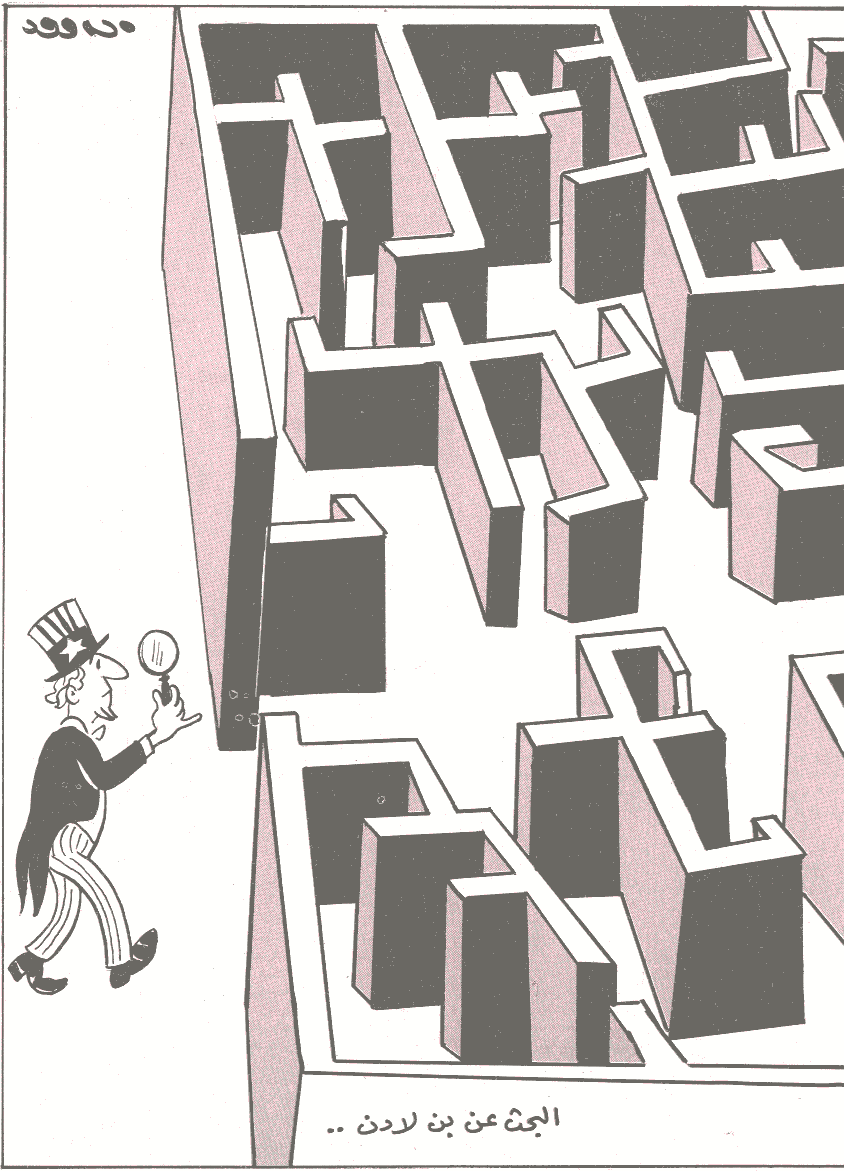
This cartoon from a 2002 issue of the magazine Caricature portrays the US entering a labyrinth as we seek to find Osama bin Ladin
“Who cares?”
“It’s about time.”
“So now the US can get out of Afghanistan?”
Those are some of the responses I received when I queried Egyptian friends about what they thought of Osama bin Ladin’s death.
I did not plan on blogging about this but I am getting requests from students to share my thoughts, so here goes.
For most of those living in the Middle East, Osama bin Ladin’s death means little or nothing. Osama bin Ladin was never popular with most Egyptians, and whatever popularity he may have had has been extinguished by the blood of tens of thousands of Muslims who have died as a result of Al-Qaida actions in Iraq, Afghanistan and elsewhere.
The Muslim Brotherhood denounced the killing of bin Ladin not because they laud the Al-Qaida leader–who had long condemned their renunciation of violence–but because they said he should have been captured and given a fair trial (to be fair, according the the Pentagon that was the mission, but he put up such a strong resistance they were forced to shoot him).
The problems that Osama bin Ladin denounced–US military bases in the Middle East, secular dictators supported by Western money and arms, Israeli attacks on Palestinians, Western economic dominance–are problems that continue to bother most people in the Middle East. But bin Ladin’s narrative of why these problems plague the Middle East and how to overcome them has mostly been consigned to the dustbin of history.
The Al-Qaida narrative described the purity of an Islamic Caliphate in which justice and holiness could take root and thrive defiled and usurped by the West, first through Colonialism, whose last gasp was the creation of the Israeli state, and then by the rise of Western modernist ideologies, Liberal western versus Soviet, whose irrelevant battles against one another played out on the canvas of the Islamic world, leading to oppression, loss of agency and autonomy, economic dislocation, and rising immorality. Efforts to overthrow the dictatorships of the Middle East were doomed because they were backed by powerful states in Western Europe and North America, most importantly the United States.
All this had been said before by other Middle Eastern militants. What the Al-Qaida ideologues offered was the notion that the US and its allies were vulnerable, and that it was not unjust to attack them in their own territory. My student Mourad, who was in 2002 an Osama bin Ladin sympathizer, explained it to me thus: While most interpretations of shari’ah would accept defensive war against military and political targets, but condemn the killings of civilians, Al-Qaida argued that because the US is a democracy, all citizens are by definition, political targets. As voters, we bear responsibility for the actions of our government in ways citizens of autocracies do not.
The uprisings in Tunisia and Egypt, and to a lesser extent those elsewhere in the region, are a denial of this doctrine. They are demonstrations that collective action in the Middle East by citizens who are willing to put their lives on the line for freedom, can overcome the apparently overwhelming force of the dictatorships.
There are others for whom this death has more significant meaning.
In the United States, it is a culmination of ten years of war in Afghanistan, a final retribution for the man credited with planning and ordering the 9/11 attacks. That it happened a few months before the 10th anniversary of the attacks on the Twin Towers gives it a special poignance. But it will certainly become a politically controversial sign, as the Obama administration takes credit for leadership, while the opposition seeks to undermine that claim. And much will depend on whether, and how, bin Ladin’s
Supporters of Osama bin Ladin, in Al-Qaida and other organizations, have lost a significant symbol. While bin Ladin is probably not very important any more to Al-Qaida operations, his ability to continuously elude the most powerful country on earth was a powerful symbol. Bin Ladin was, without doubt, the face of global terrorism.
The death also signals a loss of an important unifying symbol. While Ayman al-Zawahiri (who is Egyptian) will almost certainly take over, and there are plenty of potential leaders in the Saudi Arabia, Yemen, Iraq, and other local branches, no one has the charisma and biography Osama had.
Before he ever created Al-Qaida, some people saw Osama bin Laden as a kind of folk hero. As they saw him, he was a millionaire from a family of millionaires, who’d risked – and lost – his wealth in a struggle for independence and democracy against a despotic Saudi monarchy. Fleeing to the Sudan, he’d rebuilt his fortune by helping build this ravaged country, only to suffer further persecution at the hands of the Saudis and their American allies. Instead of retiring to some quiet place to live off his wealth, he’d used that money to help one of the world’s poorest Muslim countries fight for freedom from atheistic Russian invaders. This bin Laden is the kind of man many upper class Egyptians wish they had the courage to be. Even Ronald Reagan had called the mujahideen led by bin Laden heroes. Nobody in the movement has that kind of back story.
“They are all just criminals,” Mourad said
Preview Connected in Cairo via Google Books
 A Google Books preview of Connected in Cairo is now available on the Indiana University web page for the book. You can see all the front matter, including the entire new preface tying the book’s content to the Jan. 25th uprisings, and read the first half of the introduction (warning: it ends on the “and” at the bottom of page 13–quite a cliffhanger!)
Taking Satire into Egypt’s Public Sphere
The most important thing about Bassem Youssef’s heavily viewed YouTube channel is that his brand of humor–inspired by Jon Stewart and Stephen Colbert–indexes and offers metacommentary on Egyptian media.
In regional stereotypes, Egyptians are usually seen as the funniest of the Arabs. They are said to be khafiift id-damm (light of blood). This was once described to me by an Arabic instructor as, “Our lives are so hard, so filled with absurdity that if we don’t laugh, we would never stop weeping.” Much of this character is expressed in everyday life in political satire–jokes about politicians, the police, the president himself. But such satire has almost never been expressed in the public sphere.
Until now.
Like the US shows it emulates, Bassem Youssef’s B+ offers “an experiment in journalism” that ” uses techniques drawn from genres of news, comedy, and television talk to revive a journalism of critical inquiry and advance a model of deliberative democracy” (Baym 2005).
What makes the humor of shows like The Daily Show and the Colbert Report interesting is not that they parody the news but that they use actual news reports (and newsmakers) to create humor. This is done through a series of metacommentaries that weave news clips and metacommentary by the show’s main characters together to create a new, entertaining narrative.
Remediating news in this way is not only funny, it offers viewers alternative ways to think about the news they view in the mainstream media. According to Elliott Gaines, the “narrative continuity constructed from rebroadcasts of news stories, told with the intent to entertain, ironically informs the audience of the significance of events whose meanings are obscured in conventional broadcast journalism” (2007: 81)
Media satire that sends up the actual pretensions of media and politicians is unknown in Egypt, with the possible exception of some political cartoons.
This is a different kind of satire than many other forms of news parody. In the US, news parody historically tended to involve invented news, silly stories that were narrated with all the characteristics of straight news. This goes back at least to Sam Clemens, who supposedly twice had to flee for his life when his satires were taken for true news stories (Sanborn 1990) and has had many subsequent incarnations, most recently The Onion.
That this is one of the most popular you tube channels in Egypt is not surprising. The question is, will Bassem Youssef move to a television show? And if he does, will he be able to get politicians to appear on it? Because if public political satire is almost unknown, the inability of Egyptian public figures to laugh at themselves is completely unknown, and even hard to imagine.
In fact, it’s one of the things Egyptians–including Bassem Youssef– make jokes about.
You can go to the Bassem Youssef show’s Youtube channel here.
References:
Baym, Geoffrey. 2007. Crafting New Communicative Models in the Televisual Sphere: Political Interviews on The Daily Show. The Communication Review. 10(2):93-115.
Gaines, Elliott. 2007. The Narrative semiotics of the Daily Show. Semiotica. 166: 81–96
Sanborn, Margaret. 1990. Mark Twain: The Bachelor Years. New York: Double Day.
Other Accounts:
NPR story: “Egypt Finds Its Own Jon Stewart”
Daily Beast story: “Bassem Youssef: Egypt’s Jon Stewart“
One of my most visited posts was about the Canadian-Israeli journalist who funded her trip to Cairo, and her blogging about it, by taking donations from people who were solicited via the news commentary web site for which she blogs. Here’s another, similar project: a radio producer soliciting funds to create a “Music of the Revolution” album and web site.
Egypt’s Continuing Experiments in Social Media

What role social media will play in post-revolutionary Egypt is still up in the air. The revolution showed everyone the power such media could wield as a medium for social change, as well as the difficulties in controlling it. Social media has also proven a catalyst for internal debate and change–and a greater degree of transparency–within the Muslim Brotherhood. Yet the Shebab al-Facebook youth movements are not the only ones using social media for political action any more. Many others are also experimenting.
The prosecutor general announced the detention of Hosni Mubarak on Facebook, rather than calling a press conference or releasing the information through state media, as would have been the practice in the past. This allows him to release information to the media generally, and avoid the questions that would arise at a live press conference. It also suggests that the relationship between government agencies and state media has become ambiguous. The prosecutor no longer wants to favor state media, or he is concerned state media would ask the same probing questions as independent and international media, or both.
A week later, some 1400 university professors used Facebook as a vehicle to demand the removal of Higher Education Minister Amr Ezzat Salama and demand reforms of higher education. The Facebook page called for demonstrations before the Supreme Council of the Armed Forces on April 16 (several hundred reportedly showed up), and posted a list of requests to the council and to Prime Minister Essam Sharaf.
[Under the Mubarak regime, university presidents and deans were often appointed on the basis of State Security recommendations — based on loyalty to the regime — rather than experience or demonstrated ability. The primary request is that all senior administrators be removed and replaced with others elected from university staff by the end of the academic year. The professors also demand a gradual increase in their salary scheme until it is on par with that of the judiciary, a reformulation of the scholarship system and the formation of a syndicate for university staff.]
A media ecology refers to the dynamic, complex system in which media technologies interact with each other and with other social and cultural systems within a particular social field, and the ways these interrelationships shape the production, flow, and consumption of images, texts and information within this system. In Egypt’s current revolutionary phase, the media ecology is unstable, in flux, as the myriad of institutions and technologies adapt to the dramatically changed–and changing–economic, social and political climate.
The notion of a media ecology assumes that changes in any one part of the system will likely have affects on most other parts of the system. Social media revealed in January a set of crucial political capacities that in turn affected all the other major elements in the media ecology. Following the uprisings, the inability of the Shebab al-Facebook to produce a “No” vote on the constitutional referendum, or to generate significant protest against the military for the detention and torture of protesters March 9, emphasized its limitations, even as the protests April 8 for the prosecution of Mubarak showed that social media still could exert considerable political power under the right conditions.
Egypt is currently in an experimental phase, and these two incidents, like the prosecution of Maikel Nabil, (and experiments in political writing in the press and political coverage on television) are examples of hundreds of contingent actions which will collectively restructure Egypt’s media ecology as the revolution continues to unfold.
Space Wars in Cairo
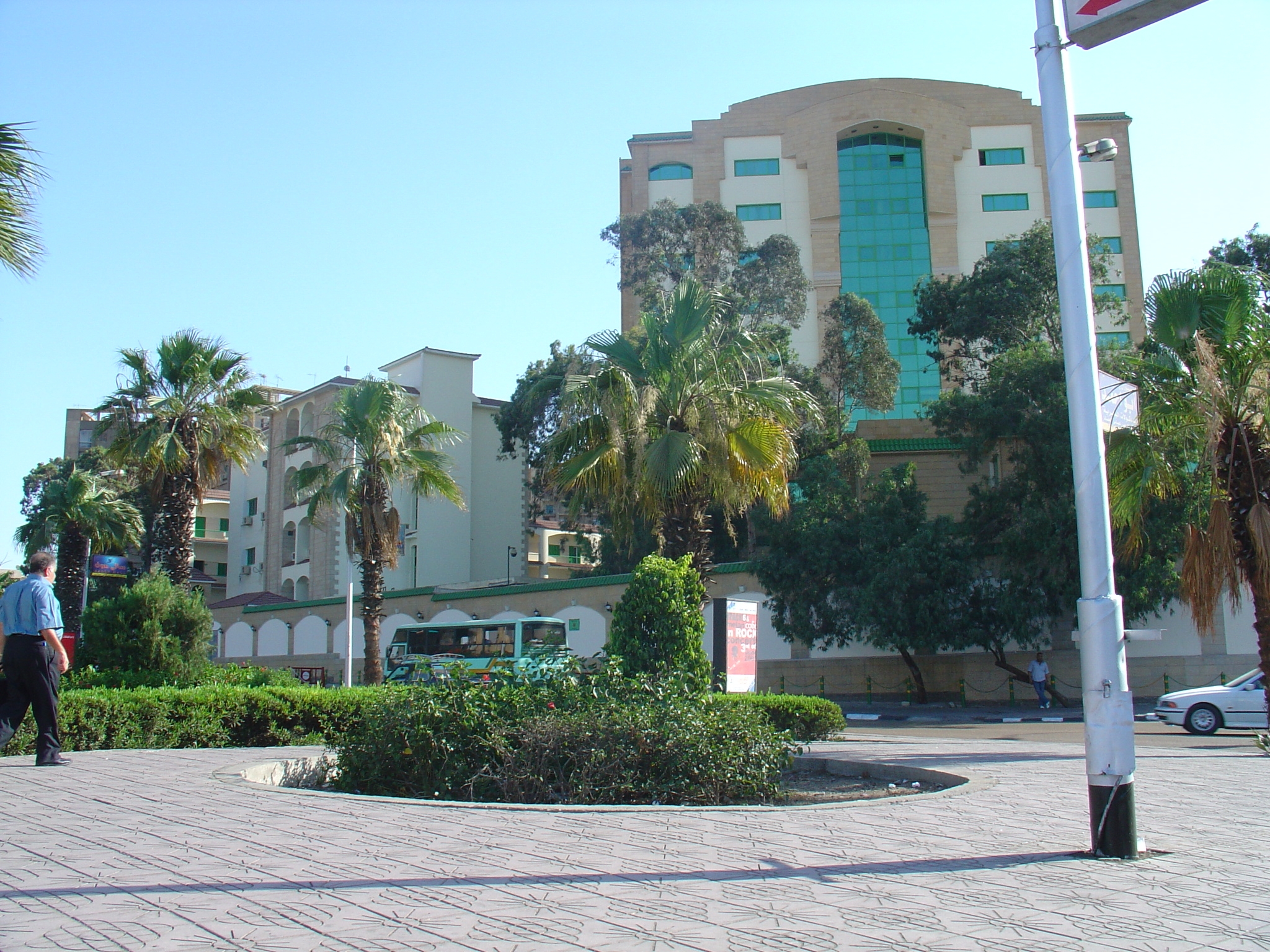
As the wealthy flee to gated communities like this, the center of the city becomes a battleground over the meaning of urban space.
Cairo, at the moment of the revolution, was in the middle of an ongoing “space war” over the heart of the city. The rich have long been moving to gated communities on the outskirts of Cairo, while the amount of unplanned “slum” housing has expanded exponentially. The heart of the city–including the spaces around Tahrir Square–is slowly being abandoned by its traditional inhabitants (government office buildings and the American University in Cairo) and turned over to international developers who are creating commercial properties.
That’s the picture painted by my former colleague Mona Abaza in an article in the latest issue of Urban Studies. The article, “Cairo’s Downtown Imagined : Dubaisation or Nostalgia?” is a fin-de-siecle piece, having been initially submitted in February 2010, then revised and fianlly accepted in January 2011, just as the uprising transformed everything.
Or did it? In her conclusion, Abaza suggests that the Tahrir Square protests can be seen as a moment–perhaps a decisive moment–in this battle over what the central space of Cairo will be, and how it will be occupied. She writes:
More recently – in early January 2011 – the ‘space wars’ of Cairo took a new and more fundamental turn. The “January revolution” represented an escalation of political protest led by the younger internet and facebook generation of Egyptian protesters. Tahrir Square (The Liberation Square), the vital heart of the centre of modern Cairo, the entrance square to the belle époque city, witnessed during January one of the most fascinating space struggles between those intent on maintaining the Mubarak regime and the multiple streams and classes of protesters, which reached over two million on the day of the “march of the million”. Tahrir Square witnessed a massacre perpetrated by the supporters of the regime on the second of February. It witnessed equally the encircling army tanks as check points, as well as artistic innovation, endless ironic slogans, jokes, performances of singers and poets and film directors, tents and campers, women and children squatting and what not and last but not least, opposition leaders and government officials who desperately wanted to contain the movement. If these space wars were to represent more than the contestation of the city – posing a challenge to the state itself – the future (at least at the time of writing) is uncertain.
The essay has all the trademarks of Abaza’s style: insightful analysis expressed in clear, quick-moving prose, but without a great deal of substantive data, whether statistical, ethnographic or other, which one might use to affirm or reject the argument. The journal frames it a “critical commentary” rather than an article because the reader has to come to their own judgment as to whether the arguments hold up.
Personally, I think she’s spot on, as usual.
Egyptian State Media Changes Structural or Cosmetic?

The Maspero Building, housing the state television and radio company, ERTU.
Since the 25 January Revolution we have seen a number of dramatic changes in Egyptian media. But does this drama represent genuine structural change or mere bricolage?
The Egyptian Radio and Television Union (Ittihad al-Idha‘ah wat-Tilifizyun al-Miṣri–always abbreviated ERTU irregardless of language) is the state agency that operates all broadcast television in Egypt. Its role as a voice of the state was sorely tried during the uprising, when it famously showed images of quiet streets even as protests of thousands of people were raging nearby.
Like the police, ERTU was seen by the protesters as a repressive arm of the state and there have been repeated demands that senior management be sacked and policies be overhauled.
And significant changes have happened, just as they have in the state press. Senior staff have been replaced, and no cabinet level Minister of Information has been appointed.
These changes have failed to appease many staff members who are calling for more dramatic reforms. Staff point out that the new faces are mostly long time players as comfortable with the traditional ways of doing things as the people they replaced. And many of the sacked leaders have been kept on as consultants.
Worse, there have been reports that the government is planning to appoint a Minister of Information and is considering Governor of Luxor Sami Farag for the position. Farag is a notorious Mubarak crony; Farag carried out many of the evictions of Luxor citizens in order to carry out tourism “development” that would have enriched Cairene investors at the expense of the local economy (see here). My friends who protested in Luxor during the uprisings told me that the protests there were more about ousting Farag than Mubarak.
The government authorized a committee headed by the journalist Sekina Fouad to discuss the journalists’ grievances but ignored their recommendations.
What they seem to want is a “union” that operates like a union, instead of like a state-owned company. They want to be able to elect the heads of departments from among the union’s members, a minimum wage of EGP 2,000 ($335 USD), and a restructuring of contracts and conditions of employment.
In 1984 William Beeman published a brief but useful essay on the media ecology of Iran before, during and after the revolution. After briefly discussing the relationship between interpersonal gossip (“the grapevine”), and state television and radio, he discusses the dramatic changes in the news media as the revolution progressed, only to settle back into its original role as a voice for the regime—albeit a new regime.
Whether the same thing happens in Egypt will depend in part on the extent to which changes in the media during this transition period lead to structural changes in journalistic practice.
The Apotheosis of Zahi Hawass

Forget the Supreme Council. The History Channel knows who really rules Egypt. Photo courtesy of http://twitpic.com/4l6qg7
Wow. Zahi Hawass, Egypt’s Antiquities Minister, has it all. A cabinet post created especially for him by Mubarak that survived the purge. A reality show on a US cable network available throughout many parts of the world (including the Middle East, via Nilesat). A Facebook fan page and a fan web page. A column in Egypt Today. And now–a line of men’s designer clothing.
Okay, I’ll admit it. When we were back in Cairo in summer of 2010 I briefly thought about buying my (then) 7-year old son a Zahi Hawass hat. One of the students had bought an Indiana Jones hat, and he and Jaden took turns wearing it throughout our trip. As it got close to time to leave, I thought about getting Jaden his own hat–and there they were in the American University in Cairo Bookstore for EGP 400 (about USD $55). It’s a brown fedora identical to Indiana Jones except that it has a Zahi Hawass label on it.
Then I found out he had his own clothing line opening in its own trendy shop in Harrods department store in London. Billed as “the brawny new look for men” it’s the brainchild of Lora Flaugh, President and Founder of Art Zulu designs. The Art Zulu web site says:
Exploration and adventure are the undercurrents of this collection, and each piece is designed with a utilitarian approach. The ZAHI HAWASS line is carefully crafted to convey a sense of time and place.
ZAHI HAWASS is a novel fashion line not just for the traveling man, but the man who values self-discovery, historicism and adventure. Rich khakis, deep blues and soft, weathered leathers give off a look that hearkens back to Egypt’s golden age of discovery in the early 20th century.
The ZAHI HAWASS vision can only be fully realized in an environment that matches the grandeur and classicism of Egypt. …More than anything else, the proposed ZAHI HAWASS collection and shop will be a retail experience that evokes the beauty of Egypt through its décor, and invites consumers to pack their suitcases and journey to the exotic locale.

Zahi Hawass′s web site
Hawass is without doubt an interesting character. On the one hand, he made a tremendous effort as Secretary General of the Supreme Council of Antiquities to internationally publicize appreciation and knowledge of Egyptian antiquities. Many of the changes he brought to Egyptian antiquities were long overdue, especially improving the training of indigenous archaeologists.
Hawass comes off quite well in the only ethnographic text to feature him as a key informant, L.L. Wynn’s excellent Pyramids and Nightclubs: A Travel Ethnography of Arab and Western Imaginations of Egypt, from King Tut and a Colony of Atlantis to Rumors of Sex … a Marauding Prince, and Blonde Belly Dancers (UTexas Press, 2007).
On the negative side, he spread interest in Egyptian antiquities largely by creating a cult of personality around himself, insisting on control over media reports about discoveries made by other archaeologists, creating his reality show on the History Channel and establishing these commodities. He has resisted many new scientific efforts to add to Egyptological knowledge, such as DNA testing of mummies.
He also has achieved his ends by playing off neo-colonial and Orientalist themes themes, which are clearly present in the catalog language of this clothing design, with its references to exploration, adventure and exotic locales. And yet, this kind of thing is what brings many tourists to Egypt where their dollars are in great demand.
“Everything I do is for Egypt” Hawass has said over and over, dismissing his many critics. But like many other members of the regime, Hawass has also done well for himself by doing everything for Egypt, and he has many detractors. The web site Talking Pyramids follows antiquities news in Egypt and can’t say anything good about the man. They have a lengthy discussion of his transferring the operations of the gift shop from the previous Egyptian company that ran it to the American University in Cairo in spite of a court order, and are throwing suspicion on many of his claims about what artifacts were stolen during the uprisings and what has been returned.
Yet Hawass, in spite of his detractors, is one of several officials who escaped the purge of Mubarak appointees. In fact, he’s done well by the revolution. At the end of 2009, he was promoted personally by President Mubarak to the post of Vice Minister of Culture.When Mubarak tried to appease the protesters by shaking up his cabinet, he created the new post of Minister of Antiquities, and appointed Hawass to the job.

The wind whips away my son′s fedora (an Indy fedora, not a Zahi fedora, but what the heck they look the same)
During the uprisings, Hawass went on State TV, urging Egyptians not to believe the “lies and fabrications” of Al Jazeera and Al Arabiya. Hawass told the NewYork Times that the protesters “should give us the opportunity to change things, and if nothing happens they can march again. But you can’t bring in a new president now, in this time. We need Mubarak to stay and make the transition.”
On March 3, 2011, Hawass resigned, but on March 30, 2011 he posted a tweet stating that he was once again the Minister of Antiquities, which was subsequently confirmed by Prime Minister Essam Sharaf’s government. He apparently avoided a jail sentence for failing to obey a court order regarding the Egyptian Museum’s gift shop and dismisses criticisms over the use of antiquities to sell his clothing line on the grounds that proceeds go to support a childrens’ hospital.
So life seems to be looking better than ever for the archeologist who knows what the well-dressed man is wearing.

 CONNECTED in CAIRO