Whatever Became of Hosni Mubarak?
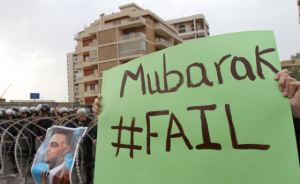 Hosni Mubarak and his sons were taken into custody for questioning April 12. Following the questioning, they were detained in custody for fifteen days. The former president apparently suffered a heart attack under questioning and is being detained in a hospital. So say reports from Al-Jazeera, Al-Masry Al-Youm and Reuters.
The former president had released a statement 10 April on the Al-Arabiyya satellite channel assuring listeners that he had done nothing wrong but was the innocent victim of an unjust campaign of false allegations aimed at harming his reputation, undermining his integrity and tarnishing his military and political history. This was the same day Egyptian prosecutor’s issued a summons for him–and, separately, his two sons–to appear in court for depositions on corruption and killing of protesters, according to Reuters.
The statement follows a series of events that suggest Mubarak is headed for “the cage”–the secure metal enclosure in which accused criminal sit during high court hearings and trials.
The most significant of these events was probably the well-attended April 1 protest in Tahrir Square, calling on Field Marshal Husayn Tantawi to resign from the Supreme Council. Tantawi was Mubarak’s minster of defense and his resignation would have been a sign that the government was going to seriously move to:
- purge itself of members of the old regime
- investigate former officials, including Mubarak, for corruption, ordering violent attacks on the protesters, and other offenses.
- to put the deposed dictator and his cronies on trial.
Instead of resigning, Tantawi announced April 6 that a committee led by Assem al-Gohari had been formed to investigate Mubarak . Nobel laureate Muhammad El-Baradei and other politicians associated with the revolution applauded this, but only as a first step.
According to a Washington Post story April 9, Egypt’s top prosecutor asked the United States to provide assistance in retrieving assets stolen by former Mubarak and members of his family. This followed a statement April 8th from the US embassy in Cairo saying officials were “vigorously pursuing all leads provided by the Egyptian Government with regard to freezing assets of former Egyptian officials” and a report the following day that an American judicial delegation to Egypt told al-Gohari that Washington was keen on cooperating with the Egyptian authorities to return the assets of the former president, his family and his colleagues from the former regime.
And on April 10, the Supreme Council of the Armed Forces (SCAF) said that some Arab countries had offered incentive packages to support the Egyptian economy under the condition that Mubarak be brought before court.
Mubarak and his family have been living in the Red Sea resort of Sharm el-Sheikh since he left Cairo. The military said the 82-year-old president, himself a former senior military officer, is banned from leaving the country.
Among other things, according to the documents obtained by the Washington Post, the Mubaraks are accused of
- having “seized public monies and partnered with businessmen, investors, importers and exporters by force to realize profit without basis other than that they are the sons of the president.”
- purchasing “one of the debts of Egypt for 35 percent of its value and then collected the full 100 percent value from the Egyptian state budget.”
- using Gamal’s position on the board of the Egyptian Central Bank to withdraw 75 tons of Egyptian gold held by the US Federal Reserve.
Popular Arab league chief Amr Moussa, a possible candidate for president, told the Spanish newspaper El Pais that people should be careful about condemning Mubarak before he was investigated and prosecuted. “We will see if there is anything against him,” Moussa said. “But for now, he is retired and should be treated like an ex-president, with all due respect.”
But not everyone is so patient. Mubarak has more than a hundred million dollars in Egyptian banks–he did not save that out of his military or presidential salaries, pointed out Chief Editor Abdel-Beri Atwan in an editorial in the Palestinian daily Al-Quds Al-Arabi April 9th. And how, he asks, could he afford to build that palace in Sharm al-Sheikh? Quite a contrast with the Arab Nationalist president Gamel Abdel Nasser who died with an estate of only a few hundred Egyptian pounds and no vast estates to leave his children.
And earlier, on April 3rd Muhamad El-Baradei told Al-Masry Al-Youm that “Egypt will always remain sick as long as Mubarak’s situation remains unclear. He should either leave the country like the Tunisian President Zine El Abidine, or he should stand trial… Also, why are we late in retrieving our money from them? This is the people’s money…”
The Revolution Reaches Egypt’s State Run Media
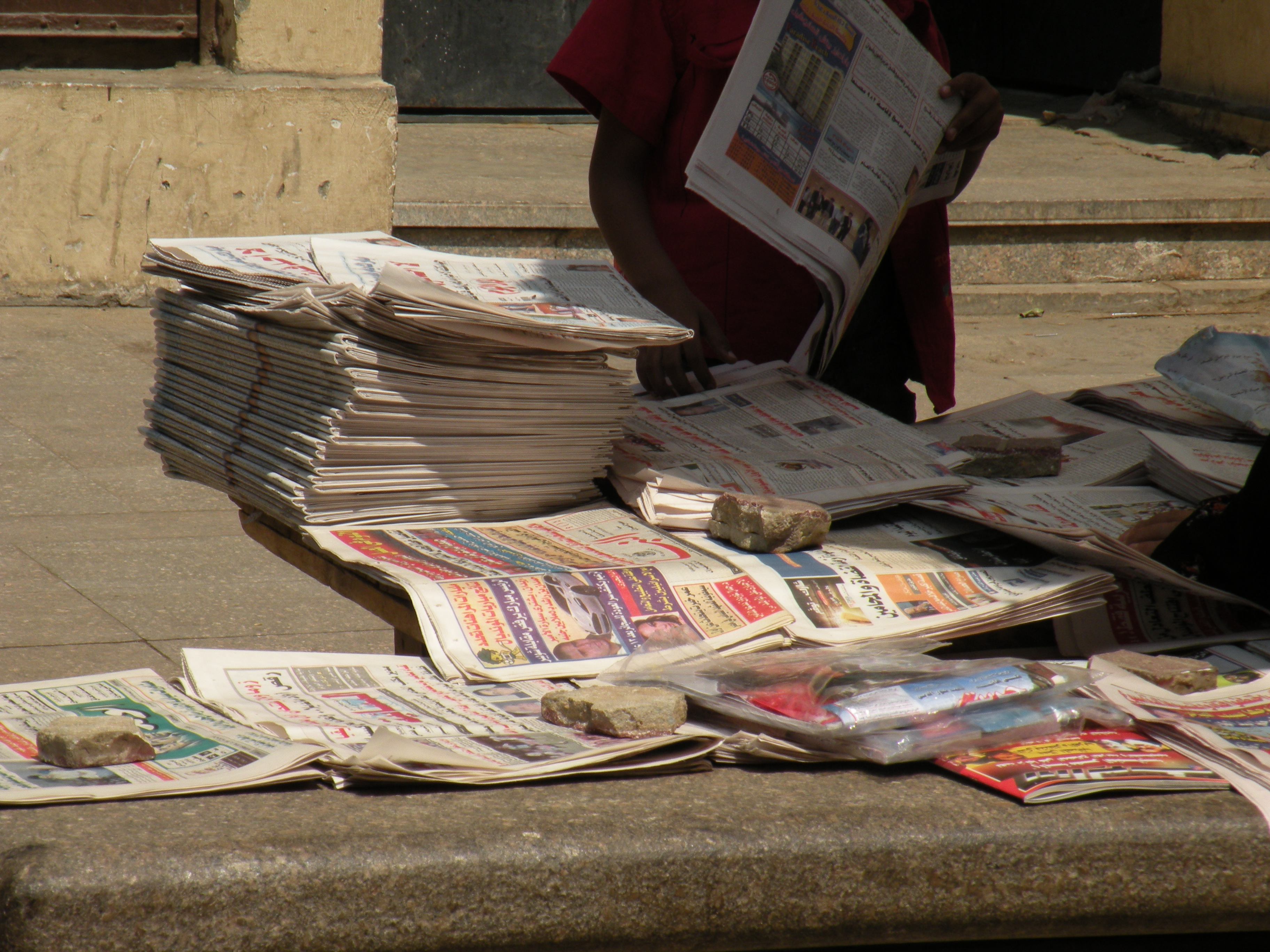
There are many changes in the state run media. But what will they mean within the larger media ecology?
I blogged recently about the role of state media in post-Mubarak Egypt and the possibility it was being made more independent. Official changes were announced March 30 and they were sweeping: 17 new people have been appointed to chairmen of board and chief editor positions in seven state newspapers.
There are two main reasons for the changes. First, many of the people being replaced were considered to be Mubarak appointees, and particularly cronies of his son Gamal. Second, there’s been a significant decline in revenues at the state media over the last decade as they have failed to successfully compete with independent and international news media.
The most significant change has been at the flagship state newspaper Al-Ahram where Abdel Moneim Said, one of Gamal Mubarak’s closest aides, was ousted as chairman of the board and replaced by Labib al-Sebai, an award winning journalist who had reportedly been denied promotion for his independent views.
Even more significant is the replacement of editor in chief Usama Saraya by Abdel Azim Hamad a political commentator with Arab nationalist sentiments who left Al-Ahram a few years ago to edit the independent Al-Chorouq.
Usama Saraya was the poster child for sycophantic journalists. He was the genius who authorized in 2009 the Photoshopping of a photograph of world leaders to put Mubarak in front. He later defended the practice in a column in Al-Ahram saying it was an “expressionistic” photo “a brief, live and true expression of the prominent stance of President Mubarak in the Palestinian issue, his unique role in leading it before Washington or any other” (as he told The Guardian) rather than portray the actual order in which the men walked, which was set by protocol (i.e., as host of the Sharm al-Sheikh conference, Mubarak politely allowed the others to precede him out of the room).
Under Saraya’s editorship, Al-Ahram initially ignored the protests, then defamed the protesters as hooligans bought with foreign funds, then–hours after Mubarak resigned l–headlined the paper “The people ousted the regime.” He subsequently apologized to “the Egyptian people” for the years of propaganda.
The shake-up extended to state television, where Ibrahim Kamal al-Said replaced Abdel Latif al-Manawy replaces as head of Egyptian TV’s newsroom. Nihal Kamal was appointed head of state TV and Ismail al-Shishtawy al-Iraqi was appointedhead of State Radio.
Newspaper and magazine Ruz al-Youssef has three new leaders. Board chairman Karam Gabr, a former NDP representative on the Shura Council, has been replaced by Gamal Al-Madul. Independent journalist Ibrahim Khalil was appointed as editor-in-chief of the paper and Usama Salama replaces replacing Abdallah Kamal as editor-in-chief.
Adil Abdel Aziz was appointed as the chairman and editor-in-chief of the Middle East News Agency (MENA), replacing Abdallah Hassan.
Helmy al-Namnam was appointed editor-in-chief of Al-Hilal, a monthly magazine, founded in 1892.
Gamal Abu Bey was appointed editor-in-chief of Al-Massa daily.
Many of the people being replaced were allies of Gamal Mubarak, or had close ties with the regime. But their replacements are mostly journalists with long histories of working within state media.
What this line-up suggests to me is that the government is seeking to cut obvious ties with the former regime, but not necessarily change the basic role of state media as a voice of the state. On the other hand, in the face of competition from increasingly less-censored independent media, will they be able to revive their flagging revenues if they don’t alter their position?
“The new names indicate that the government is responding to the demands of the revolution by removing all corrupt journalists who transformed the state-owned media that belongs to the people into a platform to serve the former regime,” said Salah Abdel Maksoud, chargé d’affaires of Egypt’s Journalists’ Syndicate.

Drastically diminished tourism revenues because of the unrest is a serious blow to the economy--but most protesters are concerned about bigger issues.
If I were an Egyptian political leader, I would not want to win the forthcoming election.
The way I figure it, the first new administration is not going to be able to please anybody, because most Egyptians want economic reforms and they want them now. It’s important to remember that the April 6th Youth Movement, which became part of the core of the 25 January uprisings, began in solidarity with striking workers in 2008, and when the movement in Tahrir seemed to be faltering in the face of the regime’s recalcitrance, it got a shot in the arm from labor movements in Ismailia and elsewhere.
Ironically, but not surprisingly, the revolution itself has caused considerable, and ongoing, economic damage to Egypt.
Lost tourism revenues alone cost Egypt about US$850 million in the span of about two weeks, about half the $1.7 billion the government estimates the uprisings cost the country. And while some tourism has returned, the overall effects are pretty dire. The industry amounts to 5 to 6 per cent of Egypt’s gross domestic product.
The revolution has also raised Egypt’s debt by an estimated $3 billion. The Egyptian Central Auditing Organization (CAO) reported that the country’s internal and external debts have reached EGP 1080 billion (USD $181 billion), constituting 89.5 percent of Egypt’s total 2010 GDP.
Egypt owes $35 billion to the US, $160 million to the British government, and large amounts to many other countries and institutions. The global economic slowdown means that Egypt’s exports will bring in less, yet efforts to borrow to cover deficits will be more expensive because Standard and Poor, Moody and Fitch all lowered Egypt’s credit ratings during the uprising.
Meanwhile, Egyptians continues to demand a minimum wage, greater collective bargaining rights and other changes to enable them to meet their economic needs.
Neoliberal economists only answer to this is to recommend that Egyptians stop protesting, go back to work, and try to convince foreign financials that everything is rosy.
Consider Monal Abdel-Baki, assistant professor of economics at the American University in Cairo, in an interview with Al-Masry Al-Youm English:
“The motto of the revolution was ‘equality, democracy and freedom,’ but of course economists keep complaining about this and are trying to tell people to carry on with work and to stop demonstrating,” she said. “This is harming the economy, yet the demonstrators say this is the process of democracy.”
Sigh. “Democracy” in this context is not about the economic growth, Dr. Abdel-Baki. It’s about the distribution of wealth. Unlike undergraduate students at AUC’ whose families benefited from the Mubarak regimes policies to the extent that they could afford $10,000+ tuitions, many of the protesters were part of Egypt’s vast body of educated unemployed or underemployed (not that there weren’t plenty of AUC students–and professors–out there protesting).
Increasing tourism and exports is important to the people who rose up but only if there are serious efforts to change the structure of the economy. Even the most committed neoliberal economist has to admit that crony capitalism wasn’t working. For example, privatization of state-owned companies under the Mubarak regime was a farce. In spite of setting dramatic goals to persuade World Bank and others to loan them more money, the regime basically just sold off less than 20 percent of shares of public companies, giving them some cash but not really converting from “socialism” to “liberalism” as was claimed.
That’s why it was nice to read an optimistic economic account offering steps forward. In an interview Feb. 19, Ahmed Galal, director of the Economic Research Forum and World Bank and Egyptian Center for Economic Studies alumnus, offered a four-part a blueprint for Egypt’s economic reform:
- Egypt needs to continue its economic reform agenda to maximize the benefits from private initiatives. Capitalism can be bad. You want to encourage creative capitalism, not crony capitalism, or the kind based on ripping off somebody else.
- Then comes the distribution of, as well as generation of, wealth. We should make sure to reward effort and that no one is left behind. The government’s responsibility is to equalize opportunities for people of different socio-economic classes. We have to make sure that kids who can’t afford to go to school go and are able to get health services, etc.
- The third part is making sure those who can’t participate in the economic process–or example, the disabled–have a safety net.
- Finally, accountability and political liberalization is fundamental to achieving the objectives of growth. Without accountability, policies will be made to benefit the few. At the end of the day we would get neither growth nor distribution.
The real question will be whether the new government–any new government–can adequately tackle this daunting project, and how patient the populace will be with their progress. Based on what has occurred in other countries, Parts 2, 3 and 4 of the above plan may be held hostage until Part 1 is successful. Only “success” often turns out to be a moving target, and soon the people may be back in Tahrir Square, asking where their share of the nation’s wealth is.
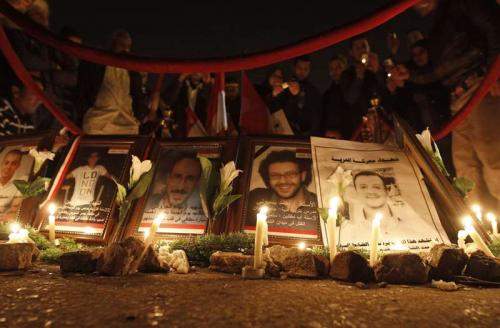
Pictures of Egyptian anti-government protesters killed during clashes with police and pro-government forces are displayed during a candlelight vigil at Cairo’s Tahrir Square on February 9, 2011. This is an AFP phot to which I have absolutely no rights. I will remove it if they ask me.
Martyrdom was not sought nor celebrated by protesters engaged in the 25 January uprising. But martyrs there were–peaceful protesters fired on by police and by hired thugs. These martyrs became crucial symbols of the revolution, and the notion that the democratic and reformist impulse of the revolution must not be lost because it would render their deaths meaningless is still frequently invoked.
Now, official figures have been released by the Egyptian health Ministry. They include data from private, police, military and university hospitals.
840 people died during the uprising, and 6467 were injured, according to Health Ministry spokesman Hesham Sheeha.
Earlier figures in the 300 range were based on a more limited data set. These figures, Sheeha told Al-Masry Al-Youm, were based on data at sites where death certificates were issued.
This figures are smaller that estimated by some rights groups, who suggested that as many as 1500 might have been killed.
Web sites, makeshift candle-lighting sites, wall murals, graffiti and other media continue to remind Egyptians of the cost of the uprisings.
Support the Revolution: Visit Egypt and Spend Some Money
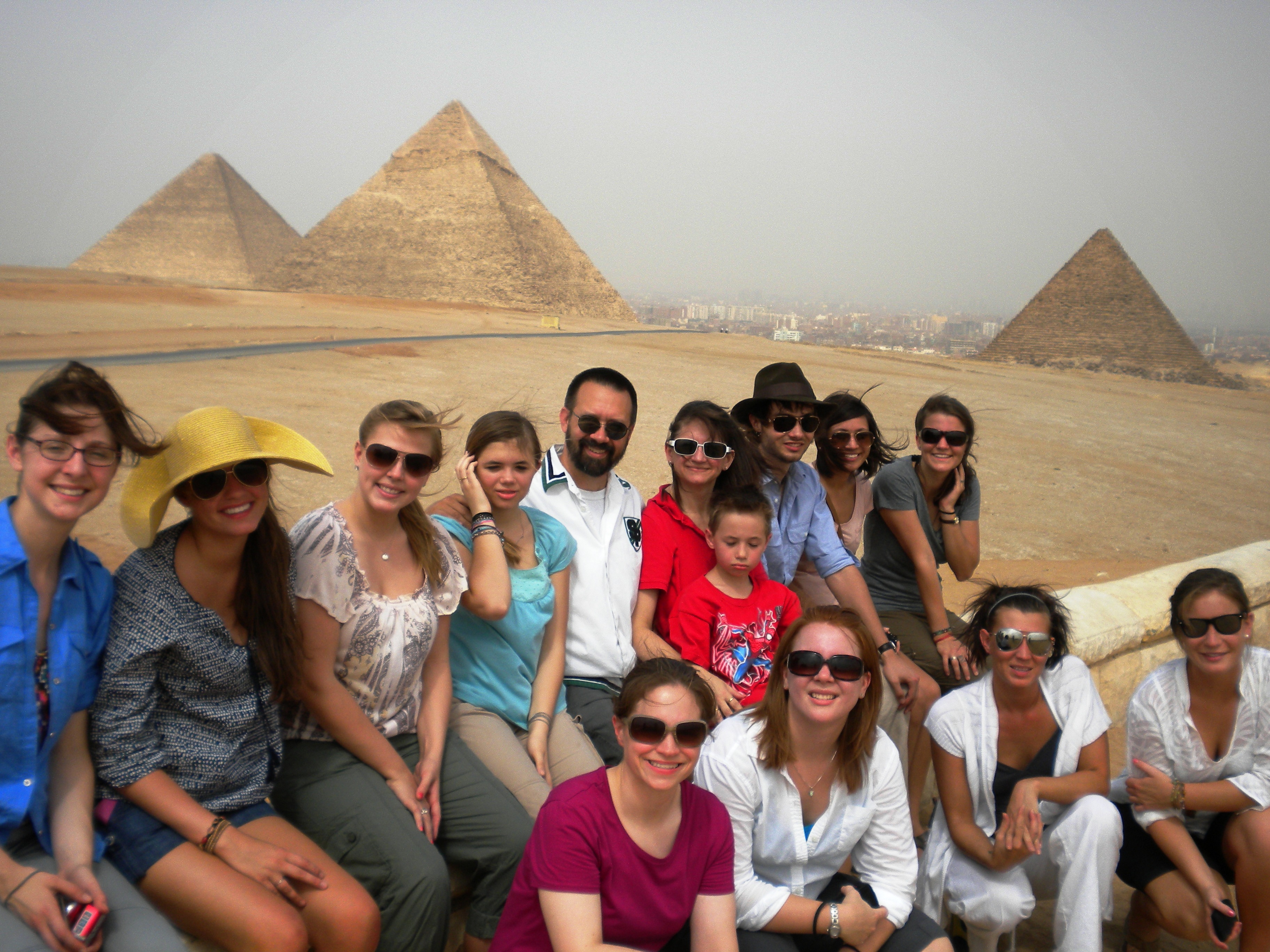
I took a group of students to Egypt in Summer of 2010 but insurance problems would prevent us from returning this summer. Hopefully we will be able to return in 2012.
Every other year my wife and I take students to Egypt as part of an anthropology field methods research class. If I could, I’d try to take students there this summer instead of 2012 and talk to folks about the revolution. Alas, I can’t, because as long as the US Travel Advisory remains in effect, they can’t get student travel insurance.
Like most U.S. universities, Miami had to bail our students out of Cairo when the demonstrations turned violent, whether they wanted to leave or not, for insurance reasons. The students who left were among nearly a quarter million travelerswho fled the country in the last week of January and the first few days of February.
The government has estimated that tourism losses cost the nation about US$850 million in the span of about two weeks. And while some tourism has returned, the overall effects are pretty dire. The industry amounts to 5 to 6 per cent of Egypt’s gross domestic product.
Worse, about 2 million Egyptians make their living from tourismin a country where unemployment already is widespread, and underemployment, or jobs that pay less than needed to meet the cost of living, is even more common.
One interesting thing about tourism in post-Mubarak Egypt is that downtown has become a tourist hot spot. Whereas for my students, Tahrir Square was a hub from which we traveled other places in Cairo via Metro (albeit we also went there for koshary, to buy replacement electronics and visit the AUC bookstore), now foreing tourists make Tahrir Square a tourist attraction in its own right.
Naturally this has attracted sidewalk merchants, who line the circumference of the square hawking T-shirts, flags, bookmarks, hats, badges, stickers and wall hangings dedicated to the revolution.
Meanwhile, Egyptians have begun revisiting Pharaonic monuments, which have long offered a symbol of Egyptian nationalism, something I write about in Chapter Four of Connected in Cairo.
News Media Explosion in Egypt

There will soon be more newspapers than ever in Cairo as freedom of the press meets freedom to create new political parties.
One of the major consequences of the changes in post-Mubarak Egypt has been freedom of the press and with it the creation of many new newspapers to give voice to the many voices of reform and political ideology. Released from the the restraints of the old regime, not only are existing newspapers suddenly free to report on corruption and wrongdoing, but nearly a dozen new newspapers have been announced.
Many of these new newspapers are being announced by emerging political parties. In a country where most newspapers were expected to voice the position of the state, or of authorized opposition papers, every new political party is likely to want its own media outlet.
Ibrahim Issa, former editor of Al-Dostour who spent two months in prison in 2007 for criticizing Mubarak and his political and business cronies, will return to the journalism scene as editor of a new newspaper called Al-Tahrir. Issa had been fired last ear when the newspaper was bought out by businessman Reda Edwards. The new newspaper is being bankrolled by Ibrahim el Moalem, owner of the Shorouk Group of media companies.
(Al-Dostour employees had already expressed their ire at Issa’s firing earlier by striking and, when Edwards refused to negotiate, launching a news web site titled “The Real Al-Dostour”)
Another famous media figure and target of Mubarak regime ire is also planning to bring out a newspaper: veteran television journalist Hamdi Qandil, who was part of the memorable On TV broadcast that apparently brought down the brief Shafiq government. Along with journalist Abdullah al-Sinawi, a former editorialist with Al-Araby newspaper, he has announced the creation of Al-Horriyya newspaper, whose first issue is scheduled for June. This project is being funded by a group of businessmen led by Mohamed Metwalli. Metwalli last yearbought the iconic Omar Effendi department store, and had reportedly tried and failed over the last few years to buy the newspapers Al-Badeel, El-Fagr and Al-Dostour.
According to a story in the Lebanese newspaper Al-Akhbar last week, Al-Horriyya newspaper will also have two sister media: a satellite news channel headed by Hussein Abdel-Ghani, the former director of Al-Jazeera’s bureau in Egypt, a research center, and a continuously updated web site.
Media colleagues are also telling me that plans are underway to create one or two new printing establishments with state of the art presses. One of the minor but lucrative forms of corruption engaged in by the former regime was requiring opposition and independent newspapers to print their newspapers at the printing house of Al-Ahram or another state press.
Citizen Journalism in Egypt: You Get What You Pay For

Lisa Goldman's April 2 blog post from Egypt on a trip funded by her readers.
Perhaps what Lisa Goldman is doing is not technically “citizen journalism”. But the idea of reader-supported freelance journalism fascinates me too much not to comment.
In India, where I was doing research on news media cultures in 2008, citizen journalism referred pretty exclusively to individual citizens who’d captured newsworthy stuff on video or other media and posted it to a citizen news blog or, more often, turned it in to local professional news media.
In much of the rest of the world, unlike India, the professional news media is in serious decline, and the relationship between professional journalism and citizen journalism is increasingly tenuous. Lisa Goldman has great credentials; according to her bio blurb she was born in Canada, lived and studied in New York for a decade, then moved to Jaffa, Israel in 2000. She’s been blogging since 2004, and she says her
articles for the mainstream press have been published in the Guardian Newsblog, Forward, Time Out Tel Aviv, Ynet, the Columbia Journalism Review and Haaretz, amongst other publications. In 2009 I was awarded the Anna Lindh journalism prize for ‘Covering Gaza from Israel,’ which was published in the Columbia Journalism Review.
But Lisa Goldman mostly blogs for a self-supported, volunteer on-line magazine/blog called +972, which offers as its purpose “independent reporting and commentary from Israel and the Palestinian territories.”
When the revolution occurred, Ms. Goldman desperately wanted to be there reporting. Alas, blogs like +972 have no resources. So on March 7, she posted an account of her first trip to Cairo, and asked people to donate funds for her to travel back to Cairo and blog about what she found, a practice she called “crowd-sourced funding.” By March 15, some 57 contributors had donated more than $3,000, and Ms. Goldman headed to Cairo. She arrived in time for the March 19 referendum. Since then, she has blogged about voting, open political discussion, and interviewed a young Al-Akhbar journalist.
The Egyptian uprisings have demonstrated many of the ways that social media can sidestep mainstream media. Here is another, this kind of reader-supported independent journalism. It adds a whole new meaning to the term, “You get what you pay for.”
Just How Significant are the Salafis in Egypt?

Salafis believe that Muslims must return to the Islam practiced by the first three generations of Muslims (as they understand it).
My post on the Washington Post article about Salafi movements brought me a lot of responses (few people post comments on my blog, for some reason; most e-mail me or post to Facebook)
Salafis are “fundamentalists” in the American sense of the word–they seek to restore the religion of Islam to the doctrinal purity of the first three generations of Muslims, which they believe they can reconstruct from limiting their theology to the Qur’an and a limited set of hadith (tales describing the sayings and actions of the prophet and his early converts).
Most people in the US, of course, find Salafis terrifying, as their words and activities feed into American fears that these Middle Eastern revolutions will all end in Islamic theocracies (and that all Islamic theocracies will resemble Iran).
Many of my Egyptian friends warned me about exaggerating the Salafi movement’s influence in Egypt. They are a small movement with no real organizational structure, led by networks of like-minded clerics, many of whom received educations in Wahhabi schools in Saudi Arabia.
Historically, Salafis eschewed politics, arguing that democracy was incompatible with Islam. The revolution thus left them in an awkward position–either they engage in politics or they risk becoming irrelevant.
Their ultimate goal, though, is cultural, not political: to make Salafi ideology the dominant faith practice in Egypt ultimately to the exclusion of other Islamic practices, not to mention Christianity. To this end, groups of Salafis engage in public protest, distribute pamphlets, commit acts of violence and other activities that call attention to themselves and their ideas. The media is complicit in this, one of my friends argued, because it brings them exactly the kind of attention they want.
Some of my friends are using a figure of 5 percent as the number of active Salafis in Egypt, and insist that their influence would be almost nil if not for articles like that in the Post and local media that draws attention to them, their activities and their ideas.
To explain more fully, I found this great column by Ashraf Sherif in Al-Masry Al-Youm that addresses both the Salafi movement and the “fear industry in the Egyptian media” in the wake of the revolution.
Salafis’ popularity in Egypt has been evident over the past decades. They are a fairly well-entrenched religious tendency that has been quite present on the Egyptian street. However, their potential for impact should not be exaggerated. In my view, Salafis are politically confined to “trouble-maker” status but nothing more. They lack the organization, political expertise and mindset to translate their doctrinal intransigence into meaningful political gains on the ground, even within the Islamist camp.
The revolution has changed things for the Salafis:
The success of Egypt’s uprising has caused Salafis to rethink their position in Egypt’s political order. They had no option but to support the revolution, or else risk becoming irrelevant. Now they are trying to reap its fruits and justify their own reactive politics in religious terms. This course of action is unusual for a group that is traditionally unbending in its doctrine. But the prospects of Salafi success are limited. Salafists barely have any experience with electoral politics (in terms of cadre building, resource mobilization and interest-aggregation techniques). Their mobilizing capacities are overrated and past successes have relied less on good organizational structures and more on exploiting public emotions and prejudices. Egypt’s new political atmosphere is pushing Salafis into unfamiliar territory. But the hegemony they so eagerly seek over Egypt’s Islamic public sphere may be undercut by the Salafis’ political incompetence.
If this topic interests you, read the column, it’s very good.
(I think this is the same Ashraf Sherif who was an undergraduate in political science at AUC back when I still taught there, and who just got a PhD at Boston University. If so, mabrouk Ashraf!).

 CONNECTED in CAIRO