What’s The Hadith On Facebook?
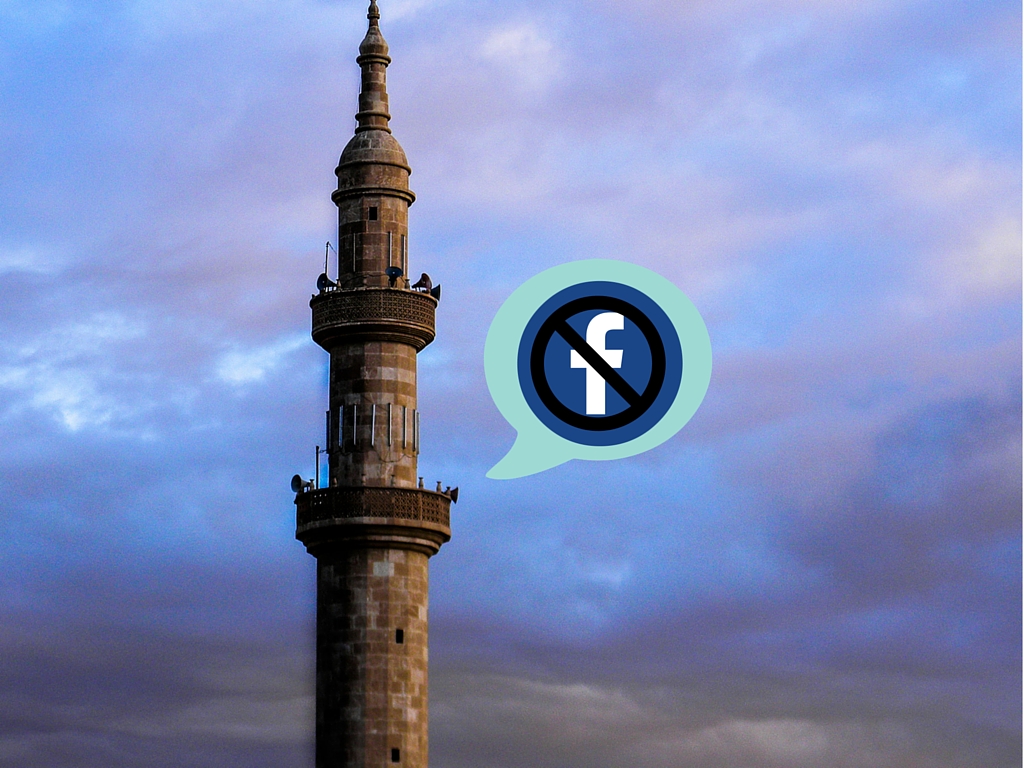 Just after dawn has broken, the musical voice of the muezzin fills the silence, calling the faithful to prayer:
“al-salaatu khayrun min al-nawm.” (prayer is better than sleep)
Except (perhaps) in the Nile Delta governorate of Beheira, where the muezzin of a mosque is accused of substituting “al-facebook” for al-nawm.
And why not? With 16 million accounts, Egypt is one of the top 20 countries for Facebook use–and number one in the Middle East.
The usual phrase, part of the dawn adhan only, is aimed at encouraging believers to get up and pray. Did the muezzin engage in a little wordplay, aimed at getting people off their early morning Facebook habit?
The Egyptian state religious authority suspended the muezzin in late August, not because the statement isn’t true, but because one is not allowed to introduce variations into the call to prayer.
If the story is true, it may be part of a broader pattern through which people find playful ways to negotiate tensions between conflicting social and cultural expectations where pre-existing religious and new social practices coexist.
Theorizing Media And Conflict

The Media Anthropology Network of the European Association of Social Anthropologists (EASA) has issued a call for proposals for the a workshop on conflict and media. The goal is to bring together in Vienna next Fall a group of anthropologists and fellow travelers who are interested in developing sophisticated ways of theorizing media and conflict.
Obviously, the so-called “Facebook revolutions” and “Twitter revolutions” of the Middle East and North Africa should be represented here.
But if you want to participate you’ll have to hurry; the deadline is Sept. 20th–less than a month away!
Call for Abstracts:
Theorising Media and Conflict workshop
Media Anthropology Network
European Association of Social Anthropologists (EASA)
Department of Social and Cultural Anthropology, University of Vienna, Austria
23-24 October 2015
In a recent survey of the interdisciplinary literature on media and conflict, Schoemaker and Stremlau (2014) found that most existing studies display Western-centric biases, normative assumptions and unsubstantiated claims about the impact of media in conflict situations. With their ethnographic methods and ground-up theorising, anthropologists are therefore well placed to make a strong contribution to the advancement of this area of scholarship. Although a growing number of anthropologists have studied media in conflict and post-conflict contexts – working on diverse topics such as media representations, cyberwar, internet activism, social protest, video-making, or radio dramas – so far they have done so in relative isolation from one another. The result is a fragmentation of the field and a dissipation of efforts.
Dying For The Revolution: Special Journal Issue
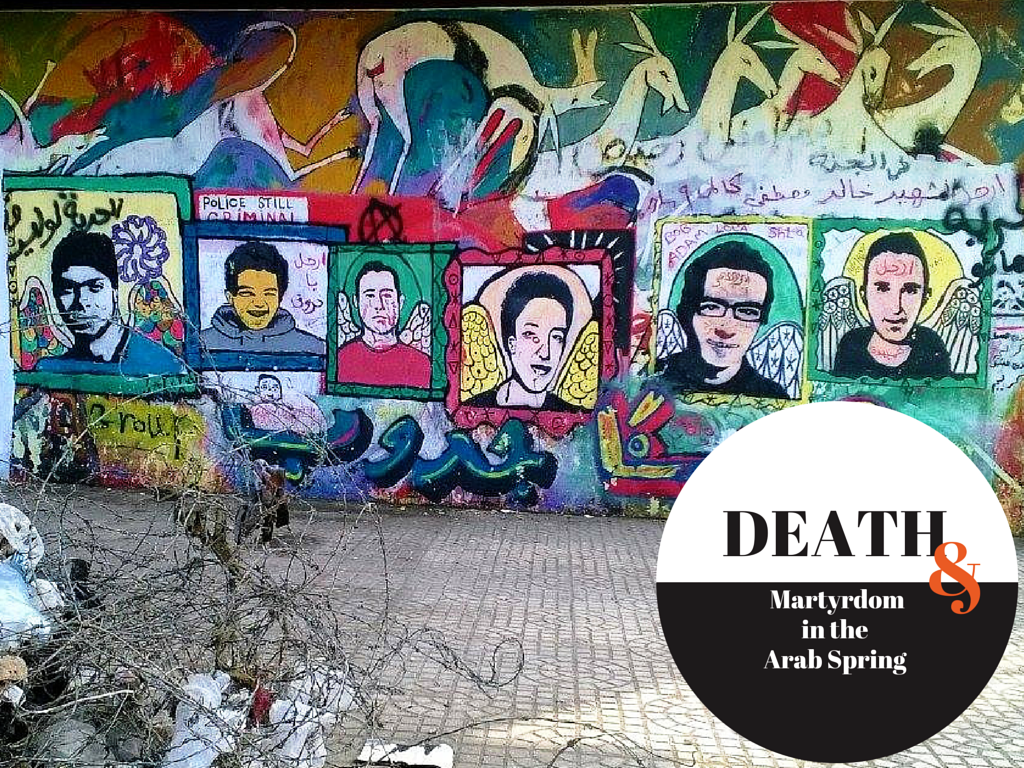 “Death lies at the beginning of the Arab uprisings and continues to haunt them.”
So writes Amira Mittermeier in the introduction to a special collection of articles in the anthropology journal Ethnos. Drawing on ethnography in Cairo, she explores many different aspects of how deaths are made meaningful by being woven into a narrative of political transformation. She is particularly good at captivating the affective aspects of death as sacrifice. And yet, one of the most profound points comes at the end, when she speaks to a Abdullah, a Muslim Brotherhood organizer who says:
remember it’s easier to die for the revolution than to live for it’. Abdullah’s frustration stemmed from his struggle in trying to find a group of volunteers to continue the revolutionary work of political organizing and attending to the immediate needs of the disempowered and the poor. If everybody could just give two hours every day – live the revolution for two hours every day – things would be drastically different, he said.
Love And Fear in Egypt

Autocratic and democratic regimes are pretty much the same, says Joseph Massad in an article in the journal Public Culture. The chief difference is whether they seek to rule by love or fear.
“The people demand the old tear gas”
This was a slogan uttered by some of the crowds protesting the Egyptian army’s November 2011 turning on civilian protesters demanding the end of military rule using a new powerful tear gas that could cause unconsciousness and convulsions.
It’s a play on the ubiquitous slogan “The people want the downfall of the regime,” an act of black humor that captures, according to Joseph Massad in an article in Public Culture, “their loss of fear of their new rulers.”
In an article in Public Culture on the continued ramifications of the Arab (and especially Egyptian) uprisings, Massad ties this act of bravado to the advice Niccolo Machiavelli famously gave to the Prince: that ideally a ruler should be both loved or feared “but since it is difficult to accomplish both at the same time . . . it is much safer to be feared than loved.”
But Massad’s argument goes very much beyond repeating again the claim that the transformative element of the revolution was the loss of peoples’ fear in their rulers. The rulers of contemporary nation states seek to be both loved and feared in different degrees by different segments of the people at different times, argues Massad.
Most contemporary states involve institutions of both hegemony–ruling with the consensus of the governed) and coercion (keeping the ruled under control through use of force). They seek, that is, to be both loved and feared.
This is partly the result of policy guided by the regimes that support them, especially the U.S. Regimes that are loved “have legitimacy” in US parlance. As for “liberalization”, Massad wries:
Did Social Media Cause The Egyptian Revolution?
 I was recently asked (by otherwise sensible people), “Dr. Peterson, how would you assess the predominant media narrative that the ‘Arab Spring’ revolutions—nicknamed ‘Facebook revolutions’ at the time—were caused by social media?”
This was my answer:
Much depends on what you mean by causality.
A few years ago I sat in on a senior capstone course on international policy. The idea was to assess a particular problem in US policy and make recommendations. One of the student projects recommended that the US could start a revolution in the particular country about which they were advising simply by promoting Internet access in the country. Apparently they had read Wael Ghonim’s maxim ” if you want to liberate a society just give them the Internet” as policy rather than exuberant hyperbole.
I had to explain to them just a few of the complexities of the so-called Internet revolution in Egypt, not least of which was the decades of labor movements, protests, political blogging and other elements that allowed the 18 days in Jan and Feb 2011 to become a tipping point.
What is the meaning of martyrdom?
The difference between a martyr and a victim is the investment of a slain body with meaning by a public. The martyrs body indexes the circumstances of his or her death and, through this, the wider context in which that death occurred. Invested through ritual and representation as a martyr, the death becomes a rhetorical call to the living to live differently, to change the context in which their death occurred.
But systems of meaning are always contestatory, and usually contested. Who gets to be a martyr, and what their martyrdom means became an issue relatively early in the revolution.
In a recent article on the Egyptian revolution, I wrote:
The term “martyr” (shahid) was widely used to describe the protesters who were killed by plainclothes policemen and baltagiyya (hired thugs). The veneration of protesters who died at the hands of the state served as a turning point in the uprising. Protesting for political reform against an oppressive regime that tortures, imprisons and kills its opponents without respect for law, they were themselves killed by the regime. They became powerful symbols of the need for change. Their deaths put new steel into the will of many protesters so that going home—no matter how deeply entrenched the regime appeared to be or how futile the protests seemed–became intolerable because it was unthinkable that these men and women should have shed their blood for an uprising that failed.
Walter Armbrust suggests that martyrs served an important function in the revolution:
The regime and its sympathizers started generating a fog of patriotism long before Mubarak left office, and it provided ample hiding space for anyone who feared close scrutiny in the post-regime environment. The martyr inconveniently asks, ‘who killed me?’ and true revolutionaries take up the cause, also asking, ‘who killed them?’ in the hope that they can beat the false patriots out of the fog (Armbrust 2012).
So far, so good. But one of the things that fascinated me were subsequent demands by police that their dead be considered martyrs, too. I wrote:
In July, less than five months after the Tahrir Square uprising ended, the Police Officers Coalition requested that the handful of security police who died in the uprisings be accepted as police martyrs, and that their families receive compensation.
What does it mean for the revolution if anybody who died during the revolution is a martyr for the revolution? I suggested:
In asking that police who died in clashes with the protesters be considered among “the injured of the revolution”, the Coalition and its allies in the interim government were essentially reframing the logic of martyrdom, removing the villains, and positioning death in Tahrir as participation in a national rite of passage irregardless of who died, or at whose hands. According to this logic, the resignation of Mubarak at the climax of the rite becomes a kind of expiatory act that demonstrates the power of the Egyptian people and releases those below Mubarak from guilt—they are all patriots, after all—and reincorporates them back into the body of the Egyptian nation—the very opposite of the meaning the martyrs have for most of those who planned and carried out protests in Tahrir.

I have a chapter in this new book on the Egyptian revolution.
“there is the responsibility that comes with any social science study, particularly in an area fraught with legacies of colonization, authoritarianism, and dependency. As academics and students, we exist within structures of power and knowledge making that enable us to influence significantly the way in which policymakers, journalists, and investors deal with the people of the area we study—in this case, ninety million Egyptians”
That’s a quotation from Reem Abou El-Fadl about part of the motivation behind her new edited volume on the Egyptian revolution in the on-line magazine Jadaliyya. Reem is interviewed about the book in a recent post.
Reem describes the book thus:
The book project brought together thirteen scholars from academic disciplines as diverse as political economy, comparative politics, and social anthropology. They wrote their first drafts in 2013, but these were continually revised and updated as events unfolded, so we now have four years of collective reflection in the book. Its chapters span Egypt’s post-Mubarak and post-Mursi political transformations, all considered in light of earlier periods. During that time the authors have drawn on interviews, media resources, and first-hand observation, as well as archival research conducted in Egypt, Tunisia, Turkey, the Gulf states, Britain, and the United States.
I’ve already posted about this great new book from Routledge on the ongoing Egyptian revolution Revolutionary Egypt: Connecting Domestic and International Struggles. I have a chapter in the book.
Here’s what she says about my chapter:
Thinking About Liminality in Tahrir Square

I have a chapter on the Egyptian revolution in this new book.
As I struggled to make sense of the dramatic changes in Egypt from January 2011 forward, I was surprised to find that the set of concepts that worked best for me came from the work of Victor Turner: process, field, social drama, antistructure, and, of course, liminality.
Liminality is the state of being “betwixt and between” two states or categories. It can refer to a person between two stages in a rite of passage; it can refer to states of virtual experience, including film viewing; and it can refer to a society in a state of revolution as one normal ends but a new, stable normal has not yet emerged.
In my position as a professor of international studies, especially going to interdisciplinary conferences with geographers, historians, economists and political scientists, where I bring an anthropologist’s perspective to various “global issues”, I find liminality increasingly to be a concept that is “good to think” with.
Turns out I’m not the only one thinking about liminality in such contexts. A special issue of International Political Anthropology on “liminality and cultures of change” in 2009 led to a series of discussions and, through them, the publication of a new edited volume, Breaking Boundaries: Varieties of Liminality edited by Agnes Horvath, Bjorn Thomassen and Harald Wydra.
I have a chapter (Chapter Nine, in fact) in this book, entitled “In Search of Antistructure: The Meaning of Tahrir Square in Egypt’s Ongoing Social Drama.”
International Sociology Of The Arab Uprisings

The latest issue of the journal International Sociology features three articles on the Egyptian revolution, as well as a couple of other articles on the Arab uprisings generally.
The latest volume of the journal International Sociology offers a special issue on Arab uprisings edited by Mohammed Bamyeh and Sara Hanafi.
Three of the six articles are about Egypt, and two are about the Arab uprisings generally but at least touch on things Egyptian (the remaining article is about the Muslim Brotherhood in the UAE)
The issue opens with an introduction by Mohammed Bamyeh and Sari Hanafi in which they suggest that the most interesting thing “about the Arab uprisings is that they were surprising.”
Sometimes one hears in public discussions voices that reject the notion that the uprisings were surprising, and insist that there were clear signs of them all along. But none of the experts on the region saw such signs, and even local intellectuals who had sincerely wished for revolutions never saw them coming. In fact, whenever they had sought, before 2011, to describe how a revolution would happen, their frame of reference was a variety of Leninism – that is, the model of organization that is least relevant to the study of the Arab uprisings. In any case, there is nothing more common that after-the-fact reconstructions of events, so that they appear to have been destined all along to put us on a revolutionary path.
The uprisings in the Arab World “continue to supply us with a repertoire of surprises, counter plots, setbacks and successes.” Key questions for sociologists of the revolution are:
- Where did these movements come from?
- How do they relate to older movements in the region?
- What do they tell us about how to study social movements and revolutions?
- What are their distinctive features?
- What features do they have in common with older movements and revolutions worldwide?
The first article on Egypt is “We ought to be here: Historicizing space and mobilization in Tahrir
Square” by Atef Said. Here is the abstract:
Perhaps the most interesting aspect of Words of Witness, Mai Iskander’s compelling account of the aftermath of Egypt’s 2011 revolution in Tahrir Square that led to the resignation of 30-year dictator Hosni Mubarak, is as a fascinating account of the cultural construction of knowledge and the mediatization of this process in the digital age.
That’s the beginning of my recently published review of what proved to be one of the best documentaries on the Egyptian revolution that I’ve seen. And I’ve seen many.
What I liked most about this film was that instead of trying to focus on the revolution as a whole, it focused on a particular person, journalist Heba Afify, and her efforts to make sense of what is going on and represent it in narrative form for her audiences.
The review continues:

 CONNECTED in CAIRO