Egypt’s Terrifying State Security Falls to Protesters

Photo of shredded documents at state security headquarters in Nasr City, Cairo. Photo by Tarek Al-Araby.
Egyptian protesters today invaded state security offices in several locations Mar. 5 and 6, freeing prisoners, seizing records and capturing state security officers, often in the act of shredding or burning incriminating files. They invaded state security buildings in Alexandria, Aswan, and other locations. The most significant building invaded by citizens was the State Security building in Nasr City.
For Egyptians, the Ministry of the Interior is a frightening entity, and the headquarters in Nasr City is a building into which people go in bound and blindfolded, and from which many never return. Horrific tales were told of it by taxi drivers, none of whom actually knew anything about it. The official name is Mabahith Amn ad-Dawla al-‘Ulya (State Security Investigations Service), or Amn ad-Dawla for short. It is also often called the SS and “Stasi” after the WWII gestapo it in some ways resembled.
Emboldened by the fall of the Shafiq government and the ousting of Habib al-Adly, for 15 years Minister of the Interior, a group of Egyptians surrounded the building around 4pm and, after some negotiation, were allowed to enter by the military officers charged with its security (perhaps because, as an AP story claims, it could not stop them).
Building is a misnomer; “complex” is a better term for a span of buildings and underground tunnels, basements and subbasements. Inside were found luxurious suites, exercise rooms and high-tech offices, as well as torture chambers, some filled with blindfolded prisoners, one of whom claimed to have been held there for 14 years.
Inside they found torrents of shredded documents. Leaders received messages from Wikileaks promising the assistance of its world-class document restoration team to piece the documents back together.
A large number of intact documents were also found, including a few indicating that the ridiculous claim that the US, Iran, Israel and Hamas were jointly behind the protests as a way to destabilize Egypt may have reflected actual intelligence “findings”. “No wonder they were only good at torture not intelligence” quipped the administrator of the “We Are All Khaled Said” Facebook page.
Some documents are dynamite. Perhaps the most startling are files that apparently describe the planning and execution of the Alexandria New Year’s church bombing by state security itself.
Other important finds are said to include names of the Ministry’s spies within opposition parties (apparently including some well-known public figures), spies within the Muslim Brotherhood and lists of political prisoners and the torture devices used on them.
Also among the intact documents were thousands of files kept on various individuals–Islamists, atheists, communists, bloggers, activists, union members, members of the regime itself, and even people who called in to talk shows.
One document describes a plan to “make a fake announcement in the media that State Security is disbanded” while reconstituting it under another name, with some cosmetic changes to appease the public. Documents are being scanned or photographed and posted to sites like flickr before being turned over to the public prosecutor.
Making public the documents seized from the security agency is, of course, a mixed blessing. Most of the documents that could have been used to prosecute State Security officers have been shredded or burned; many of the available documents reveal damaging personal information about people who may not be guilty of anything except coming under scrutiny. It is not clear how much discretion people are showing.
The invasion of the buildings began in Alexandria, where security officers opened fire on the protesters from inside. More than 1,000 people stormed the building, forcing their way inside. AP reported four protesters were wounded and more than 20 security officers were badly beaten.
For a rich account of events and what’s been found, with lots of pictures and videos, visit Zenobia’s The Egyptian Chronicles blog. You can also follow @SSLeaks on twitter for ongoing posts as to what people are finding.
Meanwhile, Habib el-Adly, who was in charge of police and state security for fifteen years, appeared in court today on charges of money laundering and abuse of authority–in particular, he is accused of having ordered the brutal attacks on protesters by riot police during the early protests in Tahrir Square. AP reports tha hundreds of people turned out to see him arraigned, including many of the families of the more than 300 protesters killed. They hung him in effigy and chanted, “The death sentence awaits you, el-Adly.”
For More Information:
Osman, Ahmed Zaki. 2011. The rise and fall of Egypt’s notorious state security. Al-Masry Al-Youm Mar. 9
Did Cairo Influence Wisconsin Protests?
“It’s like Cairo has moved to Madison these days,” said Wisconsin Rep. Paul Ryan Feb. 17. He was viewing the 70,000 protestors demonstrating against Gov. Scott Walker’s efforts to take collective bargaining rights away from public unions. Gov. Walker is no Hosni Mubarak, but Ryan isn’t alone in noticing the resemblance.
A student e-mailed me, asking whether I thought the protests in Wisconsin were influenced by the uprising in Cairo.
I ended up devoting twenty minutes to the question in my Feb. 24 next class. As the following video shows…
…there are connections. Activists in Tunisia, Egypt and Wisconsin may well find themselves acting in solidarity with one another. They may send one another messages. A protester in Wisconsin may wear the kufiyyah as a sign that indexes the protests in Cairo, but the Cairo protests cannot be said to have led to or inspired the Wisconsin protests in the way the Tunisian protests can be said to have inspired the Cairo protests.
And yet, there is a distinct connection and it concerns ways the current global economic downturn has exposed the rising gulf between rich and poor, and the demand for an economics that serves the public good.
Globalization means we’re all more connected than ever before. Ecological and economic shocks in one part of the world lead to dramatic shifts in food prices elsewhere. According to a December 2010 briefing paper on the website of the UN’s Food and Agriculture Organization:
Recent bouts of extreme price volatility in global agricultural markets portend rising and more frequent threats to world food security. There is emerging consensus that the global food system is becoming more vulnerable and susceptible to episodes of extreme price volatility. As markets are increasingly integrated in the world economy, shocks in the international arena can now transpire and propagate to domestic markets much quicker than before.
As it becomes harder and harder for the poor, the working classes and the middle classes to make a living, they begin to notice the wealth disparities around them. These disparities give them someone to blame: the wealthy elites—in the government—who are prospering by the same system that is hurting them.
By the measurements used by neoliberal economists, Egypt was a tremendous success as it shifted from Nasserist socialism to a free market economy. But this was not the case for most citizens.
What citizens saw is that the infrastructure built during the Nasserist era—especially the health care system and the public school system (the only hope for many for social advancement)—fell into decay. The new regime built fabulous new private hospitals and schools, but most Egyptians could not afford them. Instead, they experienced stagnant or falling wages relative to rising inflation. The government estimated unemployment at approximately 9.4% last year (disproportionately distributed among people under thirty), while some 20% of the population is said to live below a poverty line defined as $2 per day per person.
The rich grew richer not by stealing from the poor but simply by taking advantage of their existing wealth to invest in the privatization process. As Walter Armbrust writes:
To describe blatant exploitation of the political system for personal gain as corruption misses the forest for the trees. Such exploitation is surely an outrage against Egyptian citizens, but calling it corruption suggests that the problem amounts to aberrant behavior from a system that would otherwise function smoothly. If this were the case then the crimes of the Mubarak regime could be attributed simply to bad character: change the people and the problems go away. But the real problem with the regime was not necessarily that high-ranking members of the government were thieves in an ordinary sense. They did not necessarily steal directly from the treasury. Rather they were enriched through a conflation of politics and business under the guise of privatization. This was less a violation of the system than business as usual. Mubarak’s Egypt, in a nutshell, was a quintessential neoliberal state.
Okay, that’s Egypt, a third world country run by dictator and a corrupt regime. Obviously, the root causes leading to the Wisconsin protests must be quite different, right? Well, yes… but there are more similarities than you might expect.
First, the disparity between rich and poor is actually greater in the US than in Egypt. According to the CIA Factbook, the GINI index (which measures the degree of inequality in the distribution of family income) is 34.40 in Egypt but is 45.00 in the United States. That means the wealth disparity in the US is 23.5 % greater. We just don’t notice because there’s so much more wealth in existence. Here is the US disparity shown graphically:

And like Egypt, not only is the wealth disparity growing but the rich are growing richer as the poor get poorer. According to the Congressional Budget Office, while the top one percent of Americans have enjoyed enormous growth in average gross household income since 1979, the top 20 percent has enjoyed only modest growth and the bottom 80 percent has stayed roughly the same.
Until you take taxes into account. Once you add in taxes, the bottom 80 percent of the US actually has less spending power than they did in 1979!
 Now for Gov. Williams, and many other Republican governors, this disparity is irrelevant. For him, the problem isn’t the rich, it is the middle class teachers, nurses, administrators and other public sector workers who—though their salaries are marginally lower than their private sector peers—enjoy relatively generous health benefits and pension benefits, leave policies and protection against unfair termination. These were won through collective bargaining, and Williams wants to end that practice.
The bottom line, said Williams recently, is the bottom line. The state can’t pay for all these benefits any more.
But why not? Data from the Senate Joint Committee on Taxation suggests that part of the problem has to do with how we’ve been taxed over the last couple decades. Since 1950, income tax has held relatively steady, paying for between 40 and 50 percent of the federal budget. But corporate taxes have decreased from 32 percent in 1979 to less than ten percent now. The difference has been made up by payroll taxes. Payroll taxes, of course, are shared between employers and employees, so as corporate taxes decline, workers are taking on more and more of the burden of supporting the government. State budgets are different, of course, but the trends are similar.
 I don’t suppose that the average protesters can articulate these trends or describe such statistics. But like the protesters in Cairo, they are aware that something is unfair, that they are being punished for economic declines by the very people who have profited by those downturns.
One of the chief differences between the neoliberalism that structures global economic interactions in the contemporary world and classical liberal economics is the notion of a public good, or commons. While classical liberalism assumed a common good protected by the state, neoliberalism assumes that markets can handle public goods better than governments. This erosion of public goods is noticed by the public, though they may experience it differently. I would expect such protests to continue.
 Speech acts have the potential power to change social reality. The apology, as a speech act, has the potential power to restore a breach in existing social relations. But an apology can also be perceived as perfunctory or insincere.
The latter was my culturally-conditioned response to the the apology by the Supreme Council of the Armed Forces now running the country for the attack on the protesters by Army personnel. I dismissed the apology as just another piece of political face-saving.
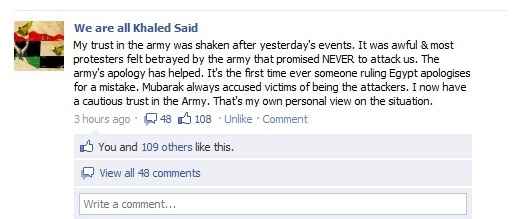
Not so the anonymous author of the English Facebook page, “We Are All Khaled Said“, who wrote:
My trust in the army was shaken after yesterday’s events. It was awful & most protesters felt betrayed by the army that promised NEVER to attack us. The army’s apology has helped. It’s the first time ever someone ruling Egypt apologises for a mistake. Mubarak always accused victims of being the attackers. I now have a cautious trust in the Army. That’s my own personal view on the situation.
Apologies, as any linguistic anthropologist knows, express negative politeness. They signal the speaker’s awareness of having impinged on the hearer’s negative face, the desire of social actors that their actions be unconstricted, their rights respected and their freedom unimpeded. That’s what’s being expressed by the first two lines of the “Khaled Said” post: “My trust in the army was shaken after yesterday’s events. It was awful & most protesters felt betrayed by the army that promised NEVER to attack us.”
The power of any speech act to affect social reality depends on the contexts in which it is uttered by the speaker and received by the hearer. My hearing of the speech is conditioned by a cultural framework in which a) politicians rarely apologize for even the most egregious errors; b) when they do, the apologies usually seem perfunctory; c) if a politician apologizes, that apology will immediately be construed as “too little too late” by political opponents (which reinforces frames a and b).
The anonymous poster articulates his/her own context as conditioned by a frame in which a) members of the ruling class never apologize for face-threatening acts; instead b) they frame the person whose face was threatened by their words or actions as the aggressors whose actions forced them to reluctantly employ verbal or physical force.
Any given culture will have a range of strategies for expressing this aspect of negative politeness. The offences which elicit apologies and the strategies selected to realize them provide clues to the kind of speech acts the community regards as face-threatening acts, the relative seriousness of these acts and, more broadly, what kinds of rights and freedoms the culture accords to different kinds of social actors.
The moderator of the “We Are All Khaled Said” Facebook page is pointing out that in apologizing the army is breaking with decades of political tradition and forging a new tradition in which the government apologizes to people which entails a recognition that it has obligations to those people.
At the same time, one action does not a new political culture make. Hence the poster points out that he has moved from a position of “trust” to one of “cautious trust”.
(For my non-anthropologist readers who may think I’m reading too much into a mere 68 words, that’s what linguistic anthropologists do. Human communication is semiotically dense and the amount of social information and contextual framing that can be performed by even a short utterance is truly amazing).
FYI
Brown, Penelope and Stephen C. Levinson. 1987. Politeness: Some Universals in Language Usage. Cambridge: Cambridge University Press.
Egypt’s Protest Dispersed by Force

Photo: Al-Jazeera
Each time I’ve been asked to answer the question “What’s next for Egypt“–most recently yesterday in an address to the Model Arab League–my first scenario, a military coup, receded further into the background. Like many Egyptians I’ve been cautiously optimistic about the military’s posture (not so many of my academic friends, esp. Ted Swedenberg of the University of Arizona, who has been chanting “Don’t trust the military, don’t trust the military” since tanks rolled into Cairo Jan. 28th)
The military coup scenario moves forward now that the army 25-26 Feb. dispersed Friday demonstrators by force, and enforced the curfew. It is telling–an ominous–that they appear to have waited until there were no television cameras, and that many wore black masks under their riot helmets. This uprising has very much become both a social drama and a media performance.
I first heard about it through social media (of course). I received two messages back to back via Facebook from two different friends:
At least 60 protesters arrested in Tahrir. Military police & masked commandos attacked people w/ whips, sticks & tasers, & waved machine guns around 2 intimidate them. They chased them thru side streets. The square has been evacuated but they’re trying 2 regroup. Now they’v…e beat up protesters at the parliament sit-in & are threatening & arresting them.
”More fun with the army tonight, who decided to break up a two small peaceful protests (why?) using completely unwarranted force. I knew they would do this, but didn’t think it would be so ugly. Sherif Azer was beaten up, but he’s fine” via Sarah Carr about today’s protests in Cairo. The army has shown its true face today…
The continuing Friday protests were intended to keep the pressure on the Supreme Council of the Armed Forces now running the country that they must deliver on their promises. One of my wife’s friends told her (via Facebook) that it had become a Friday after-prayer outing for many people. Indeed, there was a carnivalesque ritual aspect, where munaqaba (veiled women) make posters alongside young men in jeans, vendors sell grilled snacks, and parents bring their children.
One stream of messages by young men I kibbitzed involved an argument between a young man who called himself Shady, saying “We got what we wanted. The guy gave up power, resigned his office. My friends and I went home and so should the rest of you.” A half dozen others jumped on this, arguing that “Mubarak was just a figurehead” and “You may have gotten what you wanted but we are fighting for a better Egypt”. This, I think, is emblematic of a number of similar debates.
Later today (Sat., Feb. 26) the ruling military council apologised for the military action, said the incident “wasn’t intentional”, and promised such confrontations would not happen again. While the apology may be sincere, I am reminded of an old Mubarak ploy, arresting this journalist or that NGO leader, even though they are later let go or have their cases dismissed in court, just as a way of sending a chill through the rest of the press or NGO community.
After this, how many dads will bring their daughters to Tahrir next Friday? And if the Friday protest ritual stops, from where will come the pressure for the military council to make good on their promises?
For More Information:
Egyptian Military Forces End to New Protest – New York Times
Renaming the Egyptian State
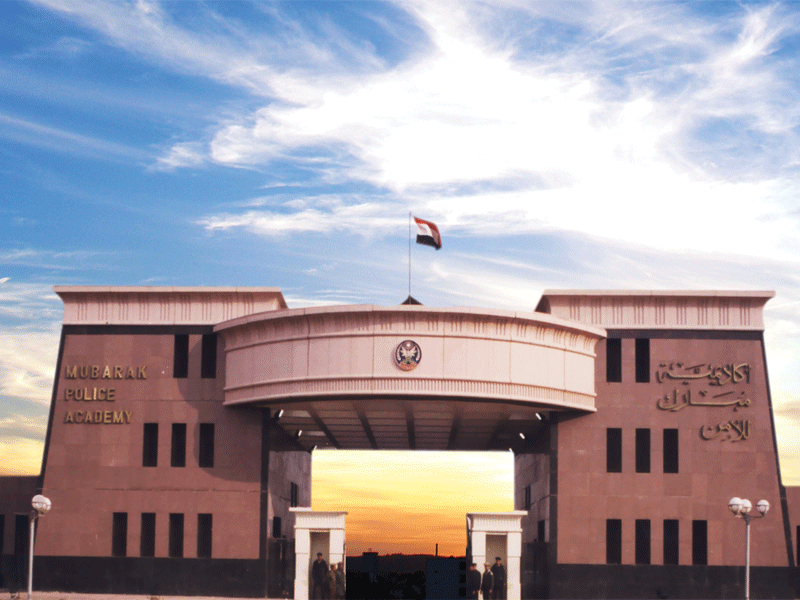
Egyptians have petitioned to rename the Mubarak Police Academy after Khaled Said.
Rumors went around last night that Mubarak’s picture was put back in a ministry building in Alexandria and this led to many fearful comments–what could it portend, people asked.
One of the projects of a state–understood as a hierarchical bureaucracy with a legal monopoly on the use of force– is to lay claim to the nation through the use of symbols in order to naturalize its authority.
In Hosni Mubarak’s Egypt, the images and names of the first family were efforts in this vein. Every school, every government office and many other buildings contained photographs of the president. Since he left office, these have mostly been removed.
Institutions and sites named in honor of the Mubarak family–usually Suzanne or Gamal Mubarak–are also being renamed.
For example, the Ministry of Culture has renamed “The Suzanne Prize for Children’s Literature” as “The Egyptian Prize for Children’s Literature”, and the Mubarak Prize for Social Science, Arts and Literature has been renamed the “Nile Prize”.
In Minya city residents have supposedly petitioned to rename Suzanne Mubarak Square as “The Martyrs of the January 25 Revolution” Square.
Protesters have also called on the authorities to change the name of the “Mubarak Police Academy” on the Ring Road to “Khaled Said Police Academy” in honor of the 28-year-old Alexandria native who was beaten to death by Egyptian Police last year. There’s also a petition to rename People’s Assembly Street as “People’s Street”.
Not all anti-government protesters are patient enough to wait for their petitions to be considered. Protesters in Tahrir took matters into their own hands and crossed out Mubarak’s name from the Cairo Metro Station.
Just as cartouches of some Pharaohs were defaced by their successors–who sometimes replaced them with their own names–removing the names of the Mubarak’s is a sign of change. Equally important is the question of what they are replaced with. The Ministry of Culture has apparently decided not to name prizes after living people any more. From the reports so far, it sounds like the protesters feel the same way.
Is This Book “Media Anthropology”?
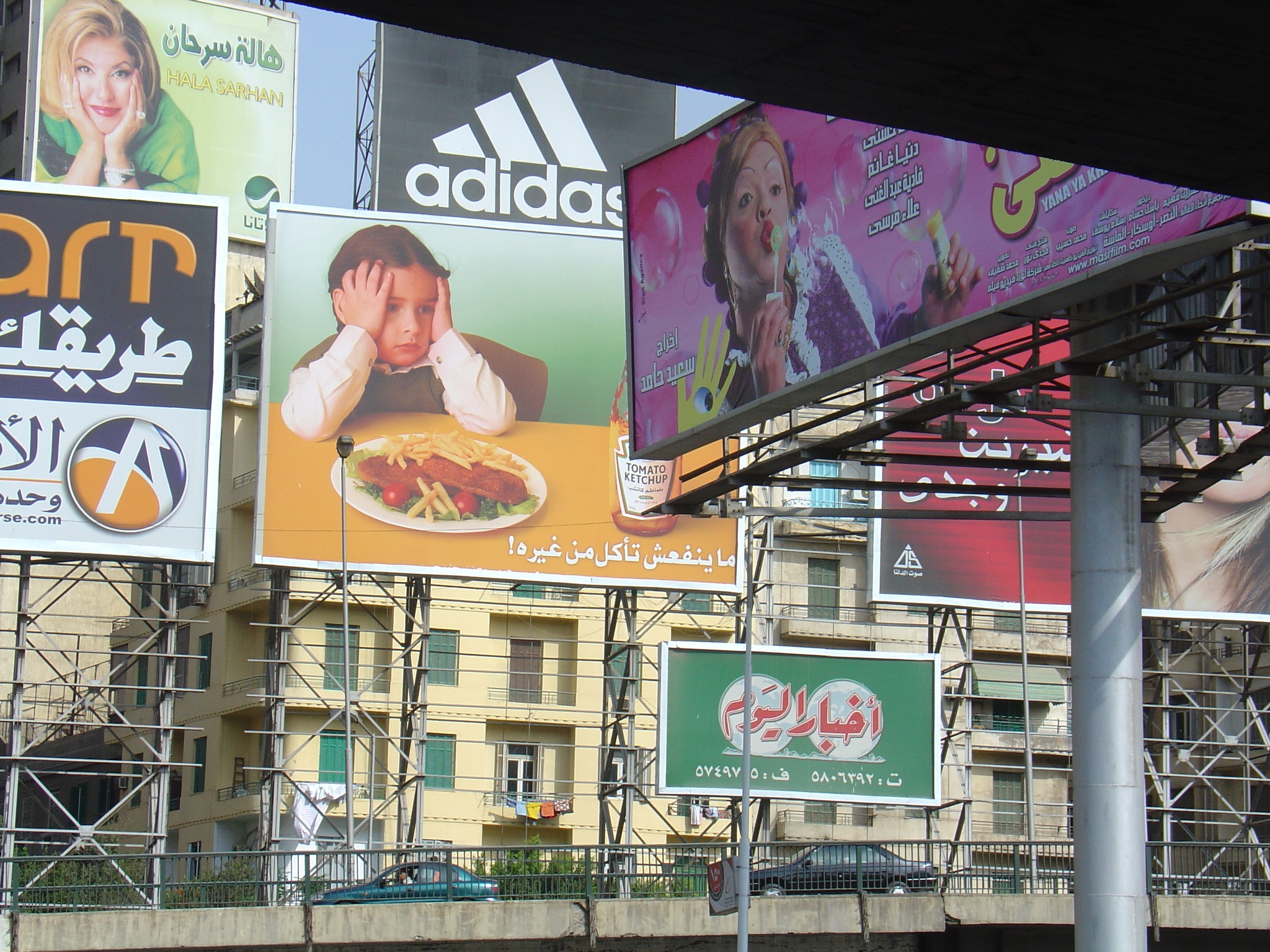
A photo from the book. Connected in Cairo is about the forging of cosmopolitan identities in millennial Cairo. Media is ubiquitous, but does that make it "media anthropology"?
[T[he point of media anthropology is to broaden and deepen our understandings of human engagements with media through the application of the anthropological perspective—broadly comparative, holistic in its approach to complexity, ethnographically empirical, aware of historical contingency and relativistic.
–Me, 2009
“This is a real departure for me,” I told a colleague about Connected in Cairo: Growing Up Cosmopolitan in the Modern Middle East. “After all these years about writing about media, this book is about transnational economic flows and class identities. I wonder what my colleagues will make of it?”
It turns out that I may be the only one who thought it was a departure.
New York University’s Bambi Schieffelin called it “a beautifully nuanced account of the interpenetration of local and global media practices, other consumption practices, and the people for whom they are relevant.”
Elizabeth Bird, one of the leading media anthropologists, described it as “a very mature statement about the nature of media experiences in a globally interconnected world.”
And even the publisher lists it in their catalog of Newest Titles in Cinema, Media, and Performance Studies
So I took another look at it, from the distance of a few months since I completed proofing the galleys, and realized that although I did not focus on media, media run through the book as vehicles for cultural operations.
The second chapter is entirely about Arabic children’s magazines.
The third chapter is about kids playing with Pokemon in Egypt’s private schools, but one can’t talk about trading cards, GameBoys and tazu without also talking about broadcast television and videos. Moreover, part of the context of Pokemon’s reception in Egypt was tied to a moral panic in Saudi Arabia and there’s a lengthy content analysis of their newspapers, and Egyptian magazines, that contributed to this.
The fourth chapter is about how teens and young adults reconstruct their identities—but it opens with an extended analysis of one of the most successful films in Egyptian media history, and the sixth chapter, although ostensibly about the entrepreneurial imagination, has several discussions about advertising.
I wrote several years ago, in response to a criticism that panels devoted to media were notably absent from the American Anthropological Association meetings, that this was not a sign that the discipline was not taking media seriously.
Rather, I wrote, it was a sign that media has become so inescapable that papers touching on media appear in multiple panels on myriad subjects. Media anthropology looks at the media practices in many dimensions of human lives; it need not be exclusively focused on media.
Clearly I need to pay more attention to the things I say.
Reference:
Postill, John and Mark Allen Peterson. 2009. What is the point of media anthropology? Social Anthropology17(3): 334–342.
Egypt After Mubarak: What Next?

I'm giving a public talk at Miami University on what might happen in Egypt following Mubarak's resignation.
On Feb. 14th I gave a public talk at Miami University on what the future might hold for Egypt now that Mubarak had resigned. This was the gist of my talk:
The Egyptian military has dissolved parliament, suspended the Constitution, and imposed a military junta that has declared itself an interim government responsible for overseeing an “orderly transition” to civilian rule in six months time.
This followed the 11 February resignation of Hosni Mubarak, president of Egypt since October 14, 1981. Vice President Omar Suleiman announced Mubarak’s resignation to Egypt and the world. State power was handed over to the Supreme Council of the Armed Forces, a body of the 18 highest-ranking officers who head the Egyptian military.
The Supreme Council’s first communiqué to the Egyptian people reported that 75-year old Field Marshal Muhammad Tantawi would function as Egypt’s head of state. Tantawy has long been a close ally of Mubarak’s who served under him as defense minister and commander in chief of the armed forces (he’s been called “Mubarak’s poodle”).
Other key players include Vice Admiral Mohab Mamish, the Navy commander in chief, Air Marshal Reda Mahmoud Hafez Mohamed, the Air Force commander, Lt. Gen. Abd El Aziz Seif-Eldeen, Commander of air defense, and Lt. Gen. Sami Hafez Enan, the Armed forces chief of staff who received roars of approval in Tahrir Square Feb, 11 when he told the protesters their demands would be met and their security guaranteed.
Yet the people of Egypt are joyful, celebratory, ebullient. Yesterday morning CNN reporter Ben Wedeman tweeted “Egypt is swept with a new spirit of optimism. Huge challenges, but finally people feel THEY can face them.”
What might appear to us to be a military coup does not have that connotation to most Egyptians. Although there are important relationships between the military and political leadership in Egypt, most Egyptians perceive the military as relatively benign.
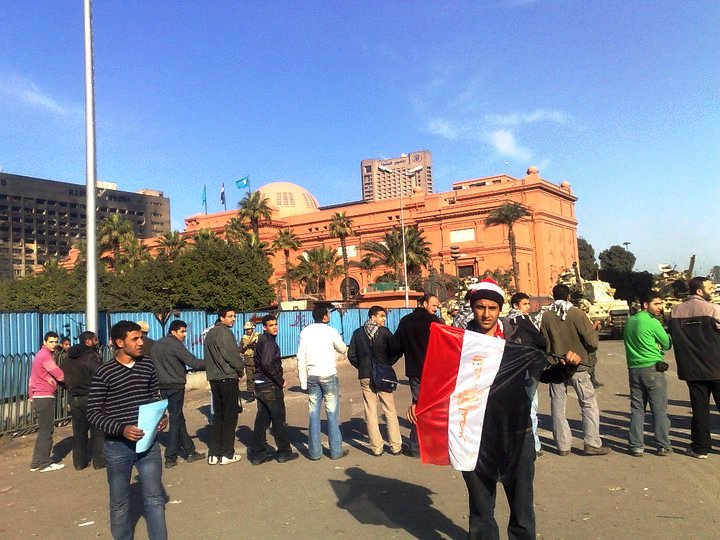
Photo by Abdelrahman Mostafa.
There are two reasons for this: First, every adult male is required to do military service. Because everyone either has served, or has a son or brother serving, the army is viewed with both affection and nostalgia. Second, the army has never really been used as an arm of state repression against the Egyptian people. On the contrary, its job has been to symbolize a bulwark of strength protecting Egypt from potential threats by its frightening neighbor to the east.
At its core, this uprising has involved a joining of two movements, the first a social movement for greater political and social freedom largely driven by educated people under 30 years old that largely evolved in the past decade. The second is a labor movement that has been engaged in strikes and protests for better wages and working conditions for forty years (and some would say since the British Colonial period).
The two movements are not unrelated—those in the social movement often belong to the large and growing number of college educated unemployed, and expect “freedom” to lead to economic reforms. Both groups were also united in their anger over corruption by political leaders and their hatred of the Emergency Laws that essentially allowed the state to abrogate their constitutional rights and use force and intimidation stop them from airing their grievances.
There have been a number of “communiqués” and manifestos issued by various groups within the protesters listing their goals. One issued Feb. 12th by the so-called January 25th Leadership summarizes and typifies these, asking for:
- Immediate repeal of the State of Emergency
- Immediate release of all political prisoners
- Suspension of the existing constitution and its amendments
- Dissolution of the federal parliament and creation of a temporary, transitional governing council
- Formation of an interim government which would oversee free and fair elections
- Drafting of a new constitution which the Egyptian people would vote on in a national referendum
- Removal of all restrictions on formation of political parties.
- Freedom of the press
- Freedom to form unions and non-governmental organizations
- Abolition of all military courts (especially their jurisdiction over civilians)
The military has already agreed in principle to lift the emergency laws, and this move seems to be backed by the Obama administration. The dissolution of Parliament took place Feb.13. And a communiqué from the military council calls for talks with opposition parties, new elections in six weeks, and the drafting of a new constitution.
So what can we expect to happen? There are six scenarios that are being raised, some of which are more plausible than others:
Mob Rule
Unending protests. Riots. Clashes between police, protesters and army. Collapse of rule of law. Anarchy.
Islamic Theocracy
Islamists seize control of the state and establish a theocratic state like that of Iran.
Army Takeover
The military junta entrenches itself, maintains the state of emergency, and establishes direct military rule.
Silent Coup
The old elite of military officers and businessmen who surrounded Mubarak survives him to remain more or less in power.
NDP Electoral Victory
New presidential and parliamentary elections allow the old elite of Mubarak cronies to use their political experience and vast wealth to dominate the new Parliament, while the officer corps remains a power behind the scenes.
Liberal Democracy
There is a genuine social and political revolution, in which substantial amounts of wealth and power are redistributed to new social actors. We see the emergence of new political parties, free and fair elections, an independent judiciary, free press, and civil service.
After Mubarak: Liberal Democracy?
Here’s an exciting scenario: there is a genuine social and political revolution, in which substantial amounts of wealth and power are redistributed to new social actors. We see the emergence of new political parties, free and fair elections, an independent judiciary, free press, and civil service.
From the Egyptian perspective—and my own, I freely confess—this is the preferred outcome.
It has huge risks. Already there are at least thirteen new political parties forming and more may form as the rules get established. It is quite possible that no one party will form a government, and that political coalitions will become the norm. The NDP and a party promoting a Muslim Brotherhood platform (whether the MB itself will become a party depends in part on whether or not the new constitution continues to forbid overtly religious parties), will certainly take a number of seats in Parliament.
Such a democracy may prove fractious and inefficient, as democracies often are. Egypt’s economic woes are deep-seated, the result of decades of failure by the government to invest in basic civic infrastructure rather than profit-making enterprises, with a result that they will take years, if not decades to improve.
If Egypt gets a liberal democracy, I see chaotic times ahead as new governments are consistently unable to deliver immediate economic improvements to the lives of their constituents. We need only to look at voter impatience with the Obama administration in the U.S. to see how poorly political parties fare when they cannot deliver economic relief quickly to the voting masses, no matter how intractable the problems. In democracies, would-be leaders often promise the impossible, then must face the music when they cannot deliver. As impatience grows, so does the power of even the most outrageous demagogues as they promise simple answers to these issues.
In turn, such democratic chaos will chill Western allies, who fear for their security alliances. Not that Western concerns should shape Egypt’s future–but they will impact it, like it or not.
After Mubarak: An NDP Electoral Victory?
New presidential and parliamentary elections allow the old elite of Mubarak cronies to use their political experience and vast wealth to dominate the new Parliament, while the officer corps remains a power behind the scenes.
This scenario assumes that the military, under continuing pressure from ongoing protests and public scrutiny by the increasingly free media, pushes forward with democratic reforms and moves to new, free and fair elections. The NDP runs, and wins control of Parliament and forms a government.
It may seem odd to outside observers that after all this effort the NDP would win in free and fair elections, but it is not as improbable as it might appear.
The NDP is the only organization in Egypt with any real political experience, since all other political parties were suppressed or kept down to mere token status. Dozens of new parties are springing up—thirteen by last count—which makes for a very divided opposition.
Even the Muslim Brotherhood, probably the best organized non-state actor in Egypt, when it gained a significant number of seats in the 2005 elections, showed itself as inexperienced and unable to function effectively as an opposition party.
The NDP regime has sought to purge itself by hanging out to dry four of the ministers most hated by the population, and scapegoating the conveniently absent Gamal Mubarak.
There is still solid support for Mubarak among some constituencies in Egypt for whom chaos is worse than dictatorship. This includes both many of the wealthy who profited indirectly from the regime, but also many of the poor who are especially vulnerable to the economic consequences of the uprising, which will not go away quickly.
Moreover, if the post-Soviet revolutions are any guide, nostalgia for the old regime—remembering its ability to provide stability and predictability and downplaying its evils—will set in rapidly even among many who currently are celebrating its fall.
If this happens, the real test of whether Egypt has become a democracy will be how they fare in subsequent elections. The test of a democracy, after all, is whether an electorate can overturn a government through a peaceful electoral process. India did it in 1977 when they threw out Indira Gandhi’s government in spite of the Emergency Laws that allowed her to impose direct rule, censor the media and restrain court challenges. If Egyptians can vote the NDP out as well as in, they will have achieved democracy. If not, an NDP election will have turned into another silent coup.
After Mubarak: A Silent Coup?
One possibility that is raised again and again by observers of the Egyptian uprising is the very real possibility that there will be new presidential and parliamentary elections, but that the Mubarak associates who’ve run the country for so long will use their experience in organizing, along with the wealth they have gained from their crony status, to dominate the new institutions.
The officer corps—currently headed by a close Mubarak ally—would remain a power behind the scenes.
As one Egyptian activist, Hosam al-Hamalawy said
while I believe the Supreme Council of the Armed Forces, who receive $1.3 billion (US Dollars) annually from the US, will eventually engineer the transition to a ‘civilian’ government, I have no doubt it will be a government that will guarantee the continuation of a system that will never touch the army’s privileges, keep the armed forces as the institution that will have the final say in politics… (and) guarantee Egypt will continue to follow… US foreign policy…
What makes this so plausible is that it allows the leaders of the armed forces, who are currently in control, to make many of the changes demanded by pro-democratic protesters while being confident that they will not lose control of their current wealth and power, nor disrupt too badly the wellsprings from which it flows.
It might also be attractive to their foreign allies, including the United States, since it offers the veneer of democratic reform, while maintaining the status quo of stability.
Mitigating against this scenario has been the steady constant pressure being maintained by protesters—continued presence in Tahrir, large Friday demonstrations, continued labor strikes and protests—reminding the Supreme Council that a return to disorder is always only a few tweets away…

 CONNECTED in CAIRO