“The Fine Grained Data …That Only Careful Ethnographic Work Can Yield”
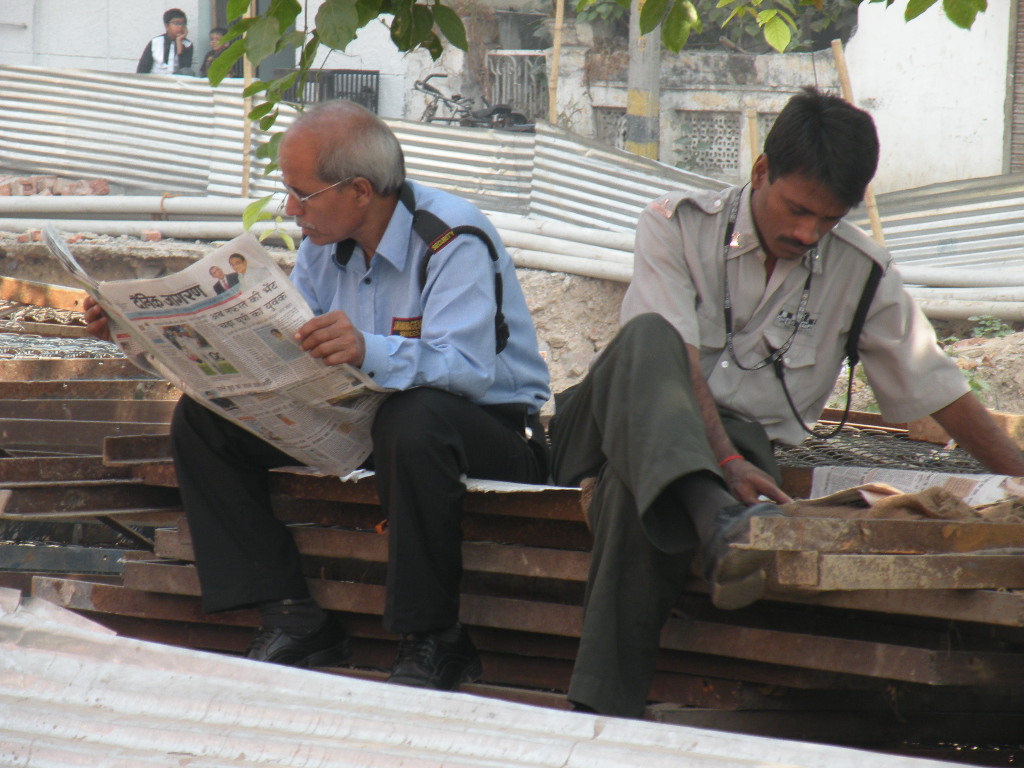
Reading the news in New Delhi
The most recent edition of the journal Journalism had a very nice review of Elizabeth Bird’s book The Anthropology of News and Journalism (Indiana University Press, 2010).
The reviewer had this to say about my chapter:
Mark Peterson’s chapter set in New Delhi demonstrates the fine-grained data on news literacies that only careful ethnographic work can yield; his analyses of such phrases as “taking the newspaper,” raddi, and “common man” that circulate amidst his informants reveal the profound embeddedness of news in webs of social relations.
“The fine-grained data … that only careful ethnographic work can yield” is, in fact, what I’m going for in all my work in Egypt, India and the United States. It is gratifying (not to say flattering) to have this recognized.
While we’re on the subject, I strongly recommend this book to anyone interested in news media. If there is anything new to say on these subjects, it is likely to come from anthropology, if only because that field is a relative latecomer to the study of media generally and news media in particular.
What’s Next for Egyptian Newspapers?

Reading the news in Cairo--on Mohamed Mahmoud Street, just down from Tahrir Square, in fact.
Earlier this week, I wrote about the evolution of the state newspaper Al Ahram in the face of the democratic revolution. The same day, the Saudi-owned news website Elaph reported on the same topic, arguing that as Egypt goes, so goes the Middle East.
The writer for Elaph argues that media in the Arab world generally have lacked transparency and served as voices for the various regimes. In Egypt since the ouster of Mubarak, government newspapers have become bolder and more honest, and that this is an unprecedented historic evolution.
Elaph quoted the Arab League’s Mohammad al-Dali as saying, “When I read the pages of Al-Ahram and Al-Akhbar now, I see that they reflect reality in all transparency. This is a very important change that will act as an essential element in development. Journalism will indeed become the fourth estate, a monitoring authority…”
“What happened in Egypt will have repercussions on other countries, which will lead to the development of the region,” al-Dali said. “This will serve the interests of the Arab people, and perhaps the interest of the ruling sides as well, as these must evolve with the events.”
The web site also quoted Elhami al-Miligi, an Al-Ahram journalist as saying that the many rules and restraints that restrict journalistic practice remain technically in place. They need to be reworked.
If anything, this is an understatement. The entire structure of journalism is designed to make newspapers an arm of the state. Will the new Egypt need a Ministry of Information to manage news at a cabinet level? Will it need a General Body for Information to supervise what should and shouldn’t be said? Is the Office of the Foreign Correspondents still necessary to grant and revoke press passes to international correspondents?
Until now, chief editors of national newspapers are appointed by the Higher Journalism Council, headed by the Minister of Information. Newspaper directors have been appointed by the president–which is to say by the security apparatus.
And if the state is not not controlling the journalists, will it continue to fund the national newspapers? Should they be funded as a public good (but with less direct state oversight), or should they be privatized?
While these questions remain unanswered, al-Milagi told Elaph that most journalists are just ignoring the old rules. “In light of the [recent] events … journalists now are not placing a limit on themselves, and they are practicing freedom to the maximum,” he said.
From Fox News to the Qatar Tribune to the Huffington Post to Al Jazeera it’s been popular since Jan. 25th to trot out the old saying, “As Egypt goes, so goes the Middle East.” If al-Dali, al-Miligi and the anonymous writer for Elaph are right, that could be a very good thing where news media are concerned.
The Egyptian Uprising Spanned the Generations
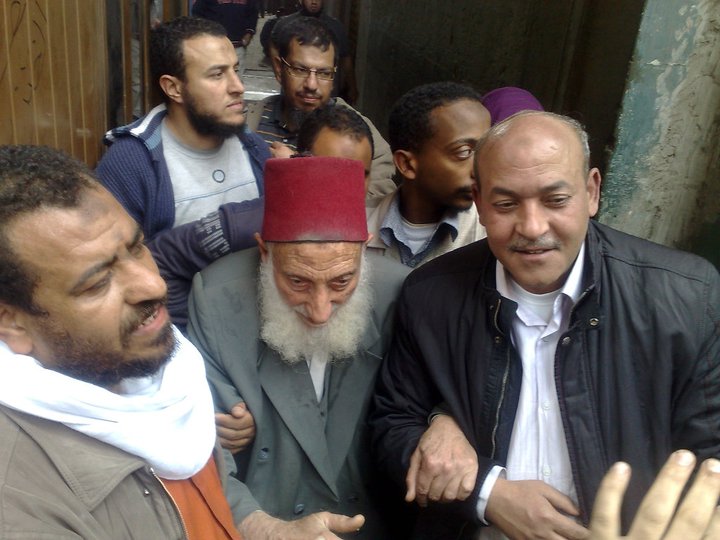
The Egyptian uprising, though planned by young activists, was a multigenerational project, says Jessica Winegar. Photo by Abdelrahman Mostafa.
The important role that youth activists played in the Egyptian uprising often lead media to represent it as a youth revolution. But part of the power of this uprising was prcisely that it pulled together people from across classes, religions, and generations joined by their common hope that they could produce real change.
My colleague Jessica Winegar, author of a wonderful ethnography of Egyptian modern artists called Creative Reckonings: The Politics of Art and Culture in contemporary Egypt, has been in Egypt all through the uprising and she writes today in the blog Jadaliyya:
While it is true that young activists planned the January 25th demonstrations and organized and raised support throughout much of the process leading up to that day, this uprising would not have succeeded in ousting the President and Cabinet, and would not be continuing, were it not for older generations of Egyptians.
Jessica, who teaches anthropology at Northwestern University, goes on to describe the ways multiple generations of Egyptians, some of whom were Leftist protesters in their own youths, responded to, and participated in, the current events.
On the night of Mubarak’s departure, I rushed to Tahrir as did thousands of Cairenes. … I sat across from one man in his late 70s who
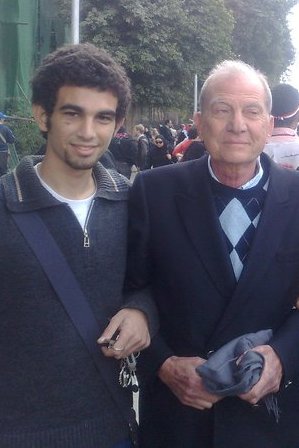
Young and old at Tahrir Square. Photo by Abdelrahman Mostafa.
sat with a smile on his face, staring at the teen and twenty-something men in amazement and admiration, with tears of joy in his eyes. He kept saying to me in English, “Revolution. Revolution.” He was going to Tahrir too, and when I got there, amidst the massive celebrating crowds, I saw countless older men and women, some quite old and in wheelchairs or with canes. They walked with their spouses, and/or children and in many cases grandchildren. Some of the mothers and grandmothers ululated. Fathers and grandfathers participated in the moving cheer, “Lift your head up, you are Egyptian!” It seemed that they had once been able to lift their heads up in pride as Egyptians, and although now many were stooped from the effects of living under an oppressive dictatorship, they were clearly so thrilled that their offspring could now lift their heads proudly and that they were among the fortunate ones to live to see this day.
On-Line Islamic Activists Are A Whole New Political Animal
On-line Islamic youth activists have very different approaches to politics than the traditional Muslim Brotherhood leadership.
The “Shabab al-Facebook” network—and network seems the only way to describe this intercommunicating and interactive web of individuals, cells and organizations–includes many who see Islam as a source of inspiration, and many members of the Muslim Brotherhood. But these are not your father’s Muslim Brothers:
“Very soon, and it’s happening already, there will be no such thing as the Muslim Brotherhood anymore. The organization will be there, but it will have been transcended,” said Ibrahim el Houdaiby, 27, whose grandfather and great-grandfather were supreme leaders of the Brotherhood.
This quotation is drawn from an illuminating article by Hannah Allam entitled “Tolerant, tech-savvy young Islamists may reshape Egyptian politics.” Allam points out that the educated, interconnected children of Muslim Brotherhood leaders are turning away from the traditional styles of leadership, organization and action toward forms of political action that allow tolerance toward and cooperation with other groups in pursuit of shared goals.
As Allam puts it:
The youths who fought alongside secular, Christian and other non-Islamist peers not only helped to unseat one of the world’s longest-serving autocrats, they’re also rewriting the rhetoric of the conservative Muslim Brotherhood and other established Islamist blocs. The voice they found during the anti-Mubarak protests could just as easily be raised against the traditional Islamist leadership if the old guard doesn’t conform to their demands for a more democratic Egypt, several activists said.
The strength their success has given their critical voices is new, as Allam indicates, but the critical youth movement itself has been growing in strength and numbers for many years.
I was first exposed to it in 2000 through the work of Mohamed Mosaad Abdel Aziz, who wrote about the struggles over blogging within the Muslim Brotherhood in early drafts of a thesis ultimately approved in 2004 as “Islam and Postmodernity: The New Islamic Discourse in Egypt” (supervised by AbdAllah Talib Donald Cole).
Mohammed was particularly interested in how the blogs shifted from what was supposed to be a top-down, centrally driven publicity vehicle to a distributed network of commentary and communication over which the central leadership had little control.
One of the most important changes is that rather than a leadership style marked by secretive debates culminating in a unified front, the blogs tended to put the debates “out there” in a transparent manner that made many uncomfortable and others excited.
Marc Lynch also wrote about the new “young brothers in cyberspace” in 2007 in the Middle East Report, pointing out the scathing response by the Muslim Brotherhood’s more than 150 bloggers (up from a handful just the year before) to the organization’s newly announced political platform (“Is this the platform of a political party or a religious organization?” asked one).
Lynch wrote, presciently:
In some ways, the rise of the young bloggers is another round of a recurrent pattern of generational challenges to the Brotherhood’s hierarchy. But it also responds to wider trends in the environment in which the Brotherhood operates. The transformative impact of new media technologies, the enthusiasm unleashed by a year of political protests in 2004–2005 and the growing repressiveness of a sclerotic regime on the brink of a leadership transition have affected the youth of the Muslim Brotherhood just as they have the rest of Egyptian political society.
The politically pragmatic but idealistic stance of these new brothers seems like a contradiction to standard explanations of the rise of political Islam in the Middle East, which, in good Enlightenment fashion, tends to cast Islamism as a move backward rather than forward.
The revival of Islam as a social and political force in the world is usually explained by Western scholars as a simple reaction to the economic and political dislocation created by autocratic regimes like that of Hosni Mubarak, and the rest, and reactions to the West provoked by its support for those regimes, and its military activities in that part of the world.
In this argument, the poor, the unemployed, and the politically excluded turn away from the desire for prosperity, the promise of democracy, and the unreachable world of modern goods to something else, something that makes them feel better about themselves and that exposes material satisfaction as illusory. There is a great deal of truth to this; Unni Wikan has done a fine job demonstrating how such an approach might explain some members of al-Qaida.
But how can we then explain the increasing attraction of an active Islamic renewal to cosmopolitan Egyptians who are well-off, and well-educated with good job prospects, who have opportunities to enter the corridors of power through kinship relations, social networks, and cultural capital, and whose dress and lifestyles are marked by consumption of imported goods?
The attraction of this kind of Islamic renewal to this affluent population can better be explained by an emerging literature that describes resurgent Islam as a kind of action that many people see as a relevant and powerful tool for bettering their situation rather than turning from it (Wiktorowicz 2003; Sparre and Petersen 2007). In this understanding, mass literacy spread by national educational reforms took Islam out of the hands of the small class of scholars, preachers, and jurors (Eickelman and Anderson 1997; Eickelman 2002) and made it possible for individual Muslims to “put Islam to work” (Starrett 1998), especially in new (often commodified) public spaces not yet dominated by the older religious authorities, such as television (Abu-Lughod 2005), cassette recordings (Hirschkind 2001, 2006a, 2006b), and the internet (Anderson 2003a, 2003b).
Connected in Cairo p. 125
But Lynch warns us that the tech-savvy, urban pragmatic Islamists of Cairo and Alexandria who make up only an estimated 15 percent of the organization, are not the only future of the Muslim Brothers:
Outside of Cairo and Alexandria, however, the vast majority of Brotherhood youth seem to be traveling in a different direction, toward a more conservative, religious orientation unconcerned with politics. When the Brothers sent the party platform out to the cadres in the provinces, “salafi” youth reportedly had few opinions to offer—and when they did, they chided the leadership for its more progressive positions, calling for a more “Islamic” document. The showdown between these two trends among Muslim Brotherhood youth will have long-lasting repercussions for the future of the organization and for Islamist politics around the world.
Whether the resounding political successes of the shabab in ousting the regime and paving the way for the Muslim Brotherhood to emerge as a political party will be a game-changer, or will lead to a schism in its ranks as the daily newspaper al-Masri al-Yawm has long predicted, is yet to be seen.
Further Information:
Allam, Hannah. 2011. “Tolerant, tech-savvy young Islamists may reshape Egyptian politics” McCatchy Newspapers http://www.mcclatchydc.com/2011/02/18/109037/tolerant-tech-savvy-young-islamists.html#ixzz1Eal76anV
Eickelman, Dale. 2002. Inside the Islamic Reformation. In Everyday Life in the Muslim Middle East, 2nd ed., ed. Donna Lee Bowen and Evelyn A. Early. Pp. 246–256. Bloomington: Indiana University Press.
Eickelman, Dale, and Jon W. Anderson. 1997. Publishing in Muslim Countries: Less Censorship, New Audiences and the Rise of the Islamic Book. Logos 8(4): 192–198.
Sparre, Sara Lei, and Marie Juul Petersen. 2007. Youth and Social Change in Jordan and Egypt. ISIM Review 20: 14–15.
Starrett, Gregory. 1998. Putting Islam to Work: Education, Politics and Religious Transformation in Egypt. Berkeley: University of California Press.
Unni Wikan. “”My Son—A Terrorist?” (He was such a gentle boy).” Anthropological Quarterly 75.1 (2002): 117-128.
Wiktorowicz, Quintan. 2003. Islamic Activism: A Social Movement Theory Approach. Bloomington: Indiana University Press.
The (R)Evolution of Al Ahram
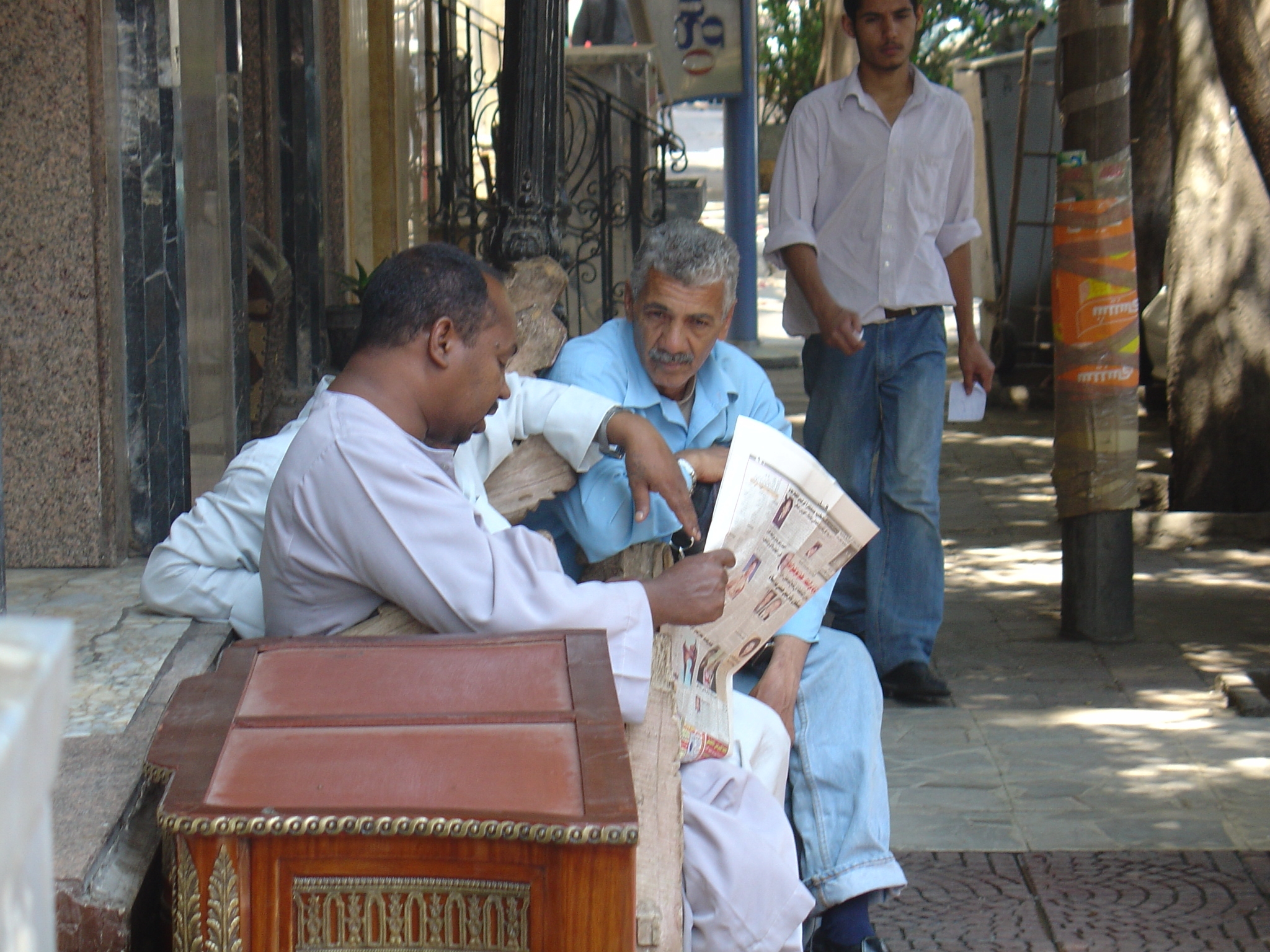
Reading the news in Cairo. Photo: Sophie Peterson.
Al-Ahram, the state-controlled newspaper with the highest circulation, apologized Feb. 13th to the Egyptian people for it’s decades of “bias in favor of the corrupt regime” and pledged for the future “to always side with the legitimate demands of the people” and to become “the conscience of this nation”.
In so doing, it took a further step toward distancing itself from the government for whom it had so long been a mouthpiece. It has, like electronic state media, been driven by uncertainty about its role in the new Egypt the pro-democracy protesters are trying to create.
Since well before the Mubarak regime, the Arabic press had served as apologist for the rulers of Egypt. The function of the press, following lines laid down as far back as the Nasser regime, was to serve as the voice through which the paternal state spoke to its literate children (while state television served as its voice to the nonliterate population).
On the one hand, the press was supposed to help bind the people of Egypt together by sharing with them common content and a common perspective on the state, and make them aware through the common practice of reading the news, that they were members of a collective Egyptian nation, rather than dominated by a foreign power as they had been more-or-less since the Ptolemies.
In addition, this common perspective included a coherent narrative that idealized Hosni Mubarak personally. I would argue that, as Akhil Gupta has claimed for India, the state narrative blamed the sufferings of the common man on the corruption of petty bureaucrats, and the anti-Egyptian machinations of external actors like the Zionists (variously construed) and Iran, and portrayed the president as engaged in a heroic struggle to overcome these besetting ills.
The idealization of Mubarak was graphically revealed to the world in the famous photograph in which President Mubarak was photoshopped from a position trailing Obama, Netanyahu, Abbas and King Abdullah walking in the White House, to a position in which he was leading the group.
On the other hand, by putting a positive spin on almost every action of the state, and by selective silence about criticisms and protests against the state, the state press isolated critics of the regime—even though they were almost everywhere. It may be that you and everyone you knew hated the Mubarak regime, but you could not be sure of the millions of other Egyptian citizens with whom you have no direct intercourse but “know” only through media representation.
Its early coverage of the Tahrir protests fit this model well. On Jan. 26 Al Ahram reported that there had been protests in Lebanon the previous day, but not in Tahrir Square. It noted that citizens had celebrated Police Day by exchanging “chocolate and flowers” with policemen.
Four days later, on Jan. 30th, Al Ahram reporters signed a letter asking the paper’s editor asking that the newspaper distance itself from the government. But on Feb 3 the front page headline of Al-Ahram Arabic daily read “Millions march in support of Mubarak”
After mobile phones and Internet connection were restored, and Al Jazeera found a way to continue broadcasting, Al-Ahram found it more and more difficult to sustain its position that the protests were the product of a few hundred agitators paid by foreign powers and that the state had everything under control
Finally, on Feb. 7 Al Ahram finally changed its narrative when the newspaper’s editor-in-chief Osama Saraya hailed the “nobility” of what he described as a “revolution” and demanded that the government embark of irreversible constitutional and legislative changes. A few days later, on Feb 12, the newspaper’s headline trumpeted “The people have ousted the regime.”
The changes have not gone unnoticed. “[T]he Egyptian media landscape is witnessing the preambles of a revolution that may radically change the past equations and restore to the Egyptian media its leading role that it had lost but with a new spirit, a higher level of freedoms, and total liberation from the pressures of hegemony that took it to extremely low professional levels,” wrote Abdel Beri-Atwan in a Feb. 15 editorial in the Palestinian-owned newspaper Al-Quds al-Arabi.
But does this mark real change? Or is Al-Ahram merely awaiting a new regime to which to give voice.
In his study of media during the Iranian revolution, William O. Beeman argued that during the revolution, all the state media—press, radio and television—seemed to undergo extraordinary transformations. Yet, once the revolution had taken place, within six months, the media returned to its familiar, well-established cultural role in Iranian society as a mouthpiece of and for the state.
But there’s one difference between Egypt in the 21st century and Iran in the 20th: social media. Social media allows people to bypass state and private media to connect, and to appropriate and comment on those very media representations. It allows citizens to make one another aware thay others do share common criticisms of the regime.
Certainly, social media played a significant role in this regard in the uprising. But Internet penetration in Egypt is only 17-20 percent, so its hard to know if these new media will really initiate significant structural changes in Egypt’s media ecology. Al Ahram is an interesting test case to see just how far reaching the changes initiated by the so-called Twitter revolution really are.
Symbols of Blood Sacrifice in the Egyptian Uprising

Photo by Abdelrahman Mustafa
When Hosni Mubarak addressed the protesters for the second time on Thursday, perhaps the biggest misstep he made was to invoke the martyrs and to promise to bring their killers to justice. In doing so, he invoked a powerful symbolism of blood sacrifice–with himself on the wrong side.
When I was a professor at the American University in Cairo 1997-2001, we used to do an introduction to liberal arts seminar that involved dozens of faculty from across the disciplines.
One of the texts we invariably read was John Stuart Mills “On Liberty”, and the political science professor who spoke on it invariably led the conversation around to the importance of tolerance and dialogue as alternatives to conflict and war. They were comfortable platitudes but just that—platitudes.
That’s why it was a breath of fresh air when another political scientist, William DeMars (author of a very interesting book on African NGOs) asked one year, “But what about meaningful deaths? Aren’t there things worth dying for? Isn’t death, in the case of people like Jesus and Socrates, crucial to the whole point of their message?”
I keep thinking about that as I reflect on the crucial political role the 300 martyrs to the cause of political liberty in Egypt have had on the success of the pro-democracy movement.
The killing of protesters by plainclothes policemen (many of whom were too stupid or too arrogant to leave their police IDs at home) and hired thugs (baltagiyya, as they say in Egypt) was a turning point in the uprising. After their deaths, their families took to the streets demanding justice. Their pictures appeared on signs, and their names became widely known.
Their deaths were not merely powerful symbols of the need for change. Protesting for political reform against an oppressive regime that tortures, imprisons and kills its opponents without respect for law, they were themselves killed by the regime. They were sacramental, in the sense proposed by the anthropologist Gregory Bateson: signs that become what they signify.
And this put new steel into the will of most protesters so that going home—no matter how deeply entrenched and willing to ignore them the regime appeared to be–became intolerable. It was unthinkable that these men and women would have shed their blood for an uprising that failed.

Photo by Abdelrahman Mustafa
This is why Mubarak’s invocation of the martyrs in his address was so misguided. That the regime was perfectly capable of locating some of the hired thugs and low-ranking policemen who carried out the killings and offering them up as scapegoats no one doubted. But that anyone could trust Hosni Mubarak’s word to punish those responsible, those who gave the orders, was also not in doubt.
Mubarak stood for the regime; and the regime had slain the protesters. That he dared to invoke the martyrs of the revolution in his speech was as much part of what set off the rage of the crowd as their disappointment with his failure to resign in the face of their hopes.
The power of blood sacrifice as a metaphor has deep roots in ancient Near Eastern religious traditions, and in contemporary (and historical) Judaism, Christianity and Islam. It continues in secular cosmologies, such as the notion of military veterans (and soldiers who’ve died) as having sacrificed for the values of their country–freedom, sovereignty, unity, the Fatherland, or whatever.
The power of the Tahrir martyrs to symbolize the need for ongoing democratic reform continues.
On Feb. 13, when Al-Ahram newspaper apologized to the “noble Egyptian people” for three decades of propaganda to shore up a corrupt regime, and promised to remake itself into the “conscience of the people”, it explained its change of conscience with reference to “pride in the pure blood that was shed to defeat the forces of backwardness and oppression” and said it “sought the forgiveness of the families of the martyrs” for having been on the wrong side of their fight.
One may certainly doubt the sincerity of Al-Ahram. But as my mentor Phyllis Chock once told me, you have to draw on the same cultural truths to tell lies as you do to tell truths. Whether or not people invoke the symbol of the martyrs sincerely is irrelevant to the truth that their deaths are one of the most potent symbols of the ongoing effort to remake Egypt into a country worth their having died for.
A More Democratic Islam in Egypt?

Al-Azhar University
News stories discuss the influence of Egypt’s pro-democracy protests in Tahrir Square on the rest of the Muslim world outside Egypt. But what about the rest of Egyptian society? Specifically, what about al-Azhar?
Should the leader of the world’s chief center for Arabic literature and Sunni Islamic learning be democratically elected?
Yes, says its current head, Ahmad at-Tayyib, according to a Feb. 15 article by Walid Abdul-Rahman in the Saudi-owned London-based Asharq al-Awsat daily newspaper.
In the spirit of the new democratic reforms being sought in Egypt, at-Tayib told the newspaper that “if the current government calls for the election of the Sheikh of Al-Azhar this morning, then I will surely be the first one to support it.”
The Sheikh of Al-Azhar has usually been appointed by the government, in part to ensure that the university would not make pronouncemetns against the actions of the regime.
The current sheikh was appointed by the Mubarak regime after the death of his long time predecessor Muhammad Sayyid Tantawy in March of last year.
According to the newspaper, at-Tayib told his senior cleric colleagues “I do not mind the election of the Sheikh of Al-Azhar instead of his nomination. This has always been my demand and it has always been one of my priorities. However, I have been waiting for the right time to make that announcement…” The right time, apparently, is on the heels of successful pro-democratic uprisings.
Doctor Abdul-Rahman al-Berr, a professor at Al-Azhar University and a member of the Muslim Brotherhood, said he would support elections by Egypt’s most distinguished clerics “provided they are based on clear and proper principles.” He said the senior cleric of al-Azhar should be elected by an ” independent committee that has no ties with the state and is not subjected to any partisan influence…”
Not everyone was so supportive. Dr. Abdullah al-Najjar warned that if the sheikh of Al-Azhar is elected, all the senior clerics will become rivals jockeying for the prize. ” This situation will create anarchy…”
And Dr. Abdul-Mohti Bayyoumi, a prominent member in the Al-Azhar Research Center said that rether than elections or government appointment, the sheikh should be chosen strictly by seniority.”
There are real risks and rewards in this kind of change. On the one hand, it frees the Sheikh of Al-Azhar from being a mere mouthpiece for the state in matters of doctrine and morals. On the other hand, it opens the possibility for the emergence of leaders less moderate in their pronouncements on the world.
After Mubarak: Will Egypt Become an Islamic State?
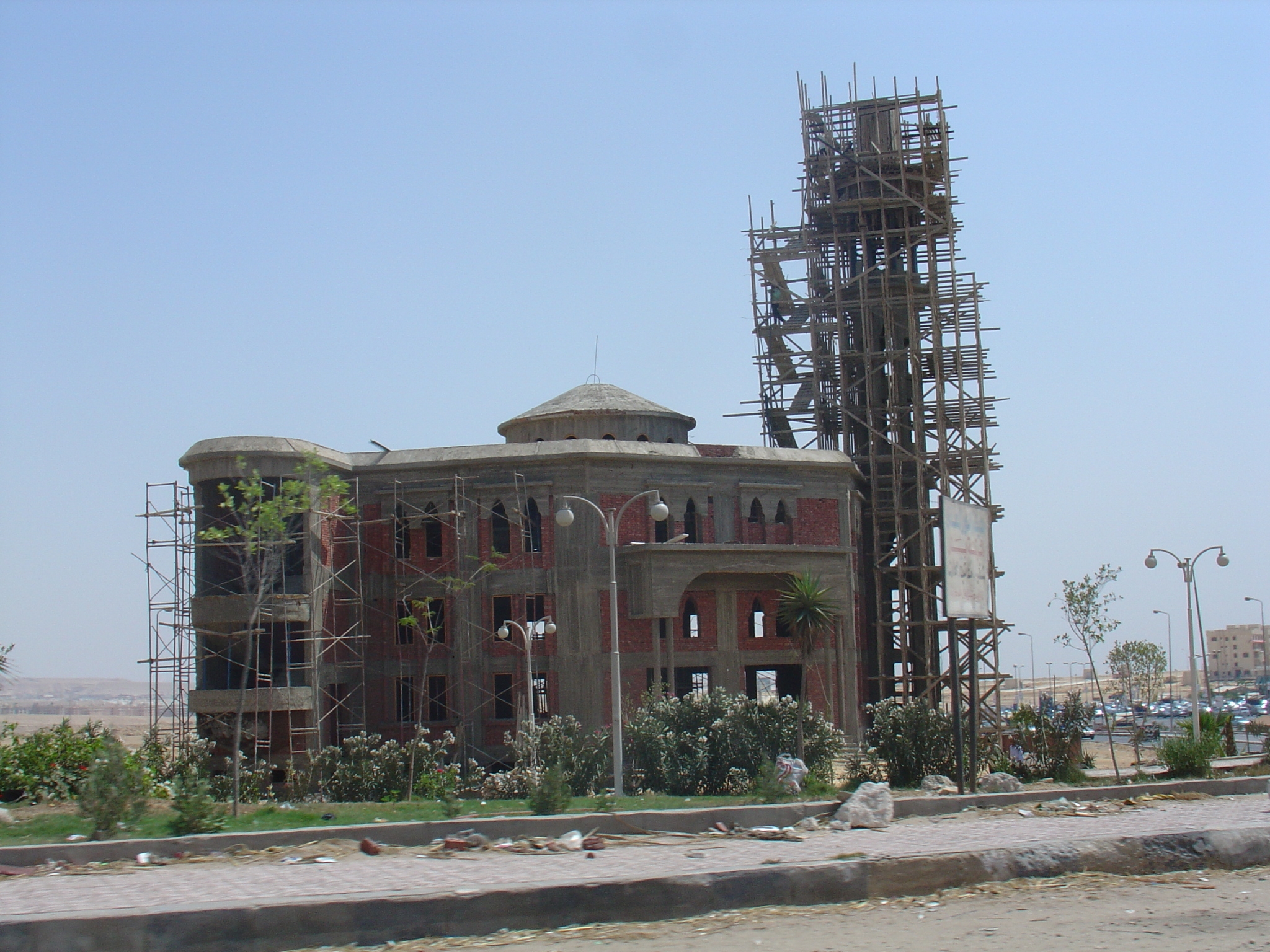
Mosque in the making. Egyptians are religious, but they don't want an Islamic government.
For many people in the US and Europe, Egypt’s uprising is terrifying rather than exciting. Unrest in a Middle Eastern country continues to raise the spectre of a repressive Islamic government hostile to the West coming in to power.
Television pundits, many of whom have no credentials and no idea what they are talking about, ask whether Islam is compatible with democracy, and claim that “every time a Muslim majority country gets a democracy, the Islamists take over.” They support these allegations in ways that would earn them pretty lousy grades in my introductory International Studies class because they either don’t mention any of the successful democracies in Muslim majority countries or they offer very distorted pictures of what’s going on in those countries (see Will Islamists Derail Democracy?)
What these pundits are really thinking about, of course, is Iran. But Iran is a terrible model for predicting the role of political Islam in other countries. Iran was never really a democracy because it is committed to the principle of the Velayat-e Faqih, or “rule of the chief jurisprudent.” This political principle, which mandates a hierarchy of clerical decision-making, is rejected by almost all other Islamist political thinkers, both Shi’ite and Sunni.
The other spectre that haunts European and US imaginations in watching Egypt is al-Qaida. And so it should, but not for because the uprising gives al-Qaida a foothold in Egypt. Al-Qaida’s legitimacy is entirely premised on the notion that Middle Eastern autocracies backed by the economic and military might of Western powers cannot be overthrown by popular movements; only militant action aimed at these Western states can produce change.
A successful, popular revolt that overturns a Western dictator gives the lie to the very basis of this claim, and undermines al-Qaida’s legitimacy more than anything the US or its allies have ever been able to do (see Bin Ladin’s Nightmare in Egypt).

 CONNECTED in CAIRO