The Muslim Brotherhood On-Line, In English
Ikhwanweb, says Soumia Bardhan, was a rhetorical tool through which the Muslim Brotherhood addressed Western audiences. The message has changed, but the desire to address Western audiences in English remains important.
What was the point of Ikhwanweb, the Muslim Brotherhood’s official English-language web site?
The Muslim Brotherhood operates pretty much entirely in Arabic. The Brotherhood already had an Arabic web site. So why offer a web site in English?
Obviously, Ikhwanweb is designed to address different audiences than the MBs main web site. Who was this audience and what did the MB want to say to it through Ikhwanweb?
Those are the questions addressed by an article in the latest issue of the Digest of Middle East Studies (DOMES).
“Egypt, Islamists, and the Internet: The Case of the Muslim Brotherhood and Its Rhetoric of Dialectics in Ikhwanweb” by Soumia Bardhan analyzes the rhetoric of the Muslim Brotherhood on Ikhwanweb between 2005 and 2010.
Based on her analysis, Bardhan argues that Ikhwanweb sought to address Western societies–and especially the US:
Was The Egyptian Revolution Really Revolutionary?
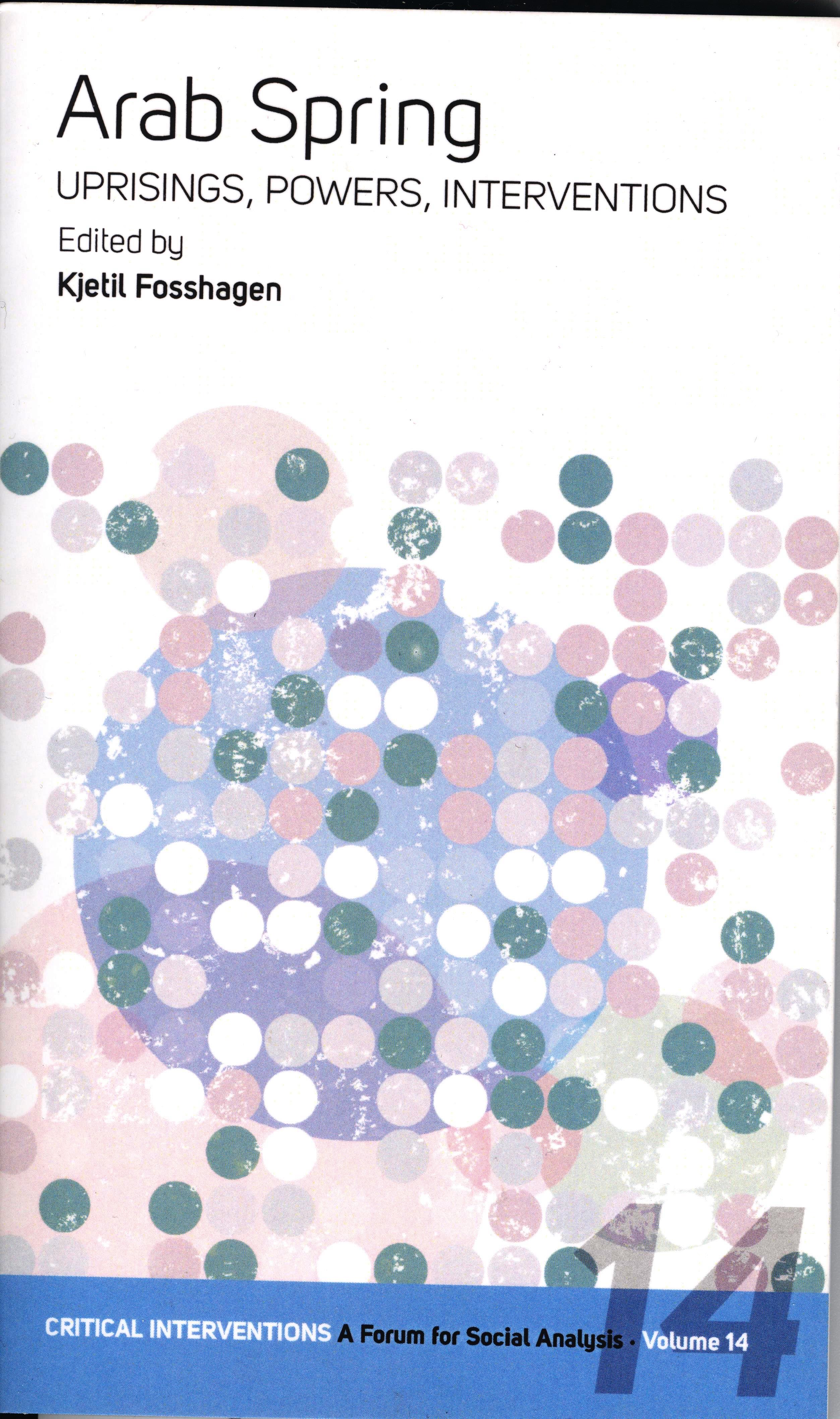
Was the “Arab Spring” truly revolutionary? That’s a question posed in this slim new book out from Berghahn Books.
In his introduction to the new book The Arab Spring: Uprisings, Powers, Interventions (Berghahn 2014), author and editor Kjetil Fosshagen poses two key questions:
- Were the Arab revolutions truly revolutionary?
- Is there any evidence of coherent structural social forces that can be theorized and explicated to explain the many events collectively labeled “the Arab Spring”?
Fosshagen’s answer to the first question is clearly “no,” and his reasons for saying no are based on his “yes” to the second question.
He sees the Arab Spring as offering significant parallels with Europe’s 1848 “Spring of Nations,” uprisings which began as popular revolts but ended with an aristocracy of the financial and industrial elites and, ultimately, the emperorship of Napoleon III.
And just as Marx analyzed these events in his classic essay “The Eighteenth Brumaire of Louis Bonaparte,” so Fosshagen believes the early successes and (what he sees as) the ultimate failures of the Arab Spring can be understood through a classic analysis of relations of production. Read more…
Being Connected: Class and Cosmopolitanism in Cairo

I was talking about digital media in Egypt at the Center for International and Regional Studies is located in the Georgetown University School of Foreign Service in Qatar
I spent part of last week in Qatar with a brilliant group of scholars, discussing digital media in the Middle East.
Each of us offered a 10-15 minute general introduction to our assigned topic, followed by 45 minutes of discussion and commentary.
My own topic was “Being Connected: Class and Cosmopolitanism in Egypt.” My introduction was as follows:
The title I was assigned for this discussion is apparently drawn from the title of my book, so let me start with issues of digital media raised by that work.
My primary work in Egypt focused on the ways children grew up constructing identities in which they could be at once Egyptian and Arab and at the same time modern and global (that combining these identities is problematic in their social imaginations reveals much about the cultural system through which such identities are authenticated and authorized).
And the strategies children and their families found all had to do with creating connections between the local and various external locations from which goods, and ideas and images flow. Since access to these flows is differentially distributed, cosmopolitanism becomes a way inflecting class (also age, gender, education, and other distinctions but these, too, were bound up with class).
So when I initially thought about digital media and connectedness, it was within this framework of practices and discourses in which connectedness is itself a sign of class, and modernity and other sorts of identities.
In thinking about digital technologies, then, I think that we need to attend to the fact that they are not only practical devices that serve functions but semiotic devices that mean things in particular local contexts and which are wrapped up in statuses and identities.
My thinking on this topic was broadened and deepened by the Egyptian uprisings in 2011. I have the four points I want to make derive from these reflections, and conversations about these reflections with Egyptians and with other scholars studying the Egyptian revolution.
I want to suggest that as we consider digital media, connectedness and cosmopolitan identity in Egypt and the region, we need to attend to four things:
Is As-Sisi Rebuilding “Mubarak’s Pyramid”?

Construction of the canal that delivers water from the “New Valley” project under the Toshka spillway. Widely recognized as a debacle, the project is one of several issues involving farmers in a new essay.
The Toshka project (recently revived by President As-Sisi) is “sucking in funds that might have been available for rural development in the old lands and might have boosted domestic nutrition,” according to a recent article in the Middle East Research and Information Project.
Entitled “Small Farmer Uprisings and Rural Neglect in Egypt and Tunisia,” the article by Habib Ayeb and Ray Bush is a wide-ranging essay that describes the tragic disappointment of farmers, among the most economically vulnerable of all Egyptians.
In Egypt, Toshka is a symbol for the Mubarak regime’s mismanagement, capturing both the government’s obsession with large scale projects and its commitment to foreign investment as a silver bullet for what ails the country.
Toshka was a proposed mega-project to build a 240-meter irrigation channel from the Nile Valley to the southwestern desert to irrigate land for agriculture. The idea was to solve population problems by moving farmers–up to 20 percent of the population–out of the Delta, where land is at a premium, while at the same time attracting foreign investment in new farms that would grow high-value crops for export.
In one swoop, Toshka was going to solve Egypt’s severe overpopulation, unemployment, and food security problems by creating a “new valley” to supplement the Nile valley.
Toshka failed miserably.
The Power of Being Powerless in Egypt

As the regimes commitment to neoliberalism creates more and more powerless people in institutional terms, their collective real power increases, argues a recent article by Girijesh Pant. Photo: Hossam al-Hamalawy. Creative commons.
It is the “power of being powerless” that allows the Egyptian protests to continue, even after they have drive two regime changes, claims an article in the most recent edition of the journal International Studies.
In “From the Vantage Point of Tahrir Square: Popular Uprising in the Arab World,” author Girijesh Pant argues that Tahrir Square is a powerful metaphor for the clash between two commitments that seem, in developing nations, to be increasingly opposed: democracy and neoliberalism.
Discontent with the economy stems from very real ecnomic inequalities, Pant argues. He points out that while it is true that the number of people living under $2 day fell during the Mubarak regime, prosperity peaked around the millennium; after that, the number of people living on less than $8 a day rose, while the number of those living on $10 a day or more shrank.
Pant argues that as Egypt adjusted its agricultural system to meet foreign exchange requirements, it went from a country that produced the majority of its own food to a country dependent on food (especially cereal grain) imports.
Poverty thus rose higher in the rural areas, producing a 70 percent increase in urbanization. And this rising tide of poor is overwhelmingly young.
In the face of this rising tide of young Egyptians with nothing to lose, we see the emergence of the power of the powerless:
In Mubarak’s Egypt, It Was the Economy, Stupid

It was the failure of the Mubarak regime to alleviate poverty and deliver prosperity that led to the uprisings–not its authoritarianism, claims a recent article. Photo: Sophie Peterson.
A new article appearing in the journal International Studies argues that the fundamental cause of the Egyptian uprisings was not anger at the regimes undemocratic authoritarianism but rather the failure of the Mubarak regime to provide economic prosperity to the majority of the population.
The article, “The Egyptian Uprising and the Global Capitalist System” by Ibrahim Aoude, is not the first to make this claim of course. What he does is make a strong attempt to embed the argument in the decline of the global world system especially in the wake of the 2008 world financial crisis.
Aoude begins by describing the crisis of the global (capitalist) economic system, drawing heavily on the works of Samir Amin (2001, 2003, 2011a, 2011b), with an emphasis on the 2008 global financial crisis and its continuing aftermath. He then describes how Sadat laid the groundwork for everything that has gone wrong in Egypt over the last forty years by drawing the country into the global economy, and how Mubarak’s continuation and acceleration of that policy worsened conditions.
Book On Egypt’s Security State (Plus) Wins Award

Richard Schroeder (left) presented Paul Amar with the Charles Taylor book award for “The Security Archipelago” which looks at (among other things) the changing security state, and resistance to it, and its abilities to counter that resistance, in Egypt.
Paul Amar’s book “The Security Archipelago” won the Charles Taylor Book Award at the American Political Science Association convention in Washington, DC, August 28-31.
This prize is for the “best book in political science that employs or develops interpretive methodologies and methods,” and is selected by the Interpretive Methods and Methodologies Section of the APSA.
His new book, “The Security Archipelago” is a fascinating account of the evolution of a network of global security “hot spots” he metaphorically likens to an archipelago, a chain of islands physically and culturally disconnected that nevertheless constitute a system.
In this case, the system is the creation of a new form of security state that combines humanitarian discourse with techniques of surveillance and control.
Certain hot spots serve as laboratories where these emerging forms are tested out. Among these are Brazil and Egypt, and Paul–fluent in Portuguese and Arabic–studies them here with nuanced (dare I say ethnographic?) attention to details of language and body.
The whole book is interesting but the Egypt-relevant chapters include: Read more…
Globally, Youth + ICT = Protest
Can you take the people out of the equation? A new article does just that but comes to similar conclusions with quantitative data as those of us who work directly with qualitative data (i.e. people). Photo by Monasosh
Most of my work on globalization involves seeing it as a work of the imagination. Using ethnography, I try to see how people situated in particular locales see themselves as connected and disconnected to other locales, how these ways of seeing the world affect their actions, and what actual connections can be discovered that are consonant or at odds with their beliefs.
There are other ways of researching the global, of course. Almost the polar opposite of my approach is abstracting individual people–and to a large extent the locales in which they live out of the picture altogether–and seeing what aggregate data can show you.
This is the approach taken by an interesting article entitled “Protests by the young and digitally restless: the means, motives, and opportunities of anti-government demonstrations” by Adrian U. Anga, Shlomi Dinar and Russell E. Lucas, published in the most recent issue of Information, Communication & Society.
The authors were interested in the argument made by many social scientists, and increasingly taken for granted by the media, that protests were a result of a large disaffected population of young people (a “youth bulge”) ill served by their societies, who took advantage of ICT to foment protest.
Breaking this argument down, the authors developed several hypotheses to test against available demographic data between 1995 and 2011. The hypotheses are:
Can Social Media Save Egypt’s Heritage Sites?

Scholars like Monica Hanna are trying to save Egypt’s heritage through social media.
The ancient heritage of the Middle East is being seriously damaged by the uprisings, revolutions and foreign occupations (i.e. US in Iraq and its aftermath).
I was interviewed about this as it affects Egypt a year ago by a South Korean radio station, on the occasion of the thefts last summer of artifacts from the Malawi Museum in the city of Minya.
An article in the Chronicle of Higher Education this week highlighted efforts by archaeologists and other scholars of antiquity to use web sites, blogs, Facebook, Twitter and other social media to address the problem.
Since it is protected content–i.e. you can’t read the article without a subscription, I reproduce the passages touching on Egypt here:
In Egypt, Monica Hanna, an archaeologist, began tweeting about threats to her country’s heritage more than three years ago, when the Egyptian Museum was broken into as the uprising against former President Hosni Mubarak began. With Egypt continuing to experience political upheaval and violence, Ms. Hanna’s work expanded. She has become a well-known social-media activist with nearly 35,000 followers on Twitter.
Protecting heritage “is not on the agenda, and it’s not getting the attention it deserves, and we’re pushing till that stops,” says Ms. Hanna, an independent scholar who has taught at the American University in Cairo.
Israel And The Arab Spring

Thanks to the Egyptian revolution the Sinai is once again becoming a central security issue between Egypt and Israel as militant activity in the region grows, according to Yeehudit Ronin. Photo by Vyacheslav Argenberg. Creative commons use.
A new issue of the journal Israel Affairs features a number of articles about the Arab Spring and its implications for the state of Israel. Two of these are about Egypt.
Yehudit Ronin’s assessment of the “jihadist” threat in the Sinai is already out of date, since Israel’s recent occupation of Gaza and destruction of the tunnels into the Sinai through which arms, food and medicine flow.
His basic argument seems to be that thanks to the Egyptian revolution, and the decline in security in the Sinai, the peninsula is poised to once again become a central security issue between Egypt and Israel as militant activity in the region grows.

 CONNECTED in CAIRO