Egyptian Bibliography Updated

The Bibliography resource on the Egyptian uprisings has been updated.
The bibliography now includes over 675 references.
Updates include articles from such journals as Pragmatics, Feminist Studies, Feminist Media Studies, Third World Quarterly, Media, Culture and Society, Journal of Communication Inquiry, and many others.
It also now includes books like Farhad Khosrokhavar’s The New Arab Revolutions That Shook the World, Al-Zubaidi and Cassel’s Diaries of an Unfinished Revolution, Are Knudsen and Basem Ezbidi’s Popular Protest in the New Middle East, Paul Gerbaudo’s Tweets and the Streets, and Manuel Castell’s Networks of Outrage and Hope.

Abdel Fattah As-Sisi announced he will doff his uniform and run for president of the Arab Republic of Egypt. Photo Credit: Abode of Chaos via Compfight cc
In the name of God, the Compassionate, the Merciful.
Proud and honorable people of Egypt, today I stand before you in my military uniform for the last time. I have decided to end my service as the Commander-in-Chief of the Armed Forces and the Minister of Defense and Military Production.
I have spent my entire career as a soldier of this homeland serving its hopes and aspirations, and I shall continue in this course.
This is a very significant moment for me. The first time I wore military uniform was in 1970 as 15-year-old cadet at the Air Force High School, almost 45 years ago. And I take pride in wearing this uniform to defend my country. Today I am taking off this uniform to defend this homeland as well.
These recent years of our nation’s history have shown conclusively that nobody can become president of this country against the will of the people or without their full support. No one can force Egyptians to vote for a president they do not want. This is a fact.
Therefore, I humbly come before you to announce my intention to run for president of the Arab Republic of Egypt. Only your support will grant me this great honor.
Revolutionary Feminism In North Africa: An Interdisciplinary Journal Looks At Women, Gender and the Arab Spring

Revolutionary feminism, freed from its ties to the state, offers a purer feminist agenda–but is it any more effective? Photo Credit: Gigi Ibrahim via Compfight cc
A new special issue of the Journal of North African Studies features a series of articles on “Women, Gender and the Arab Spring.”
In her introduction to the volume, Andrea Khalil argues that the Arab Spring has seen a shift in feminist politics from a situation in which state-sponsored women’s organizations sought to solve “the woman question”–an effort which “lacked a real feminist agenda and exacerbated the difficult conditions of rural and poor women”–to a decentralized, non-institutional activism through which “popular pressures have been applied to the new governments by a wide range of groups of women whose opinions are redefining how constitutional and legal language treats gender in newly debated definitions of national identity.”
The issue contains two papers specifically on Egypt.
The first is “The revolution shall not pass through women’s bodies: Egypt, uprising and gender politics” by Sherine Hafez. Exploring the changing meanings of women’s bodies in modern Egypt, she looks at Aliaa’s al-Mahdy’s naked activism, the woman in the blue bra, and Samira Ibrahim’s lawsuit against the forced virginity test imposed on her by SCAF to see what women’s bodies can mean in revolutionary times.
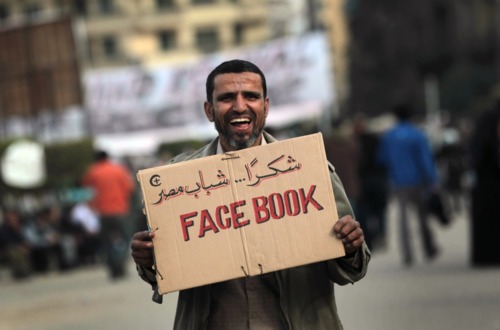
Does it help us understand what is going on in the Middle East if we treat the idea of a “Facebook revolution” as a meme? A new paper says yes; I think not.
A recent study in Revista de Comunicación offers an analysis of how narratives of the Egyptian revolution spread using the putative model of “meme analysis.” Alas, like every other study I have seen that seeks to apply the concept of memes to social and cultural analysis, it fails.
Summer Harlow’s “It was a ‘Facebook revolution’: Exploring the meme-like spread of narratives during the Egyptian protests” is, in the end, just a narrative analysis of a few English media texts with an effort to paste it over with the veneer of using “meme” to understand how the narratives spread.
This is only partly a review of this particular paper. I am actually using it to ponder the utility of “memetics” or “meme analysis,” an approach to culture too riddled with problems to get real traction, yet which refuses to die.
What’s a Meme, Anyway?

Meme is a term coined by the scientist Richard Dawkins in his 1979 book The Selfish Gene. It refers to a unit of culture, modeled on the concept of the gene, which travels and mutates much as genes do, and which Dawkins offers as a way to put the study of culture on a “scientific” basis.
Al Jazeera and Citizen Journalism

Was the incorporation of citizen-produced content into its news coverage of the Egyptian uprising part of the secret of Al-Jazeera‘s success? A new analysis says yes.
Al Jazeera has much less social capital than it used to, since Qatar began using its money to promote political causes in the Middle East and the station has come to be seen as a shill for those causes.
Still, its coverage of the Egyptian crisis was extraordinary and courageous by any measure, and may have played a significant role in the success of the revolution.
A new article by Diane Bossio in the journal Media Asia suggests that part of Al-Jazeera’s formula for success during the protests was its incorporation into its coverage of material produced by people in the Square and elsewhere.
“Citizen Journalism” can mean a range of things from independent journalists whose work is funded by the readers of their material to web sites that publish widespread rumors and many other things. The most common usage seems to involve professional journalists–which essentially means journalists working for media corporations or state media–incorporating the work of non-professional citizens into their broadcasting.
Musings On Media Ecologies (In The Middle East)

Photo Credit: Gigi Ibrahim via Compfight cc
Thanks to Wikipedia, I’m now an expert on “media ecologies” (?!). I have another piece on “New Media in the Middle East” coming out next year in which I discuss the term again, so I decided to blog about what I mean by the term.
The way I use the term, media ecology “refers to the dynamic, complex system in which media technologies interact with each other and with other social and cultural systems within a particular social field, and the ways these interrelationships shape the production, circulation, transformation and consumption of images, texts and information within this system (Peterson 2011).”
The concept of ecology, applied to media, seems to me a no-brainer. “Media” is obviously plural, and every medium and media type exists in complex interactions with other media. Media have infrastructural elements that depend on, and are integrated with, other infrastructural elements (power grid, transportation). People have beliefs about media, and how they should be used, and these inform their actual media practices (although not always in straightforward ways). All these relations are systemic in nature such that changes to one part of the system are likely to induce changes in other parts of the system.
In other word, an ecology.
Ecologies and Determinism
Focusing on the ways that media technologies are introduced, and the necessary adaptations of infrastructure, social relations, political institutions and cultural practices that result, requires us to consider communication practices as interactive systems.
Even Arab Media Trapped By Anti-Muslim Frames
Here’s an interesting article from the Asian Journal of Communication.
It has long been argued (including by me in my article “Making Global News”) that once frames are fully established and widely disseminated, it is extremely difficult to write outside them.
According to this article, which analyzes terrorism coverage in Al-Jazeera and Al-Arabiya, even these news programs can’t escape the “Muslim as Terrorist” trope, which implies (falsely) that most, if not all contemporary terrorists are Muslims.
The best they can do is counter it with an additional (true) message: that the majority of victims of terrorism are Muslims.
Here’s the abstract:
This study examines the coverage of terrorism in two leading Arab news websites, Al Jazeera and Al Arabiya from 11 September 2009 to 10 September 2010. It finds that the stereotype that ‘the terrorist is a Muslim’ continues in terrorism coverage, despite the fact that some terrorists are non-Muslims. However, the two sites manage to send out the message that ‘the majority of terrorism victims are Muslims.’ In addition, the findings reveal that too much media focus is placed on disseminating and supporting official positions and decisions, and humanitarian sufferings from terrorism are seldom brought to the attention of the public.
References:
Peterson, Mark Allen. 2007. “Making Global News: ‘Freedom of Speech’ and ‘Muslim Rage’ in U.S. Journalism” Contemporary Islam: Dynamics of Muslim Life 1(3): 247-264.
Zeng, Li, and Khalaf Tahat. 2012. Picturing terrorism through Arabic lenses: a comparative analysis of Al Jazeera and Al Arabiya. Asian Journal of Communication 22(5): 433-448
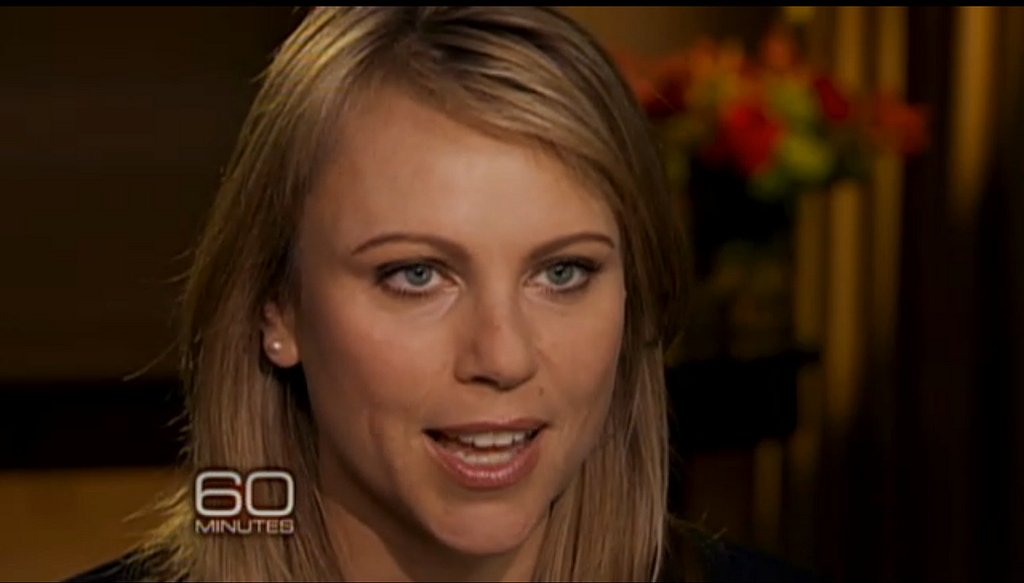
People used blogs and other on-line spaces to critically contest news accounts of Lara Logan’s sexual assault, according to a new article in Feminist Media Studies journal. Photo Credit: k-ideas via Compfight cc
A new article in Feminist Media Studies analyzes the ways bloggers and on-line commenters have used these electronic spaces to contest “blame the victim” narratives used in constructing news reports about Lara Logan’s sexual assault in Tahrir Square in Egypt.
CBS correspondent Lara Logan was assaulted while reporting on the post-Mubarak celebrations in Tahrir Square on 11 February 2011.
On May 1, 2011 CBS 60 Minutes (for which she is a correspondent) broadcast an interview with her about the incident. Logan said that she was speaking out to help end the code of silence surrounding sex assaults on female journalists. You can see the interview here.
I can’t read the article–there is an 18 month embargo for this journal at my library because Taylor and Carfax charges so damn much for access to their journals–but I’m curious about the claims.
Farha Ghannam on Masculinity in Egypt

Men make their own masculinity, but they do not make it as they please; they make it in social contexts, in dialogue with others, including women, and with the resources provided by their social and cultural circumstances, says Farha Ghannam in her new book, Live and Die Like a Man: Gender Dynamics in Urban Egypt (Stanford, 2014).
What is it like to be a man in the Middle East?
Raising three daughters in Cairo, I spent a lot of time observing differences in child raising not only between between Egyptians and Americans, broadly conceived, but between various intersections of class, religion and sex. Some of my discoveries are articulated in the fourth and fifth chapters of Connected in Cairo.
Over and over again I heard boys and young men’s behavior regulated with admonitions like “Khalik gada!” (Be a man!). Ruguula, manhood, is a central life problematic.
With her new book Live and Die Like a Man: Gender Dynamics in Urban Egypt (Stanford, 2014), Farha Ghannam has offered an extended ethnographic exploration of masculinity in the Middle East. It’s a wonderful, readable account that will become a standard work on gender in Egypt.
This book is important for a number of reasons, of which I’ll emphasize two:
First, the study of gender in the Middle East — as in most places– has been largely approached by focusing on women. While this work has helped counter many stereotypes of women as passive and powerless, it has had the unfortunate consequence of rendering masculinity unproblematic. Male becomes the “unmarked category,” the norm against which the female other is assessed.
Second, this woman-centered approach ignores the ways in which gender is mutually constructed. Both masculinity and femininity are shaped by general structures of patriarchy but the agents through which this structure shapes individual males and females in particular ways are people, and usually the people closest to you: it is not only fathers but mothers who make their sons men; brothers not only watch and watch over sisters, those sisters’ speech and actions help form the brother’s behavior in both broad and subtle ways (indeed, the very act of “watching over” a sister forces men to confront their own masculinities in various ways).
Farha Ghannam approaches this problem of masculinity in two ways.
Learning About Political Change from Pious Egyptian Women
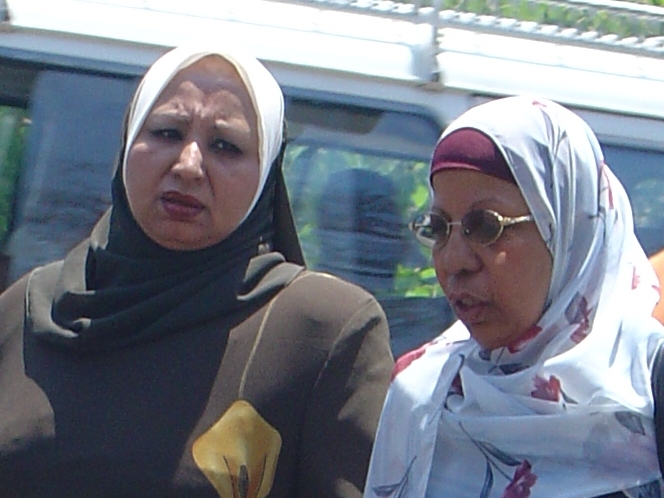
Can an understanding of the agency of pious Muslim women teach us lessons about political change generally? Anthropologist Leslie Lewis thinks so.
Leslie Lewis reflects on the nature of women’s personal piety and how it can be an agent of political and social change in an article in the most recent issue of Anthropology News.
The pious Muslim women she studied in 2006 sought to discipline themselves, and one another, to make themselves better people in the eyes of God. Besides dress, comportment and prayer, many devoted time to caring for the poor. In the process, they transformed Egyptian society “toward greater gender segregation, public expressions of piety, and social conservativism.”
We can learn a lot, Lewis says, from thinking about such women, and what they accomplish.
Her conclusions:

 CONNECTED in CAIRO