Overdressed and Underexposed or Underdressed and Overexposed?

Women who have been judged to be wearing too much are called to undress or be seen as interfering with the rights of others, while women judged to be wearing too little are urged to clothe themselves to avoid being seen as inviting sexual assault, points out Lori Beaman.
Fatema Mernissi, in her interesting book Scheherezade Goes West claims that Western women are no “freer” than Middle Eastern women.
In the Middle East, she argues, the harem is about family. Bodies are covered, to be revealed only to the husband, who marries you before he sees it. Femininity is thus largely invested in intelligence, wit, skills and education. How you look and what you eat does not define you. Mobility is circumscribed, however, to keep you—and your family–from shame.
In the West, women are freely mobile. Their harem, says Mernissi, consists of submitting themselves to the male gaze, of starving or exercising their bodies to meet a cultural code that places a woman’s prime value on her ability to display herself as a particular kind of woman, primarily to men.
Mernissi argues that neither cultural system offers women real freedom. Both systems constrain them in different ways. In both societies, she says, women have to seize their freedom.
It’s a sweeping generalization, but it sparks a lot of class discussion.
I was thinking about this claim when I read an essay by Lori Beaman in the most recent issue of Social Identities.

Mohammed Morsi. Photo Credit: Jonathan Rashad via Compfight cc
There was a very interesting editorial in Lebanon’s Al-Nahar newspaper Nov. 6. It’s in Arabic, but here’s my gloss:
The author, Monalisa Freiha, wrote essentially that the trial of Morsi was a show trial even though Morsi was guilty, and deserved to be tried and jailed.
She called it a “show trial” not just to mean that the trial is a public performance with strong dramatic interest, but in the traditional Cold War sense that the guilty verdict against the defendant has been more or less predetermined by political goals.
Morsi, the author pointed out, was guilty of the following:
Bassem Youssef and the Future of Public Discourse in Egypt

Will Bassem Yussef be silenced for making fun of sweets featuring the Field Marshal’s face? Photo alarabiya.net
“Bassem, we need you now,” one of my Egyptian friends posted on her Facebook status recently.
She missed the irreverent comedian Bassem Youssef during his summer hiatus from the show, when so much was happening: the ouster of Morsi by the military, the rise of fervent nationalism, and the leak of videos in which military leaders discuss their propaganda strategies.
Many Egyptians told me they feared that the comedian would not be able to parody the new government as he did the old. I was surprised–did they really think the military government would be less open to free speech than the Muslim Brotherhood?
But when he returned to the airwaves in October, he again used his position as humorist to challenge strictures on what can and cannot be said in public when commenting on Egyptian political life.
His hilarious Al-Bernameg show reportedly led to more than 50 complaints being filed against him in the prosecutor’s office for such crimes as “spreading anarchy,” “undermining national security,” and “harming Egypt and his image”, as well as insulting Minister of Defense Field Marshal Abdul Fattah as-Sisi.
Here’s what he did:
In SpongeBob We Trust?

“Choose the one you trust more!” says this Imad Hajjaj cartoon.
- “Choose the one you trust more!” says this Imad Hajjaj cartoon.
I love this cartoon. It has so many layers.
At the most basic level, this is a cartoon about the elections. “Who do you trust more?” The man is turning away from the local politician to the cartoon character SpongeBob SquarePants.
At another level, this is a cartoon about cell phones. The guy is a not actually voting; he’s taking a picture. The cartoonist is using this everyday mediating activity to indicate who this man would vote for.
It can do this because cell phones–with digital photographic and sharing capacities–have become so ubiquitous. The object in the man’s hand is represented by just a few pen strokes, with no detail, yet any reader in Egypt will immediately recognize what he is holding and what he is doing with it.
At still another level, this is a critical comment on Arab politics and elections. The untrustworthiness of candidates a theme that Mahjoob has dealt with in many cartoons (Imad Hajjaj signs his cartoons “Mahjoob”)
One of the classic discourses of Arab politics is to blame unhappy circumstances on the activities of outside forces that want to see the country suffer and fail. The old regime and the next regimes alike would blame problems on Israel, the U.S., Iran, even all of them working in tandem. Here it is SpongeBob, who IS an outsider, a cartoon that comes from, and hence indexes, the United States…but still more trustworthy (or perhaps just cuter?) than indigenous politicians.
Or is SpongeBob an outsider? At another level, this is a cartoon about SpongeBob, a character who is enormously popular in Egypt and the wider Middle East these days. Choosing SpongeBob over the local politician is a wry commentary on the quality of local politicians, sure, but it is also a commentary on SpongeBob.
SpongeBob is everywhere in the Middle East these days. Don’t believe me? Check out the Tumblr website “SpongeBob on the Nile,” run by American students Andrew Leber and Elisabeth Jaquette, With the assistance of Egyptians, expatriates and travelers, it documents sightings of SpongeBob SquarePants in Egypt and to a lesser extent the wider region.
Women and Media in the Middle East

Does media empower women against hegemony or reinforce hegemonic representations? A new collection of papers looks at this question in many different venues. (BTW I took this photo at an Internet Cafe in Sharm El-Sheykh in 1998)
There’s a great new special issue of Feminist Media Studies just out (Vol 13, No. 5), edited by Nahed Eltantawy, on “Women and Media in the Middle East.”
It features 12 articles ranging from the experiences of women broadcasters in Iran, to how women who have abortions are represented on Turkish television, to an analysis of the Marvel Comics X-Men superheroine Dust (who, for those of you who don’t shop at Kryptonite, is a devout Sunni Muslim from Afghanistan).
In her introduction, “From Veiling to Blogging: Women and Media in the Middle East,” Nahed Eltantawy argues that after decades (or longer!) of women in the Middle East being portrayed as oppressed yet exotic, the Arab uprisings suddenly introduced images of active, politicized women empowered by social media. This moment calls for a greater interrogation of the ways in which women in the Middle East use media, as consumers, as producers, as well as further interrogation of the range of representations of Muslim women.
There are two articles on Egypt: “In Their Own Voice: Technologically mediated empowerment and transformation among young Arab women” by Courtney C. Radsch and Sahar Khamis, and “The First Ladies and the Arab Spring: A textual analysis of the media coverage of the female counterparts of authoritarian oppression in the Middle East” by Elza Ibroscheva.
Taken together, they suggest that while new media technologies empower women, the representational strategies of “old media” continue to extend the Orientalist gaze.
Arabic Women in the News: Active Agents or Passive Subjects?
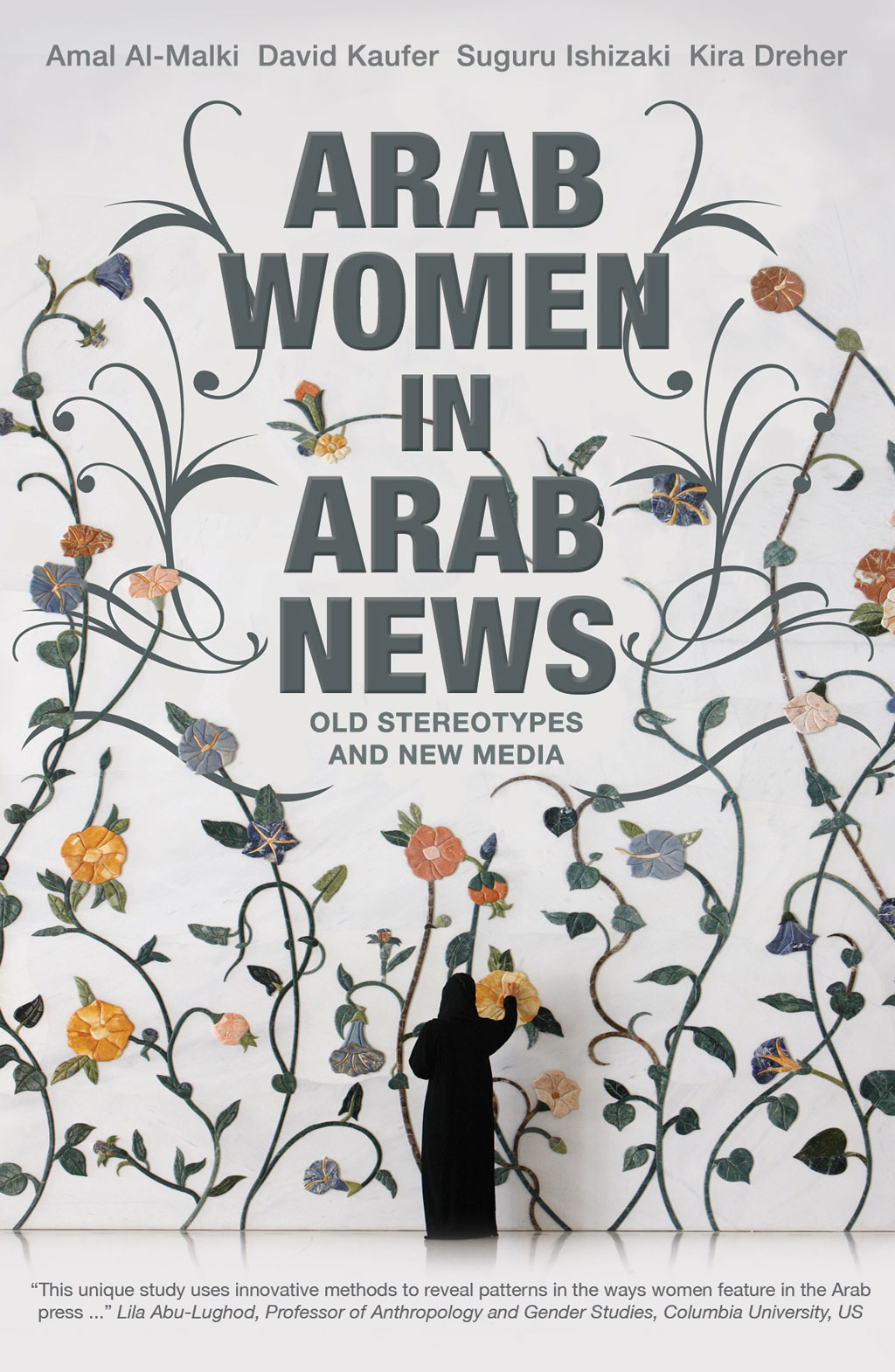
Arabic media are far more likely to represent Arab women as active agents than are Western media, according to this new study.
The book Arab Women in Arab News: Old Stereotypes and New Media by Amal Al-Malki, David Kaufer, Suguru Ishizaki and Kira Dreher is not really a book about new media and its uses by Arab women. Rather, it is a book that seeks to undermine stereotypes of Arab women as submissive, using accounts of new media practices as evidence.
This book is unique in its efforts to contrast how the Arabic press represents not simply gender but a very specific gendered and politicized categorization of people in contrast to the way the Western media represent the same category of persons.
Several studies have shown that Western media tend to portray Arab women as passive, fulfilling a longstanding Orientalist stereotype. The authors of this text set out to discover whether Arab media portrays Arab women in the same way. As the author of a paper on ways US media represents Muslims worldwide, I was very interested in the answer.
To analyze how Arab media represents women, the authors engage in a quantitative analysis of 2323 news items from 103 Arabic-language news sources in 22 countries reported between 2005 and 2007. These are then coded to determine whether women are represented as active agents or passive subjects:
How Long, Oh Egyptians, Will This Revolution Go On?

How long will the Egyptian Revolution last? Photo: Rusty Russ, Creative Commons license.

History suggests it could be a long time. Photo: Jonathan Rashad, Creative Commons license.
Several months ago I was at a public talk here at Miami University on the Middle Eastern uprisings by a visiting scholar. When it was over, the person next to me said, “But when is it going to finally settle down? Why is it taking so long?”
I keep hearing these sentiments — and from Egyptians as well as North Americans and Europeans. There seems to be an expectation that when a regime falls to popular protest, an orderly transition to democracy should be expected.
“Well, after all, it took the US 20-30 years to establish order after the revolution,” I said.
“What do you mean?” she asked. After a brief conversation it became clear that this colleague, with a PhD in Arabic Literature, educated in US high schools and universities, had some notion that the US sprang magically into being in 1776 or thereabouts, once the British regime was thrown out. To be fair, she’d never really thought about it before.
Nothing, of course, could be further from the truth.
Four Easy Pieces on Egypt
 The latest issue of DOMES: The Digest of Middle East Studies (Vol. 22, No. 2) has four moderately interesting articles that either focus on Egypt, or focus on the “Arab Spring” but with some emphasis on Egypt.
These articles involve the following four topics:
- Christian-Muslim Relations in Egypt
- ICTs and the Transition to Democracy
- Thucydides’ Stasis and the Arab Spring
- Leadership needs in the Middle East
Christian-Muslim Relations in Egypt
The first article which caught my interest, was “Christian–Muslim Relations in Egypt in the Wake of the Arab Spring” by Paul S. Rowe, which is definitely the best of the lot. Rowe offers a useful general introduction to the dramatic changes facing Coptic relations with other groups and institutions since January 2011, while acknowledging that “the broader implications of the revolution to Copts are unclear.”
Rowe’s effort to create some clarity on this issue centers around a model of change that goes like this:
- The Mubarak regime had formed a stable elite “neo-millet” partnership with the hierarchy of the Coptic Orthodox Church, through which the Church could speak directly to the state in regard to Coptic interests.
- The uprisings eroded this partnership “in favor of a republican and pluralist model of citizenship in which individual Copts represent their own interests.”
- As lay movements among Copts play increasingly visible and assertive public roles in Egypt, (and in the wake of Pope Shenouda’s death and replacement by a young and untried successor), the neo-millet model continues to lose traction.
but
4. Only “time will tell whether or not pluralist representation or church corporatism will dominate Christian–Muslim relations in Egypt into the future.
(For nonspecialists in the Middle East, the millet system refers to the Ottoman practice of creating institutionalized relationships between the state and specific protected minorities (such as Jews and Christians), who were governed by their own special courts and councils. By “neo-millet” system, Rowe seems to mean that while officially Copts are Egyptian citizens like any others, the Copts were recognized by the regime as a distinct subcommunity with whom the state could develop specific relations through the medium of the Church hierarchy.)
I realize that “only time will tell” is not much of a conclusion, but I was struck by the fact that Dr. Rowe’s notion of an evolution from a corporate Church that speaks for Copts to a range of secular Coptic organizations offers a theoretical language for some of the descriptive writing I have done on Coptic activism on this blog.
ICTs and the Transition to Democracy
The other article whose title intrigued me was “ICT, Social Media, and the Arab Transition to Democracy: From Venting to Acting” by Mohammed M. Aman and Tina J. Jayroe. Unfortunately, this article brings nothing new to the ongoing discussion of the roles of information and communication technologies in the Arab uprisings, it just summarizes what most of us who follow this topic already know, to whit:
Bibliography of the Egyptian Revolution Updated

Photo Credit: Thomas Hawk via Compfight cc
The Bibliography resource on the Egyptian uprisings has been updated.
The bibliography now includes over 500 references. Updates include articles from such journals as Democracy, the Washington Quarterly, Middle East Topics & Arguments, Television & New Media, Journal of Arab & Muslim Media Research, Journal of Civil Society, Soccer & Society, Australian Journal of Communication, Social Research, Foreign Policy, and many others, including books like Jeffrey Alexander’s Performing Revolution in Egypt, Naomi Sakr’s Transformations in Egyptian Journalism, Mohamed El-Bendary’s The Egyptian Revolution Between Hope and Despair: Mubarak to Morsi.
“Terrorist” MB Responsible For 9/11, Asserts US Congresswoman Bachmann
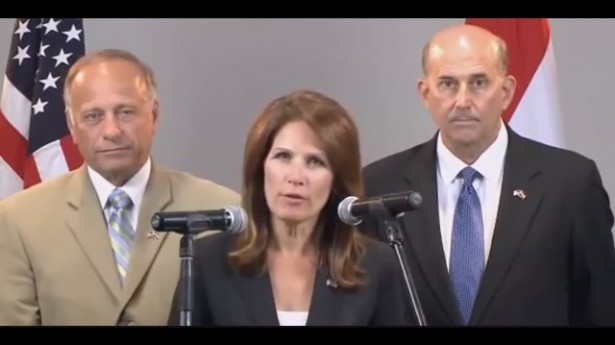
Michelle Bachmann explains to Egyptians how the Muslim Brotherhood was responsible for 9/11.
Michelle Bachmann appeared Sept. 7 (along with fellow representatives Steve King and Louie Gohmert) in a prerecorded message on ONTV where she cheered the Egyptian military for removing Morsi from power and putting down the Muslim Brotherhood.
Bachmann’s penchant for making dumb erroneous statements was in full swing as she described the Muslim Brotherhood as a worldwide terrorist organization and implied they were responsible for 9/11
The MB is not, of course, a terrorist organization. They are an organization of socially committed Muslims who combine political activism with Islamic charity work. There are members of the organization that have committed acts of terrorism, and members who have broken away to form terrorist organizations.
And they are not associated in any way with Al-Qaida, which was formed in the 1980s in the crucible of the Soviet invasion of Afghanistan and the subsequent US-USSR proxy war.
I get the semiotics of Bachmann’s statement,, of course:

 CONNECTED in CAIRO