The US And The Muslim Brotherhood

“Why did the US put the Muslim Brotherhood in power?”many Egyptians ask. For most Americans the question doesn’t even make sense.
It was not the confusions and contradictions of Egyptian electoral politics that pushed the Muslim Brotherhood into power. Morsi was put into power by the United States. Resistance against the Brotherhood protesters is thus also resistance against US domination of Egypt. Threats by the US to halt aid or introduce other sanctions are just last-ditch efforts by Washington to keep its ally in place.
That is the way many Egyptians see relations between the US and Egypt right now in this period of violence and uncertainty.
The latest iteration of this is an editorial this week in the UAE newspaper Al-Khaleej:
The American Administration is practicing a dangerous policy in the region, namely in regards to the post revolutionary Egypt, by using all sorts of means and tools such as threatening the use of force and political and economic pressures. This all aims at containing the countries of the region and placing them under the American control in a way that primarily serves America’s and the Zionist entity’s interest.
The editorial goes on to reassure readers that the Egyptian people will never submit to American blackmail.
The Arab sheikhdoms have made it clear how pleased they are not to have another “Islamic democracy” in the region that might give their own people ideas, but this op-ed is more than a piece of propaganda. It represents just one instance of a widespread discourse that links the rise of the Muslim Brotherhood to the national interests of the US and Israel.
On The Theft of Egyptian Artifacts
 I’m not sure exactly why they picked me, but I was asked this week to comment on the situation in Egypt and specifically the recent theft of artifacts from the Malawi Museum in the city of Minya. Joining me was Carol Redmount, Assistant Professor of Egyptian Archaeology at UC Berkeley. We were featured on “This Morning”, which I’m told is the top-rated morning show in Seoul, Korea (but I’m told that by the show’s producers, so…)
Anyway, click on the screenshot to the left to hear a podcast of the story.
Cut Aid to Egypt and US Workers Lose Jobs

Photo Credit: freestylee via Compfight cc
A couple of weeks ago on the radio I listened to Senator John McCain and a couple of other lawmakers pontificate on the issue of whether or not to cut US aid to Egypt.
The question was, “is what happened in Egypt a coup–in which case we should cancel our aid to Egypt–or is this a revolution, in which case we should not cancel our aid to Egypt”
The same issue is now being raised on the left by Human Rights First and ANSWER Coalition with regard to the massacre of Morsi supporters by Egyptian security forces. And news stories say that lawmakers are pressuring President Obama to cut part or all of our 1.5 billion in military aid, and/or our 250 million in humanitarian and development aid.
This debate is simplistic in the extreme–not that that should surprise anyone who follows politics here or anywhere else in the world. Much of political rhetoric is organized by cultural logics that are important to the speakers and hearers because they express particular understandings of how the world works, but they have only tenuous connection with realities.
The idea is simple: the US doesn’t support bad guys, so if this is a coup, and if these people are killing protesters (armed or not), then they are bad guys and we Don’t wanouter tax dollars supporting them. Moreover, if we cut off the money, they’ll change their behavior to get us to start giving them money again.
I won’t take up the question of the coup here, other than to say that the Obama administration is right to be perplexed by how to classify the takeover. Of course it was a coup by almost any definition, but against a narrowly-elected president who was actively dismantling the little democratic gains Egypt had made (for example, he had declared himself to have the powers of the legislature (after it was dissolved by Judicial order), and then announced he was immune to judicial oversight)–and it was a coup that had broad public support.
But lets consider the question of aid.
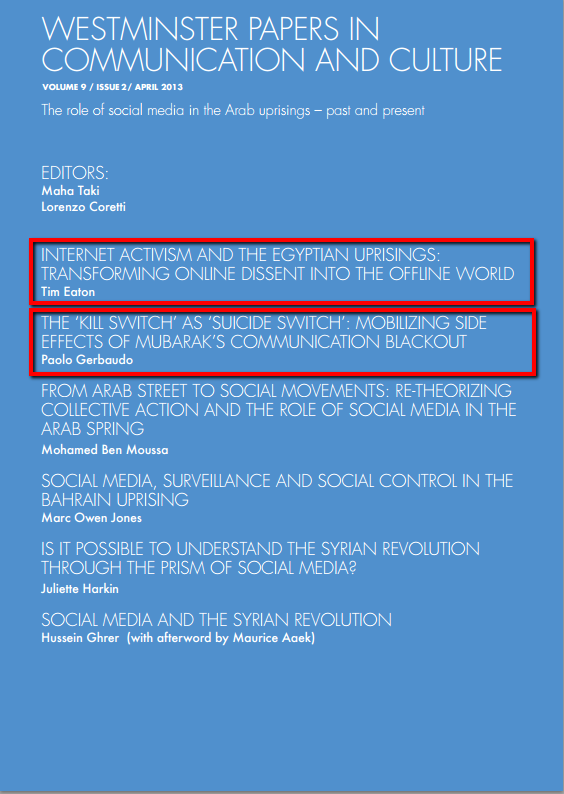 The most recent issue of Westminster Papers in Communication and Culture is a special issue on “The Role of Social Media in the Arab Uprisings – Past and Present.” The issue is free on-line.
Two of the articles deal with Egypt, a piece on Internet activism by Tim Eaton of BBC Media Action, and an article about the Internet shutdown by King’s College lecturer Paolo Gerbaudo. Also of interest is an essay assessing various theories about the importance of the Internet in the Arab uprisings. The special issue also contains an article on social media and social control in Bahrain, and two articles on social media and the Syrian revolution.
Eaton’s article investigates the use in Egypt during the 2011 uprisings of “internet activism”, which he defines (after Vegh 2003) as “a politically motivated movement relying on the internet, using strategies that are either internet-enhanced or internet-based.” Eaton argues that there are three forms of Internet activism:
Cameras and Conflict in Contemporary Cairo

Photo Credit: modenadude via Compfight cc
The Egyptian Revolution has often been ironically contrasted with Gil Scott-Heron’s now ubiquitous quote “The revolution will not be televised” because, of course, that particular revolution was televised, and very thoroughly so, in spite of powerful efforts by the Mubarak regime to suppress it.
There has been a lot of discussion about the visuality of the Egyptian revolution–the signs, graffiti, erasure of the Mubaraks’ names from institutions, posters, art, images of martyrs and so forth–and there has been a great deal of discussion about the role of the Internet in communicating, dissemnating and hacking the state media system.
What has not been much discussed is the role of cameras–in all the myriad guises these take in contemporary technology–as the crucial bridge between visuality and the Internet.
That’s why I’m very excited about a call for papers on just that subject.
“Thinking with a Camera during Revolutionary Times: Generative Visualities in the Middle East” is the tentative title of a panel being proposed for the Society for Cinema and Media Studies (SCMS) meetings in Seattle, Washington this March.
Highlighting Connected In Cairo
 Web 2.0 offers all manner of interesting ways of exploring texts. A few days ago, I went to my Amazon author page to update my biographical note–six months late–and was distracted by a feature called “Notes & Highlights”
“Popular Highlights” displays passages that people reading the text on a Kindle have marked using Kindle’s highlight feature. Amazon combines “the highlights of all Kindle customers … identifying the passages with the most highlights” according to their helpful “What’s This?” explanation.
Not every book entry in Amazon shows highlights because “some books don‘t have enough highlighting in them.” Amazon conveniently shows “the number of people who have highlighted the text … at the beginning of the marked text.”
Why? Because “the resulting Popular Highlights help readers focus on passages that are meaningful to the greatest number of people.”
Ousting the Brotherhood: Take That America?

What happens when the US and Egyptians differ on the meaning of “democratically elected”? Photo by Malak Rouchdy
Last Spring I gave the keynote address at the regional Model Arab League, which Miami hosted. It was on continuing challenges in Egypt (of course).
After the Q&A, as I was gathering my coat and briefcase to leave, I was approached by a student from one of the other schools. He was a young Egyptian studying in the US,
He asked, “So why do you think the US put the Muslim Brotherhood in power, anyway?”
I can’t quite remember what I answered beyond a simple assertion that I did not accept the premise of the question.
There were several other students hanging about, some my own Middle East Capstone seminar students, some from other universities, waiting to reassure me that my talk was not an incoherent mess as I feared–I was a last minute replacement when a featured speaker canceled and my talk was a patchwork of posts from this blog–and they were surprised and perplexed by the question.
I was not surprised. I knew that there was widespread belief in Egypt that the only reason the Brotherhood was in power was that the US supported them. But I was not prepared for the question as I had not anticipated it in that venue. To have a US educated, politically astute Student asking me that question suggested that the assertion was given far more credence by a much wider swath of Egyptian society than I had (from my current distance) assumed.
I’m thinking about this right now because for the past several days the Arabic press in Egypt and elsewhere in the region has been reflecting on what the fall of the US-backed MB government means for US foreign policy–and the articles are predicated on the assumption that the US wants the MB in power.
New Review of Connected In Cairo
 I’ll confess that I had never heard of the journal Anthropological Notebooks until I saw a quote credited to them from a review of my book in Amazon.
It turns out they are a well-produced annual series published by the Slovene Anthropological Society with some interesting articles and–if I may say so myself (ahem)–great book reviews.
The review is by Heba ElSayed, and it is almost uniformly in favor of the book.
Just check out this first paragraph:
Mark Allen Peterson offers a deeply engaging and timely analysis of the complex sociocultural, religious and economic trajectories that have shaped young upper-class Egyptians in the decade prior to the 2011 uprising. Through a series of detailed ethnographic portraits of educational spaces, children’s magazines, coffee shops and fast-food outlets, Peterson’s book furthers our understanding of the many ways in which class identities –and the particular lifestyles and social expectations they harvest –are imprinted upon young people from a tender age. In particular, Peterson brings to light how education, in the Egyptian national context, is a powerful cog in a broader rigid social class system that works to crystallise and consolidate class identities. Interestingly, by maintaining a sensitive distinction of the how social practices that create class identities change between level of education (primary/higher), but also type of education (private/public/private-national/private-international), Peterson makes a unique and insightful contribution to Arab cultural studies and anthropology.
Heck, I’d read that book.
My wife accuses me of poring over good reviews in search of the one minor nitpick a reviewer will focus on. I confess there is some truth to this. Here’s ElSayed’s criticism:
The Egyptian News Media in Transition
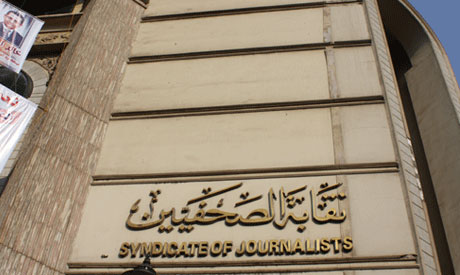 The summer 2013 issue of Arab Media and Society offers two useful articles on the changes in news media in post-Mubarak Egypt.
One of these is a handy review of Naomi Sakr’s new book Transformations in Egyptian Journalism: Media and the Arab Uprisings (I.B. Tauris., 2013). The other is a very readable account of the dramatic changes taking place within the journalism syndicate, with an insightful analysis of why apparent changes do not really count as structural transformation, leaving journalism an essentially
El Nawany’s review provides a convenient chapter by chapter summary of Sakr’s book, which begins with an account of the “unpaid journalists” who covered the protests in Tahrir Square, moves on to the failure of Egyptian journalists to establish a uniform set of professional standards, discusses the limited funding models available to Egyptian media, and the failure of unions to provide protection for Egyptian journalists–affecting professional ethics, issues of governance and self-regulation.
The book concludes with a set of recommendations for change, including:

 CONNECTED in CAIRO