Sexual Politics Blog Post Updated
My most popular post so far this year has been “Rethinking Sexual Politics in Egypt” in which I ruminated on an article by Paul Amar in the International Feminist Journal of Politics and the critical discussion of the article that followed. Unfortunately, the citations were incomplete as the articles were published to the IFJP web site long before they appeared in the print edition.
Happily, the critical discussion does appear in issue 15(1), so I have updated the references in the blog post and inserted the references into my bibliography of the Egyptian uprisings.
Political Humor in Egyptian Popular Music
Continuing to think about the role of humor in Egypt’s ongoing revolution, I’m intrigued by some of the funnier mahragan (“festival”) music that directly mocks or comments on politics. A great example is “Morsico Systems” by Ahmed Samih.
I learned of this piece from Ted Swedenburg, who writes:
[M]ahragan artists are also more than willing to aim their barbs at figures of authority, including Egypt’s post-revolution, popularly elected president, Muhammed Mursi. “Morsico Systems” from mahragan artist Ahmad Samih sets a presidential speech to a sha‘bi beat, and splices Mursi’s sonorous message together with autotuned, impertinent commentary. To Mursi’s claim that “there is support for that,” meaning for his regime’s “organization,” the singer replies, “There is an elephant.” The recording goes on to repeat and counterpose the words of Mursi and the singer, “support” and “elephant,” several times, reducing the president’s intonations to nonsense.
Bibliography of the Egyptian Revolution Updated
The Bibliography resource has been updated. The bibliography now includes over 325 references.
Updates include writing from the International Review of Information Ethics, Middle East Report, and many others
Understanding the Music of Revolt

Although Western journalists love to remake the Arab world in a Euro-American image, in Cairo, the rising music of the underclass is mahragan (“festival”) music, not rap, writes Ted Swedenburg.
Egypt’s popular music remains filled with calls for both national unity and social justice, writes Ted Swedenburg in an article titled “Egypt’s Music of Protest: From Sayyid Darwish to DJ Haha” in a recent edition of Middle East Report, but its role in the revolution is not quite the way Western media has tended to portray it. The article is available free on-line.
- By privileging hip-hop and rap to the virtual exclusion of every other kind of nationalist and protest music sung by musicians and crowds during the 18 days of the original Tahrir Square occupation, as though Arab youth, through the use of imported “Western” musical traditions, is overthrowing an older, passé generation’s traditional and puritanical culture, in order to usher in a more tolerant, modern and US-friendly order.
- In describing protest music as the “soundtrack” of the uprisings–a favorite media metaphor–the media frames the role of music in the uprisings “as if the tunes were a playlist on protesters’ iPods while they battled security forces or a live broadcast over a sound system behind the barricades” rather than “something integrally tied to and embedded within the social movement.”
Swedenburg writes:
Musicians on the square for the most part performed a repertoire that the crowds could sing along with, a body of songs that connected the artists and their audience to a history of struggle. Or they composed ditties on the spot, in the heat of events. The purpose of musical performance at Tahrir was to move the crowds (and the musicians themselves) into a sentimental or affective state, such as anger, mourning, nostalgia or patience, or to unify the crowds in a state that Durkheim has called “collective effervescence.” A song’s meanings therefore were not just already inherent in the lyrics and melody or in the associated memories and resonances, but they also forged in performance, at charged political moments.
Take, for example, the band El Tanbura, a collective of musicians from the city of Port Said on the Suez Canal reviving a local genre of music known as suhbagiyya, which was evolved from songs invented by laborers digging the Suez canal, and is especially known for the presence of an instrument called a simsimiyya (lyre). Swedenburg writes that El Tanbura was on Tahrir Square every day of the January-February 2011 occupation, performing “Patriotic Port Said” and other nationalist songs multiple times from the various stages.
The song initially refers to the 1956 war over the Suez, when Israel, France and Great Britain attacked Egypt after President Gamal Abdel Nasser nationalized the canal. The residents of Port Said who battled against the invaders were hailed as champions of Egypt’s anti-imperialist struggle. The song was revived in the wake of the June 1967 war, when Port Said’s residents were evacuated and settled in refugee camps until Egypt regained the Eastern side of the Canal after the 1973 war.
Whatever Happened to Egypt’s “Popular Committees”?
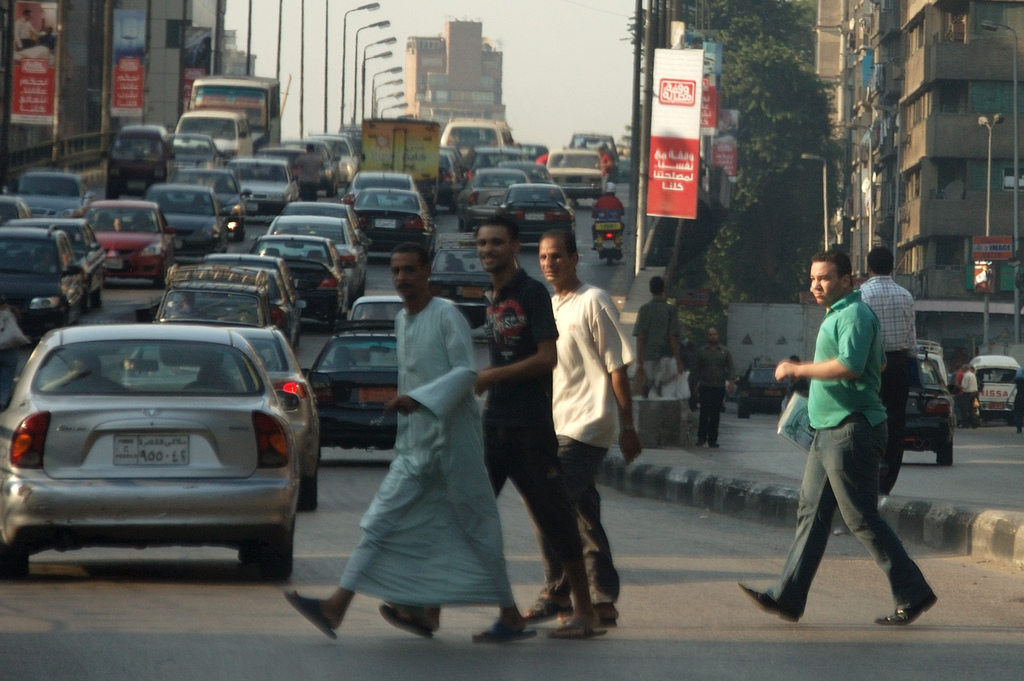
During the uprisings, citizens took it on themselves to manage the essential affairs once the responsibility of the state. Photo Credit: Daveness_98 via Compfight cc
Remember the popular committees? Those ad-hoc groups of citizens that started as neighborhood watch teams and maintained security and organized neighborhood life when the state stopped services?
In “Egypt’s Popular Committees: From Moments of Madness to NGO Dilemmas,” Asya El-Mahy describes how some of them have evolved into social service providers with complex ties to the state.
According to El-Mahy:
Some of the popular committees disbanded after Mubarak fell and police slowly reappeared. The end of Mubarak’s rule ushered in tighter state controls over civil society organizations, as well as a near monopoly for Islamist parties over formal political institutions. Nonetheless, many popular committees remained independent and active, holding their first national conference in April 2011.
In popular discourse,
The Struggle For the Walls of Cairo

Mural of the martyr Jika in downtown Cairo. Photo: Jessica Winegar.
“Whoever has something to say in Egypt these days can write it on a wall,” begins a recent photo-essay by Samuli Schielke and Jessica Winegar.
Titled “The Writing on the Walls of Egypt,” it appears in a recent issue of Middle East Report and is available on-line as a public access article.
After emphasizing that wall-writing as a form of art and political expression predates the current revolution, the authors focus on post-Mubarak efforts to control what appears on the walls of Cairo.
While generals, presidents, judges and other powerful leaders jockey for control, street art reminds us that street politics continues to have relevance, and that the art and poetry of slogans, graffiti and murals gives concrete form to “anti-hegemony” sentiments (Shokr 2012) but also to the sentiments of those supporting the SCAF, or the government of President Morsi.
Indeed, street art not only expresses differences of political opinion, it can itself be a battleground:
Anti-Hegemony in Contemporary Egypt
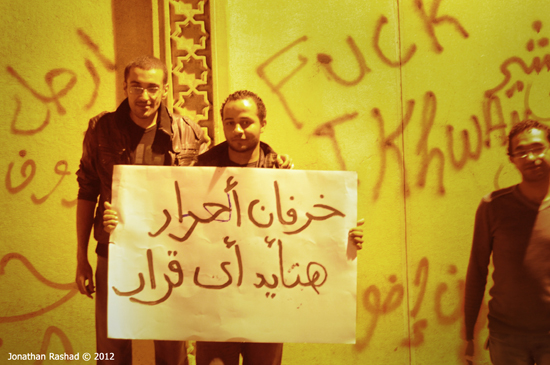
“Anti-hegemony” is the sense that there is no leadership that is not corrupt and no legitimate institutions a that do not mask the special interests of elites. Photo Credit: Jonathan Rashad via Compfight cc
The Muslim Brotherhood coalition that currently rules Egypt offers an example of a “political groups that seize power on a wave of mass mobilization, only to revert to a politics of pragmatism under the mantle of revolutionary ideals” writes Ahmed Shokr.He’s writing in an article entitled “Reflections on Two Revolutions” published in a special issue of Middle East Report and available for free on-line.
In their effort to maintain a facade of idealism while pursuing a pragmatic course of action, Shokr writes, the MB is not unlike the Free Officers who seized power after the revolution of 1952.
How the emergent order in Egypt will eventually look, and how much of the past it will retain or abandon, are matters that remain to be worked out. Since coming to power, the Muslim Brothers have engaged in a delicate balancing act: maintaining enough continuity to win international acceptance and protect their ruling coalition, while projecting enough change to give credence to their promise of a new Egypt. The result is an emerging leadership of reluctant revolutionaries: They tread carefully, keeping stability a top priority and steering clear of dramatic policy changes, while boasting of being Egypt’s first democratically elected rulers.
But there are also important differences.
The Egyptian Uprising Two Years On: Open Access Articles
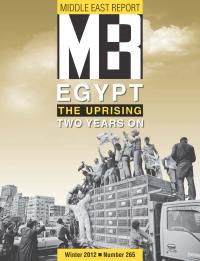
A special issue of MERIP on the Egyptian revolution includes four open-access articles
As the dramatic social changes in Egypt continue, every anniversary there is a call for reflections on how Egypt got to where it is, and where it is going. Last year, for example, I took part in a workshop at Oxford University entitled “The Egyptian Revolution: One Year On.” Now the winter 2012 issue of Middle East Report offers reflections on “Egypt: The Uprising Two Years On.”
Many of the articles are available through free on-line access. These include:
Reflections on Two Revolutions by Ahmad Shokr,
The Writing on the Walls of Egypt by Samuli Schielke and Jessica Winegar,
Egypt’s Popular Committees: From Moments of Madness to NGO Dilemmas by Asya El-Meehy, and
Egypt’s Music of Protest: From Sayyid Darwish to DJ Haha by Ted Swedenburg.
There are also a number of articles you must buy the issue to get. These include:
Human Rights and the Elections in Egypt: Live on Facebook
 Now that the parliamentary elections are coming, the NGO Human Rights First is bringing together Egypt’s “Facebook Girl” Esraa Abdel Fattah and journalist and activist Bassel Mohamed Adel Ibrahim for an interactive discussion on Facebook about human rights issues in Egypt. And you are invited.
The discussion, titled Human Rights Challenges as Egypt Prepares for Parliamentary Election, will be live streamed on Human Rights First’s Facebook page on Monday, February 4 at 12pm EST.
You can submit your questions and comments here
What: Human Rights Challenges as Egypt Prepares for Parliamentary Elections
Amid escalating protests and violence in Egypt, the United States is watching anxiously for signs that Egypt’s transition from authoritarianism can move forward. Parliamentary elections are expected to take place in the next few months. These are critical times for Egyptian democracy activists who have not been able to channel the energy of the 2011 protests into victory at the polls.
What do activists expect from these elections, and what are the obstacles to Egypt achieving progress toward a peaceful democratic transition? What can the United States do — and what should it not do — to promote human rights and universal values in Egypt in the vital months ahead?
Who:
- Esraa Abdel Fattah: Leading democracy activist; vice-chairperson of the Egyptian Democratic Academy, an independent human rights and democracy promotion organization; pioneer social media activist; known as Egypt’s “Facebook Girl” for founding the April 6 Youth Movement in 2008
- Bassel Mohamed Adel Ibrahim: Political activist and journalist; co-founder of the Al-Ghad Party with Ayman Nour in 2004; member of the steering committee of the Constitution Party, led by Mohamed al-Baradei
- Neil Hicks: International Policy Advisor, Human Rights First
When: Monday, February 4, 2013 at 12pm EST
Where: Live stream on Facebook.
Editor: Copts Hope For Strong Liberal Presence in Parliament
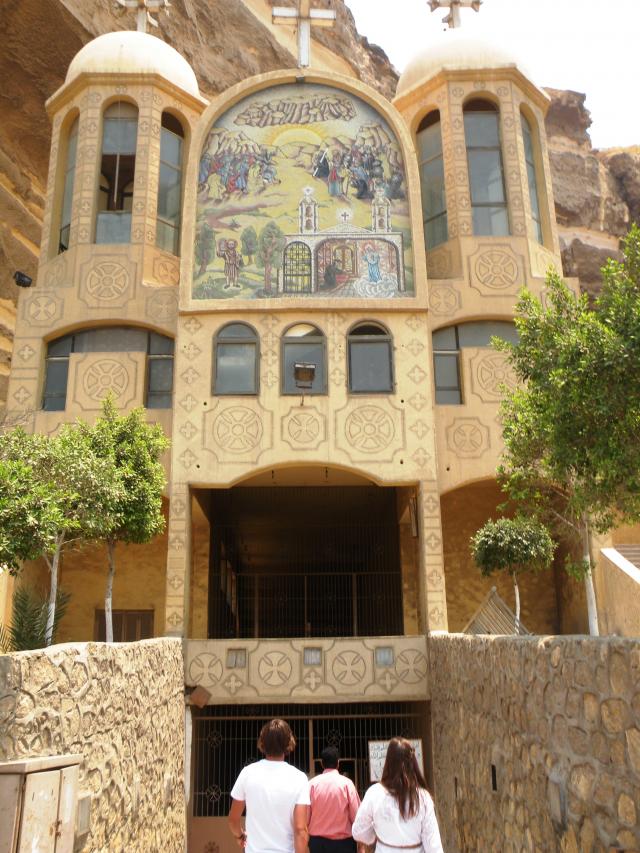
Will a more secularized parliament improve the outlook for Egypt’s Christian minority?
Youssef Sidhom, Chief Editor of Watani, a weekly newspaper for the Coptic community with a circulation of about 250,000, gave an interview to Oasis, the Roman Catholic newsletter on Christian-Muslim encounter.
Elections are looming, and Watani says many Copts are hoping for a reduced number of Muslim Brotherhood and salafist candidates. In the last election, Islamists largely coordinated their efforts so that a single Islamist candidate ran in most districts. Meanwhile myriad secular candidates competed against each other as well as against the Islamist candidates.
Watani emphasized the hope Copts have for that the next election will bring a more vibrant liberal-secular presence to Parliament:
On the one hand there are the Muslim Brothers, the Salafis and other Islamist groups that will create a strong coalition. On the other there are various liberal parties: will they be able to unite in a strong coalition? This is what they have announced and it was comforting to learn last week that in the coming weeks they will try to create a common electoral list identifying one single candidate for each constituency. I hope that they manage to do so and do not argue. It will be the last possible battle.
But he acknowedges that the challenge is that little unites these parties aside from their common antipathy to the religious parties:
They have done nothing to foster the union among themselves. What united them was the announcement of the Constitution, a passage that shocked a great number of Egyptians. This critical situation will keep the liberal parities united. Until today the liberal parties have known what they do not want rather than what they do want. The fact is that the present situation leaves no room to produce a development programme, and it is so delicate that each one has concentrated on the crucial point: to stop Egypt becoming a religious state. In the run-up to the election I do not think that the candidates will use their time to think up a political programme. The game will be played all on one issue: those supporting the civic state and those the religious one. Egyptians, make your choice.
Read the entire interview here.

 CONNECTED in CAIRO