Did the Muslim Brotherhood Take Money From Obama? The Egyptian Judiciary Wants To Know.
Here’s a fun one.
Did you know that President Obama is giving 1.3 billion dollars of your tax money to the Muslim Brotherhood? Or maybe it’s 1.5 billion, depending on which person is telling the story. Anyway it’s a lot.
It must be true. Romney said it , the National Review‘s Andrew McCarthy says so, and Rep. Louie Gohmert (TX-01) said so on the House floor in front of C-Span and everybody:
And now the Egyptian judiciary is looking into the claim. Last week (Jan 20th), the Saudi owned Asharq al-Awsat newspaper reported: “The Egyptian judicial authorities started to investigate applications accusing the Muslim Brotherhood Group, to which President Muhammad Mursi belongs, of receiving US financing to practice its activities in the country.”
Citing “judicial sources,” the newspaper said:
“The Higher State Security Prosecution Authority has started investigating the seriousness of applications accusing the Muslim Brotherhood Group of receiving funds estimated at 1.5 billion dollars from the US Administration, which is a violation of the law.”
How do they know? According to the news account, the accusing lawyers
“presented to the investigation authorities video clips of US President Barack Obama and former US Presidential Candidate Mitt Romney that confirm the truth of the accusations, and they also presented video clips of some US programs to support their viewpoint of the issue.”
In other words, the case is based primarily on selected U.S. media reports like those mentioned above (Hey, Rep. Goehmert, you’re a global star!).
However, Asharq al-Awsat reported that the Muslim Brotherhood’s lawyer in the case, Abd-al-Mun’im Abd-al-Maqsud, said the case lacked evidence, and “will not lead to any legal consequences.”
He’s almost certainly right. Here’s why:
Beyond the Art of Revolt in Egypt
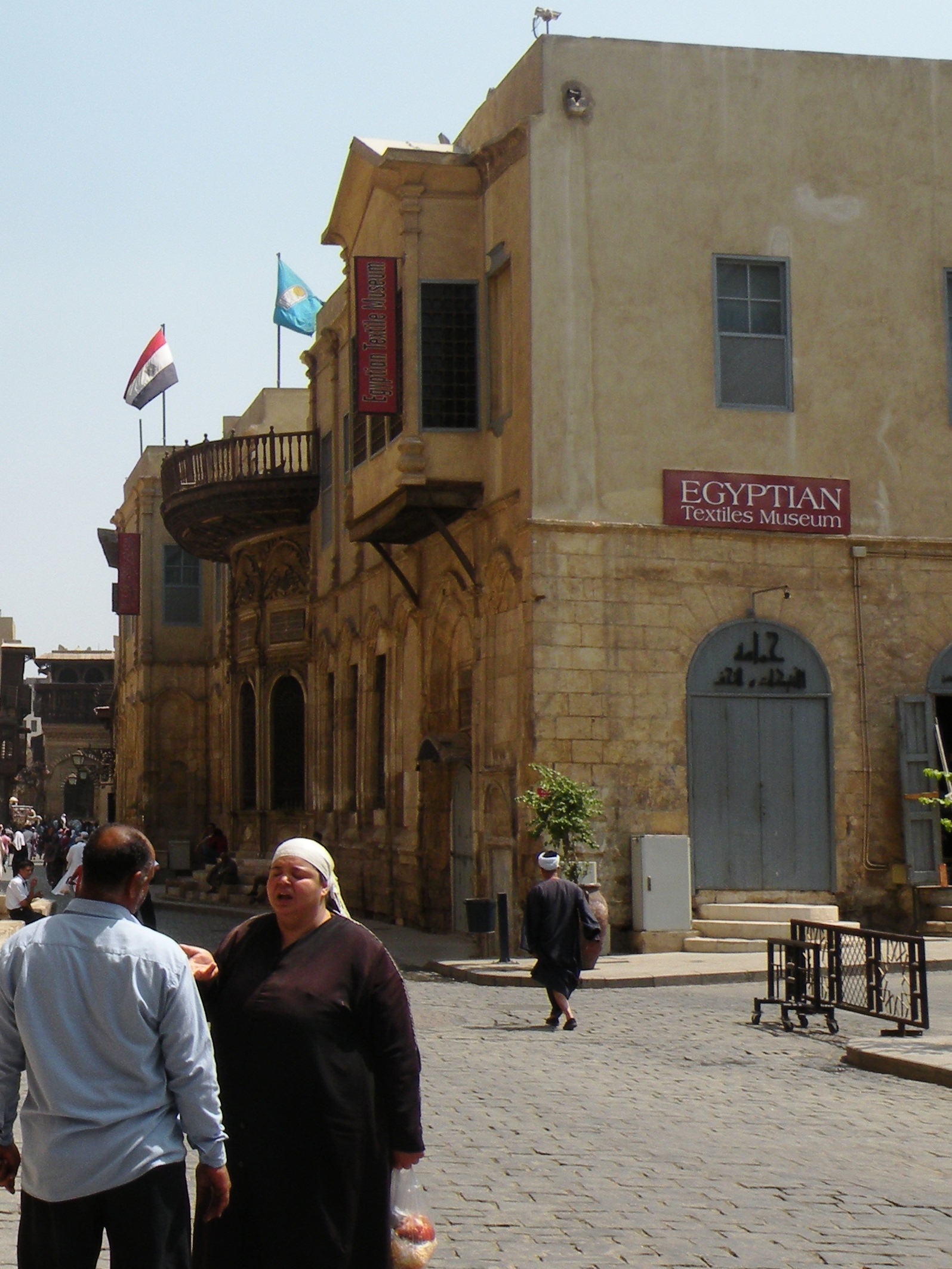
The Egyptian Textiles Museum is one of the 550 “culture palaces” run by the Ministry of Culture. Some are fabulous, others grossly underfunded and mismanaged; most fall somewhere in between. What will the new Egyptian government do with them all?
There is more to the transformation of the arts in Egypt in the revolution than graffiti and street painting, argue Sonali Pahwa and Jessica Winegar in a public-access article in a recent issue of Middle East Report.
In an essay entitled “Culture, State and Revolution,” Pahwa and Winegar describes two often overlooked aspects of the effects of the revolution on the arts:
- the support for the culture industries among mainstream Islamist circles, and
- the transformation of the relationship between the arts and the state
These contrast with–and contradict–a common narrative about the role of arts in the revolution that sees the revolution as having generated an explosion of artistic expression, which will be threatened by the rise of Islamist political leadership.
Pahwa and Winegar argue rather that in countries with strong, centralized ministries of culture like Egypt, the revolution has allowe d artists, intellectuals and new stripes of politicians (including but not limited to Islamists) to rethink the state’s ideology that promoted the arts as part of a path to progress and enlightenment, and to ask “foundational questions about the role of government in the field of culture and vice versa.”
Revolutionary Art in the Streets–and in the Galleries
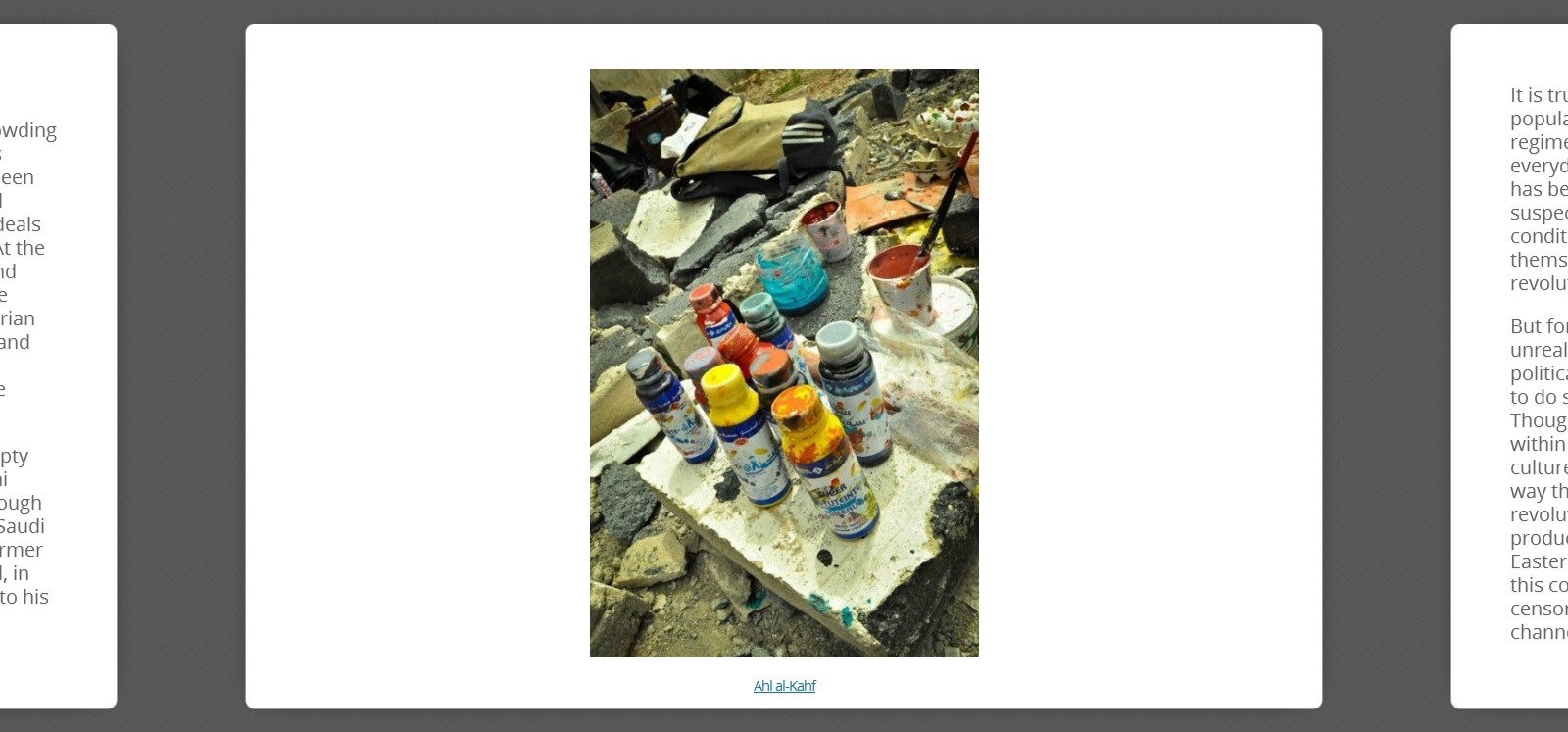
Nancy Demerdash’s new article on art and art markets after the Arab uprisings is available free on-line as either a pdf or a slide show.
Nancy Demerdash has a new article out on the role(s) of art in the “Arab Spring”. Her article “Consuming Revolution: Ethics, Art and Ambivalence in the Arab Spring” in New Middle Eastern Studies (NMES), the innovative new e-journal run by scholars and graduate students at The British Society for Middle Eastern Studies .
The article is available in two formats, a standard pdf file, or a kind of slide show they call a “Quick Study” presentation.
Demerdash’s main argument is that in spite of the continuing political and economic struggles, the idea of the revolution continues to generate artistic production because:
Rethinking Sexual Politics in Egypt
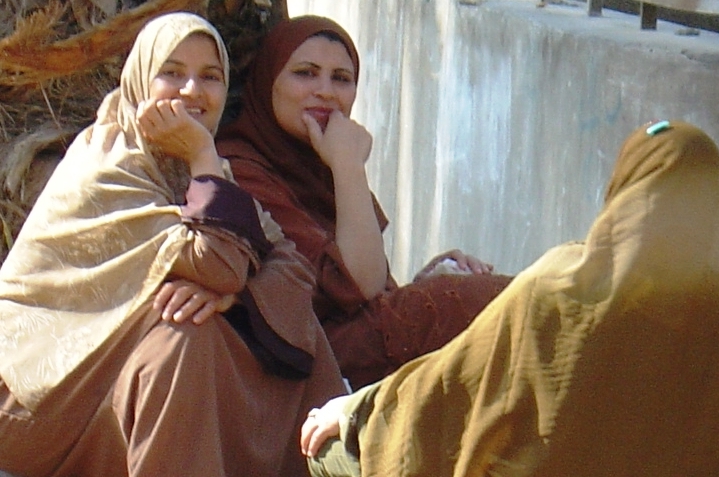
Can we represent Egyptian women without falling into academic stereotypes? Paul Amer may be showing us the way. Photo: Sophie Peterson.
In 2011 Paul Amar published an article entitled “Turning the Gendered Politics of the Security State Inside Out: Charging the Police With Sexual Harassment in Egypt” in the International Feminist Journal of Politics. In their final issue of 2012, the same journal has published a “conversation” between Paul and three other significant scholars of gender, sexuality and power in the form of essays by Cynthia Enloe, Terrell Carver, Omnia El-Shakry and Paul himself, commentating on that article.
You must be doing something right when your work inspires a festschrift before you are an old, wizened professor emeritus. I mean, I’ve been told of individual classes and workshops built around my anthropology of media work, but this is much cooler. And I’m much closer to being wizened than Paul is…)
And appropriate. Paul has long been one of the pre-eminent writers on the Egyptian security state, and his carefully nuanced descriptions of the various security forces that collectively comprise the “security state” taught me to always ask “Who deployed which security force (and why this one and not another one) against whom and with what effect?” each time new clashes occur in Egypt.
In the 2011 article, he described and thickly contextualized the efforts by women subjected to assault by police officers to sue them for sexual harassment. He does so in a carefully construed framework that is alive to the nuances of feminist activities in Egypt, and their complex intertwinings with many different Egyptian social institutions (including those of the state) so that the article undermines any effort to reduce it to a mere framing of women seizing their human rights against the illiberal Middle-Eastern state.
Top Posts of 2012
#1 Bibliography of the Egyptian Uprisings
The single most viewed post of 2012 is my bibliography of books and articles on the Egyptian uprising. I posted this when I realized that I had over 150 entries in my working bibliography. It’s been updated again and again–as of Dec. 31st, this bibliography has grown to 283, and it will keep growing through the new year as more scholarly output appears on the Egyptian revolution. So keep visiting!
#2 More from Anthropologists on the Egyptian Revolution
The second most visited post of 2012 was my review of the second issue of American Ethnologist which included nine brief (3-9 pages) essays on the Egyptian revolution.
#3 Anthropologists Writing About Copts In Postrevolutionary Egypt
In the third ranked post of 2012, I offered a brief survey of eight recently published works on Coptic Christians in Egypt. I learned about these article from anthrocybib, a blog tracking recent publications in the anthropology of Christianity co-authored by my colleague James Bielo and UCSD anthropologist Jon Bialecki.
One of my personal favorites. Chapter Three of Connected in Cairo is about Pokemon as a part of cosmopolitan social capital. This post reflects on changes in global children’s fads, and my encounters with Beyblades in Cairo in 2005.
2012 In Review
The WordPress.com stats helper monkeys prepared a 2012 annual report for this blog.

Here’s an excerpt:
4,329 films were submitted to the 2012 Cannes Film Festival. This blog had 42,000 views in 2012. If each view were a film, this blog would power 10 Film Festivals
Bipolar Unease: Arab Travelers Construct Uneasy identities in Europe

“Who am I, who am British in Egypt, but Egyptian in London?” one of my students once wrote in a class journal. Perhaps the answer lies in strategic nostalgia or banal nomadism, suggests Myria Georgiou. Photo by Gerardo Amechazurro. Used under Creative Commons license.
One of the themes I analyze in Connected in Cairo is that of young, well-off cosmopolitan Egyptians who have constructed their identities for years around some kind of North American or European co-identity. These identities are often shaken when the Egyptian travels abroad and discovers that despite their dual citizenships and local passports they are not taken as “French” or “German” by the French and German Europeans thy encounter.
Those interested in this theme will find useful and interesting reading in a new article by Myria Georgiou in latest issue of the International Journal of Cultural Studies. Entitled “Between strategic nostalgia and banal nomadism: Explorations of transnational subjectivity among Arab audiences,” the article describes some of the ways Arabs in global cities like London, Madrid and Nicosia try to construct identities at a time of passionate public debates in Europe about what sorts of threats “they” represent.
Georgiou describes two basic positions that Arabs take in the face of these “tense and contradictory” ideologies that seek to ascribe to them these troublesome roles:
The cover picture from the Middle Eastern edition of Connected in Cairo (AUC Press) features an Arab woman in a coffee shop using smart phone and laptop. What does the emergence of blogging as a new literary genre mean for the region?
[Article review by Monica Komer]
Cyberspace has blurred the line between public and private spaces. Since the late twentieth century virtual spaces have acted as a global medium for social interactions. The twenty-first century gave birth to a growing number of Arab bloggers, forcing the cyber world to play a large role in how scholars of the Middle East view the political and cultural issues of the region.
In the article, “Arab Women Bloggers: The Emergence of Literary Counterpublics,” Hoda Elsadda argues that cyberspace has welcomed the participation of Arab women. In turn, Arab women bloggers have created new literary spaces that are breaking down the conventional Arab literary establishment.
The article refers to “literary public spheres” as “circles, gatherings and groups” that communicate ideas and shape literary standards and traditions. Literary public spheres in the Middle East are changing, but this is not the first time.
Writers of the late nineteenth century met in literary salons, run by prominent figures and only open to a select few. Eventually, coffee houses, or qahwas, replaced literary salons. By the end of the twentieth century, new publishing houses had replaced coffee houses.
Private entrepreneurial publishers ran these publishing houses. Publishers varied ideologically, politically, and socially which encouraged a variety of publishing opportunities. Alongside these opportunities came a period of increasing internet access. The blogosphere soon emerged as an entirely new public sphere with even greater opportunities.
Dar al-Shorouq, a private Egyptian publishing house, published a three-part collection of short stories in 2008. The stories, written by three female bloggers, demonstrate the opportunities given to Arab women through blogs and the rise of a new literary sphere.
The three literary blogs, from which the stories are drawn, are:
- Ayiza Atgawwiz [Wanna b bride], started in 2006 by Ghada ‘Abd al-‘Aal, humorously and satirically challenges the traditions of marriage in the Arab world. Her stories are about the difficulties of marriage in a society that “looks unfavorably on unmarried women…yet limits opportunities for men and women to meet.”
- Hawadit [Stories] is a blog written by Rihab Bassam. Her short stories are filled with her inner thoughts and multiple personas. Bassam’s blog may be her personal story, but it represents the day-to-day struggles of young intelligent women across the region.
- Ma’a nafsi [On my Own], written by Ghada Mohamed Mahmoud, is the third and final blog from which the stories were drawn. Her blog delves into questions of self-understanding and the search for happiness.
New Review of Connected in Cairo by Joel Gordon
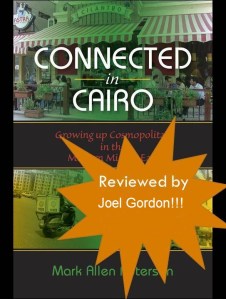
It’s a very teachable book, writes Joel Gordon, but he’d like to see more of the middle classes who challenge elite assumptions.
There’s a new review of Connected in Cairo written by Joel Gordon in the International Journal of African Historical Studies.
Gordon is a political and cultural historian of modern Egypt and the Middle East at the University of Arkansas, where he is director of the King Fahd Center for Middle East & Islamic Studies.
It’s a great review. Gordon does a very good job of briefly summarizing the thrust of the book, and does so in an interesting and readable way.
His overall assessment is uniformly positive, but at the same time he is reading the book against the grain, focusing on secondary voices–those of the aspirational, upwardly-mobile middle-class Egyptians who pepper the book as contrasts to the elite cosmopolitans who comprise the majority of the people on whom the story focuses.
Gordon writes:
There is much to this study that is enlightening. Peterson relates his points at the pace of an experienced lecturer cognizant of the degree to which his readers, especially undergraduates, require a steady dose of repetition. This would be an enjoyable book to teach, theoretically sophisticated, albeit a bit jargon-laden, but accessible. The narrative sections are engaging, whether discourses on the business of fostering and capturing cosmopolitan taste buds or descriptions of social encounters in new and traditional public spaces.
Can Egyptian Women Have Both Civil Rights And Political Freedom?
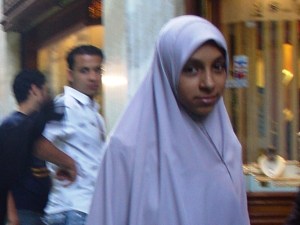
What kind of laws and regulations governing women’s action will be enacted by a new, more populist Egyptian government?
I confess–I have thus far read only one of the papers in the IDS Bulleting special issue on the Egyptian Revolution.
It was Hania Sholkamy’s article “The Jaded Gender and Development Paradigm of Egypt”
I mostly read it because as I was cutting and pasting the abstracts into my post last week, I noticed her name and thought, “Hey! I know Hania!”
And it was worth the read. Hania Sholkamy’s piece offers an interesting reflection on the complexities of gender rights. My favorite quotation:
For decades, development paradigms and programmes have adopted the values of human well-being and dignity, which are both profoundly political projects, while at the same time pretending that development is an apolitical venture. This paradox is evinced by the ability of development practitioners to claim that their rights-driven programmes have had impacts and successes even when these self-same programmes existed in the midst of autocratic and unjust polities.
Sholkamy then describes one of the ways this paradox has played out in Egypt. Rights won under authoritarianism—the al-khol law that allows women unilateral right to divorce, the right of mothers to retain custody of their children in divorce cases after the age of seven, and the cancelation of beit el Ta’a under which police could force women who left their marital homes to return to their husbands—are all under fire and in question under democratic transition (“democratic” being used here to refer to legally elected representative government).

 CONNECTED in CAIRO