Echoes of Revolutions Past
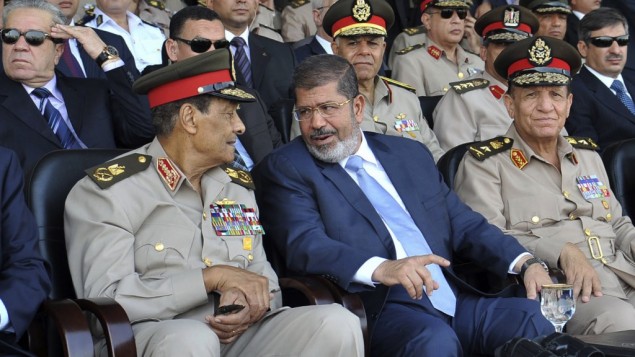
Does disillusionment with the current revolution — especially the role of the military — echo the disappointment that followed the 1952 revolution? President Morsi claimed last month that the new revolution had “corrected the path” that the first revolution had faltered along.
There’s a review of a play put on by students at Ain Shams University by Mona Hashish of Suez Canal University in the latest issue of Middle Eastern Literatures.
Entitled “Echoes of the January 25th Revolution,” it describes an 8 Dec 2011 production of Rijal Lahum Ru’us (Men Have Heads). Written in the 1960s by Mahmud Diyab, the play describes the disillusionment of a couple with the 1952 revolution in ways that resonate strongly with many peoples disillusion over the 2011 revolution.
She writes:
In his play, Diyab tackles a couples disillusionment with the reality of the 23 July 1952 revolution. The collective will crushes the individualistic demands of the people, and justice is not realized. Mubarak’s regime was as corrupt as that of Nasser [does she mean King Farouk’s regime? That was the one overthrown]. The 2011 revolution has not helped people any more than the 1952 revolution did because both revolutions have been foreclosed by the armed forces who recognize only dictatorship. In both eras the army enjoys complete authority, hinders democracy, and transforms the country into a police state.
The play starred Iman Mansur and Majdi al-Mansub. It was directed by Umar Tawfiq.
(Interestingly, they did this play in 2005 at the National Underground Freedom Center in Cincinnati, just down the road from here.)
(You can read this play in English in Short Arabic Plays: An Anthology edited by Salma Khadra Jayyusi (2003, Interlink Books)).
Reference:
Review of “Goodbye Mubarak”
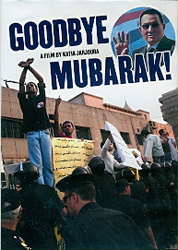 My review of Goodbye Mubarak, a film by Katia Janjoura, has been published by the Anthropology Review Database.
This film focuses not so much on the 18 days in Tahrir Square, but on the tensions and events that led up to the revolt, beginning with the elections of 2005 and continuing into the weeks and months preceding the mass outpouring of opposition. What the filmmakers discover in Egypt during the fall of 2010, in the run-up to legislative elections, is a revolution-in-waiting, simmering under the surface of Egyptian society.
Here’s the abstract:
Goodbye, Mubarak is a straightforward, narrated documentary examining the tensions building in Egypt that led to the 20111 revolution. While there is little new information, the film does an excellent job of putting the social media aspects of the revolution in context, and of capturing the paradox that many Egyptians knew their country was on the edge of a revolution, yet no one actually saw it coming until they found themselves in the middle of it.
Click here to read the whole review.
And here’s the trailer:
Review of Connected in Cairo in Arab Studies Journal

“Participant observation being the messy kind of data gathering practice it is, I don’t really select my informants. I am a guest in their world … and it is my hosts who select me.”
There’s a new review of Connected In Cairo in the Spring 2012 edition of the Arab Studies Journal.
The review is by Shane Minkin, an assistant professor of history at Swarthmore College (where my brilliant colleague Farha Ghannam also teaches).
Minkin praises the writing and organization of the book, which she says reads like a “pleasant jaunt” through pre-revolution Cairo.
The bottom line of here review, though, is that:
While enjoyable, the work suffers from a lack of methodological clarity. Additionally, it employs an expansive definition of cosmopolitanism that ultimately encompasses all things elite. This broad application ultimately muddles the meaning of cosmopolitan and leaves the reader unsure of the boundaries of its application.
By “lack of methodological clarity” she means that she is dissatisfied with my discussion of how I selected my informants, how their words and actions were distilled into data, and how I derived my analysis from that data.
I can’t really say much to refute this. I am not a fan of detailed “methods” sections in books; I tried to describe the contexts through which I knew each informant as I introduced them. This is an approach I probably picked up in my career as a journalist and while I think it makes my work more readable, a purist might well see it as just a bad habit.
Bassem Youssef on the Daily Show
Bassem Youssef was interviewed June 21st on the Daily Show–by his own account, one of the models for the kinds of shows he’s doing in Egypt .


Read my writing about Bassem Youssef:
Taking Satire Into Egypt’s Public Sphere (May 1, 2011)
Bassem Youssef Leaps From Social Media To Television (Aug. 8, 2011)
News Parody and Social Media: The Rise of Egypt’s Fifth Estate (Apr. 4, 2012)
Creating Social Change Through Digital Media I (July 21, 2012)
The Mystery of Omar Suleiman

Who knows the answers to the many questions Al-Masryoon has about Omar Suleiman’s death? Perhaps…the man behind Omar Suleiman!
What mysteries surround the death of Omar Suleiman, once called “Egypt’s torturer-in-chief”?
For many Egyptians, Omar Suleiman was a symbol of evil incarnate (okay, full disclosure–for me too). For twenty years he was the head of Egypt’s General Intelligence Service, aka the mukhabarat. Under him, arbitrary detention and torture became commonplace as deterrents to dissent. He was the contact man for the USA’s rendition of terrorist suspects (it’s said the US once asked for a sample of a suspect’s DNA, whereupon Suleiman jokingly offered to send them the guy’s whole arm).As Mubarak fell, Suleiman escaped not only prosecution but investigation, to re-emerge as a would-be presidential candidate. So his death in a Cleveland clinic seemed a strange anticlimax.
Western newspapers saw nothing strange in his death. Doctors spoke of a rare medical condition and regime officials told reporters he’d had heart problems for several years.
In Egypt, however, it is believed by many people that he was murdered, that a dying Suleiman was rushed to the U.S. in a last-ditch effort to save his life.
Many of the conspiratorial stories came together in a July 26th op-ed in the Egyptian newspaper Al-Masryoon. The opinion piece was entitled “Who Killed Omar Suleiman?” and written by Chief Editor Gamal Sultan.
Among the questions Sultan wants answers to:
- How could Suleiman have been suffering from heart problems or some unknown illness when only three months ago he was running in the presidential elections?
Ouch! Did I Say That?
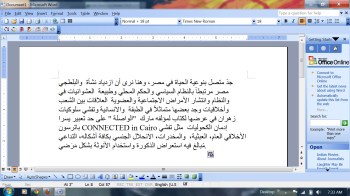 The other day I stumbled across a pessimistic Arabic blog post about the revolution that mentioned my book.
Imagine my surprise when I discovered that I was being cited as an expert on “the prevalence of addiction to alcohol and drugs, sexual decadence in all its forms” among upper class Egyptian youth.
Because my written Arabic is not as fluent as it could be, I ran the passage by a friend, Dan Varisco at Hofstra (who has really good Arabic) to confirm my gloss of the passage (I’d have been really embarrassed if I’d missed a crucial phrase like “does not” which would change the whole meaning). Alas, he confirmed that it said what I thought it said.
I don’t think I mention anyone addicted to drugs in the narrative, and the only person I mention with anything that might be construed an alcohol addiction was explaining to me how she had cured herself through a commitment to greater Islamic piety.
What I do write about, especially in the latter half of the book, is (some) people who are alienated both from the global culture to which they aspire–by their origins in an Arab country–and from their own society by their educations, affluence and participation in transnational popular culture. Many of these seek to ground their identities in a greater Islamic piety or in patriotic nationalism–two trends we’ve seen play out publicly in the revolution.
Monatov: Funny But Short-Lived Political Satire in Egypt
Not all political comedy is as successful as Bassem Youssef’s. Take for example, the delightful “Monatov.”
Monatov was a web based political comedy series like Bassem Youssef’s B+. It was a labor of love by actress Mona Hala, producer Ahmed Fahmy and writer Haisam Abu Samra, who had worked together on two Ramadan series, Lamba Show (Lamp Show) and Rob’e Meshakel (Mixed Quarter), two parody programs modeled after Saturday Night Live in the US. Mona Hala was one of the first public figures to prominently join the protests in Tahrir Square.
The title is a combination of the actress’s first name and “Molotov”–after the cocktail, of course.
The Monatov sequences are faster paced, edgier and more daring than most of Bassem Youssef’s stuff, fitting Mona Hala’s high energy style, and seem to draw their inspiration more from fast-paced MTV style television than from the news parodies of the Daily Show and the Colbert Report, from which Bassem Youssef derives his inspiration.
New Article: Ultras As Social Nonmovement in Egypt
One of the most fascinating questions about the Egyptian uprising is the role of the Ultras.
Ultras are sports fans renowned for their fanatical support of Egyptian sports clubs–especially Zamalek (“Ultras White Nights”) and ‘Ahly (Ultras Ahlawy)–and for their elaborate displays intended to create an atmosphere that encourages their own team and intimidates opposing players and supporters. Ultra activity can lead to violence, and Ultra-police clashes have long been common (a common Ultra slogan is ACAB, meaning “All Cops Are Bastards”). Since the revolution, Ultras have involved themselves in fights between anti-military protesters and government security forces in Egypt.
One important aspect of the Ultras in the Egyptian uprisings?
The presence of ultras in Tahrir Square was the only organized entity with vast experience in dealing with the security forces and police brutality.
Those are the words of Faedah M Totah. In a recent article in Anthropology News, entitled “Ultras Uprising or Boys Just Wanna Have Fun?” she describes the Ultras as an example of “social nonmovements” (Bayat 2010) in which people come together in similar activities that can trigger social change without the structure, leadership, and formality associated with traditional social movements.
She writes:
it is this ability to shift from sports to politics that makes the ultras fascinating. They already had vast experience in marking the cityscape with the logos of their favorite teams and were skilled at rioting at local games and evading the police and security forces. These skills were transferable during the demonstrations in Tahrir Square. Perhaps the interesting thing about these ultras is their ability to organize and mobilize individuals who are “action-oriented rather than ideologically driven” (Bayat 2010:19). The lack of ideology makes it easier to attract supporters regardless of their socio-economic and political backgrounds. They are one of the few entities in Egypt that transcend the social, religious, and economic barriers to coordinated political action in Egypt. Therefore, “social nonmovements” such as the ultra can engage in political activities without being political actors.
References:
Bayat, Asef. 2010. Life as Politics How Ordinary People Change the Middle East. Stanford University Press.
Totah, Faedah. 2012. Ultras Uprising or Boys Just Wanna Have Fun? Anthropology News
 Tax Justice Focus, the newsletter of the Tax Justice Network, has an article in its latest issue on a topic I’ve blogged about before: Are there connections between the Arab uprisings and the Occupy movement?
Obviously there are symbolic connections: Protesters in Tahrir using the web to order pizza for occupy protesters, Occupy protesters dedicating songs to their colleagues in Tahrir Square, and so forth.
This issue has an article entitled “Reconceiving Class War” by philosopher Philip Goff (University of Liverpool) in which he argues that both movements are seeking to create more perfect democracies.
The Egyptian uprising seeks to establish democratic institutions at a national level, he writes, while the occupy movement is trying to help democratic institutions that already exist in the countries it inhabits to resist the antidemocratic forces of global market capitalism.
 I blogged earlier about the International Studies capstone group here at Miami that naively proposed using the Internet to inspire a democratic revolution in Russia. Clearly they had drawn inspiration from the most rabid of cyberutopians, and they quoted Egyptian activist and cyberutopian Wael Ghonim in their presentation.
Yet the notion that electronic media–radio, television, the Internet and especially Web 2.0–can truly be a game changer that transforms the ways people engage in social and political change remains a compelling belief, one to which the Egyptian uprising and other Arab revolutions have contributed.
The issue of emancipatory media poses two crucial questions:
- Can media be used in emancipatory ways by social movements and
- if so, how is this to be accomplished?
I recently reviewed a two volume series of case studies examining successful as well as not-so-successful efforts at harnessing media to create social change. Since then, my attention has been drawn to several more efforts that answer the first question with a resounding “Yes” and seek to move on to the second.
Here’s the first installment, an assessment of Dan Gillmor’s Mediactive.
Dan Gillmor tackled the first question in his 2004 book We the Media. His new book, Mediactive, tackles the second.


