Article: Obama and the Arab Spring
 A new article has been published on the uprising.
Roberts, Lorna and John Schostak. 2012. Obama and the ‘Arab Spring’: desire, hope and the manufacture of disappointment. Implications for a transformative pedagogy. Discourse: Studies in the Cultural Politics of Education 33(3): 377-396.
Abstract:
For a period, in the run up to the election (2007–2008) and the months after the election, the name ‘Obama’ signified hope for millions, not just in America but across the world. As the hope turned to disappointment, the financial crisis deepened and the Arab Spring renewed a call for a ‘humanity’ that could transcend the differences of nations and faiths. What can be learnt from such events about the pedagogies of hope, disappointment and public action? Are there lessons for a transformative pedagogy, an education that could underpin and continuously create the conditions for a politics of freedom and social justice? A range of print, broadcast and digital/Internet news media is analysed to explore the political/rhetorical/pedagogical strategies already set into play that ‘manufacture disappointment’ in order to undermine and negate the transformative, transgressive symbolic significance of ‘Obama’ and thus manage the theme of change to reassert the same.
Social Media and the Egyptian Revolution Redux

Blogger Aalam Wassef (photo by Scott Nelson). The use of social media for political change and resistance in Egypt would seem to deny Sherry Turkle’s isolationist hypothesis.
I was recently part of an on-line discussion that started when a colleague suggested that one way to start thinking about the role(s) of social media in the Arab revolutions would be to look at Sherry Turkle’s book Alone Together (Basic Books, 2011).
Not, many of us thought, a frutiful line of thinking.
As my colleague Philipp Budka responded on the European Association of Social Anthropologists’ Medianth list:
The Turkle book/idea is highly problematic, as she more or less continues to propose an isolation theory towards digital media practices. In doing so she is stark contrast to most of the sociological/anthropological research in this area that sees online activities closely related to offline social practices (e.g. extension of “offline” social relations online).
In other words, Turkle’s recent work has claimed that:
Technology promises to let us do anything from anywhere with anyone. But it also drains us as we try to do everything everywhere. We begin to feel overwhelmed and depleted by the lives technology makes possible. We may be free to work from anywhere, but we are also prone to being lonely everywhere. In a surprising twist, relentless connection leads to a new solitude. We turn to new technology to fill the void,but as technology ramps up, our emotional lives ramp down.
I don’t want to knock Turkle’s work, which “is the result of [her] nearly fifteen-year exploration of our lives on the digital terrain” and is “[b]ased on interviews with hundreds of children and adults” but this kind of sweeping generalization and universalizing of culturally specific data contradicts two key assumptions I see as at the core of the anthropology of media:
International Studies – Second Edition
 Just a quick piece of shameless self-promotion:
Amazon is now taking pre-orders for the second edition of International Studies: An Interdisciplinary Approach to Global Issues for both the paperback and Kindle editions.
Written by a geographer, a historian, a political scientist, and an anthropologist (me!), this textbook provides a much-needed interdisciplinary approach to international studies. Emphasizing the interconnected nature of these disciplines, the authors detail the methodologies and subject matter of each to provide a fuller understanding of the world. Applying these discipline lenses to regional chapters, the authors examine issues facing these regions and the global community. Case studies give readers a closer look at issues such as international terrorism and national identity. This disciplinary and regional combination provides an indispensable, cohesive framework for understanding global issues
The new edition includes:
- a rewrite of the economics chapter (with me as co-author) to include the global financial crisis.
- I also revised the Middle East chapter to discuss the Arab uprisings.
- I made minor revisions to my essays on International Terrorism and the Veiling Controversy.
- And I completely rewrote the conclusion to discuss how these disciplines can be integrated into a holistic model for analyzing global issues and thinking creatively about solutions.
All my colleagues have updated their chapters as well.
I am currently compiling a set of on-line teaching resources, so if you have any good ideas for creative use of web sites, video clips, animations, slideshare presentations or other resources freely available for enhancing lectures on social science disciplines (anthropology, economics, geography, history or political science) or world regions (Africa, East Asia, Europe, Middle East, South America or South Asia), please share them with me!
Making Sense of Political Parties in Egypt

The large number of political parties in Egypt can be roughly grouped into three categories, claims Daniel L. Tavana.
As we anticipate the next round of Parliamentary elections following the court decision to void the results of 30 percent of the elections, it’s useful to reflect on the organization of political parties in Egypt. Daniel L. Tavana did just this in his “Party Proliferation and Electoral Transition in post-Mubarak Egypt” published last year in the Journal of North African Studies before the first round of elections.
Tavana’s paper explores the radical change in the Egyptian political landscape brought on by the legalization of real political parties (in contrast to the Mubarak era, when the only real political party was the NDP). Tavana’s basic thesis is that parties can be clustered into three main political categories:
- religious
- leftist
- liberal.
There is nothing particularly deep or insightful in Tavana’s paper (I’m not even sure I accept his categorizations) but it offers a very good general summary, very concretely organized.
Evolution of Political Diversity
Tavana locates the roots of this political diversification in the rule of Anwar Sadat, who split the Arab Socialist Union (founded by Nasser) into three separate groups:
 I tell my International Students that if they read only one academic journal about the Middle East it should be The Middle East Report. It is genuinely interdisciplinary, usually well-written, offers a range of articles from microlevel accounts to macrolevel analyses, and has a great web site in which they give away some of their content.
So now some of the best essays from Middle East Report have been collected in a book entitled The Journey to Tahrir: Revolution, protest and Social Change in Egypt, edited by Jeannie Sowers and Chris Toensing. It’s published by Verso.
I’ve written about several of these essays here in this blog, including Mona El-Ghobashy’s The Praxis of the Egyptian Revolution, Elliott Colla’s The Poetry of Revolt, Jessica Winegar’s Taking Out the Trash: Youth Clean Up Egypt After Mubarak, and I’ve referred to work by Joshua Stracher, Joel Beinin, Asef Bayat, Linda Herrera, Mariz Tadros and Issandr Al-Amrani. And here they are together in one big book which promises to be the best book on the Egyptian uprisings so far.
Here’s the complete table of contents:

Casting the revolution as an archetypal narrative of heroic revolutionaries fighting against the villainous Mubarak, as much of the Western media has done, conceals many real-world complications claims Karin Wilkins.
In the same issue of the Danish media research journal Mediakultur that has my book review, there is a full length article on the role of digital media in the Egyptian uprising. Entitled “Wearing shades in the bright future of digital media: Limitations of narratives of media power in Egyptian resistance” by Karin Gwinn Wilkins, the article argues that the essence of political engagement is collective resistance, and that while digital media can be an important tool in creating this, it is neither necessary nor sufficient.
Her main concern is that in their news coverage of the Egyptian uprising, “U.S. media rely on Orientalist narratives, not only essentializing complex communities to a reductive tale of hero, victim, and villain, but also privileging the role of social media as an anthropomorphic heroic sidekick, indispensable to the success of the movement.”
In other words, global media reduced the story to a handful of young, attractive underdog heroes (the youth revolutionaries) battle a master villain (Mubarak), who has all the power of the state and its media at his command, thanks to their special seemingly insignificant weapon (the One Ring—oops, I mean Social Media).
Telling the story this way is interesting, and gets ratings, but conceals important complex realities such as
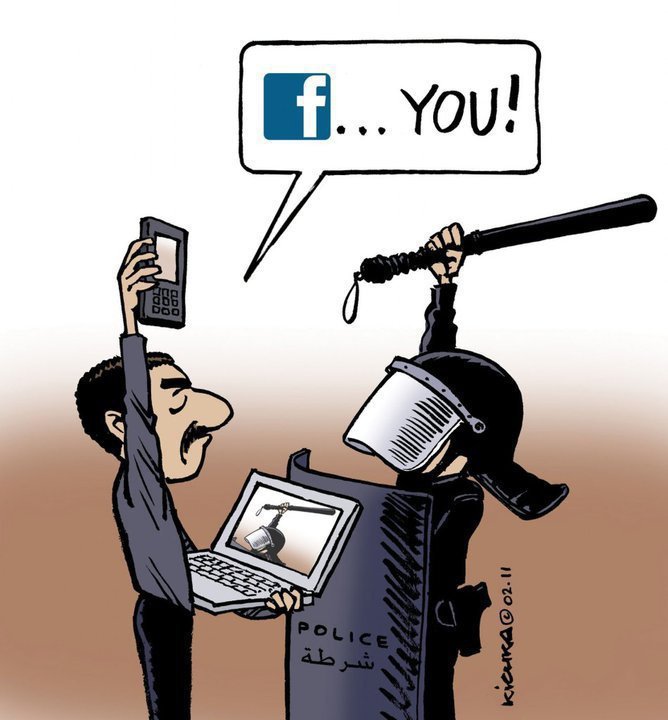 While the recognition that small media can play a crucial role in democratic social movements, civil society and political resistance against the state (and powerful non-state institutions) has received a huge boost from the significant uses of the Internet, cell phones, hand-held video, and alternative news networks by protesters in the Middle East, sub-Saharan Africa, Spain, Greece, the United Kingdom, and elsewhere throughout the last year, the broader notion that a third kind of media–controlled by neither the state nor corporations–can serve as a tool for resistance (to the state or the corporations or both) and democratic change is not new. It did not arise with social media or with the Arab uprisings.
My review of a two-volume set of books on such media, “Our Media” in the language of its authors, was just published in the Danish media research journal Mediakultur.
Making Our Media: Global Initiatives Toward a Democratic Public Sphere is a two volume set that seeks to examine how small and alternative media are being used around the world to transform communication practices in more democratic ways. The set consists of 24 studies set primarily in Latin American countries, as well as the United Kingdom, Canada, Australia, India and South Africa.
New Civilities in the Egyptian Uprising

Unlike earlier protests, which were about economic issues, particularly changes in food subsidies, the current uprisings were about restoring civil dignity argues Salwa Ismail.
The largest protests and demonstrations before the current revolution in Egypt had been bread riots, carried out mainly by members of the lower classes and poverty-stricken people whose main concern was the rising price of food threatening them with starvation. The 2011 Egyptian uprising was about something much deeper–seeking to reclaim the dignity and character of an entire nation.
That’s one of the central points made by Salwa Ismail in her paper “Civilities, Subjectivities, and Collective Action: Preliminary Reflections in Light of the Egyptian Revolution” published in Third World Quarterly.
The article was one of two by Ismail in a special issue on “civility“–the forms of “mutual deference” (Boyd 2004) and “self-restraint” (Salvatore 2011) that allows particular forms of active citizenship to come into play–just at the time that the ways civility is constructed is being radically transformed in the face of the revolution
Ismail looks at how Egyptian “national character”–as expressed in the ways people interact with one another and the agents of the state–changed in light of the revolution. She describes how, for example, in the aftermath of the police being called off the streets in the first few days of the Revolution, ordinary Egyptians took it upon themselves to, among other things, keep the streets clean, form public protection committees, and regulate traffic.
 Nathan J. Brown, of the Carnegie Endowment for International Peace, lays out the key questions posed by the supreme court decisions on Egypt’s next important transitional stage, the drafting of a new constitution:
What happens to the constitutional assembly just elected?
Can a constitutional assembly elected by an unconstitutional parliament still sit?
Does the parliament’s passing of a constitutional assembly law remain valid even if the parliament is dissolved and the Supreme Council of the Armed Forces (SCAF) has not approved the law?
Even if the constitutional assembly is not dissolved by this ruling (and as I write this, that question is not clear) can the fact that the parliament elected some of its own members to the body (even if they are no longer parliamentarians) be used to challenge the body?
And politically, will those who were going to boycott the constitutional assembly (because they disagreed with its social composition) now agree to take their seats?
And in the legal realm, a new parliamentary election law is needed. Who will issue it? The SCAF in its waning days by decree? Or the new president by decree?
And more generally, will the SCAF use the absence of parliament to parachute in a new constitutional declaration so that it does not have to surrender all its power to the president at the end of the month?
Or will the SCAF revive the 1971 constitution it cancelled last year?
References
Brown, Nathan J. 2012. Cairo’s Judicial Coup. Foreign Policy, June 14

Egypt’s Supreme Constitutional Court was the site of the latest major event in Egypt’s ongoing unpredictable political transformation.
Wow. The verdict of Egypt’s Supreme Constitutional Court today offers yet another sudden abrupt shift in Egypt’s ongoing political transformation.
The Supreme Constitutional Court was meeting to consider the validity of a law passed in April by the parliament that denied political rights to anyone who held a senior government post or NDP position in the last decade of Mubarak’s rule.
The law would have effectively barred Ahmed Shafiq, one of the two front runners in the Presidential election from participating in the run-off elections.
Perhaps this would have meant third-ranked Nasserist candidate Hamdin Sabbahi would have moved forward to run against Morsi.
Instead, the Court’s decision was that one-third of Parliament had been illegally elected, so the law banning former regime officials doesn’t count. Nor does any other law it has passed. And, in fact, the whole Parliament will have to be dissolved and new elections held.

 CONNECTED in CAIRO