The Man Behind Omar Suleiman Still Going Strong

Hebatallah Salem of the American University in Cairo spoke briefly about the Man Behind Omar Suleiman phenomenon in Oxford on May 18th–and revealed that the jokes continue…
When I wrote about “The Man Behind Omar Suleiman” as a form of revolutionary humor, I believed it had crested and declined during February of 2011.
But when I was at Oxford last month I heard two new Omar Suleiman jokes that came out during the electoral nomination process. It seems that the visual meme did in fact decline after the request by Col. Hussein Sharif’s family. But verbal jokes apparently continue.
The first one was a text message that went like this:
“The Man Behind Omar Suleiman nominates Abu Ismail for president.”
The joke here stems from the fact that Hazem Salah Abu Ismail did announce his candidacy for office but was rejected by the Electoral Commission when it was confirmed that his mother held U.S. citizenship.
The second one is much funnier and goes like this:

Under what conditions can collective action occur among Egypt’s laborers? Under what conditions can it succeed?
Labor actions don’t take place in a vacuum. Even in a situation like Mubarak’s Egypt, where neither the political parties nor the federation of unions represents workers, collective action only takes place under exceptional circumstances.
The Egyptian uprising, and its aftermath, provided those circumstances.
That was one of the key points I got from Marie Duboc’s talk “The Egyptian Labour Movement and the Politics of Visibility” at the international conference ‘The Egyptian Revolution, One Year On: Causes, Characteristics and Fortunes’ held on 18 and 19 May 2012 at the Department of Politics and International Relations, Oxford University.
The role of labor in the Egyptian uprising has been undercovered in the world’s media, but has played a very important role in the revolution.In particular, it provided a number of ways for labor to make itself visible on the political scene.
The beginning of the twenty-first century was a period of exceptional contention and mobilization in Egypt starting with demonstrations against the US-led invasion of Iraq and protests denouncing Hosni Mubarak’s repressive regime and his attempts to designate his son, Gamal, as successor. Workers have also voiced their grievances through strikes, sit-ins and other forms of protest against poor living conditions caused by the erosion of wages, rising inflation and precarious employment. With two million Egyptians protesting in the workplace, these actions have been the largest wave of labor action since the fifties.
What, you never heard about any of it? Don’t blame the US media–Egyptian state media didn’t cover it either. There have been thousands of strikes, but most of them are rendered invisible to the wider public because there is little communication about them. Often, even other unions don’t know when one union strikes.

The regime’s corruption did not stifle entrepreneurialism–it encouraged the creation of new businesses by elites for elites. Photo by Sophie Peterson.
In the light of Mubarak’s acquittal on charges of corruption, and even more shocking, that of his sons, it is interesting to review what is known about corruption during the Mubarak era.
Fortunately, there’s a paper posted to Scribd entitled “The Nexus of Power and Money in Mubarak’s Egypt” by a guy named Christopher Haynes that does a very good job of aggregating the literature on corruption during the Mubarak regime. (Hayne’s bio on Scribd doesn’t reveal many specifics about him but I think he might be the Chris Haynes studying for a Master’s Degree at the American University in Cairo who sometimes writes articles about Egypt for the Atlantic Sentinal. Certainly his papers read like good grad seminar papers).

And middle class entrepreneurialism struggled on amidst the declining infrastructure and widening gap between rich and poor.
His thesis in this paper is a variation on the readily accepted fact among most Middle East scholars that the US and European push for Egypt to adopt neoliberalism as part of its repositioning in the global economy became a way for a business elite closely connected to the regime to enrich itself at the expense of the people by avoiding competitive bidding for state properties, buying land at sub-market rates, and so forth.
He argues–correctly, I think–that this goes beyond mere corruption and describes a whole structure for doing business.
One part gave me pause. He quoted my account–in this blog–of people in Luxur complaining that their houses have been razed by a company connected with Gamal Mubarak against which they were helpless to do anything.
Okay. So far, so good.
But the lesson he draws from this anecdote is not one with which I’m entirely comfortable. He writes:
Anger and Disappointment Over Mubarak Sentencing

The sentencing of Hosni Mubarak has produced anger, not celebration in Cairo. Although convicted to life imprisonment for not trying to stop the killing of protesters, the president was acquitted of corruption charges and is expected to be acquitted of the other charges on appeal.
At the conference on the Egyptian revolution I attended last month at Oxford University, Mustapha Kemal as-Sayyid argued that one of the four necessary operations that must be met during Egypt’s transitional phase is that of “ensuring traditional justice.” In Egypt, he said, it is the court that has taken on this projects, and the question as to whether or not it is working would be decided by the sentencing decision on Hosni Mubarak June 3.
The anger and disappointment in Egypt over the sentence make it very clear that for most of those engaged in the Egyptian revolution, the court has failed miserably.
The court sentenced Mubarak and Habib El Adly, the former interior minister, for complicity in the deaths of more than 850 protesters killed during the uprisings, but acquitted the six security officials also charged in the killings. The court also left the door wide open for an appeal, which most Egyptians assume will end in an acquittal for Mubarak as well.
To add insult to injury (from a revolutionist’s viewpoint), the court acquitted Mubarak and his sons of corruption, citing lack of evidence–in spite of the fact that the Mubarak and his family have clearly enriched themselves through the use of their positions in ways neither of his predecessors ever did.
Way back when I first began to talk about the revolution, I outlined six possible outcomes, one of the most likely of which was a silent coup, that is, a situation in which the dictator falls but the regime remains intact.
Becoming Muslim: Self and God in Egypt

Anthropologists have written of people as Muslim because they grow up enculturated as believers, but also because they make themselves Muslim through their actions. But how can we also include their beliefs that God reaches out to them as an active agent? asks a recent article by Amira Mittermaier.
One of the most important shifts in the anthropology of Islam was the recognition of the role that “self-cultivation” played in religious practice.
After ages of Islam being described as a fatalistic religion, or one in which shari’a governed every possible form of action, anthropologists began to pay attention to the ways in which pious people created themselves as pious through strategic actions. Rather than being regulated by rules they learned growing up, ethnographers began to attend to the ways people disciplined their bodies, actions and–so they say–minds in an effort to become ever more in line with the will of God.
It was an important shift because Islam was often treated as if it were an irrational obstacle to individual free will, the autonomous self, and the innate desire for freedom that characterize most Western notions of personhood, and which are assumed by many Europeans and Americans to be human universals.
Extreme versions of this attitude are still sometimes expressed by students on their blogs in my introductory anthropology class . One young woman wrote that women in Morocco (which she had visited) wore veils because they have culture, whereas women in the US don’t because they don’t have culture. Or the guy who wrote that people in the Muslim world were constrained by their culture, whereas “we” can do anything we want within the limits of law and public acceptance (one wonders what he thought “culture “was…). (To be fair, both these statements were posted early in their respective semesters. I hope that by the time the class ended, their understandings had deepened…albeit they may merely have learned to be discreet in what they say to the professor!)
Anyway, the work of Talal Asad, Saba Mahmood, and Charles Hirschkind led us to a very different language for writing about people’s practices as Muslims. I first encountered this approach in the work of Saba Mahmood, and it was a revelation. In Mahmood ‘s work, people are not simply believers because they have been religiously enculturated to be believers. Rather are they continually–and quite consciously and strategically–creating their inner states of piety by disciplining their bodies so as to develop habits of acting piously.
This approach fit perfectly with a set of a dozen or so interviews I had with well-to-do, Westernized young people who were turning away from secularism toward God, and more-or-less inventing the way as they went, cobbling their practices together from the teachings of various sheikhs, teachers, television personalities and things they read or heard on religious cassettes. Four of these play a prominent role in Chapter Four of Connected in Cairo.
 The interdisciplinary journal Interface: a journal for and about social movements has just released a special issue entitled “The season of revolution: the Arab Spring and European mobilizations.” The first half focuses on the Arab uprisings, while the second half focuses on the recent uprisings in Spain and elsewhere in Europe.
Below I list the thirteen articles focused on the Arab Spring, including Egypt, but if you want the European articles as well you can download the entire 408-page issue free as a .pdf file by clicking on the title or the cover image above.
And the articles are:
Shihade, Magid, Cristina Flesher Fominaya and Laurence Cox. 2012. The season of revolution: the Arab Spring and European mobilizations. Interface: a journal for and about social movements 4 (1): 1 – 16.
Mackell, Austin. 2012. Weaving revolution: Harassment by the Egyptian Regime. Interface: a journal for and about social movements 4 (1): 17-19.
Explaining Shari’a–Well, Better Than Usual, Anyway

This classic Western media image of shari’a as a burdensome body of strict (and oppressive) laws is so much simpler–and easier to communicate–than the actual complexities of shari’a as “the way of being Muslim.” [BTW I stole this image from an “anti-jihad” web site and I have no idea where they stole it from, as they gave no credit. So if anyone owns this image and wants credit (or wants it removed) let me know.]
Teaching exactly what shari’a is, and how it can be variously interpreted in different contexts by different judges, and the ways some parts are meant to be mandatory and binding while others are merely recommended is a teaching nightmare especially in an overview class where you can’t devote more than 50 minutes to the topic (although I do have a fun short lecture about how different jurists in the 13th and 14th centuries fit the new beverage coffee into shari’a, based on Ralph Hattox’s book on the topic).
So I’m grateful to Nathan J. Brown at the Carnegie Institute for his “Egypt and Islamic Sharia: A Guide for the Perplexed” which does a very nice job of explaining shari’a and putting it into the current Egyptian political context.
It will definitely be on my syllabus next time I teach “Middle East: Anthropological Perspectives” or the International Studies course “Issues in the Middle East”
A Bibliography of the Egyptian Uprising
 For some time I’ve been collecting academic articles on the Egyptian uprising, including those that I’ve already described elsewhere on this blog, into a single bibliographic reference list.
When I started I only had a few dozen references so I didn’t publish it. Last week, I was updating it after the conference in Oxford and I discovered it had grown to more than 150 citations. So it was time to make it available as a resource: A Bibliography of the Egyptian Uprising.
Naturally it favors my own discipline of anthropology, and my topical interests in media and communication, but I’ve tried to also pay attention to political science, geography, economics, history and other disciplines. I’m not trying to include news stories and op-eds unless they take on a significance in the scholarly literature–like Malcolm Gladwell’s controversial piece in the New Yorker.
Please feel free to e-mail me references (preferably in Chicago style) at petersm2@muohio.edu if you see something worthwhile is missing.
Evil Foreigners Versus Authentic Egyptians in TV Debates Over the Meaning of the Tahrir Square Protests
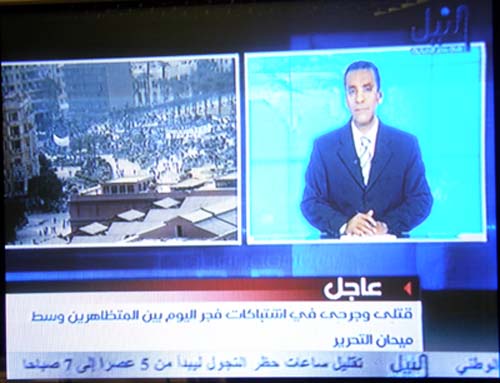
How did media figures construct their identities during the 18 days?
Stance, in sociolinguistics, refers to the ways people use language to establish identity by positioning themselves with one group or another; literally, “who do I stand with?” Of course, in establishing in-group identities stance also established out-group identities.
Sociolinguist Reem Bassiouney, associate professor at Georgetown University and author of the excellent Arabic and the Media: Linguistic Analyses and Applications (2010, Brill) has written a fabulous article looking at stance in the media wars over the protests in Tahrir Square between Jan. 25 and Feb. 11, focusing on how the Egyptian media tried to discredit the protesters by constructing them as non-Egyptian, or at least inauthentic Egyptians–and how at least one poet fought back.
Bassiouney looks at three specific cases.

 CONNECTED in CAIRO