
Bassem Youssef’s El Bernameg was the main focus of the paper on news parody I gave this week at the International Studies Association meetings in San Francisco.
On Monday April 2nd I presented a paper entitled “News Parody and Social Media: The Rise of Egypt’s Fifth Estate” at the International Studies Association meetings in San Diego.
There are multiple versions of this paper, all of which center around the potential of news parody like Bassem Youssef’s B+ and El Bernameg to use humor to entertain, but also to offer a critique at once of the absurdities of political posturing, on the one hand, and the ways media construct authoritative accounts (and hence get used by politicians), on the other.
You can read the longer version here. The ten minute oral version is reprinted below.
Here’s my abstract:
The capacity of social media to copy, quote, cite, link to, transform, and otherwise engage in metacommentary on mainstream media was crucial to the roles it played in Egypt’s 25 January uprising. More recently, news parodies like the Bassem Youssef shows and El Koshary Today have emerged to play similar roles. These parody news programs represent a shift of political parody and ironic humor from the private realm of interpersonal interactivity to the public sphere. They offer a continuation of the anti-structural elements that began in Tahrir Square and offer a carnivalesque experience that exposes and inverts traditional hierarchies. Collectively, these institutions may comprise an emerging “Fifth Estate, a watchdog on the news media, who are supposed to be the watchdog on government and corporate intrusions into people’s liberty, but too often become their voices.
The panel was entitled “All the News? Reporting and Media 2.0” and featured two papers on social media use in the context of the drug war in Mexico, an analysis of news media preference and knowledge about the Iraq War in the US, and my personal favorite, which concluded by criticizing International Relations specialists who pontificate and write for the media without any accountability for the continued failure of their claims and predictions.
Here’s the panel line-up with links to their abstracts and long versions of their papers.
From Microblogging to Microperformance in Egypt

My April column for the Society for Linguistic Anthropology just appeared in the Anthropology News web site. It will also appear in the print edition. The topic is the tweetnadwa. The version below is pretty much as it appears in the Anthropology News version, except for the embedded video.
The claim that Egypt’s 2011 uprising was a “Twitter revolution” has been hotly contested, with numerous pundits taking one position or another depending on just what they mean by the term.
What is significant about the use of social media in the North African uprisings is not so much the technologies of blogging and microblogging themselves, but the creative capacity of Egyptians to invent new ways to use the technologies to organize resistance and try to build a new Egypt based on different, more representative principles than the Mubarak regime.
Among the most interesting of these in post-Mubarak Egypt is the emergence of a new kind of speech event, the tweetnadwa.
A tweet, of course, is a Twitter microblog entry, defined by a hashtag, limited to 142 characters but capable of linking to blog posts, web sites, photos and other texts. Nadwa is Arabic for a gathering of minds around a central topic—it is sometimes translated as council, seminar or symposium (the International Prize for Arabic Fiction uses the term to label its annual writer’s workshop).
Thoughts On The Loss of Egypt’s Pope Shenouda
The death of Pope Shenouda adds yet more uncertainty to an already fluid, uncertain and erratic process of economic, political and social change in Egypt.
Several student in my International Studies classes have asked me this week what I thought about the death of Pope Shenouda III, and what it might mean for Egypt. These are my answers:
Pope Shenouda guided the Egyptian Coptic Church for a little over forty years, since 1971. This era saw the October War, the infitah (transition from Hasserist socialism to a form of capitalism), the assassination of Sadat, the entrenchment of the Mubarak dictatorship, the Coptic diaspora, the rise of politicized Islam, and rising inter-community tensions.
Shenouda sought to meet these tensions by encouraging Christian cohesion, building a sense of Christian identity among the faithful, building stronger catechesis (understanding of the faith), and seeking to assert a non-submissive but also non-aggressive Christian presence in Egyptian society. Little more than a year after the fall of President Mubarak, which Shenouda witnessed without enthusiasm, his disappearance provides a further sign of the end of an era and obliges the greatest Christian community in the Arab world to make its own delicate transition in the midst of a general transition.
Beyblade Like An Egyptian

"Divinity Ra," a Beyblade with an Ancient Egyptian theme was submitted as part of a contest in which kids designed their own Beyblades.
In 2005, when I returned to Egypt after a three year absence to gather information on Egyptian entrepreneurs for Connected in Cairo, I visited a former graduate student with two young children.
I was talking to her about my Pokemon chapter, and she warned me “Pokemon is old news in Egypt. The big thing now is Beyblades.”
“Um…I know about Yu-Gi-Oh. What is Beyblades?” I asked.
She called one of her sons over and spoke to him. Five minutes later my cupped hands were overflowing with decorated plastic tops in different colors. They had a series of “attack” and “defense” rings that could be attached, as well as a metal “weight ring” that gave them some heft. The packaging (which he let me keep) was in French , suggesting that local stores were importing them from there rather than the US (as in the case of Pokemon).
The tops were apparently released in specially designed arenas where they could fight one another. And there were a lot of them, with different cool names. In other words, like Pokemon and Yu-Gi-Oh, they tapped into a deep desire by 8-10 year olds (especially but by no means limited to boys) for collecting and combat.
Flash forward to 2011. I’m at a Cub Scout meeting and we’re planning what to do each month for the Pack event which brings all the kids from 5-year old Tigers to 11-year old Webelos together for activities. Scouting is made for Spring and Fall; Winter activities are hard. One of the adults suggests a Beyblade tournament, and the others enthusiastically agree.
My wife and I go off to Toys’R’Us that weekend and pick up a couple of Beyblades for my poor deprived son, who doesn’t own any. They are heavier than I remembered, with ring-like gadgets that can slip on and off. (I’m reminded of the chariot wheel bades in Ben Hur). The Beyblade tournament ends up being one of the most popular events of the season.
Meanwhile, I’m thinking “Wow. Globalization is weird. Egypt was ahead of the U.S. curve on that one.” (Unlike Pokemon, as I describe in Connected in Cairo Chapter Three)
I’m reminded of this because of an article in today’s New York Times about the Beyblade phenomenon in the U.S. According to the Times, it’s big, and getting bigger. It is hard to imagine anything ever taking the place of Pokemon, which essentially colonized global children’s imaginative play for about five years, but toys like Beyblades clearly are all trying to tap into those same transnational desires.
It turns out I’m only partly right. Thinking about globalization in terms of waves is a bad way to imagine processes of transnational flows, which (continuing the hydraulic metaphor) run across irregular channels, and in multiple directions, with different strengths of current.
Masculinities in Egypt and the Arab World

“Khalik gaada,” Arab boys are told again and again growing up. “Be a man!” But what does masculinity mean in the contemporary Middle East? Arab masculinities is the topic of a conference next week in Cairo
I just got an invitation for a symposium next week in Cairo.
Let’s see… March 31st I’ll be flying to San Diego for the International Studies Association conference. I’m looking forward to it but I wish I could be in Cairo, not in the least so I could attend the Cairo Papers in Social Science Twentieth Annual Symposium.
The topic is “Masculinities in Egypt and the Arab World: Historical, Literary, and Social Science Perspectives.It’s a very interesting topic. Arab boys are told again and again growing up, “Khalik gaada,” (Be a man!). But what does masculinity mean in the contemporary Middle East?
In other words:
This symposium will highlight cutting edge research in masculinity studies in Egypt and the Arab world from various theoretical, literary, historical, feminist and social science perspectives. Some of the major themes that will be covered in this symposium are: women’s rights movements/organizations engagement with masculinities, contemporary enactments of masculinity and sexuality within everyday practice among Arab youth, depictions of masculinities in Arab film and fiction, and masculinity and marriage in early 20th century Egypt.
In my lecture on the topic in my Anthropology of the Middle East course, I speak of masculinities as constructed in terms of six items:
- Circumcision
- Marriage
- Virility
- Male Friends
- Shaham
- Wasta
although one could focus on plenty of other things as well.
The conference also has huge nostalgia value.
Cairo Papers in Social Science is an in-house American University in Cairo publication series that publishes revised versions of the very best dissertations at AUC, as well as collections of papers from conferences like this one.
One of my former AUC colleagues, Helen Rizzo, will be presenting.
Even more exciting, my former graduate student Mustafa Abdalla, who was also my erstwhile host in 2005, will be presenting a paper. Mustafa is the author of Beach Politics: Gender and Sexuality in Dahab (AUC Press, 2006) a slim but eye-opening book that is the basis for a lecture I give every year in my Intercultural Relations class.

The public debate over whether social media is “revolutionizing” political action is actually interfering with getting solid scholarly accounts of where and how social media is transforming political contexts.
Long before the Arab revolts, the notion that new media might revolutionize politics emerged as one of the most influential and popular trends in political communication. Journalists, academics, politicians, engineers, corporate heads and spokespersons all weighed in authoritatively on the topic.
Cyberutopians–like Wael Ghoneim–insisted that the Internet was completely transforming political action. Normativists–like Malcolm Gladwell in debates over the role of social media in Egypt–argue that it is just a new set of tools for political actors to do what they have always done. This debate has created a general frame for assessing the roles of social media in political activity in binary terms–a “revolution” vs. “normalization” frame in popular discourse
Scholarly work on the topic is informed by this public discourse. The result, claims Scott Wright of the University of East Anglia, has been to reduce the quality of academic research into the subject by leading scholars to frame their work in terms of two polarized schools of thought:
- a ‘revolution’ school which argues that new media tools will bring sweeping changes to the functioning of the whole political system. “Effectively, technology deterministically generates a democratic state of affairs – however conceived – because the characteristics of new technologies overcome barriers to ‘idealized’ direct or deliberative democracy,” writes Wright. Early examples include Rheingold (1993), and Corrado and Firestone (1996)
- a ‘normalization’ school whose members argue that, after all, these technologies are just tools for doing politics as usual in new ways; they see their opposite numbers as describing relatively small changes and promoting them as being revolutionary. The chief example is Margolis and Resnick (2000).
In a new article entitled “Politics as usual? Revolution, normalization and a new agenda for online deliberation” published in New Media & Society Wright argues that his article argues that the schism between revolution and normalization has negatively influenced subsequent empirical analyses of political conversation online (and of e-democracy studies more generally).
He argues that
- many scholars have failed to consider the nature of revolutionary change in any detail. Revolutions can occur on myriad spatial scales from the local to the global, the revolutionary significance of new technologies can emerge according to different scales of time, and revolutions may involve a variety of kinds of technologies and practices. Instead of attending to these complications, scholars often tend to frame and interpret their research findings in terms of the very technologically determinist accounts of revolutionary change of which they are so critical.
- the binary frame of revolution vs. normalization has led researchers to disproportionately analyze existing political institutions and practices, often using narrow definitions of politics and normative underpinnings that may not be relevant in the context of new media.
- the revolution vs. normalization frame may have led researchers to interpret their empirical data in an unduly negative way.
The Arab Revolts-One Year Timeline
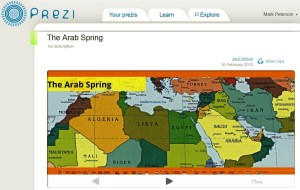 Whenever the International Studies program at Miami University hosts a Grayson-Kirk lecturer, we assign appropriate texts to all our students, especially in the ITS 201 “Introduction to International Studies” classes. As a television journalist who has not written a book, Ben Wedeman’s visit posed an interesting problem. We had clips and blog posts and op-eds, but no book or lengthy academic articles.
I posed that problem to ITS major Jack Nelson, who was doing an independent study with me, and we came up with a timeline of the Arab Revolts–Jack labeled it “Arab Spring”–on Prezi, and embedding links to Ben’s videos and writings.
So that’s what we did. You can read it here or cut and paste this url into your browser:

I am a terrible photographer. I spend two days with Ben Wedeman, and this is the only picture I got.
Ben Wedeman, CNN’s senior international correspondent based in Cairo, Egypt, presented “The Great Arab Revolt: Tales from the Trenches” March 14 at Miami University. He also visited classes and had lunch, dinner and a nightcap with International Studies and Journalism students.
Wedeman’s lecture focused on three key points:
First, the Arab revolts–he doesn’t like the term “Arab Spring”–had been building for a long time. Everyone who had lived and worked in the Middle East knew revolt was building but the exact form and shape these revolts took was not predictable by anyone, not even those who carried them out.
Second, the Arab revolts have taken on very different characters in different countries because the nature of the regimes was quite different in Tunisia, Egypt, Libya and Syria. Syria was the most disturbing in Wedeman’s account. It is a state-sponsored bloodbath now, but with strong sectarian elements; when and if the regime falls, there will be a sectarian bloodbath.
More From the Anthropologists on the Egyptian Revolution
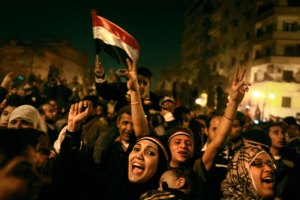
This photograph of jubilant crowds in Tahrir Square after hearing that President Mubarak will step down from his presidency is featured on the cover of the latest issue of American Ethnologist. Credit: Rick Loomis/Los Angeles Times/Polaris
Just a few weeks after the Cultural Anthropology web site released an on-line set of seventeen short essays (which they call a “Hot Spot”) entitled “Revolution and Counter-Revolution in Egypt a Year after January 25th.” (and which I blogged about here), the latest issue of American Ethnologist just came out with nine brief (3-9 pages) essays on the Egyptian revolution.
I’m sure I’ll have more to say about these essays once I’ve read them. In the meantime, here are the citations, links, and abstracts for the articles. There’s also a photo gallery on the web site with photos by Samuli Schielke.
Just for Fun: Giza Plateau From the Air
 Taking a break from trying to understand, interpret and articulate the Egyptian revolution, here’s something that’s kind of cool: a virtual tour of the Giza Plateau from the air.
Just click here or on the picture.

 CONNECTED in CAIRO