When Cream Is Not Cool

A t-shirt design for people who are ishta--or think they are...
For the last ten years I’ve been co-author/co-editor of a column on linguistic anthropology in Anthropology News.
Sometimes my columns are about the mysteries of language use in Egypt, like this one, my most recent:
When I taught linguistic anthropology in Egypt, I used to use the untranslatability of idioms as a way to draw student attention to problems of overreliance on lexicon and syntax to understand meaning.
I asked students to describe a word or phrase that made no sense when directly translated and then to provide a gloss.
One of the most commonly offered idioms was ishta, literally “cream.” This word is used, mostly by young people, to express that something is appealing. For the most part, “cool” is a good gloss for American English speakers of my generation.
But not always.
Salafi Movement Issues Political Fatwas

Salafis continue to leave the mosques for the public limelight, acting as the loose cannon of Egyptian politics.
Freed from the repression of the Mubarak regime and having changed their position on political activism, Salafis continue to explore ways to play political theater.
One Salafi sheikh, Mohammad Amer, issued a fatwa Oct. 29 prohibiting people from voting for any Muslim candidates who do not perform their daily prayers. He also declared that Muslims may not vote for Christian, secular or liberal candidates
“I want the voters to vote in favor of the candidates of the Islamic movements and to oppose those who want to separate religion from the state,” Amer told Asharq al-Awsat‘s Cairo correspondent Walid Abdul Rahman. “There is nothing called liberalism in Islam and there is no absolute freedom in our religion…”
Understanding Tunisia and Egypt as a Network Society Revolt
 The uprisings in Tunisia and Egypt represent the kinds of political revolutions appropriate to a “network society,” argue Ilhem Allagui of the American University of Sharjah and Johanne Kuebler of the European University Institute who write:
Allagui and Kuebler make this case in a short essay, “The Arab Spring and the Role of ICTs” in which they claim:
the Arab revolutions in Tunisia and Egypt demonstrated the power of networks. People did not assemble in the streets to espouse their political views or opinions nor to demonstrate solidarity with their political parties, the leaders they followed, or the gatekeepers they trusted. Instead, they mobilized for two other reasons, the first being the pain they shared due to difficult socioeconomic conditions: Unemployment, the high costs of living, inequalities among classes, censorship, and so forth were at the root of people’s humiliation and frustration. Deplorable economic conditions, political deprivations, corruption, and social repressions are ubiquitous among most Arab countries and represent the motivating factors for these revolutionary actions. The second reason, as important as the first, is the flow of networks to which people belong: networks of friends, family, work, school, and others of interest (such as the media).
While many scholars have written about “network society,” and meant somewhat different things by the term, these authors specifically cite the work of Manuel Castells (1996, 2004, 2006, 2007), especially as interpreted by Philip N. Howard (2010, 2011).
Castells notion of a “network society” is based on the premise that networks–including peer, family, work, but also mediated networks created through information and communication technologies–are replacing the vertically integrated hierarchies that have long been our primary mode of social organization.
One can see the appeal of this kind of analysis. The Egyptian uprising appears in many ways to perfectly capture the relationship between a system of networks–the protesters–and a hierarchical authoritarian state, in which the initial outcome, at least, was victory for the networks.
Moreover, the authors see the events in Tunisia and Egypt in the light of Philip N. Howard’s claim that democracy can only occur in authoritarian Middle Eastern countries if digital network dissemination of information replaces centrally-controlled state mass media–something which appears to have occurred to some extent in these uprisings.
But the future is not yet clear, the authors point out:
On the whole, however, because a military ruling council is in charge, Egypt cannot be said to have undergone regime change (yet), as the nation has been run by the military since 1952. The council has promised to hand power over to an elected government in Fall 2011, but the military has political, economical, and social vested interests in maintaining the current system. In fact, the army has enjoyed, until now, high autonomy. Its budget has never been under parliamentary scrutiny: the military manages enterprises in sectors such as olive oil, bottled water, hotels, construction, petrol industries and hospitals.
The article is the introduction to a special issue of the International Journal of Communication focused on the role of information and communication technologies in the Tunisian and Egyptian uprisings.
References
Castells, Manuel. 1996. The Rise of the Network Society, The Information Age: Economy, Society and Culture Vol. I. Cambridge, MA; Oxford, UK: Blackwell.
Castells, Manuel, ed. 2004. The Network Society: A Cross-Cultural Perspective. Cheltenham, UK; Northampton, MA, Edward Elgar.
Castells, Manuel, ed. 2006. The Network Society: From Knowledge to Policy. Washington, DC, Center for Transatlantic Relations.
Castells, Manuel. 2007. Communication, power and counter-power in the network society. International Journal of Communication, 1(1), 238–266.
Howard, Philip N. 2010. The Digital Origins of Dictatorship and Democracy: Information Technology and Political Islam. New York: Oxford University Press.
Howard, Philip N. 2011. Castells and the Media: Theory and Media. Cambridge: Polity Press.
Al-Azhar Sheikh: Women Shouldn’t Marry Former Mubarak Supporters

Wondering who to marry? Not a former NDP member, says Sheikh Stouhi.
In his classic text Weapons of the Weak: Everyday Forms of Peasant Resistance James Scott describes how the oppressed resist their political and economic domination by the powerful in small ways. One of these is marriage; the village leader, complicit with the state, discovers that for all his relative wealth and power he cannot marry his son to the daughters of any of the respectable families in the community.
That’s what popped into my mind when I read an account in Asharq al-Awsat about a fatwa forbidding pious Muslim families from letting their daughters marry members of the ousted NDP party.
According to the story, Sheikh Omar Stouhi, the secretary general of the Calling Commission at Al-Azhar, was visited by a man asking about the propriety of his daughter’s marriage to a former member of the National Democratic Party, the party of ousted president Hosni Mubarak. He told him the marriage should not take place.
Then he issued a public fatwa prohibiting any marriage with former members in the banned NDP, on the grounds that all those who were NDP members had contributed to the corruption of the Egyptian society.
“A Muslim should always choose the right partner to spend his life with,” Sheikh Stouhi told the newspaper. “If a girl were to marry such a bad person, she would certainly be affected and influenced by his beliefs and this is something unacceptable…”
In an interview, the Asharq al-Awsat reporter apparently pointed out to the sheikh that total membership in the NDP was some 3 million people. Surely they were not all corrupt.
“I did not say that all members of the banned party are bad people,” the Sheikh is quoted as having replied. “Only those who have contributed to corruption must not be allowed to marry Muslim girls…”
And there’s the rub! How, exactly, are we to know the corrupt from the uncorrupt?
This fatwa is the latest in a series of efforts to ensure that the former party cannot make a comeback.
First, a judicial order disbanded the party and forced them to give up their campaign funds to the state. Then a political activist group “Emsek Feloul” headed by Sharif Diab, has begun a campaign of text messages, emails and faxes to the military council, government officials and judges urging that former members of the NDP should not be allowed to run in the upcoming elections or be appointed to any public office. Just a few weeks ago, the Democratic Bloc split as some parties accused others of running candidates who had previously run on the NDP platform.
Now, it seems, nice girls won’t even marry them.
Tahrir Square, City of Westminster, England.

Some clever person at the Occupy London protests posted this sign, designed to look like an authentic British street sign.
When I first saw this sign posted to Facebook, my reaction was: That’s cool. That’s totally awesome.
It was another case of people in the West indexing their own protests to the uprising in Egypt, like others I’ve blogged about here and here and here. And done in a particularly well-executed and subversive, playful way.
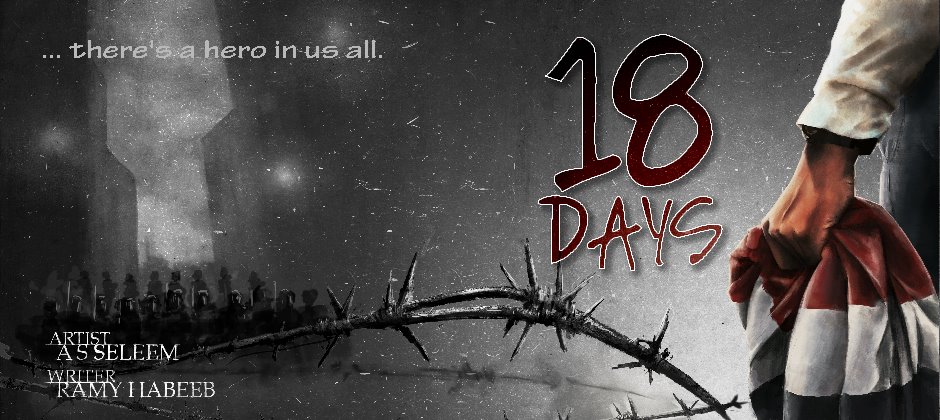
A forthcoming graphic novel about the Egyptian uprising.
I first saw it on Facebook, posted by 18DaysNovel, a page dedicated to a forthcoming graphic novel written by Ramy Habeeb and illustrated by A.S. Saleem, about the impact of the Tahrir uprising on the lives of an Egyptian man and woman.
Then I reconsidered. Maybe the sign wan’t real. Maybe it was just photoshopped.
I queried the original poster, 18DaysNovel, and he referred me to an article entitled “Star Books: Occupy London Protest Inspires Improvised Library” by Roger Tagholm. It’s an interesting article about a young protester who has started a lending library within the occupation community, calling it “Star Books” and using a parody of the Starbucks logo. The photo appears as an illustration in the story with the caption “Tahrir Comes to Westminster” but offers no further information.
A short Google search later, I located a CNBC Europe article entitled “Occupy Movement Hits London” posted to the web site of CBI Voice of Business (a pro-business lobbying group). This story ran the photo and mentioned it in the body of the story, thus:
One protester managed to post a sign near Paternoster that replicated a typical London street sign and declared: “Tahrir Square, City of Westminster.”
Tahrir Square refers to the location of protests, many of them violent, that took place in Cairo, Egypt, earlier this year. The uprising, part of the so-called Arab Spring, eventually resulted in the end of Egyptian President Hosni Mubarak’s 30-year reign.
The article emphasizes the links those in the “Occupy the London Stock Exchange” movement make to similar protests around the world, sparked by growing dissatisfaction with how their governments are handling the global economic crisis.
The question now is, do I trust CNBC? One of the things that is increasingly happening in the world of journalism is stories being cobbled together from multiple on-line sources and phone calls rather than actual reporting. So did someone actually go down and see this for themselves or did they rely of what they were given? I am especially curious in the absence of a reporter’s by-line. “CNBC Europe Staff” is exactly the kind of byline we would have put on a cobbled-together article backin my days as a journalist.
Analyzing Twitter Flow in the Tunisian and Egyptian Uprisings
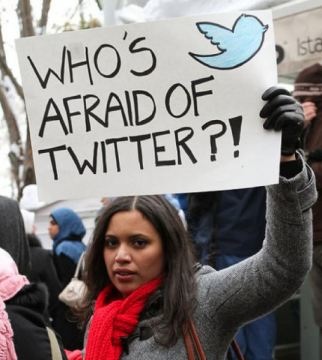 In “The Revolutions Were Tweeted: Information Flows During the 2011 Tunisian and Egyptian Revolutions,” Gilad Lotan, Erhardt Graeff, Mike Ananny, Devin Gaffney, Ian Pearce, and danah boyd, all of whom appear to work for private organizations like Microsoft and the Web Ecology Project, track tweets and analyze the relations between different kinds of tweet users and “patterns of sourcing and routing information among them.”
Their goal is to
describe the symbiotic relationship between media outlets and individuals and the distinct roles particular user types appear to play. Using this analysis, we discuss how Twitter plays a key role in amplifying and spreading timely information across the globe.
While both blogs and Twitter enable rapid information flow, the non-reciprocal nature of information sharing on Twitter means that it operates more like an information-sharing network than a social network, complete with well-positioned influencers who can shape how information flows.
Is Egypt’s Revolution Part of a “Mediterranean Spring?”

Did what happened in Tunisia and Egypt spark the Arab Spring--or the Mediterranean spring?
Did what happened in Tunisia and Egypt spark the “Arab Spring”–or the “Mediterranean Spring”?
That’s a question that will be taken up at the British Academy (aka The National Academy for the Humanities and Social Sciences) in December a workshop on urban protests in the Middle East and Mediterranean.
“City/State/Resistance. Spaces of protest in the Middle East and Mediterranean” will be held Thursday 1 December 2011 at the Royal Holiday University of London (RHUL).
Speakers will include Sara Fregonese (RHUL), Chris Doyle (Council for the Advancement of Arab-British Understanding), Alan Ingram (University College London), Laleh Khalili (School of Oriental and African Studies), Adam Ramadan (Cambridge), Larbi Sadiki (Exeter), Nadim Shehadi (Chatham House), Lynn Staeheli (Durham), Andrea Teti (Aberdeen), Lorenzo Trombetta (Agenzia Nazionale Stampa Associata-Beirut), and Yair Wallach (SOAS).
Although taking as its starting place Mohamed Bouazizi’s self-immolation in the Tunisian city of Sidi Bouzid in December 2010, the beginning of what has become known as ath-thawra al-arabiyya (the Arab revolution), or ‘Arab Spring’. Protests against authoritarian regimes and calls for social justice and freedom have spread across the whole region, from Tunisia to Bahrain, and have been met with fierce state repression.
Yet this is not an exclusively Arab phenomenon. In the south Mediterranean, NATO has been using bases in Italy and southern Europe for air raids on Libya, and thousands of Tunisian, Libyan and other North African migrants reaching Lampedusa and the Italian mainland.
Egyptians Learning the Messiness of Democracy as Elections Loom

Elections are going to be pretty different this time around with no predetermined results...
I’ve been thinking about Steven A. Cook’s contention that Egypt is not in a crisis; it’s pretty much where we would expect it to be at this point in a political transition of this magnitude. What’s making me think about it is watching the political blocs struggle with each other over acceptable power sharing.
American students often find parliamentary systems confusing. Dozens of political parties, some extremely small or highly localized, vie for seats. It’s very democratic (perhaps more so than our two-party system), but it can be amazingly inefficient, especially because it’s easy to end up with no party having enough votes to form a government. Israel, for instance, is notorious for never having one party win enough seats to form a government.
So what the party with the most votes has to do is share power with other parties that have even fewer votes so that, when all these Parliamentary seats are added together, there are enough to form a government.
Egypt is in the first throws of having to actually think about how to form multiple party political blocs. With the exception of the El-Ghad party in 2005, the other parties received one or two seats in most elections as a mere courtesy of Mubarak’s National Democratic Party (the Muslim Brotherhood could not even run as a party and had to run its candidates in 2005 as independents).
So the Egyptian political parties–of which there are dozens–are starting to form political blocs. And unform them. And reform them…
Tamer Shaaban Nominated for Viral Video Award
The video about the Egyptian revolution by Egyptian American college student Tamer Shaaban is one of 21 short films nominated for the international short film festival in Berlin in the Viral Video category.
Unlike the juried contests for the film festivals other five awards, the viral video award allows people to vote on-line for their favorite. Voting for the best video opened today and continues until Nov. 17th at http://www.viralvideoaward.com/.
(While there, you might also check out “A Liter of Light” from the Philippines, which I show in one of my anthropology classes)
Is Egypt Having an Identity Crisis?
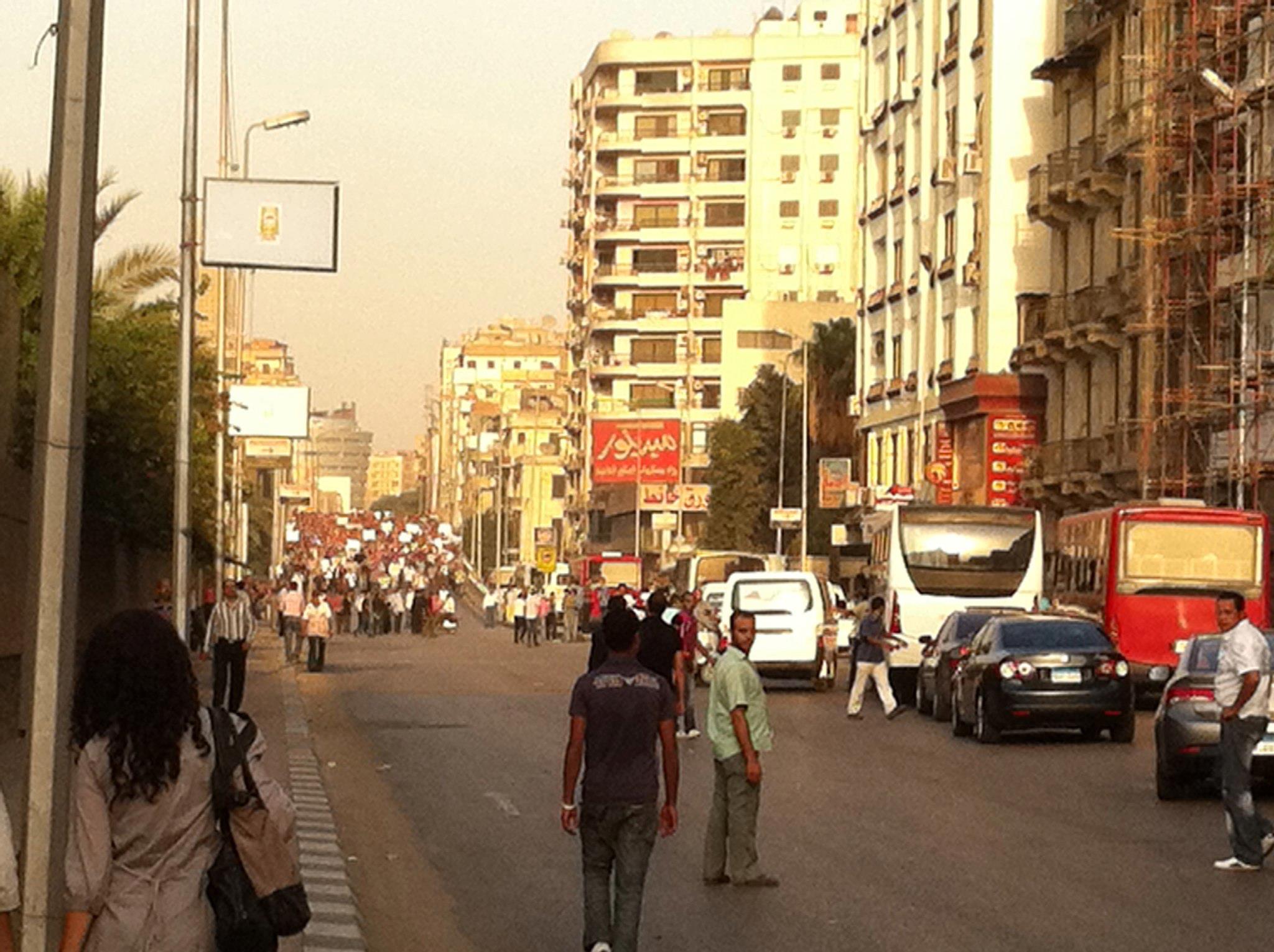
Is Egypt suffering from an identity crisis? Photo by Malak Rouchdy.
Shortly before the violence that shook Egypt this month, Steven A. Cook published an article in Foreign Policy commenting on the current anxieties besetting pretty much everyone in Egypt these days.
Like me, and several other commentators, he recognizes that current conditions of ambiguity are eroding hope and increasing anxieties. He describes it thus:
Everyone seems to be struggling with the complexities of the present moment. Egyptian liberals are despondent over what they fear will be a Muslim Brotherhood rout in the November elections; revolutionary groups are having trouble gaining traction with a fatigued population; Islamists are confident, but have flailed tactically in an unfamiliar political environment; Prime Minister Essam Sharaf’s government is a non-factor; and the Supreme Council of the Armed Forces seems to be staggering under the pressure of a political role for which they were never trained. This bleak atmosphere is a stunning turnaround from the post-uprising mantra of “Anything has got to be better than the Mubarak regime.”
Unlike many other commentators, Cook suggests that there is nothing wrong with this state of anxiety. It may be unpleasant, but it’s also natural.

 CONNECTED in CAIRO