Socializing the State from Tahrir Square

Socializing the state: Crowds in Tahrir on the night of July 13th. Photo by Malak Rouchdy.
Historically, the Egyptian state has always followed its colonial predecessors in treating the public as a deficient entity that must be improved, contained and ordered (into “stability,”) for example, rather than an entity to be meaningfully engaged with.
The current efforts in Egypt might be fruitfully seen as efforts to re-socialize the state, to create a new civility in which the state perceives the public as an entity to which it must listen, with which it must engage, and to which it must respond.
The New York Times and the Washington Post have both done interesting stories recently on the return of protesters to Tahrir Square, but the media accounts still don’t really know what to make of it all. They keep looking to organized political institutions–the Muslim Brotherhood, the Supreme Council of the Armed Forces, the interim government–for signs that they are responding, for signs the “the” revolution is happening.
And they take the polyphony of voices in Tahrir about what should happen next as a weakness, a fragmentation of purpose and message (and therefore effectiveness).
But perhaps “revolution” in the classic sense is not the best way to understand the political changes being pushed by these multiple and polyphonic movements.
To a great extent, these social movements can be seen as falling into the category Asef Bayat, in his book Making Islam Democratic, calls “post-Islamic”, movements that seek to fuse religiosity and rights, faith and freedom, Islam and personal liberty. These movements can encompass everyone from moderate Islamists to ardent secularists.
Are the Revolutions Reclaiming a “Lost Arab Dignity”?

Protest in Tahrir, July 8th. Photo by Malak Rouchdy.
Are the revolutions in Egypt, Tunisia, Libya, Syria, Yemen and elsewhere part of an intergenerational reclaiming of pride and self-respect across the broader Arab world?
That’s the claim of Azza Kazam of the UN Population Fund in an article in Anthropology News:
It is important to be aware that the revolution has already resulted in the single most important contemporary change in Arab consciousness: retrieving a sense of dignity.
Kazam argues that with the end of French and British colonial rule, Arab Nationalism arose as an idea that structured political and social narratives. But when the Arab armies were decimated in just a few days by Israeli forces during the 1967 war, it led to “humiliation and Arab emasculation.”
I’m not sure what to make of this kind of thing. On the one hand, I am mistrustful of studies of large-scale “national cultures” much less transnational regional “cultures” encompassing hundreds of millions of people.
On the other hand, there is certainly a level at which this assertion is true, and it dovetails rather nicely with Selim Shahine’s account of intergenerational cultural experiences.
References:
Kazam, Azza. 2011. “Reclaiming Dignity: Arab Revolutions of 2011.” Anthropology News 9: 19
Shahine, Selim H. 2011. Youth and the Revolution in Egypt. Anthropology Today 27(2): 1-3.
Globalization as Fugue
In an op-ed in the New York Times, Arab American composer Mohammed Fairouz suggests the musical notion of “counterpoint” as a way to think about contemporary globalization.
Fairouz is the composer of Tahrir for Clainet and Orchestra, a lovely short piece performed by Ensemble 212, soloist David Krakauer, at Merkin Concert Hall, New York, June 9, 2011, which can be heard (and seen) via YouTube:
Fairouz is writing about the ways music from very different cultures are being put into juxtaposition by young composers. He uses the metaphor of “counterpoint” both to talk about this kind of musical hybridity, but also the larger processes of globalization in which it takes place.
Counterpoint in music involves a relationship between multiple voices which are rhythmically independent but harmoniously interdependent, Each musical element retains its uniqueness but when woven together by a skilled musician they form a polyphonous (rather than cacaphonous) whole. The fugue is a composition that derives its effect from the interplay of counterpoint.
There are three basic ways that people have articulated theories about processes of globalization.
Ecumenism Versus Secularism in the New Egyptian Politics
 How are religious minorities to live alongside majority populations? It is a question that has plagued political thinkers for centuries.
In the modern world, the answer is usually secularism, understood particularly as the belief that religious life can be separated from ordinary life, and that political institutions in particular should be kept separate from religious institutions in nation states.
But efforts by religious-political organizations to create political parties has led to alternative visions of Islamic-Christian cohabitation in a democratic Egypt, a kind of interfaith pluralism I gloss as ecumenism. And most of the advocates are Christians.
Five Characteristics of the Egyptian Youth Movements
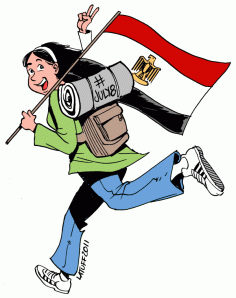
Cartoon by Carlos Latuff
The Al-Ahram Center for Political and Strategic Studies has released a new paper in its “Strategic Studies” series on the youth movement and its role in contemporary Egyptian politics.
“Youth Movements and the January 25 Revolution” by Dina Shahata is a 40 page account focusing particularly on the 2005 Youth for Change Movement and its role within the larger Kifaya movement. She argues that the new youth movements have five key characteristics:
- These movements began independently of existing political parties and other political organizations such as trade unions and student organizations.
- The movements have flexible, decentralized structured and fluid leadership. They are often divided into many highly independent, specialized subgroups of the sort I’ve been calling (in my anthropological way) sodalities.
- The movements are “trans-ideological”; that is, they encompass anti-regime, pro-democracy advocates from many different ideological backgrounds.
- These movements depend to a great extent on social media for communication.
- While the movements initial leadership was drawn from men and women experienced in protest activities, they were able to draw in large numbers of participants who had never before engaged in a public political act.
The paper is, unfortunately for most of my readers, in Arabic, but there is an excellent summary on Al-Ahram On-Line.
The author is one of the few political scientists to actually be writing about youth movements before this year, so she’s the ideal author for something like this. I have this vague memory of having met her briefly at Georgetown in 2003, but I’m not positive (my memory is not very reliable…).
Reference:
Shehata, Dina. 2011. Al-Harakat Al-Shababeya wa Thawret 25 Yanayer (Youth Movements and the January 25 Revolution). Strategy Papers series no.218. Cairo: Al-Ahram Center for Political and Strategic Studies.
El-Wardani, Mahmoud. 2011. Review: A Map of the New Youth Movements in Egypt. Ahram Online, 6 July. http://english.ahram.org.eg/News/15667.aspx [accessed 9 July]
Talking With the Muslim Brotherhood
 When U.S. Secretary of State Hilary Clinton announced the U.S. would open some limited communication channels with the Egyptian Muslim Brotherhood, it raised a lot of eyebrows, and not only among Republican opponents.
But it was the only sensible thing to do.
Washington was caught unprepared by the size, timing and energy of the protests in January and February, and by the sudden fall of long-time relaible US-ally Hosni Mubarak. They are aware that because the US supported Mubarak for so long, it has to build new relations with Egypt.
And there’s the lesson of Hamas.
Five Lessons From Egypt’s June 29th Violence

Christian Science Monitor photograph
The violence that erupted in Cairo 29 June when police clashed with protesters left more than 1,000 people injured. Many of the details remain unclear, but what is very clear is that people remain unhappy at how long it is taking to bring the main officials of the Mubarak regime to trial. Former interior minister Habib al-Adli has been sentenced to jail for corruption but he and other officials are still being tried on charges related to killing protesters.
The event, and the flurry of commentary in local and regional media, emphasizes how much change is yet required before most young urban Egyptians will be satisfied.
As for me, I take five lessons from this remembrance turned protest turned violence:
- First, the revolution isn’t over yet.
- Second, the martyrs remain potent symbols for the revolution.
- Third, the Central Police Force needs to be completely reformed (or just abandoned, with real police doing their jobs).
- Fourth, the governing institutions need to develop new rhetoric and new techniques for handling the people of Egypt.
- And fifth, media continue to be a game changer in the ongoing revolution.
Let’s take these one at a time.
Read more…
Islam and Democracy: The Catch-22

Turkey is one example of a country where democracy and Islam seem to be compatible. Why not North Africa?
A recent paper by Jnc Hill published in Third World Quarterly supports my contention that Islamic participation does not necessarily harm democratic institutions.
(This should not be a very profound contention but in some circles… well, read on)
On the contrary, Hill says in his paper “Islamism and Democracy in the Modern Maghreb,” that the only real harm Islamic groups in North Africa do to democracy is allow authoritarian governments to use them as an excuse to suspend civil liberties and ignore election results.
Why? A Catch-22 in Western political attitudes toward Islam and democracy.
Coca Cola for the New Egypt
“It’s all about optimism” Ahmed Nazmy, marketing director at Coca-Cola Egypt reportedly told his team after the fall of Mubarak. So youth, optimism and Coca-Cola are linked together in this newest ad:
For those who can’t understand the Arabic refrain, a gloss is ““Make tomorrow better, the sun is rising.”
I’ve already written about the spirit of Tahrir being appropriated by various political actors; it was only a matter of time before we saw efforts by marketing to link their products with the events of Jan 25.
Stability, the Generation Gap and the Egyptian Uprisings
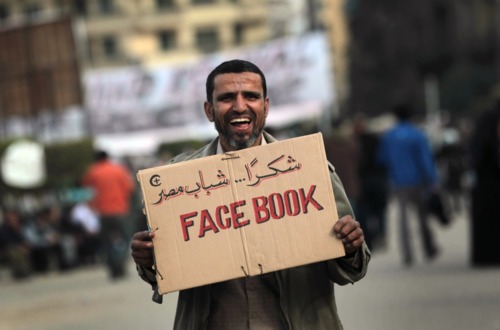
Generational cultures, wrote Karl Mannheim in 1923, are shaped by different life experiences. Selim Shahine muses on what this means for the Egyptian uprisings.
“Shabab al Facebook,” the Youth Movement, the Internet Generation–these phrases are widely used to describe the the people who started the revolution. “Egyptians of all ages express their admiration for the shabab (youth) and their revolt, and define themselves in relation to that revolt,” writes Selim Shahine.
In “Youth and the Revolution in Egypt” published in the February edition of Anthropology Today, Shahine reflects as a member of the 1960s generation on the cultural differences between those born in the waning years of Nasser and those born and raised under Mubarak.

 CONNECTED in CAIRO