Egypt Seeks to Balance Budgets Without Foreign Loans

Finance Minister Samir Radwan announced that a revised budget plan had cut the deficit so that foreign loans would not be required.
The Egyptian government has, after having negotiated what is (for development banks) a great deal with World Bank and the International Monetary Fund (IMF), declined the loans. Nor are they planning to issue new bonds to raise revenue.
Much of world media news reporting on the Egyptian Uprisings has focused on the dramatic, and often very visual, political reforms. But there are important economic concerns driving these that often go unnoticed save by academics. One of these is the concern the military has had with the ballooning debt under President Mubarak, who went freely to IMF and World Bank year after year, even as he sold off every Egyptian property he could to foreign investors.
The Egyptian military, now in charge of Egypt, has not fought a war since the signing of the Camp David Accords in 1977. In the meantime, the officer class has evolved into canny businessmen with economic interests in local shopping malls, apartment complexes, tourism and other such industries. The crony capitalism of the regime, with its focus on foreign investors and foreign loans, did not benefit their investments, and rising debt could have ruinous consequences as they can see looking across the Mediterranean at Greece.
And they must balance their concern with debt, with the need to keep commitments to social justice for the poor, who have faced severely diminished quality of life under the Mubarak regime in recent decades. Here’s how they propose to do it:
State Television Was “Just Obeying Orders”
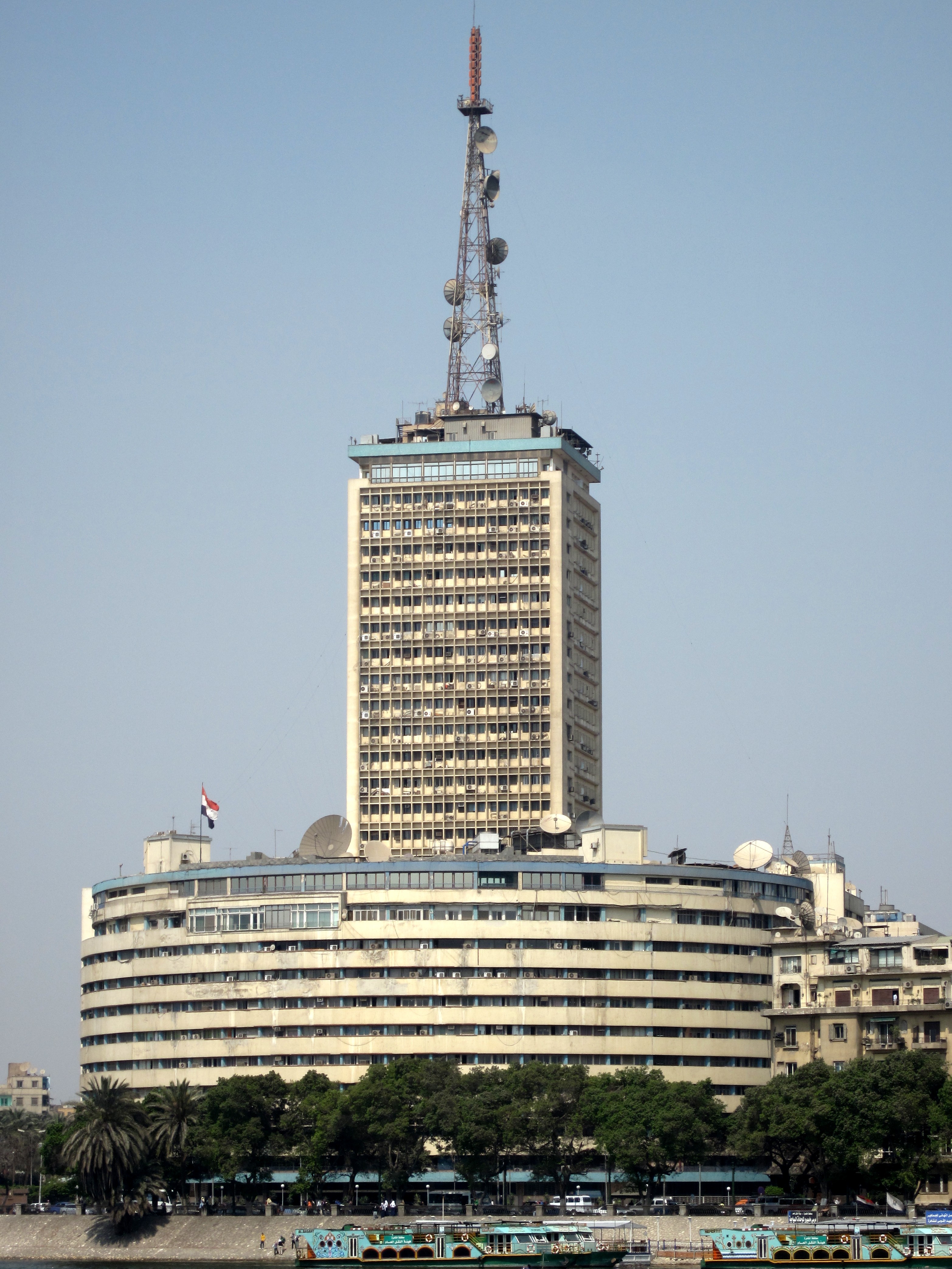
The Maspero Building in Cairo houses state television.
The changing role of state media during the uprisings has been much written about, including on this blog, so much of Basma Salama’s article on this topic in a recent issue of the English daily Egyptian Gazette is necessarily redundant.
There are a few interesting tidbits though. For example:
Meanwhile, Egypt’s most popular website, Masrawy.com, polled 78,000 users about news channels that they watched during the protests, and the results revealed how much Egyptians distrusted their TV channels. bout 45 per cent reported watching Aljazeera and Al-Arabiya channels, while 27 per cent said they watched Egyptian private channels like Dream, Al-Hayat, Al-Mehwar, On TV and others. Only 11 per cent tuned into Egyptian State media.
And there’s the interview in which her journalist informant uses the same hoary excuse used by all state apparachiks irregardless of locale or cultural background:
As for where Maspero was during the demos? They replied: “Nobody inside Maspero was really happy about the Government’s response to the protests; we were just following orders.”
IUP Offer E-Book Edition of Connected in Cairo

IUP has released an e-book of Connected in Cairo
I like physical books. I like underlining significant passages, making check marks in the margins of things relevant to me, and writing margin notes linking ideas in this book to those in other books.
But I’d be lying if I denied that text-searchable electronic books and articles haven’t entirely changed the way I do scholarship from the now almost archaic forms of information gathering I engaged in during my doctoral dissertation. So I have to think that an electronic edition of Connected in Cairo is a good thing.
In addition to the Kindle edition I already referred to here, Indiana University Press has introduced an electronic version of the book. You can purchase perpetual access to the full text of Connected in Cairo for $20.95 if you want a nice, text-searchable electronic version. Or if you just prefer your library to be stored in the cloud, accessible whenever you have an internet connection.
Even if you don’t want to buy an electronic edition, you may want to visit this page because you can also download pdf files of the Cover, prefatory material (Table of Contents, Preface, Acknowledgments, and Notes on Translation), and the entire first chapter (which is more than you can get free on Google books!).
 How are we to understand the tensions between pushes for democratization and economic reform that motivated the ongoing revolutions in Egypt and Tunisia?
That’s the question posed in the latest issue of Middle East Report. Entitled “North Africa: The Political Economy of Revolt,” the articles focus on teasing out the meanings of the delicately intertwined political and economic orders whose futures are being decided at stake in the revolutions.
One of the widely circulated slogans during the revolution was John F. Kennedy’s ” “Those who make peaceful revolution impossible make violent revolution inevitable.” The Making of North Africa’s Intifadas by Laryssa Chomiak and John P. Entelis essentially makes this argument by comparing authoritarian structures in Algeria, Morocco and Tunisia, and arguing that Tunisia revolted because the government of Zine El Abidine Ben Ali was the most oppressive. Presumably the authors are only explaining part of the story of how the revolutionary “virus” (their term) got started; I’m not persuaded this argument holds up for Egypt and the Gulf states.
Another paper, Tunisia and Egypt. Understanding the Political Economy of the Arab Revolts by Omar Dahi offers a crucial description of the economic underpinnings of the revolutions. Following the guidance of the neoliberal “Washington consensus”, Egypt and Tunisia transformed their national development policies away from direct spending on the poor toward reforming the economy by reducing direct spending on the poor and creating more “market-friendly” environments. It’s the devastating consequences of these policies that pushed the populace into revolt, Dahi argues. (A similar argument by Walter Armbrust in Jabaliyya can be read here for free).
Coptic Youth Asserts Leadership
 Recognizing the new proposed law on building places of worship as an important first step in creating Christian-Muslim equity in Egypt, the Maspero Youth Union suspended their sit-in outside the Maspero building and gave the Egyptian interim government until July 8 to make progress on their demands, or declared that they will return to protesting outside the Maspero Building, which houses Egyptian state media, with thousands of fellow Copts and their Muslim supporters.
What is the Maspero Youth Union that the Egyptian government should be mindful of them?
 I just learned that Amazon has released a Kindle edition of Connected in Cairo.
The best thing about this is the price. The digital edition listed price is $20.95 but right now Amazon is offering it for only $9.99.
My daughters bought me a Kindle last Christmas and I must admit that I don’t use it as much as I should–I really like the portability, and the screen clarity, and I like that it can read to me–in a monotone robotic voice–while I’m driving or making dinner or some other task that occupies my hands but not all of my mind.
It’s best for reading novels, especially old novels I can download free from Project Gutenberg)
For my professional reading, though, I like books. I underline passages, make notations, indicate links to ideas in other books and the Kindle notation system, although many of my students love it, just doesn’t let me make the hand-to-brain connection that physical marginalia writing does.
This is one professional book I plan to get in a Kindle edition, however (and no, I don’t get it for free. That’s not how it works, alas).
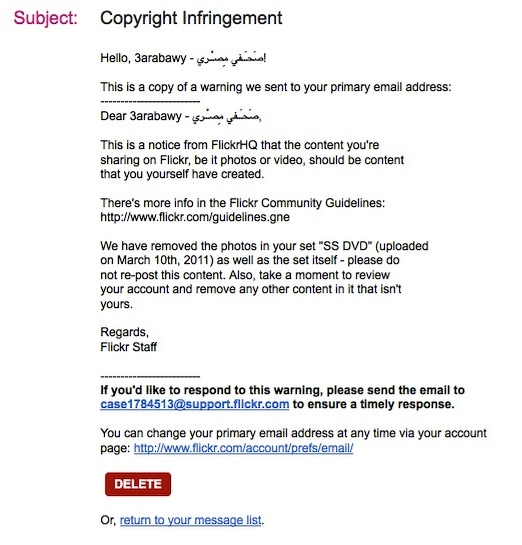
Alas, freedom fighters don't own the copyrights to images they've seized from the regimes they've overthrown.
The genius of many of the leaders of the Jan. 25 uprisings, as I have mentioned before, has been their ability to take existing technologies designed for specific social and commercial functions, and find ways to give them a revolutionary twist.
The problem with finding new ways to use existing platforms is that those platforms come with baggage attached. The Piggipedia, a Flickr “group pool” started by Hossam El-Hamalawy to which are being uploaded the photographs and names of members of the state security forces recently ran afoul of this problem when Flickr deleted a large number of the photos they had seized from a raid on state security offices.
Love and Safety in Egyptian Tourism Videos
Rebuilding tourism remains crucial to the Egyptian economy, regardless of the actual government that emerges after the September elections. A number of recent videos have appeared by Egyptians seeking to woo tourists back. The main theme running through them is love:
I swear I’m acquainted with some of these people; I think one of the guys speaking Italian runs a souvenir shop in one of the upscale hotels along the Corniche. Anyway, love, in this context, means welcome. Please come to our country and let us feed and care for you.
Love, of course, is a two way street. In another video, a group of visiting Italians praise the new Egypt, and encourage other tourists:
Europeans make up the largest number of tourists to Egypt. Some estimates I’ve seen put Germans and Italians at the top, but even Great Britain sends over 1.5 million people there annually according to a British government web site.
Tourists were evacuated in late January during the uprisings over fears for their safety. Even those who did not want to leave–some students studying abroad, for example–were forced to leave because their travel insurance was voided when theur various government’s issued travel advisories. In spite of the claim in the previous video–that in Egypt, even uprisings are peaceful, many people abroad saw the protests as chaotic, dangerous and frightening. Safety thus becomes a crucial issue in luring tourists back.
Thus while this video is entitled “Love from Tourists”, love is less emphasized. Instead, “safety” is the central theme in this advertisement for Sharm al-Sheikh:

It's usually been much easier to get permission to build a mosque than a churce--a significant bone of contention for Christians in Egypt.
There is a fascinating story in Farha Ghannam’s excellent ethnography of urban Cairo Remaking the Modern in which she describes the disputes that arose in 1981 in the poor urban neighborhood of az-Zawiya al-Hamra as Christians seeking to build a church had the space hijacked by Muslims. One of the Christians gets so frustrated he fires a gun at Muslims praying on the site, instigating violent reprisals by Muslims (albeit there were many stories of Muslims protecting their Christian neighbors as well).
The fact that Christians must spend months seeking permission to build churches, while Muslims seem to be able to build mosques at will has long been a touchstone of Christian discontent. A new law proposed by the ruling Supreme Council of the Armed Forces would change that, putting all houses of worship under the same rules.

Al Masry Al Youm photo by Tarek Alfaramawy
Where were you June 6, 2010?
I was in the Sinai with a group of ten Miami students, my wife, daughter and son. I didn’t hear about the young man dragged from a cybercafe and beaten to death by police until we returned to Cairo three days later. I didn’t know it, but it was a key event in modern Egyptian history, and a turning point in Egyptian revolutionary activities.
On June 6, 2011, hundreds of Egyptians remembered Khaled Said, and reflected on what his death led to, what it accomplished, and what has not yet been accomplished.

 CONNECTED in CAIRO
