 The recent special issue of Arab Media and Society may be the first academic take on the role of new (and old) media in the Arab Spring, but it won’t be the last.
Case in point: the journal MedieKultur is planning a special issue on “Media, Empowerment and Democracy in the Global South,” edited by Poul Erik Nielsen of Aarhus University and Norbert Wildermuth of Roskilde University, to be published Spring 2012.
The issue will not focus on Tunisia, Egypt and the rest per se, but will be open to submissions about the uses of media, especially new media (i.e. Web 2.0 and mobile phones) in civil engagement, social movements and processes of social change throughout the developing world. The editors write:
We thus invite papers with a thematic and theoretical focus on civil society based forms of communication for democratic deliberation and empowerment, in the broadest sense. Case studies and attempts to develop theoretical conceptualisations should explore relationships between media and communication developments, civil society, citizens’ engagement and governance processes. Papers with a focus on such issues in the context of the Global South are of specific interest.
I am willing to wager, though, that the bulk of submissions concern the countries of the Arab Spring.
MedieKultur is still accepting submissions until September 1, 2011
Tahrir Squared: Can Communitas Be Digitalized?
The community forged in Tahrir Square was vibrant and exciting, filled with promise, creative energy and hope. This is the sense of comradeship anthropologists call communitas created when traditional social structures break down and new structures have not yet been forged to replace them.
Artistic expression flourished and social organization–security, emergency health care, food distribution–was managed not by the state of civic institutions but by sodalities of volunteers who contributed their expertise.
I predicted in an earlier post–based on the work of colleagues of mine who study the postsocialist world–that when the protesters at last left Tahrir we would find two interesting social processes emerge. The first would be a political process of groups seeking to claim the Tahrir Square uprisings as theirs, and the second the emergence of a powerful nostalgia for the 18 day period. The two are linked–the nostalgia gives the symbol of Tahrir Square part of of the force political groups wish to claim.
In Egypt, this antistructural communitas is sometimes called “the Tahrir effect” and pundits discuss its nature and whether the revolution is continuing it or losing it, and whether returns to Tahrir like that of Friday May 27 renew, extend or deplete this “effect.”
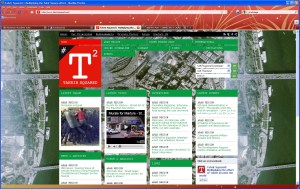
One very interesting new effort to claim, and reproduce, the “Tahrir Effect” is a web site called Tahrir Squared.
During the revolution, there was a very united & civilised Egypt in Tahrir square. Protesters from all backgrounds & ages stayed together in Tahrir square which turned to a model town where everyone worked together despite their differences. A group of activists have started a new initiative called Tahrir Squared. It aims to multiply the Tahrir Effect & expand the Tahrir Region. Please visit the website to learn more.
This experiment is not only about communitas and antistructure, of course, it is also about social media. Tahrir Squared suggests that social media has the capacity to not only recapture and maintain the kind of social energy (what Emil Durkheim called effervescence) present in Tahrir Square during the 18 days of protest, but extend it beyond the geographical boundaries of central Cairo.
Can communitas be digitalized? If it is, is it what Turner meant by communitas or has it become something else? And if so, what?

The Rafah crossing at the Egypt/Palestine border. Photo from Paxgaea.com c/o IMAMC
In opening the Rafah Crossing between Egypt and Gaza, the Egyptian ruling military council is ending one of the key issues that symbolized the disaffection between President Mubarak and the people he ruled. The decision to permanently open the Rafah crossing and facilitate the movement of the Palestinians across it apparently annul visa requirements for Palestinians of all ages, making it possible for Palestinian students to study in Egyptian universities and for the ill and injured to receive treatment
While nothing like an abrogation of the peace treaty with Israel, which was predicted by both Glenn Beck and Donald Trump (and which the military council has publicly said it would not do), it is a reminder that a democratic Egypt–an Egypt more sensitive to public opinion and national interests–will be a very different kind of partner in the Middle East for both Israel and the U.S.
And the context in which the decision was taken seems chosen to underscore this message.
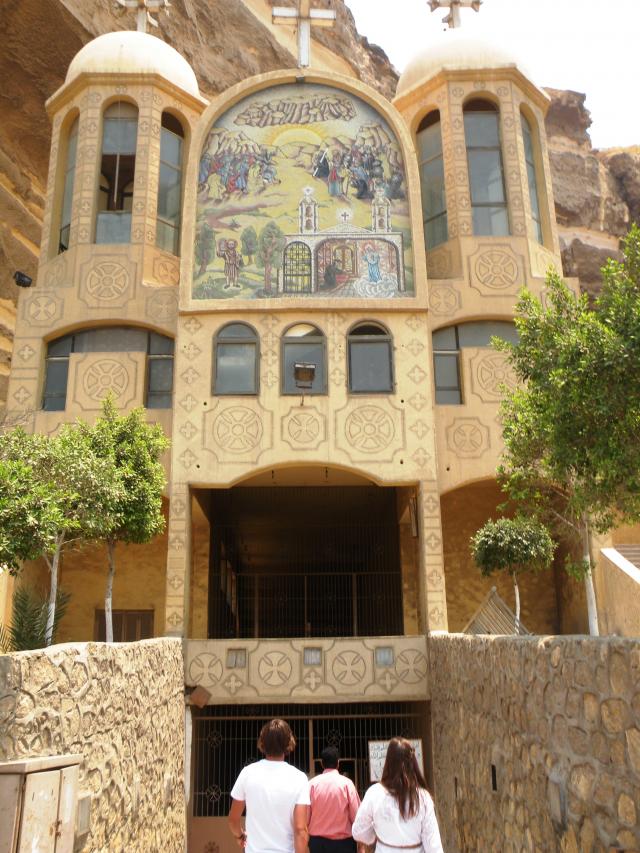
The Catholic journal Oasis–dedicated to Christian-Muslim relations in the “age of Mestizaje of Civilizations” (aka “globalization”)–has two essays in its May 31st edition on the recent sectarian violence in Egypt.
The first, “From the Hopes of Tahrir Square to the Shadows of the Present” by Milad Sidky-Zakhary reflects on the decline into sectarianism from the unity of the protesters in Tahrir Square. Of the latter, he writes:
Who would have thought the protesters would clean up Tahrir Square and repaint its pavements, a Christian girl to take water to a Muslim Brother for his ritual ablution, a veiled woman to lift up the cross together with the crescent? Or that Muslims would form a human shield around a church to protect it during the Easter celebrations? Or that one of them would write in Egyptian dialect a banner addressing the former president, before his resignation: “May God curse you, you let us love one another”?
He blames the degeneration on the absence of effective police, the release from prison of criminals and extremists, and the Army using neutrality as an excuse for inaction.
This persisting void of power has surprisingly allowed many Islamic extremists to circulate freely in the streets. In the absence of any deterrent, they have begun to call the shots: after provoking Sufi anger by destroying the shrines of the saints venerated by Muslims, they turned their attacks against churches…
The second article “The Egyptian Church is Called to a Rennaissance” by Father Rafiq Greiche, also blames salafis for instigating the sectarian violence, but calls on the Church to consider how it will need to respond to these events in the absence of any reliable order.
The Church, particularly the Orthodox Church, must, however, discover its own essence and reserve a more active role for the laity, allowing them more freedom to express themselves and their will, and to play, as everyone else, a social and political role in society, and not just inside church walls. After having lived marginally or, to be more precise, after having marginalized themselves, Christians must adhere to parties (particularly to the liberal ones), and take on the place that belongs to them in the Country, by participating in the next elections and forming an opinion on the current situation in Egypt.
Oasis is published monthly in Arabic, English, French, Italian and Spanish by the International Centre for Study and Research by Cardinal Angelo Scola.
For some deeper background on Egypt’s sectarianism, I recommend “Behind Egypt’s Deep Red Lines” by Meriz Tadros, published in the Middle Easr Research and Information Project October 2011, just a few months before the uprising began.
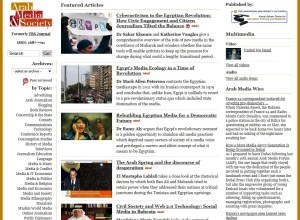
Add this to your summer reading: AMS special issue on media and social change in the Arab Spring
The latest issue of the on-line journal Arab Media and Society is a special issue focusing on the role of media in the Arab uprisings.
The first four articles focus on Egyptian media.
“Cyberactivism in the Egyptian Revolution: How Civic Engagement and Citizen Journalism Tilted the Balance” by Dr. Sahar Khamis and Katherine Vaughn, offers an overview of the multiple roles new media played in the overthrow of President Mubarak. The authors argue among other things that
these new media avenues enabled an effective form of citizen journalism, through providing forums for ordinary citizens to document the protests; to spread the word about ongoing activities; to provide evidence of governmental brutality; and to disseminate their own words and images to each other, and, most importantly, to the outside world through both regional and transnational media
The paper also considers whether these media tools will enable activists to keep up the pressure for change during the lengthy transitional period.
A media ecology refers to the dynamic, complex system in which media technologies interact with each other and with other social and cultural systems within a particular social field, and the ways these interrelationships shape the production, circulation, transformation and consumption of images, texts and information within this system. In Egypt’s current revolutionary phase, the media ecology is unstable, in flux, as the myriad of institutions and technologies adapt to the dramatically changed – and changing – economic, social and political climate.
Comparing this situation to that of Iran during and after its revolution, I suggest that Egypt is likely to have a quite different outcome.
In “Rebuilding Egyptian Media for a Democratic Future” Dr Ramy Aly argues that the current moment, in which the older structures no longer hold sway, provides a golden opportunity to abandon media practices that privileged a narrow range of voices and create a pluralistic media that recognizes many ways of being Egyptian–but only if the revolution imagines itself as progressive rather than nostalgic:
Echoing throughout Tahrir Square and now on the airwaves of satellite channels are the words of Sheikh Imam “ya Misr oudi zay zaman” (Oh Egypt return to your former self) – a testament to a nostalgic yearning for an imagined and romanticized past that is often debilitating to attempts to make sense of the present and imagine the future. While nostalgia at times of crisis is by no means unique to Egypt or the Arab world, Egypt’s revolutionary moment will certainly remain unrealized if, as Sabiha Al Kheimir (1993) persuasively puts it, we “wait in the future for the past to come.”
Finally, El Mustapha Lahlali looks at the rhetorical devices used by Ben Ali and Mubarak when they addressed their nations through state media in their last three speeches during the Tunisian and Egyptian uprisings in “The Arab Spring and the discourse of desperation.”
Although the two former leaders used different dialects of Arabic, and chose their words very differently, both employed the same strategies, in roughly the same order: first, a strategy of blame and denial in which they denied the reality of the protests — renaming them as “chaos,” for example — and then shifting the responsibility for them onto others, especially “foreign elements. Second, both men a strategy of self-defense, in which they sought to reclaim their authority and assure protesters their concerns were being attended to.
He concludes
The analysis shows that they followed similar strategies, passing through a series of stages as earlier strategies failed. …The one contrast is in the realm of register: while all Mubarak’s speeches were delivered in MSA, Ben Ali in his final speech switched between MSA and Tunisian dialect.
Other papers in the special issue focus on the roles media has played in other uprisings, or across the Arab world as a whole. These include:
- “Civil Society and Web 2.0 Technology: Social Media in Bahrain” by Magdalena Maria Karolak
- “The Narrative of Resistance – Bahrain and Iraq” by Anne Hagood
- “The Media Reality in Iraqi Kurdistan” by Alice Hlidkova
- “Ruling the Arab Internet: An Analysis of Internet Ownership Trends of Six Arab Countries” by Michael Oghia and Helen Indelicato
Finally, there are a couple of papers on how the uprisings affected local media use in other parts of the world. These include:
- “Hip Hop & Diaspora: Connecting the Arab Spring” by Dr Lara N. Dotson-Rent
- “The Debate Over Al Jazeera English in Burlington, VT.” by William Youmans
The journal is published by the Al-Adham Center for Journalism Teaching and Research at the American University in Cairo.
 The ruling military council has begun to take a more direct interest in what journalists and their sources say, and it’s not clear what this bodes for the emergent Egyptian news media.
On May 19, the council summoned editor Amr Khafagi and two reporters from Ash-Shourouk newspaper in order to question them about their story that former president Mubarak was going to ask for the people’s forgiveness and amnesty in exchange for his holdings. The story cited unnamed Egyptian and Arab officials, as well as an unidentified military official.The story was widely circulated and led to angry protests throughout Egypt.
The journalists were released after signing a pledge not to report on issues involving the armed forces that might cause “confusion” in the streets. The newspaper did not, however, print a retraction.
On May 31st, the council summoned journalist Reem Majed and blogger and activist Hussam Hamalawi. Hamalawi had appeared on Majed’s highly successful program Baladna bel Masry on ONTV and accused the military police of violating human rights and continuing to torture people in prison.
Writer Nabil Sharafeddine was also taken to the military council to answer questions about a statement he made on ONTV during the news coverage of the May 27 protests, during which he claimed that the military council had a deal with the Muslim Brotherhood to abstain from criticizing one another.
And the council summoned Sayyed Abdel Ati, the chief editor of the weekly Al Wafd opposition newspaper, and his reporter Hussam al-Sweifi to ask questions about a May 26 story headlined “The Details of the Forbidden Deal between the Brothers, the Salafis, and the Authority.”
On the surface, all this seems disappointingly like the kinds of actions the previous regime undertook to keep the press from overt criticism. In a June 1st editorial entitled “Military Council in Charge: Farewell to the Spring of the Media?” the Lebanese newspaper Al-Akhbar said the relationship between the ruling military council and the journalists “has lately stepped into a new and dangerous phase.” A number of protesters staged a sit-in during the investigation, reportedly emphasizing several times that their criticism was directed only at the council’s dealings with the media and was not objecting to its political or military activities.
But in an interview with the Saudi-owned London-based Asharq al-Awsat newspaper (also June 1), Reem Majed gave her own account, which portrayed the military council as more concerned with finding out if the allegations were true so that they could investigate them and prosecute those responsible:
No one was accused of anything, not even my two guests. They were just asked a number of questions in regard to the issues that were debated during the show. The military court also asked Houssam al-Hemalawi to present a complaint before the prosecutor in regard to the violations which he said were taking place in prison. They also asked him to present pieces of evidence to back up these accusations in order to enable the military council to punish the people responsible for these violations.
“Freedom of speech is a right enjoyed by everyone and the military council does not intend to breach that right in any way…” she concluded.
Perhaps so. But the possibility that one might at any moment be summoned before a military council over which there are currently no constitutional controls, just the fickle weight of public opinion, must surely have a chilling effect on the media, and lead to a degree of self-censorship.
Mubarak also insisted that he had no intention of abridging anyone’s right to freedom of speech. But this was the technique commonly used by the Mubarak regime: summonses, questions about intentions, subtle threats, combined with an occasional prosecution, all of which led to a considerable caution on the part of most journalists.
The Ad That Started the Egyptian Uprisings (Not)
Finally, the truth is out. It wasn’t the success of the Tunisians, or Twitter, or Facebook or blogs by activists risking their freedom to express their discontent that inspired the revolution in Egypt. It was an advertisement.
According to the JWT Advertising Agency that made it, it was this advertisement:
This inspiring video was the centerpiece of a brand campaign for Vodafone Egypt created by the JWT agency. The video, featuring beloved actor Adel Imam speaking of the “power of 80 million people” was released on-line a few weeks before the uprisings began Jan 25. It opens with the words, “For 30 years, Egyptians have felt powerless. On 1 January, 2011 Vodafone launches ‘power to you’ in Egypt.”
In three days the video got 100,000 hits on YouTube and over 500,000 fans on Facebook.
And on June 1st, at the MENA Cristal Awards, JWT won an award for their campaign. To celebrate, they released another video that opened with the words, “for 30 years, Egyptians have felt powerless. On 1 January, 2011 Vodafone launches ‘power to you’ in Egypt.”
Over scenes of the Tahrir Square protests, the video takes credit for inspiring the Egyptian people to rise up:
“We did not send people to the streets. We did not start the revolution. We only reminded Egyptians how powerful they are.”
The video ended with a quote from Wael Ghonim, administrator of the influential “We are all Khaled Saeed” Facebook page, in which he praises the original advertisement.
Ghonim was not amused. On June 2 he tweeted his criticismof the video” “It gives the credit to Vodafone for the revolution! And they used my name/posts without permission!”
The video also drew angry comments on YouTube and was pulled. Vodafone, already smarting from people’s anger with them for shutting down phone serviceon orders from the Mubarak regime, insisted that the agency had created this video without authorization and posted it without authorization.
It is to be expected that various political institutions over the next several years will try to lay claim to the revolution, to use the protests, the martyrs, and the resignation of the dictator, to authorize their political goals.
And the work of William Mazzarella (2003) and Brian Moeran (1996) make us aware that ad agencies are always trying to authorize their expertise by laying claim to the latest trends.
But being able to explain it doesn’t make it any less ridiculous.
Read a very well-written story about this in Al-Masry Al-Youm English right here.
Interviews With a Sandmonkey

Mahmoud Salem, aka Sandmonkey
There’s a new interview in Egypt Today with Mahmoud Salem, who Tweets as @Sandmonkey, and was one of the most influential bloggers of the Egyptian uprisings with his blog “Rantings of a Sandmonkey.”
Rantings of a Sandmonkey is popular in a large part because it is almost always contrarian. It rarely took the obvious position and took delight in pointing out contradictions and logical absurdities.
“A lot of times I would take positions I don’t believe in specifically to present the other point of view and force people to actually deal with the situation,” he says. “Many people had the ‘This is the truth’ mentality. I wanted to break that by asking: How do you know?”
And here’s one of the early interviews with him (on MSNBC) after he revealed his identity last February:
And here he is more recently commenting on the arrest of Hosni Mubarak:
Egypt’s Media Ecology in a Time of Revolution

Here's the web page with my new paper on it.
My first formal paper on current events in Egypt, “Egypt’s Media Ecology in a Time of Revolution” has just been published in the latest issue of the on-line journal Arab Media and Society, published by the Al-Adham Center for Journalism Teaching and Research at the American University in Cairo.
Here’s the abstract:
In 1984 William Beeman published a brief but useful essay on the media ecology of Iran before, during and after the revolution. After briefly discussing the relationship between interpersonal gossip (“the grapevine”), and state television and radio, he discusses the dramatic changes in the news media as the revolution progressed, only to settle back into its original role as a voice for the regime—albeit a new regime. The Egyptian uprising had new elements absent in the Iranian revolution, most notably social media and satellite television. Social media does not replace either “the grapevine” of networks of face-to-face interaction nor the monodirectional power of television (which was, in fact, somewhat less unitary than 1970s Iran because of satellite programming). Rather, it offers a way to extend the “grapevine” networks to link otherwise geographically separated individuals into an entirely new public sphere, on the one hand, and to appropriate, supplement, comment on and reframe other media on the other. The revolutionary media ecology of Egypt—in particular the ways various media index, image and influence one another—suggests that (unlike Iran) whatever the ultimate political outcome of the uprisings, the mediascape of Egypt after the revolution will be significantly different than it was before January 25.
You can read the paper on-line or download the entire paper as a .pdf file.
Creating a Revolutionary Culture On-Line

Aalam Wassef
I had a technologically-minded student in my Intercultural Relations class last semester who was troubled by the fact that the media made so much of the Web 2.0 aspects of the Egyptian Revolution, which he saw as very low-tech. For him, and many of his friends, things like Facebook and Twitter are dead-end commercial sites; they reject them in favor of alternatives that require at least minor programming skills.
Why, he wondered, weren’t people creating new, innovative technological forms rather than using existing platforms and commercial sites?
The answer is that while social media technologies have played a key role in the revolution, it is a revolution not by the technorati but by the tech-savvy. The fundamental principle is not invention, but innovation–finding new, political uses for technologies created for non-political purposes. Take, for example, the political work of Aalam Wassef.
Aalam Wassef is an artist and scholars who has been involved in the protest movements for many years. He is the creator of a professional social networking site called Peer Evaluation. Wassef is not a programmer or technological innovator. But he is a brilliant example of the kind of social media innovator who helped develop an on-line revolutionary culture.
My favorite example was his use of Google Ads back in 2007.
Google Ads is Google’s main source of revenue. It allows you to buy ad space that will run in the ad sidebar as people use Google for searches. One feature (introduced in 2003) was site-targeted advertising. With this feature, advertisers can choose keywords, domain names, topics, and demographic targeting preferences for their ads. If the keywords are not particularly popular, you can set the cost to you very low. And if people don’t click on the ad, it can cost you next to nothing.
So in 2007, Wassef asked people reading his blog to send him their grievances against President Mubarak. He then opened an Adwords account and turned the grievance messages into advertisements. Then he bought a number of significant keywords such as “Mubarak,” “Nile Cruise,” and “Egypt.” Each time someone googled one of these words, a message about Mubarak would show up in the ad space to the right.
After about three months, somebody in state security figured out how to stop this. The way Google Ads works, there is no minimum bid for cost-per-click advertising. However, if multiple users want the same keywords, they bid against each other by offering ever higher cost-per-impression or cost-per-click.
Once state security figured it out, they simply outbid him. And he moved on to other efforts.
One of the other interesting things about on-line protesters in earlier times is that they recognized the importance of interweaving multiple social media platforms–Youtube, Blogs, Delicious, Digg, CiteULike, Technorati (no Twitter or Facebook)–but had to create cross platform links manually because there were no “share” or “like” buttons back then.
Here is an interesting interview with Aalam Wassef describing how he and others like him tried to use new media to sidestep the state’s control over mainstream media, an effort that ultimately led the state to shut down the Internet in Egypt.
You can also see him interviewed here

 CONNECTED in CAIRO