Most Americans Support Middle Eastern Democracy
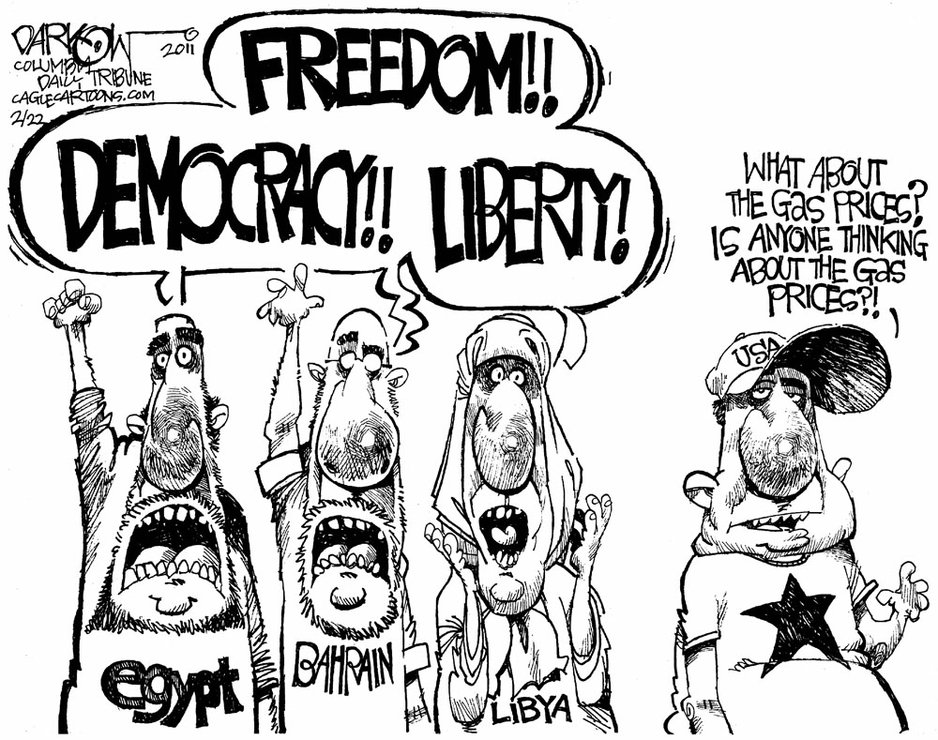
Cartoon by Darkow, Columbia (Missouri) Daily Tribune 22 Feb. 2011.
A lot of the comments I hear about Egypt’s uprisings from neighbors and acquaintances are negative. One acquaintance, a blue collar worker, said of Egypt “all I see over there is chaos.” Even those who believe that the uprisings in Egypt and elsewhere represent real efforts at democratizing aren’t happy about it. Either they believe that the Middle East can’t “do” Democracy for various reasons, or they argue that any democracy will be taken over by Islamists, turning these countries into clones of Iran. Still others argue that democracy in the Middle East isn’t in US interests.
So it was with great pleasure I read the report that a poll shows that most Americans see democratization of the Middle East as positive for the US.
Asked, “if the countries of the Middle East become more democratic,” how this would be for United States “over the next few years,” 65% say it would be mostly positive, while 31% say it would be mostly negative. Asked about “the long run,” an even larger number–76%–say democratization would be mostly positive for the US.
Even better, a majority of 57% say that they “would want to see a country become more democratic even if this resulted in the country being more likely to oppose US policies.” This number is up from five years ago, when only 48% said yes.
I blame much of the negative response I get from my neighbors on politics. I live in a crimson county in a purple state–Ohio is a swing state that voted for Obama in 2008 but gave George Bush his second term in 2004. John Boehner is my district’s congressional representative, and except for an occasional judge, you can’t get a Democrat elected dog catcher in my county.
This isn’t to knock Republicans per se–I’m a “pox on both their houses” type myself–but there seems to me no question that my Republican friends and neighbors seek out, accept, and circulate negative/pessimistic perspectives on the Middle East to a greater extent than my Democratic colleagues and friends.
The poll findings would seem to bear this out. Fifty-one percent of Americans say they think it is likely that the changes occurring in the Arab world will lead to more democracy, but 47% are more doubtful. This divides sharply along partisan lines with two out of three Republicans pessimistic, two out of three Democrats optimistic, and independents leaning to the optimistic side.
Similarly, 59% overall, and 68% of Democrats and 59% of independents, think that it is possible for Muslim and Western cultures to find common ground, while 52% of Republicans say that violent conflict is inevitable.
Other findings include:
Trend line questions show signs of modest improvement in American attitudes toward Egypt, Saudi Arabia and Syria. Majorities express favorable views of the Arab people in general (56%) the Saudi people (57%) and especially the Egyptian people (70%)–putting the Egyptian people nearly on a par with the Israeli people (73% favorable).
Significant minorities said that the Arab uprisings increased their sympathy for the Arab people (39%), and their sense of how similar the aspirations of the Arab world are to theirs (33%). Only very small minorities said that it decreased these feelings and perceptions.
“There is evidence that the Arab uprisings have contributed to improving views of Arab countries and quite positive views of the Arab people, especially Egyptians,” comments Shibley Telhami of the Anwar Sadat Chair and the Saban Center of the Brookings Institution.
Nonetheless, when asked how the United States should position itself relative to the demonstrators and the governments, two thirds say that it should not take a position in Syria, Bahrain, Yemen, Saudi Arabia or Jordan. Among those who favor the US taking a position, though, they overwhelmingly favor the US supporting the demonstrators.
The poll size is small: only 802 Americans. But it is selective, with participants chosen by a random selection of telephone numbers and residential addresses, then invited by telephone or by mail to participate in a web-based survey. Participants who don’t have Internet access are provided with a laptop and ISP connection.
Full Disclosure
I should mention that I know both the guys whose institutions sponsored this poll and released its results at last week at the seventh Forum on US-Islamic World Relations in Washington DC.
Shibley Telhami, the Anwar Sadat Chair for Peace and Development at University of Maryland, was a public policy adviser on the Middle East for Republican administrations (tail end of Reagan, Bush Sr., beginning of Bush Jr.) until he broke with them because he disagreed that the Iraq war was in the US national interest. His book The Stakes outlined his positions on what should guide US policy. He spoke at Miami a few years ago, and visited my capstone class on Issues in the Middle East.
Steven Kull, director of the Program on International Policy Attitudes (PIPA) at the University of Maryland would definitely not remember me, but I interviewed him in my earlier life as a reporter when his book Minds at War: Nuclear Reality and the Inner Conflict of Defense Policymakers was released. I was not impressed particularly by the book (although my close reading of it helped me get a graduate TA-ship in a nuclear policy course at Brown one semester a couple of years later) but I was very interested in his interviewing technique, in which he confronted policy makers with contradictions in their interviews which led them to ever deeper levels of analysis of their own positions.
You can read the questionnaire here.
You can read the full report here.
You can read information on how the poll was conducted here.
The Regime Didn’t See It Coming Either
Did anyone see the revolution coming? Apparently not. I’ve blogged twice already (here and here) about the failure of social scientists like myself to see this coming, and the failure of the protesters to realize, initially, what they were accomplishing. Now, in a recent interview with Cairo Review, former National Democratic Party Secretary General Hossam Badrawi explains why the regime didn’t see it coming–and what it looked like from inside the power structure.
Watch too, Badrawi as a speaker. He presents himself as thoughtful, self-assured but not arrogant, with Egypt’s best interests genuinely at heart. Men like this (and they are almost all men) are one reason why the NDP, in spite of the Mubarak legacy, still has a strong chance to play a dominant role in the political future of Egypt.
Badrawi was a member of the NDP for 11 years, during which he positioned himself as working for reform from within. He was named by Mubarak to head the new government after the president dismissed the previous one. He held that role for four days, then resigned from the post, and the party. But he is still being courted by his old NDP cronies, and by other, emerging parties, so we’ll no doubt see more of him.
Here’s the entire transcribed interview:
CAIRO REVIEW: What happened in Egypt?
HOSSAM BADRAWI: It’s a revolution. It changed the status of Egypt and it will definitely affect the future. Unexpectedly, it is the middle-class, educated people that made the change. Other sectors of the society have joined in. Some sectors are benefiting more. But the major move of the people: it is much more effective than in the revolution of 1919. And definitely more credible than 1952, because it’s from the people, not the army. Egypt is making history for the Middle East.
CAIRO REVIEW: Looking at it from the inside, did you see it coming?
HOSSAM BADRAWI: I didn’t see it coming in that way. But the ceiling of my expectations was much less than what happened. In 1990, we were many people working for reform in Egypt from outside the government. The structure that had all of us was the New Civic Forum, led by Dr. Said El-Naggar. Some of us decided we can make the change from inside. I represented that group. Others decided to make the change as opposition. Some others stayed independent. But there is a network between us. Because we are looking for liberal thinking. We were all for a free economy, democracy, human rights. We decided to play different roles from different positions. And, I used to tell my friends, the most difficult position is mine. It is easy to be an opposition from outside. It’s much more difficult on the inside and keep your credibility by saying what you want to say. And bear in mind the fact that you’re not implementing what you want.
CAIRO REVIEW: What did you think would happen?
HOSSAM BADRAWI: I thought by accumulated pressure, we could change Article 77 [in the constitution] and have limitations on the president’s terms, and change Article 76 for the way the elections can be done. And at the same time, remove the emergency [law] situation. And make the changes that implement human rights issues in the right structure. There’s a document coming from me as a responsible person for the UPR, the Universal Political Review, of Egypt in early 2010 [and] stated all these facts. I presented it to the United Nations despite the fact that I was in the NDP, which put me in conflict with the party at the time. If Article 77 was going to change and limit the president’s term, I was going to be so happy. I thought it would be an opening for everything, for political reform. I would have been satisfied if I’d seen limitation of terms and implementation of human rights. Obviously, what happened [in the revolution] is much more than that.
CAIRO REVIEW: And you didn’t see it coming?
HOSSAM BADRAWI: No, I didn’t see it coming. I expected change, but I didn’t see it coming. Not that way. I thought with the change of the president, the whole country would be changed. I thought [President] Mubarak should have announced he wouldn’t run again. I was advocating that. I thought by just changing that, most changes would happen by default.
CAIRO REVIEW: So you didn’t see a popular protest movement coming up to effect change?
HOSSAM BADRAWI: No, I didn’t see it that way. I didn’t expect the middle-class people to come together that way and be that effective. It was a good surprise.
CAIRO REVIEW: Was that a common perception in the party, the president and others didn’t see the wave coming?
HOSSAM BADRAWI: I think so. I realized on the first day, some people didn’t realize what was happening even at the time it was happening. Every response from the president was too little too late, all the time. As I was given the post to direct the NDP in those four days, I had access to him and the group around him. I didn’t have it before. I didn’t have it afterwards. But during that time, I realized that they are responding always too late and too little. They don’t evaluate the magnitude of what’s happening. My role in those four days was to open everyone’s eyes, that this reality has to be respected and that the president has to step down now. That “now” was not accepted, day after day after day.
CAIRO REVIEW: Were you able to say that personally to the president?
HOSSAM BADRAWI: Personally, yes, the first day I met him. I told him he has to respect his promises to the people by amending the constitutional term [limits] and move all his authority to his vice president. I thought this is going to be more constitutional and that has to be done in the way people believe it. So he has to be clear about that, that he is not going to practice his presidency, except for one issue: to call for the referendum on the constitution, and that people should see and believe that is happening and it should be real. The delivery of his speeches did not give the impression that this was real. That was the defect. Until now I still think that moving the authority to vice president and his stepping aside from the presidency would have led the country in a more constitutional way than what is happening now.
CAIRO REVIEW: Did you mean that he resign, or hand over power?
HOSSAM BADRAWI: Hand over the power to the vice president, and to respect the constitution, so that he would have only one role, calling for the referendum. His role will be only one thing to do.
CAIRO REVIEW: But he should remain as president?
HOSSAM BADRAWI: Remain as president outside of the circle of authority. So he passes all his authority, gives it to the vice president, and moves geographically somewhere else, so he is not part of making decisions. And have things done constitutionally, and call for early elections once the constitution was amended. That was my opinion that I told him face to face.
CAIRO REVIEW: Did you ever just ask him to completely resign the presidency, as he did on February 11?
HOSSAM BADRAWI: No, I didn’t advise that. But every day that passed, I realized even the advice [I gave him] wouldn’t be accepted [by the revolution]. On the last day, I told him that even if you take my advice now, it can be successful only 10 or 15 percent. You’re late. People do not believe there’s an honest desire to step away and have the constitution be amended, and elections to be done as early as possible. That was the safest way the country can go, in my opinion.
CAIRO REVIEW: What was President Mubarak’s reaction to that advice? Did he deny there was a problem?
HOSSAM BADRAWI: Actually not. We had meetings more than three times. On Wednesday, I was not giving him advice. I was giving my statement as the secretary general of the ruling party, a position he assigned me to have two days before. I told him that from the meetings I had from different political parties and with the people in Tahrir—I had many people there with the young people—that my political understanding was that the problem isn’t in taking the action. The challenge is that they don’t believe that you are taking the action. It wasn’t advice. It was a request. And when the request was not met the way we agreed upon, I resigned.
CAIRO REVIEW: He disagreed with the request?
HOSSAM BADRAWI: No, he agreed. He understood it. He brought his legal people to make his statement on Wednesday. When I left, I was expecting him to give his statement on Wednesday, and he didn’t give it. So it was clear to me that somebody else had called him. On Thursday, I made another attempt, that he should give his statement. It is already coming to be late. He told me that he is going to give his statement by the end of the day. Then they waited and waited until 10 p.m. or something like that. The statement came in my opinion with the worst delivery, in spite of the fact that it has all the content. But the delivery was not believable to the people. At that level I was cut from communication. I could not be part of the decision making anymore. I waited. I tried to communicate and couldn’t. So I resigned.
CAIRO REVIEW: In the speech, he followed the advice?
HOSSAM BADRAWI: Yes, it followed my advice. But we had an agreement that the core of his speech should be that he was giving away his authority, clear cut. This was said in three seconds. If you look somewhere, you might not even have noticed. The delivery of the speech was not coinciding with the meaning. He started talking about himself and gave the impression that he is there. This was a big mistake. He gave his sharing of the grief of the young people who died. This was a request of the young people I met and I asked for. He separated between the revolutionary and the criminal acts. That was a request, that he has to give it to the people. But at the end of the day, if history looks at the core without the delivery system, then you realize he gave away his powers, and gave the order for constitutional amendments. So he’s not needed as a president anymore, only to call for the referendum. He didn’t say that, he didn’t press on that, he didn’t give the impression that this was the situation. The content was there, but the meaning and understanding was not there.
CAIRO REVIEW: He was not in denial about what was happening in Tahrir? He had already dismissed the leader of the party and even Gamal Mubarak.
HOSSAM BADRAWI: That was my request, by the way. That was my request. When he assigned me as secretary general, I said everyone has to resign. I have to have full authority to reform the party.
CAIRO REVIEW: So you think he was trying to remain part of the system, not to exit?
HOSSAM BADRAWI: I think the circle around him was putting him to that situation. I had the feeling that he really wanted a constitutional path. And that he’s stepping down anyway, anytime. But again, the decision and timing is part of the formula. And I think they were not—his advisors—were not helpful to let him take the right action at right time.
CAIRO REVIEW: Why?
HOSSAM BADRAWI: I’m not sure, but probably they were in denial more than him.
CAIRO REVIEW: Why did the president finally resign on the Friday?
HOSSAM BADRAWI: I saw it coming. After his speech on Thursday, and what happened Thursday night and Friday, it was clear that it is the point of no return. I think he had no choice.
CAIRO REVIEW: Did the army go to him and say he had to step down?
HOSSAM BADRAWI: All theories are possible. I was cut completely after I left the president’s house on Thursday. On Thursday evening and Friday, I was like you, listening to news and seeing it on TV. I was cut. I was not connected. I tried but I couldn’t. I came on TV [and resigned]. The only way for me was to give a statement to the BBC so it becomes public. At the end of the day, the publicity is the reality.
CAIRO REVIEW: Why do you think the revolution happened?
HOSSAM BADRAWI: I think the reaction of the police was one of the factors to create the movement. Because the excessive use of violence was part of the accumulation of other people to come in. At one level, the fear has gone. The numbers made it possible for the fear of the security forces to go away. Everybody underestimated the capacity of the youth to represent their opinion. There was underestimation of that capacity by the whole society, even by their parents, who joined them later.
CAIRO REVIEW: What led to January 25?
HOSSAM BADRAWI: It was the accumulation. I think it’s the human integrity and the human rights, more than anything else. It was not those who do not have employment. It was people with good employment in the streets. I think it was humiliation. I call it chronic anger, a chronic state of anger. In medicine, the chronic situation, you get adapted to the pain until it becomes acute. The acute exacerbation made all chronic anger come up. Part of it, was in my opinion, the way the state was dealing with the people, humiliating them in everyday activities. The relationship of the individuals with the police. They way you get your services from the state, from the cabinet, from the public officials. Everything had to do with whether you have a wasta (connections) or pay a bribe. Everybody was telling their kids, “If a policeman stops you, don’t argue.” These situations were elevating the dissatisfaction and anger. Not acute enough to revolt, but it’s there. Trigged by something, everybody came together.
CAIRO REVIEW: What was the trigger?
HOSSAM BADRAWI: The excessive use of violence within the police. Khaled Said [a young Egyptian killed in police custody in Alexandria in 2010] was part of it. And the excessive use of violence in Tahrir on the first day. On the first day everyone was calling for freedom and justice. It was not about food or unemployment. That was a collective request of everyone. As they got larger and larger, the line of fear has gone. And then with the late response, and the little response, objectives went higher. If on January 25 the president had come out to the people and said, “I’m dissolving the government and not running [for re-election],” probably everyone was going to be happy. As you go day after day, and people get hurt and die, and you are not seeing the leader of the country coming to talk to the people for three days, this was cumulative bad management of the crisis. It made the chronic stage into an acute stage.
CAIRO REVIEW: Was the “succession issue” a factor? The 2010 parliamentary elections? The Gamal Mubarak question?
HOSSAM BADRAWI: I add it as a factor to the chronic anger. There were no clear-cut announcements [about Gamal Mubarak] that people could protest against. But it created the feeling that something weird was being cooked. The president should come clearly and say that he wasn’t going to run, and that no one from his family was going to run, to give that kind of satisfaction. The parliamentary election in 2010 was another important factor. In a meeting after the election, in the party they were announcing we had the largest victory any party had. I raised my hand and said, from a limited party point of view, it might be true. But from a political point of view, I think this is the largest defeat we’ve had. Because if you do not have opposition in the parliament, you will have them in the streets. And if it was in my hand, I would definitely have worked harder for the opposition to have them represented in the parliament. And I had that conflict with the administration, because I was sure that playing alone is not in the benefit of the country. And having the parliament unilaterally ruled was not going to be accepted by anyone. In spite of the fact that they had so many proofs that they won fair and square against the Muslim Brotherhood. It was a disaster and added to the chronic anger.
CAIRO REVIEW: What was your assumption about Gamal Mubarak’s intentions?
HOSSAM BADRAWI: I was there for eight years, and this was never discussed between me and him, never raised as an issue in the party. But actions give different impressions. I don’t know if there was a smaller circle talking about that and I wasn’t a part of it. His presence and his leading of the party and his appearances and visits to different areas of the country, gave the impression that he’s politically portraying himself. He never talked about this with me, maybe with others. I once told him in the party, that the relationship of the party with the government is not [correct], because if it weas [correct], it should not depend on the president or the son of the president. It should depend on the dynamics of politicians. There was so much implementation of policies that we worked out that was not done. And I cannot make any difference. It is always going back to the president, whether he gives instructions to the government or not. It is all a relationship between the government and the president’s house.
CAIRO REVIEW: The NDP is not a real party?
HOSSAM BADRAWI: It was a real party, but very centralized. There were very good people. Excellent policy papers were done with lots of efforts from intellectuals and politicians, learning from the experiences of other countries. But that stops here. Whether that was being taken seriously by the government was something else.
CAIRO REVIEW: In the upper levels of the NDP, was it your assumption that Gamal was being prepared to become president?
HOSSAM BADRAWI: Yes. It was an assumption, yes.
CAIRO REVIEW: Was this ever an issue to raise that this was not a good idea, and could damage the president and the country?
HOSSAM BADRAWI: Yes. But sometimes when you say that to the person, he says “No, I’m not intending,” then the discussion becomes “Who said I want to do that?” And the president says “My son is just helping me.” The discussion stops.
CAIRO REVIEW: What was going through your mind when you saw the NDP headquarters being burned?
HOSSAM BADRAWI: Actually, I wasn’t only looking at the NDP being burned, but all police stations being burned down across the country. And all prisons being opened for prisoners to go away. And the NDP locations in eleven governorates being burned, and synchronized in the same way: we get in, steal contents, burn papers, get the hard disks of the computers. I don’t think this was the revolution in Tahrir. It was much more organized than that. You have to think that there is a mastermind. I cannot assume [who is responsible] because I don’t have any evidence. Don’t tell me people who in the streets going for their dignity and freedom organized that. It cannot be. We have to see who is going to benefit. The story did not come to the final chapter. So let’s see who will take power, and then we’ll know who’s the beneficiary.
CAIRO REVIEW: What happens next?
HOSSAM BADRAWI: I want a transition to take place in a secular, civil structure. However, if the parliamentary elections are being held early, I think Egypt won’t come to a stable situation for a long time. If we do not give time for parties coming out of the revolution to establish themselves and be a part of the coming elections, we’re not giving them equal opportunity with others who are already structured and ready for those elections. The army has played a neutral role. I think they’re overwhelmed with responsibility they are not trained to do. And I believe they would like to pass authority as fast as possible. But I hope “as fast as possible” doesn’t affect the right decision. We have fragmentation now. We need one-and-a-half to two years.
CAIRO REVIEW: Would the Muslim Brotherhood win the election?
HOSSAM BADRAWI: They would be the only party inside the parliament. The NDP isn’t there. So other members would be individuals, independents running without a cover.
CAIRO REVIEW: Is the NDP finished?
HOSSAM BADRAWI: No, I don’t think so, but I think it needs years to recover with new branding. It used to depend on being a part of the ruling structure, so it lost its magnet for people who want to become part of the government. But it is still the only structure that exists other than the Brotherhood. The NDP will need three or four or five years of working hard to change the image. There’s a very negative impression. You have to rebrand.
CAIRO REVIEW: Is the political role of the Mubaraks in Egypt now over?
HOSSAM BADRAWI: Yes, it is.
CAIRO REVIEW: Does Gamal Muarak have any chance to be part of the rebirth of the NDP?
HOSSAM BADRAWI: No. I don’t think he has any role in the future.
CAIRO REVIEW: What are your plans?
HOSSAM BADRAWI: I’m just listening to people, analyzing, and giving my fair opinion. I meet with all political sectors. And I think in the turbulence that exists, people have to wait and see. If there is a party that can come from down up, I’ll join.
CAIRO REVIEW: How has Egypt fundamentally changed?
HOSSAM BADRAWI: There is great opportunity for Egypt to move forward politically. It will affect the economy. I’m an optimistic person by nature. I see the opportunity there. But there are huge risks. If we fall into linear thinking that does not accept differences of opinion—either a military or a conservative religious one—neither would be best for the country.
CAIRO REVIEW: There’s a risk the military might take control completely?
HOSSAM BADRAWI: I don’t know. They are there now.
CAIRO REVIEW: You’re worried about the Brotherhood?
HOSSAM BADRAWI: My intellectual structure is to be an open person, respect diversity, and accept differences in opinion. I have nothing against a woman president, or a Coptic Egyptian president, so long as it’s through a democratic process. I definitely would like to see citizenship rights regardless of any religious belief. I see that that path might not be the path of the Muslim Brotherhood for the time being. Yet, they have good things to offer. This is the only thing that makes me worry. I have so many friends in the Muslim Brotherhood, good people and excellent people. They have good intentions. They should be part of the political scene, but they shouldn’t impose their style on me.
CAIRO REVIEW: Should the future system hold the former regime accountable?
HOSSAM BADRAWI: That worries me very much, the fact that everything is being taken now by impressions. The rule of law should be the rule of law. We cannot accuse any person and accuse and incriminate and judge at the same time. That’s very scary. I’m afraid of a sort of McCarthyite attitude, that once you’re different in opinion, you’ll be taken hostage by the fact you’re different. As if we are moving from one kind of dictatorship to another kind of dictatorship.
The Mosque in the Marketplace of Ideas

Salafis would do better to exhort from the mosque than to engage in violent political action, claims Islamic Group leader Najeh Ibrahim.
x
In an April 13 interview with the Palestinian-owned Al-Quds al-Arabi newspaper, Al-Gama’a al-Islamiyya (the Islamic Group) leader Najeh Ibrahim urged Salafis to stop trying to take political action–attacking shrines, killing accused sorcerers (or their neighbors, by accident), and mutilating Christian neighbors–and stay in the mosques.
Ibrahim is quoted by the newspaper as saying:
x
I advise them to differentiate between what is religious and what is political. What is religious is based on the eternal principles, purposes, doctrine and morals of Islam, while what is political is based on constant changes… The calling is practiced in the mosques by qualified scholars, while politics are practiced within parties and political forums by experienced politicians. I thus advise the Salafis in particular not to exit the mosques, but to continue teaching the people about religion, because their involvement in political action without any qualifications will lead them to predicaments and media traps which may thwart their calling and destroy their scholars…
From a political perspective, this might come across as hypocritical and self-serving. Ibrahim, after all, was imprisoned for decades for suspected involvement in the assassination of Anwar Sadat, and he is an associate of cleric Omar Abdel-Rahman, convicted of participating in the 1993 World Trade Center bombings conspiracy.
Ibrahim swore to abandon violence as a tool when he was released from Egyptian prison in 2006, and his statement is consistent with that promise. But it is also culturally consistent with the broader Muslim piety movement in Egypt.
The Muslim piety movement seeks to re-introduce Islam into the public sphere throughout Egypt by reciting, listening to and discussing the Quran, by sermonizing, and by mutual moral exhortation and admonishment in public discourses both mediated and interpersonal.So far those describing and analyzing the movement, such as Saba Mahmood (2005), Charles Hirshkind (2006), and myself in Chapter Four of Connected in Cairo among others, have focused on the functions of such pietistic practices in identity construction and transformation.
A recent article in the journal Anthropological Theory by Paul Anderson suggests that Ibrahim’s exhortation is consistent with a fundamental aim of the Muslim piety movement: the achievement of a non-secular sociality.He writes:
For participants in the movement, virtue is constituted primarily through social exchange and interaction (mu‘aamalaat) rather than simply through worship (‘ibaadaat) or ritual practices that discipline the self.
Anderson argues that the sociality aspect of the piety movement is best understood through a metaphor borrowed from economic anthropology: the ‘gift economy’. Contemporary Egyptian piety movements operate very much like the gift economies anthropologists have described elsewhere in the world, except that it is words that circulate rather than material goods.
The advantages of the ‘words as gifts’ metaphor are threefold. First, it emphasizes the way in which virtue, for Egyptian pietists, is constituted through transaction and exchange rather than through individual worship. Second, it directs attention to the ideology of language in Egyptian piety movements, whereby ethical communities form around and through the efficacy of the Quran and language that recalls the example of Prophet Muhammad. Third, it reflects the way in which urban piety movements in Egypt constitute themselves in conscious opposition to a notion of secularism (‘almana) which is associated with a commodity economy of goods, words and images experienced as morally and socially corrosive.
This strikes me as offering a very useful context for understanding Ibrahim’s interview. According to Ibrahim, when Salafis attack Christians and destroy shrines, they allow the media to control the circulation of words in ways that denigrate and undermine the movement. But when Salafis circulate words from the mosque, they are in a position of strength in their effort to transform Egyptian society.
Mubarak Speaks–But Not Through Egyptian Media
 It is not really surprising that, a few days before his arrest, Hosni Mubarak–beleaguered by the news that one hundred thousand people turned out to demand his prosecution and that those of his former cronies still in power seemed to be listening to them–issued a statement defending himself and calling accusations of corruption false.
What is surprising is that he should do it on Al-Arabiya satellite channel.
Al Arabiya (“The Arabic One”) is a UAE Arabic language television news channel headquartered in Dubai. Launched in 2003, Al Arabiya has become one of the top pan-Arab stations, rivaling to Qatar-based Al-Jazeera in some markets.
So why did Mubarak, recording his message in luxurious, upscale Sharm al-Sheikh, choose a non-Egyptian channel available only by subscription for his message when Egypt’s state-run TV operates 2 national and 6 regional terrestrial networks as well as about 20 private satellite channels any of which would have been more than happy to broadcast his message?
One possibility being espoused in editorials and popular opinion is that it was simple arrogance.
Abdel-Beri Atwan, Chief Editor of the Palestinian-owned Al-Quds al-Arabi daily newspaper said in an editorial, “President Mubarak is still acting with that same arrogance he mastered throughout the thirty years during which he and his family controlled the country, and is dealing with the Egyptian people and their revolutionaries as though they were ignorant and underage.”
Arrogance? Perhaps. But perhaps also uncertainty.
The Egyptian media was, after the police, one of the absolute certainties upon which the regime could rely. The state media was a sycophantic voice of and for the regime in every circumstance, the independent media were subject to laws that made it a criminal offense to criticize the president or his family, and the opposition newspapers were paper tigers.
Everything changed after his resignation. Editors in the official media scrambled to apologize for decades of propaganda. Even former Al-Ahram editor Usama Saraya, who had endured international ridicule for digitally enhancing photos of the president to “express” his leadership, did an about-face and lauded the fall of the regime. And even if they had not to a man (and they were almost all men) turned on him, they were all replaced by the Supreme Council anyway.
It seems to me very plausible that Hosni Mubarak was simply too uncertain of how his statements would be reported and contextualized by Egyptian media; that he might have worried that Egyptian media would deliberately contextualize or comment on his statements in critical ways in order to distance themselves from charges of being sympathetic to the ruler.
Whatever the reasons, Mubarak made a mistake, I think. If there remains a large contingent of Egyptians still loyal–or at least sympathetic–to the president, they are likely to be among the urban and regional middle classes who suffered economically under the chaos of the protests. Most of them have always gotten their news and information from state media, and they are unlikely to spend the money needed to be subscribers to Al-Arabiya.
Saudi Arabia is Added to Egypt’s List of Foreign Villains

The Saudis are being added to the list of "foreign hands" -- led by the US and Israel -- believed to interfere in Egypt's social worlds.
One of the oldest stories in Egypt is that of the foreign hand. Whenever anything goes wrong in Egypt, people immediately begin blaming shadowy foreign powers seeking to destroy Egypt.
The classic villain was always Israel. To hear some Egyptians tell it, Mosaad can do almost anything–and it will. The most egregious example I experienced was in 1997, just after I’d come to Egypt. The terrible Luxur incident had just occured, in which terrorists from the Islamic Group and Jihad Talaat al-Fath (“Holy War of the Vanguard of the Conquest”) murdered 62 people. My daughter’s optometrist, a smart, loquacious guy, insisted that Egyptians would never do such a thing, that the entire incident had to have been masterminded by foreign powers–probably Israel–to bring shame on Egypt and wreck the tourist economy.
The U.S. is another popular villain, as is Al-Qaida. As recently as last year, the Mubarak regime was blaming a foreign hand for the Church bombings in Alexandria, and during the January 25 uprisings, Egyptian state television suggested that the protesters were being paid and encouraged by a coalition including the U.S., Israel, Iran and Al-Qaida.
What is really interesting is that this may not only be propaganda. A memo discovered in the people’s takeover of the former secret police building in Cairo suggests that the police actually believed this, and were passing it on as intelligence.
One of the interesting turns in the post-uprising era seems to be a proliferation of possible bad guys as protesters targeted Saudi Arabia.
Shia Muslims gathered in front of the Saudi Arabian Embassy in Cairo on April 9th to denounce the Saudis. The Saudi regime supports a doctrine that permits Sunni Muslims to destroy Shi’ite shrines (as they have done in Mecca and Janat al-Baqi), and the protesters believe that recent attacks on Shi’ite and Sufi shrines were encouraged by sheikhs spouting such doctrines from the pulpit.
Demonstrators also said the Saudi kingdom plays a role in mobilizing and economically supporting Salafi Muslims to disrupt Egypt’s social tolerance, endangering Shi’ites, Sufis and Copts.
Clerics in the Saudi kingdom have issued decrees excommunicating Shias, Sufis and the 25 January revolutionaries. The Saudis have also condemned the Saudi opposition to prosecuting President Mubarak.
The protest was small in number, only a few hundred, with no well-known Sufi or Shi’ite leaders in attendance.
Connected in Cairo Has Shipped
 Just received word–via Facebook–that the first run of Connected in Cairo arrived at the warehouse yesterday. My editor e-mailed to say she’d sent the first copy to me by express mail, so I should get it today or Friday. It’s been many years in the making, and I’m so happy to have it coming out at last.
There is a hardback edition for $70 and a paperback for $24.95. You can get a look inside at Amazon or GoogleBooks, and at Google you can request a Kindle edition (I’m just saying…)
The book is part of the Public Cultures of the Middle East and North Africa book series.
It is published by Indiana University Press.
Social Media Still Not “Free” in Egypt

Blogger Maikel Nabil Sanad was sentenced April 11 to three years in Tora Prison by a military court.
One of the key questions raised by the sentencing April 11 of blogger Maikel Nabil Sanad is why the mainstream media seems to be becoming ever more free of government restrictions while social media remains an area that must be restricted by the Egyptian state.
Egypt’s Military Court handed Nabil a three year sentence for his blog post entitled “The army and the people were never one hand.” The blog entry described in detail the negative roles the army has so far played throughout the January 25 uprisings, for which Nabil was accused of “insulting the military” and “disturbing public security.”
I have blogged about the dramatic changes in Egypt’s mainstream media–it’s press and television news–here and here and here and … well, click on the tags. And I’m not alone in tracking these amazing changes. A recent article in Foreign Policy celebrates the new license journalists have to investigate and criticize.
But I’m an anthropologist. When I speak of the “evolution” of the media I mean it in the technical sense of an institution adapting in patterned ways to changing environmental circumstances. I do not intend it in a teleological sense, as if all news media somehow strives for freedom if it can just overcome the obstacles imposed by government.
Egypt’s media has responded dramatically to revolutionary shifts in the social and political context. The state media’s slavish interpretation of serving as the governments voice by airing patent falsehoods no longer serves any adaptive function–it brings rewards from neither the market economy nor the new regime.
The state has replaced editors appointed by the old regime, refrained from employing the considerable censorship powers at its command, and even suggested allowing news institutions to recommend their own nominees for editorial and board positions. The old Minister of Information was sacked and no new one has yet been appointed to replace him. State TV showed Fridays protests in Tahrir, even though the military was clearly unhappy about them.
In making these changes, the Supreme Council serves several purposes: they get themselves out of the media business, they please a public seeking reassurance that the military is a good guy in this revolution, and they build goodwill within the media institutions that represent them to that public.
What they have not done–nor would I expect to see this–is dismantle any of the considerable apparatus that allows the state to punish media if it goes “too far”. Indeed, with the constitution suspended, military courts like those that sentenced Nabil can be used to suppress errant media far more efficiently and effectively than the old state and civil courts, which were used to suppress Ibrahim Eissa several years ago.
It is important not to romanticize notions of press freedom, a common failing in political analysis. “Freedom” is a complicated concept, and mainstream media always exist in the center of a web of tensions between market forces, state forces, the personalities of owners, and the subcultures of the educated elites (“intelligentsia”) from which journalists are drawn.
When Thomas Jefferson famously said that if it were left to him to decide whether we should have a government without newspapers or newspapers without a government, he should not hesitate a moment to prefer the latter, he was not speaking of modern, bureaucratic media, whether run by corporations or the state. In Jefferson’s day, most newspapers were printed by a small factory involving a professional printer and his apprentices, and perhaps a dozen or so people he could count on to write articles regularly, often for no pay.
From a production standpoint, it resembled contemporary social media more than it resembles the contemporary press.
But social media is different. In my book Anthropology and Mass Communication I followed Enzenberger (1970) and Manuel (1993) in distinguishing between “old media” in which some person or corporation or state controls the means of media production which is then distributed to a large (“mass”) audience, and “new media” in which to own the means of consumption is to own the means of production (cassettes, for example, or fax machines). At the time, I thought the Internet and Web represented simply the latest in new media. But I failed to take into account the extent to which texts are not circulated, as in new media, but actively remade as they circulate. Social media, especially Web 2.0, is not “new media” but “third wave media”.
And Third Wave media is terrifying because it is so ambiguous. It allows dispersed individuals to come together into shared spheres of association, and to plan and organize activities, and to simultaneously reach out to global sympathizers. From the viewpoint of the military leaders, it is new, its capacities are not well understood, but it clearly does not operate the way broadcast does–it operates through networks of interconnections and viral distributions. It leaves authorities without a sense of control (I discuss this same suspicion of viral distribution and transformation with regard to Pokemon in Chapter Three of Connected In Cairo).
The authorities believe they know how to control old media fairly well. They learned a lot about dealing with new media after the Iranian revolution, but most new media has been absorbed into digital media anyway. And digital media is,at least for now, a very uncertain mode of representation.
As for Nabil’s sentencing, by detaining him in his home, and preventing his further blogging, the military has sentenced the man while more or less confirming his points. And while this action has probably had some chilling effect on some blogs, as it was no doubt intended to do, many others have used it as the basis for blogs of their own.
Can Social Media Content Analysis Tell Us Anything About the Uprisings in Egypt and Elsewhere in the Middle East?

Steve Inskeep of National Public Radio in the US spoke with Mazen Nahawi, president of News Group International, a Dubai-based news management company that monitors and analyzes traditional and social media around the Middle East and North Africa.
INSKEEP: You report here that people were united and optimistic and now they’re not united and not so optimistic.
Mr. NAHAWI: That’s right. We’re finding increasing levels of disenchantment. People are starting to lose faith in the end game of the revolution. The level of optimism was perhaps a little bit too high with the euphoria of the ousting of the former regime, and things are probably starting to settle down. But conversation about activism has in fact not declined.
The idea of this is more fascinating than the interview itself, which fails to grapple with many of the most interesting questions. If they are truly able to track thousands of tweets and blog posts, how are they doing it? Are they just sampling or are they using some kind of algorithm that pulls out key words? If the former, how many do they pull from how large a sample? And if the latter, how are they handling the differences between Arabic script, English transliterations and English transliteration that uses numbers to represent Arabic phonemes that don’t occur in English?
I’m more interested in the functions of social media in the uprisings than in the content, but this seems an interesting project nonetheless. In spite of its shortcomings, the NPR story is brief and worth hearing, or reading. You can do either right here.
The Best Story of the Egyptian Uprisings So Far

Protest in Tahrir. Photo by Abdelrahman Mostafa.
This is the best account of Egypt’s uprisings so far. I’m referring to a marvelous essay by Mona El-Gobashy, a political scientist at Barnard College, “The Praxis of the Egyptian Revolution” (okay, it’s not a title to grab lay readers, hence this shout out) appeared in the latest issue of Middle East Review and is available for free from the Middle East Research and Information Project.
El-Gobashy pulls together all the elements I and other peoplehave blogged about. She ties it all together with a narrative describing how a series of cultural and situational factors came together to allow the uprising. At times, she offers detailed, gripping accounts of events, drawn from journalists’ narratives and interviews with key players.
But these are always at the service of a model based on how three different “uprising infrastructures” came together, as a result of multiple contingent actions. El-Gobashy argues that Egypt has always had three distinct “subcultures of protest” each with its own mobilizing structures and repertoire of tactics:
- Workplace protest (collective action by industrial laborers, civil servants, students and trade practitioners such as auto mechanics and gold traders).
- Neighborhood protest (protests by Copts, Sinai Bedouins and farmers organized along residential lines)
- Associational protest (demonstrations by professional associations and by social movements)
What happened, says El-Gobashy, was that circumstances unforseen by either the regime or the protesters, allowed these three subcultures of protest to operate simultaneously and in conjunction with one another.
The author recognizes that Egypt was not outwardly strong, rotten inside. On the contrary, it was a strong state that had successfully weathered so many protests that no one, including the protesters, had any idea what was going to happen.
Egypt’s momentous uprising did not happen because Egyptians willed it into being. It happened because there was a sudden change in the balance of resources between rulers and ruled. Mubarak’s structures of dominion were thought to be foolproof, and for 30 years they were. What shifted the balance away from the regime were four continuous days of street fighting, January 25–28, that pitted the people against police all over the country. That battle converted a familiar, predictable episode into a revolutionary situation.
and
For a capable autocrat like Mubarak, large protests are no cause for anxiety. The fears are diffusion and linkage. Indeed, the diffusion of collective action in time and space emboldened Egyptians, signaling the unwillingness or incapacity of the coercive apparatus to suppress demonstrations. The simultaneity of protests across very different locations, especially the filling of streets in neighborhoods entirely unused to such processions, revised citizens’ calculations of what was possible and reduced uncertainty about the consequences of action. The second fear is the coordination between the three organizational infrastructures of protest. Indeed, the state security directorate existed to frustrate precisely this bridge building. It had done so quite successfully with the April 6, 2008 general strike, and had a stellar track record in branding each sector of dissent with a different label: Associational protest was “political,” but workplace and neighborhood protest was “economic.”
It ends with acknowledgment of the contingent nature of the ongoing revolution:
At press time, Egypt’s revolution is still in full swing. It must be expected, however, that the revolution will undergo phases of setback, real or apparent. The apparatus of coercion, indeed, has been quickly rehabilitated and is gingerly reinserting itself into civilian life. But on what terms? For Egypt’s revolutionary situation to lead to a revolutionary outcome, existing structures of rule must be transformed. Citizens must be free to choose their presidents, governors, parliamentarians, faculty deans and village mayors, their trade union, student, and professional association leaders. They must have a binding say in the economic decisions that affect their lives. The coming years will reveal how much of that will happen and how. Just as it provided an archetype of durable authoritarian rule, perhaps Egypt is now making a model of revolution.
Sandmonkey: Seven Myths About the Revolution
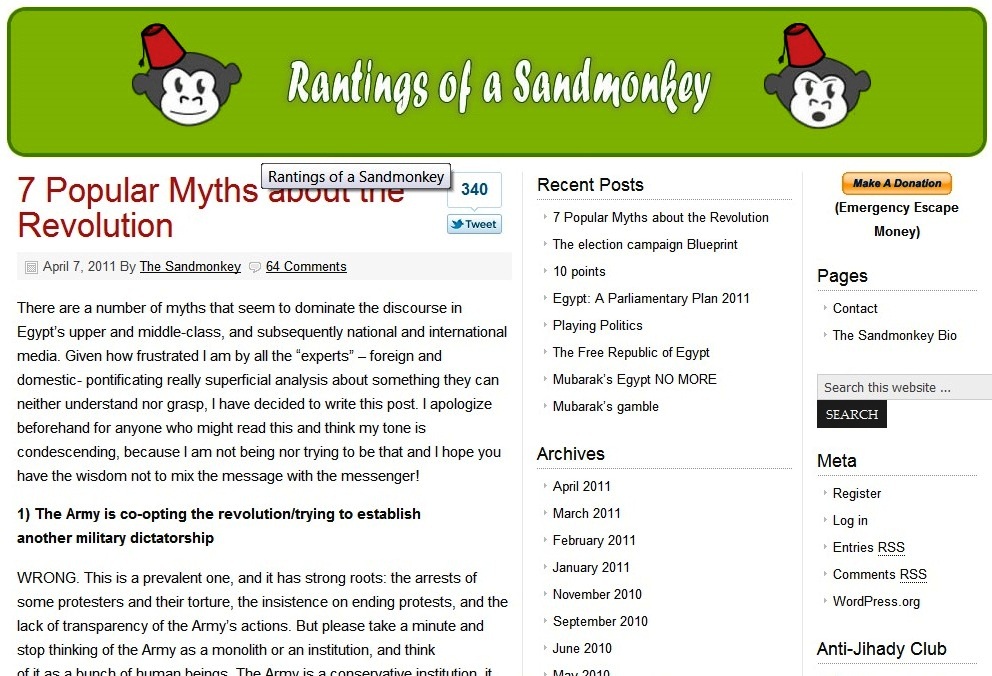
Warning! Don't pontificate about the revolution in Egypt until you've read this blog...
The popular English language blog “Rantings of a Sandmonkey” has another rant well worth reading: Seven Popular Myths About the Revolution.
Inspired by his frustration with by all the “’experts’–foreign and domestic–pontificating really superficial analysis about something they can neither understand nor grasp”, Sandmonkey has offered the following seven propositions as myths.
- The Army is co-opting the revolution and trying to establish another military dictatorship
- The NDP (and Mubarak) is still controlling the country
- The Islamists are hijacking the revolution
- New Parties are the only way to save the next elections
- Amr Moussa or El-Baradei is certain to be the next president
- International forces will destroy the revolution
- There is doom and gloom everywhere in Egypt!
So if you hear pundits spouting one of these propositions as a balanced analysis, make sure you read Sandmonkey’s rebuttal before accepting their expertise.

 CONNECTED in CAIRO