Egypt’s New Party Politics

Amid all the new political activity, here's one guy we won't see running for office. (This Mubarak campaign sign is from the 2005 elections)
It is fascinating to watch political parties forming, and political actors seeking to forge strong public identities, and to define themselves in association with, or in opposition to one another. This kind of ordinary political activity was unimaginable just a year ago, when political parties were extremely difficult to form, and it was hard for most political actors to perceive any value in it since the elections would be rigged anyway.
Rumors spread through the grapevine recently that Mohammad al-Baradei and popular Judge Hisham al-Bastawissi, now deputy general prosecutor, might engage in an alliance through which one will be candidate to the post of president and the other to that of vice president.
But a March 27 report in the Saudi-owned London-based Asharq al-Awsat daily said al-Bastawissi denied the rumor. However he might consider an alliance with Hamdin Sabahi, president of the Karama (“Dignity”)Party (and notable critic of al-Baradei), and said a meeting was scheduled for the two men to discuss this idea in detail.
The Asharq al-Awsat article reported that some al-Baradei supporters are calling on him to seal an alliance with a popular figure such as Abdul Monem Abu al-Foutouh (a leading member in the Muslim Brotherhood who recently announced his candidacy), or Amr Moussa, who has said that he was ready to cooperate with al-Baradei.
Al-Baradei’s media spokesman Ahmad Salah, was quoted by Asharq al-Awsat as saying:
Doctor Al-Baradei has no objection to and no vetoes on any other candidate. He is willing to cooperate with the other candidates as long as it serves the best interests of the country. Al-Baradei has already announced – in many meetings we have held with him – that he welcomed the idea, but assured that he had not yet decided with whom he will be forming an alliance.
Another presidential candidate, former foreign minister Abdullah al-Ashaal who announced he would run as an independent, told Asharq al-Awsat that such alliances are not a good idea.
For my part, I refuse to ally with any of the other candidates, and especially not with Al-Baradei, Nour and Moussa. I am fearful that these alliances would ruin the presidential campaign.
And speaking of Ayman Nour, he assured everybody in a March 30 interview with Issam Fadel in Asharq al-Awsat that the Al-Ghad (“Tomorrow”) Party, which he founded, is healthy and that he is planning to run for president in the forthcoming elections. He said the party is considering a number of names for vice-president including both Christian and women candidates, but was not yet ready to reveal any names.
He also acknowledged that Al-Ghad was one of several progressive parties would be forming a broad alliance that could form a government if elected.
Even the recent outreach by the Muslim Brotherhood toward Coptic Christians can be seen in this light: an effort to demonstrate to a large voting block that they are not bogeymen but moderates creating a serious political campaign. The name of their new political party, the Freedom and Justice Party, doesn’t mention God in the name, an interesting shift for a group that ran in 2005 under the slogan “Islam is the answer.”
Meanwhile, parties are also learning how to use media to undermine each others candidacy. Damning Amr Moussa with faint praise, the Al-Wafd party newspaper Al-Wafd explained that Israel and its ally the US were so terrified at the idea of the Arab League leader as president of Egypt that they tricked him into calling for US involvement in Libya, which turned public sentiment against him:
And it seems that the Arab League’s secretary-general has lost his remaining political credit in the Arab countries and he has also lost the chance at being nominated or at winning the post of the president of the Egyptian Arab Republic in succession to the ousted Mubara. We must suggest that Amr Moussa, through his demand for and approval of the military western campaign against Libya, has fallen in the trap. And when he realized that too late, he said: the military strikes have expanded and have reached the civilians and this was not agreed upon.
But hey, that’s politics.
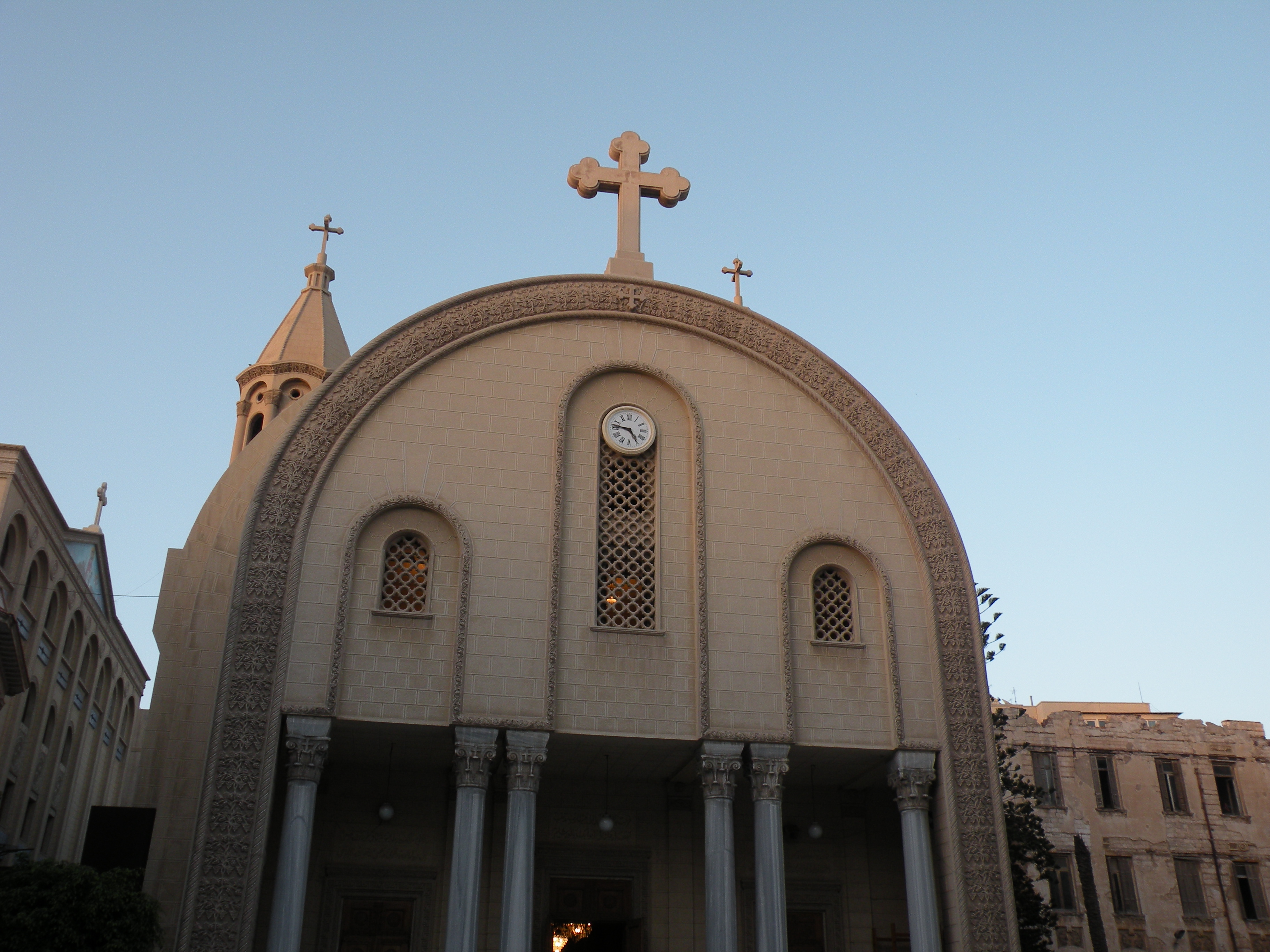
St. Mark's Cathedral in Alexandria, seat of the Coptic Pope.
During the Jan. 25th uprisings, one of the signs of the new Egypt was Muslims and Christians united against the common enemy–the state.
Since the uprisings ended, however, Muslim-Christian relations have once again become strained, particularly in rural communities and poor urban areas.
Recently, however, two efforts have been made to reach out and bridge the gap.
First, Dr. Mohammad Badi, the Muslim Brothers’ General Guide sent a telegram to Pope Shenouda when he returned from his recent trip to the US. According to a 22 March report in the Saudi-owned news website Elaph, the Pope responded by calling the Guide on the phone–a first even for this ecumenical leader. The Guide in turn surprised the Pope by asking to visit his church and meet with him.
This outreach follows a visit by the new Egyptian Prime Minister Dr. Issam Sharaf to the Pope at the cathedral March 20. This was the first visit of an Egyptian prime minister to the Pope in almost 30 years, according to Elaph. (I can’t quite fit this into Pope Shenouda’s biography–does this refer to a visit by Sadat before he exiled the Pope or by Mubarak three years later when his exile was overturned by the High Court?)
Pope Shenouda III has been leader of the Coptic Orthodox Church since 1971. The 117th pope, he has been a remarkable leader, tripling the numbers of seminarians, engaging in global Christian ecumenism, and increasing the number of Coptic churches worldwide (in the US the number of Coptic churches jumped from four to 200 on his watch).
Muhammad Badi is the 8th General Guide of the Muslim Brotherhood in Egypt, assuming the office in 2010. He is a professor of pathology in the Veterinary Medicine program at Beni Suef University and has long been an outspoken critic of the Mubarak regime’s treatment of Muslim Brothers as a member of the organizations Guidance Council.
Dr. Ismail Abdel-Fattah, a professor of political sciences, told Elaph that the relationship between the Brothers and the Church will evolve greatly in the upcoming phase in light of the Brother’s newly announced positions. These positions include that the Brothers do not oppose a Coptic person as president and that they reject the idea of Islamic rule that the Copts were concerned about…”
The second recent outreach is a meeting between Muslim Brotherhood leaders and leaders of the Coptic youth movement. The plan was reported March 28 by Al-Masry al-Youm daily, which cited Dr. Issam Aryan, the spokesperson for the Muslim Brothers group.
He revealed that the purpose of these meetings is for each group to share its point of view and concerns. He added: “there are arrangements being made for these meetings. However, the time of these meetings will not be announced in the media until after they take place and end up in producing a working paper or joint activities.”
Neither the Muslim Brotherhood not the Coptic Church distinguished themselves by their leadership during the Jan 25 uprising. In both cases, the leadership was slow to embrace the revolutionary aims of the protesters, and slow to commit their considerable organizational resources once they had.
Both are said to be facing charges of irrelevance from internal youth movements, and both fear the loss of young members to secularism, or to more personal and active forms of religion–salafism on the one hand and evangelicalism on the other.
The challenge of the revolution is to take the solidarity and communitas that developed in the protest phase in Tahrir, and find ways to structure these social relations into the new emerging state. These meetings–if they really take place–are very important steps by which both institutions can show their commitment to continuing the Christian-Muslim rapprochement of Tahrir Square, and their commitment to being significant players in the politics of the new Egypt.
Saving My Book From the Evil Eye

Apotropaic talismans to ward off the evil eye. Photo by Natalia Suit
When the final galleys came back from the printers, my production manager Marvin discovered two significant typos. They aren’t in the main text of the book, and they are easy to overlook, but once you see them they stand out like a sore thumb. I won’t tell you what they are–I’ll challenge you find them for yourself.
Marvin, of course, was terribly unhappy. He strives for perfection, like all good Western production managers.
My wife reminded me that imperfections are often introduced into a text or object to help ward off the evil eye. I passed that on to Marvin and he was much relieved.
The evil eye (ʿayn al-hasud)–which can cause bad luck, minor physical ills (I got a very uncomfortable boil once my doctor warned me might be the result of the evil eye) and so forth, is often a result of someone looking on you and your stuff with envy.
There are basically three ways to ward it off. One is to introduce imperfections into your stuff so it blunts the malicious force of the envy.
Second, there are apotropaic talismans–hands, eyes, glass beads, and mirrors–that deflect the evil eye, perhaps even reflecting it back on its sender.
Third, the name of God, the term masha’allah (as God wills), or other prayers and phrases from the Qur’an are believed to ward off the evil eye. Indeed, for some Muslims, using talismans is a sign of superstition, since only God can really protect you from supernatural forces like the evil eye.
I’m not sure who would be envious enough of my book to bring down the evil eye, and I suspect there are already some minor imperfections in it just because I wrote it and, as my wife, kids and colleagues can attest, I am occasionally less than perfect. Still, it’s good to know it is well-protected.
Marvin, however, has told me that he declines to make a regular practice of introducing imperfections into Indiana University Press books. So if you publish a book with them, you’ll have to introduce your own mistakes.
Connected in Cairo: Earlier Release Date

This book is now scheduled to ship beginning April 19th.
In my summer sprint course we always read one ethnography, along with Bowen and Early’s excellent collection of ethnographic vignettes Everyday Life in the Muslim Middle East. For this year, I modestly decided to assign my own new book.
But with my desk copy of Everyday Life I also received an invoice saying that Connected in Cairo would be available April 19th.
I e-mailed Marvin, the book’s production manager at Indiana University Press, and he confirmed that the release date had been moved up almost a whole month from the date I’d originally been given. This in spite of delaying the book production for a week and a half so I could write a new preface in light of the uprisings.
What’s four weeks, you ask? It means I get to show off my book for a couple of weeks to students and colleagues before they all leave for summer break! And it will make their break that much more meaningful because they’ll get to escape from my shameless self-promotion.
Will Egyptian News Media Have Elected Editors?
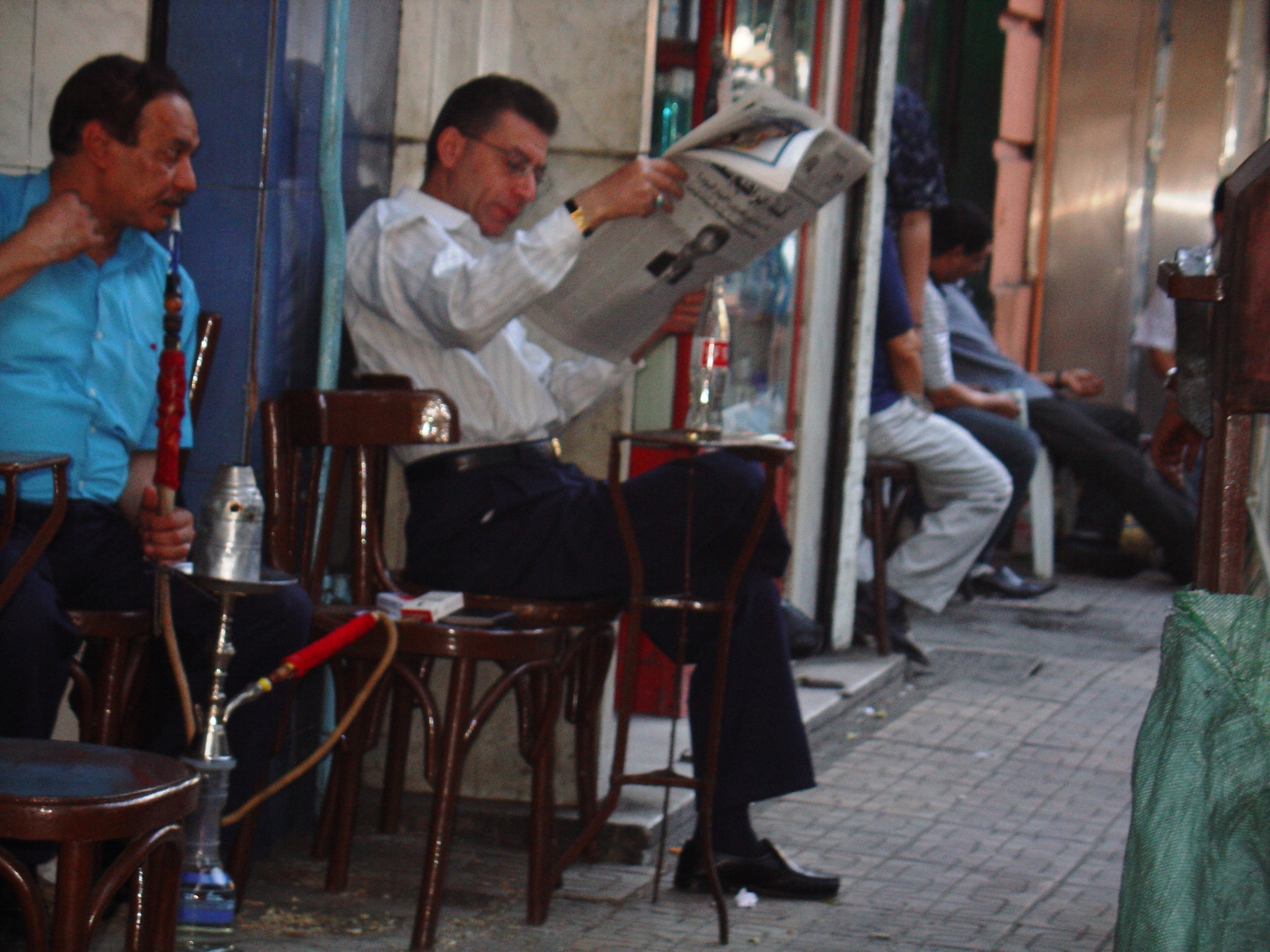 What is the proper role of a state newspaper in a democracy? The question has been raised by the ruling Supreme Council of the Armed Forces as the news media in Egypt continues to evolve in these post-revolutionary days.
Under the Mubarak regime, editors were appointed by the the Supreme Council for Journalism, with the approval of the Minister of Information and, ultimately, the big guy himself, Hosni Mubarak. Yesterday, March 27, the Supreme Council looked to continue this practice, announcing that new editors had been chosen for national news magazine Rose al-Youssef, Dar al-Hilal (the national publishing house) and Dar al-Tahrir (publisher of eight news periodicals) and that their names, and perhaps those of new editors for key newspaper Al-Ahram and others, would be announced later this week.
But even more significant changes may be in the offing, according to Deputy Prime Minister Yehia al-Gamal, who is in charge of the Supreme Council for Journalism: elections.
He told news media that elections for editors and board chairpersons at some press institutions are being considered. Elections would not be public; they would be under the supervision of the Supreme Council for Journalism, and operate through committees affiliated with the various media institutions. Does al-Gamal mean that working journalists, under the supervision of the Ministry of Information, would vote for their own editor(s) rather than just deal with an appointed party apparachik?
If so, this is a fascinating approach, quite different from how state news media is handled in Europe and the U.S. It follows the recent protests in favor of elections for top posts at al-Azhar, in which only certified religious scholars could run, or vote, but they choose the best person from among themselves rather than allowing them to be appointed by the state.
Salafis Rise After Mubarak’s Fall

Al-Masry Al-Youm photo by Hazm Gouda
One of the ironies of the concerns so many pundits had with the Egyptian revolution was their worries about the Muslim Brotherhood. Most of us who studied Egypt said not to worry–the Muslim Brotherhood is
-
- fairly moderate these days, and
- not as popular as many people think.
We expected they would try to work within the new political system. So far, that’s what is happening.
But as a recent New York Times report describes, the revolution has unleashed large numbers of Salafis, Muslims who adhere to what they believe to be the practices of the first three generations of Muslims.
But since Mubarak fell Feb. 11, many Salafists held for years without a legal basis have been released, here and across the country. In Dubanah al-Kabirah, they have returned home, and the most aggressive of them are seeking to impose their radical views with a boldness they would never have dared exhibit in Mubarak’s days.
There is nothing inherently wrong with Salafism, of course. But these narrow notions of Islamic practice often lead to intolerance. Much of the current Muslim-Christian violence has apparently been carried out by Salafis. Many of the “Vote Yes” campaigns in the recent referendum were organized by Salafis, and Salafis are said to be responsible for much of the violence carried out against “Vote No” campaigns.
Just as democracy sometimes brings into power governments we might disapprove of, so legal freedom can create spaces for legal but unsavory practices:
Not only were the imprisoned Salafists released to go about their business, villagers said, but the chastened local police force also no longer feels it has the authority to challenge them in the streets unless they clearly break the law.
“The police are the same people,” Abdusattar said, “but before, they could humiliate people, and now they don’t say anything to anybody.”
Perhaps the biggest challenge is that some Salafist groups preach that democracy is incompatible with Islam. Al Masry al Youm English reported that Salafis had been handing out pamphlets making this case in Cairo
According to one of the flyers, the values of democracy violate the law of God. Further, democracy “allows the people to govern themselves even if they are violating the rule of God.” The flyer, titled “Be a Salafi” called on citizens to reject all voices advocating for a civil state, as such a state would mean the separation of religion from general life and people being governed without the law of God.
Interestingly, some pro-democracy advocates would criminalize even this behavior:
Hassan Nafaa, a political science professor at Cairo University, said the content of these flyers “is expected from some Salafist groups, whose members reject anyone different to them.” He went on to say, “It is the state’s duty to criminalize such practices, which interfere with every citizen’s freedom of expression and belief. The fear is that such practices could influence those with limited intelligence, who could then be exploited in supporting and promoting these ideas.”
UPDATE: It’s been almost a month and I’m still getting a lot of traffic to this post. That’s fine, but make sure you also read the follow-up posts here and here.
The Anti-Protest Protest
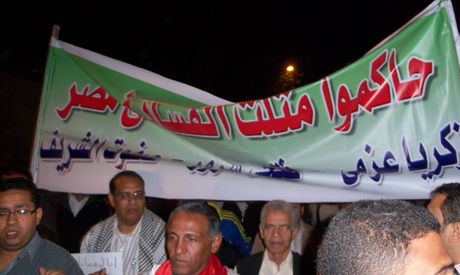
Protesters protesting the anti-protest law Sunday, March 27.
Do we call it an anti-strike strike? Or was it an anti-protest protest?
Protests continue as many sectors of Egyptian society continue to want to have their voices heard during this transitional period, even as the government seeks to restore stability and normalcy. Many of the protesters worry that stability and normalcy means a return to the old days. And some of the measures intended to end the protests–such as forcibly taking down Tahrir Square’s tent city and passing a law forbidding strikes and protests, engender more protests.
Thus Egyptian Federation of Independent Trade Unions and Democratic Forces last week called for a march Sunday, March 27th to overturn the recently passed law criminalizing protests and strikes.
They carried out the march even though Minister of Justice Ahmed El-Guindy’s explained at a press conference that the anti-strike law doesn’t ban protests and strikes, “as long as [they do] not disrupt work.”
Some of the trade unionists said they wondered if the minister was a fool, or just thought they were.
The march apparently began at the Press Syndicate with only a hundred protesters but swelled with unionists, workers and activists, numbering about five hundred when they reached the building that houses Egypt’s cabinet. According to Al-Ahram On-Line, one of the speakers was Kamal Abou Eita, head of the Independent Syndicate for Real Estate Tax Employees, said:
He demanded the rescinding of the law which deprives people of their basic rights and a response to the demands of the people, namely the dismantling of the remnants of the Mubarak regime. It is “those remnants that prove to us everyday that the revolution has not been fulfilled and that the old regime is still governing. This is our number one demand and if is realised a third of our strikes and sit-ins would be brought to an end. If they really are the ministers of the revolution, they must stop trying to silence us and deny us of our rights.
Also
Saud Omar, a trade unionist in the Suez Canal Authority, stated that “if Sharaf’s government today takes away our right to protest, sit-in and strike, I think that in the near future he will take from us our right to organise and all the other basic rights both civil and political.” A situation, he believes, would lead to a dictatorship worse than that of ousted president Hosni Mubarak. “It is a fascist law,” he stressed.
Banned Egyptian Graphic Novel Coming Out in English
English translation of "Metro"
I’m looking forward to adding Magdy El Shafee’s graphic novel “Metro” to the list of novels I give my students to read. Several news sources, including CNN announced that it will soon be published in English by the Metropolitan Books division of MacMillan. Alas, it probably won’t be out in time for this year’s summer sprint course as you can’t even buy an advance copy on Amazon yet (although they have a page for the unpublished book).
In the “Peoples and Cultures of the Middle East” class that I teach every summer, I always assign the students to read a popular Middle Eastern novel in translation. The idea is to get them to read it as a cultural artifact. Students read the novel, analyze its themes and symbols, and research its authorship and context. Then they write a short paper trying to relate it to concepts we’re learning in the class.

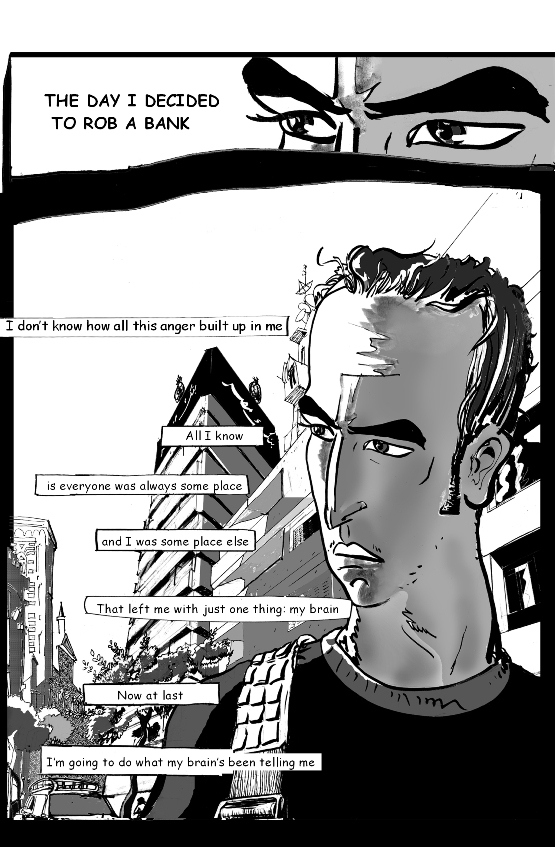
Page from the original Arabic edition
From what I’ve seen and heard of the novel, it is extremely timely, since it covers Egyptian youth culture, police brutality, and the Mubarak regime’s crackdown on peaceful protest. It tells the story of a young computer engineer named Shihab who falls victim to socioeconomic injustice, political corruption and police brutality. He becomes so frustrated that he decides to rob a bank to pay off his debts.
The book was published by Malamih Publishing House in 2008, but it was yanked from shelves in Egypt 2009. The Court of Misdemeanors on Qasr el Nil upheld the book’s ban in 2010 and fined the publisher and creator each a hefty EGP 5,000.
Magdy al-Shafee is a blogger and artist/cartoonist of Libyan descent. He’s no shebab al-Facebook (he’s my age) and has published in many venues, including the children’s magazine Alaa al-Din (about which I write at length in Chapter Two of Connected in Cairo). But like many Arabic writers he has to moonlight to make a living, in his case as a pharmacist.
Arabic copies are supposed to be available in Lebanon and UAE, but if so their buyers must really like them because I haven’t found used copies on e-bay or Amazon. The distinguished translator Humphrey Davies translated a few pages into English for the web site Words Without Borders. An Italian translation by Ernesto Pagano came out in December 2010 from Il Sirente (you can see a video about the Italian edition here).
Hopefully he earned enough to cover the fine.
The big question is: Will it come out in Egypt? CNN quotes El Shaffee as saying, “I’m sorry that my novel is available in other countries but not available to my own people.”
El Shafee has appealed to the new Ministry of Culture, but says that because his book was banned by court order, the courts will have to be consulted. He said: “I’m waiting to hear if the Minister of Culture will allow it to be published again. They will have to consult with the courts. I’m hoping there may be some kind of apology.”
The book was officially banned under Articles 178 and 198 of the Egyptian Penal Code, which prohibit the printing or distribution of publications which contravene public decency, and authorize the confiscation of publications which contain offenses to public morals.
There are two drawings in the book that might be seen as violating the acts: one depicting a couple making love in bed (albeit concealed beneath the sheets) and a drawing of a half-naked woman. There are also a few curse words scattered through the pages: fag, whore, and bastard. The book carried a label on the front cover reading ‘For Adults Only’.
Most commentators on the book argue that it was really banned because it portrayed the frustrations of Egyptian contemporary life, the brutality of the police and the deepening frustration of the growing numbers of unemployed and underemployed youth in the face of all this.
It’s certainly true that public decency was often broadly construed by Egyptian officials. I was once told by customs officials that a package of mine full of Christmas presents sent from the US had had a video removed for this reason. When I pressed the customs official, he leered at me and said “dirty movies.”
Finding it hard to believe my daughter’s godparents had sent her pornography for Christmas, I queried them.
The banned film was Prince of Egypt (DreamWorks 1998)
After the Uprising: What’s Next? My Model Arab League Speech
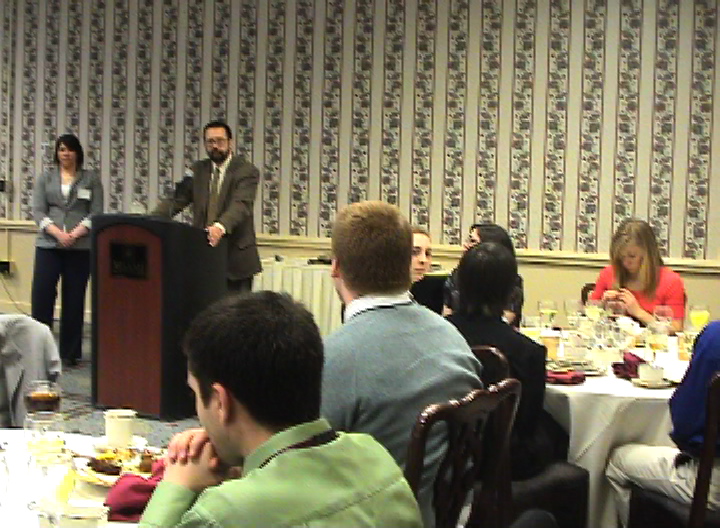
This is me giving the keynote address to the Model Arab League at Miami University Feb. 25th
On Feb. 25th, I gave the keynote address to the Model Arab League at Miami University. The address was entitled “Egypt’s Uprising: What’s Next?”
I held off posting this until I could find a copy of my talk, but it seems I didn’t save it (!). How amateur is that? Fortunately, the folks at the Model Arab League digitalized my lecture and it is available, such as it is, both as an mp3 file and as a video.
Here is the audio:
Keynote Address to the Model Arab League
I will post the video shortly.

Looking uncharacteristically professorial as I answer a student question.

The Army and the People: No longer "one".
The army’s apology in February for harassing the protesters in Tahrir led many of the revolution’s planners to hope that this truly was an end of business as usual where government was concerned. The Mubarak regime never apologized.
But the seizure and torture of protesters on March 9—what many Egyptians call “the events of March 9” or “the Night at the Museum”—has ended most people’s hopes that the interim government was going to be significantly different than the prior regime.
To describe what was happening, the Washington Post reported the story of 25-year old Samira Ibrahim Mohamed:
Samira was handcuffed to a wall in the museum complex. For nearly seven hours — almost every five minutes, she said — Samira was electrocuted with a stun gun. Her torturers would sometimes splash water on her and others to make the shocks more painful. The electrical jolts were applied to her legs, shoulders and stomach. She pleaded with the soldier to stop. Repeating what the demonstrators had chanted in Tahrir Square, she said, “I begged them. I said, ‘You are my brothers. The army and the people are one.’” Her tormentor replied, “No, the military is above the nation. And you deserve this.”
William Dobson commented March 17:
Respected human rights organizations here claim that hundreds of people are being tried before military tribunals almost every day. These organizations say demonstrators, activists and even simple bystanders are being swept up in a broad campaign of military arrests. People caught in this indiscriminate military dragnet are taken to the military prosecution’s office, then to a military court, sentenced and moved to a jail cell. It can take no more than 5 hours for a person to receive a sentence of more than 5 years. These defendants have no legal representation. They have no access to case files. There is no examination of the evidence. The military’s desire to appear to be providing law and order has trumped any concern for how that law and order is administered.
The Guardian had reported Army detention and torture of protesters as early as Feb. 10 but many were released, and many Egyptians said they hoped it was a mistake or isolated incident. But it looks as if it is business as usual–in fact, worse than the Mubarak usual, since human rights activists at least knew how the old system worked. The military has never been part of the administrative apparatus, and no one has any knowledge of how to intervene in the system
The mainstream media, including state television and top newspaper Al-Ahram, in spite of its earlier claims to now belong to the people rather than the state, has failed to follow this story in any detail.
Many of the stories that have been published were based on Army statements. Protesters testified that they were brought out before reporters at a press conference, bruised and disheveled and “looking like thugs”. Clubs, knives and Molotov cocktails were placed on a table in front of them and the media were told the protesters were arrested for carrying these weapons.
General Hamdy Badeen gave an interview to the daily newspaper Al-Shorouk, the head of the military police, , stated that his men have never tortured anyone.
The military police does not torture or electrocute or any of the things alleged. Our role is to arrest those breaking the law and hand them to the investigative authority. We didn’t and won’t lay our hand on or point a gun towards any Egyptian citizen.
And since on March 23, the interim cabinet headed by Essam Sharaf imposed a gag order on the media, news on military arrests, tortures and secret trials will be even more deeply buried.
One thing has changed, however: the nature of the victims–and the tools at their disposal. The use of new media makes it more difficult to respond to accusations with simple denial, as the old regime did.
On Feb. 27, the blog 3arabawy posted a video of the army torturing detainees.
On March 17, several protesters gave public testimony about their experiences at Cairo’s Press Syndicate. Some, like that of Salwa Gouda, were videotaped, subtitled in English, and posted to Youtube:
Ali Sobhy, an Egyptian actor and one of the early protesters in Tahrir Square also testified and kept in custody for four days.
But Sobhy wrote his testimony about these four days of torture and humiliation in Arabic and posted it to a Facebook page. It was subsequently translated into English and posted to another Facebook page.
In his interview, General Badeen simply claimed that all this photographic and video evidence was fabricated.
The military is not, of course, a monolithic institution. It is certainly reasonable to assume that there are elements sympathetic to the revolution, and elements that despise it, as well as a range of opinions in between. If so, the inability of the 25 January coalition to win a “No” vote on the referendum has likely emboldened the hard liners in their efforts to place the military above the people.

 CONNECTED in CAIRO