From Kickback to Payback
What’s the opposite of “kickback?” Payback?
I mean, what do we call it when the money stolen from a country by its political leaders is given back by the banks and countries where that money has been hidden? There’s a movement afoot to do that with Egyptian funds held in overseas banks.
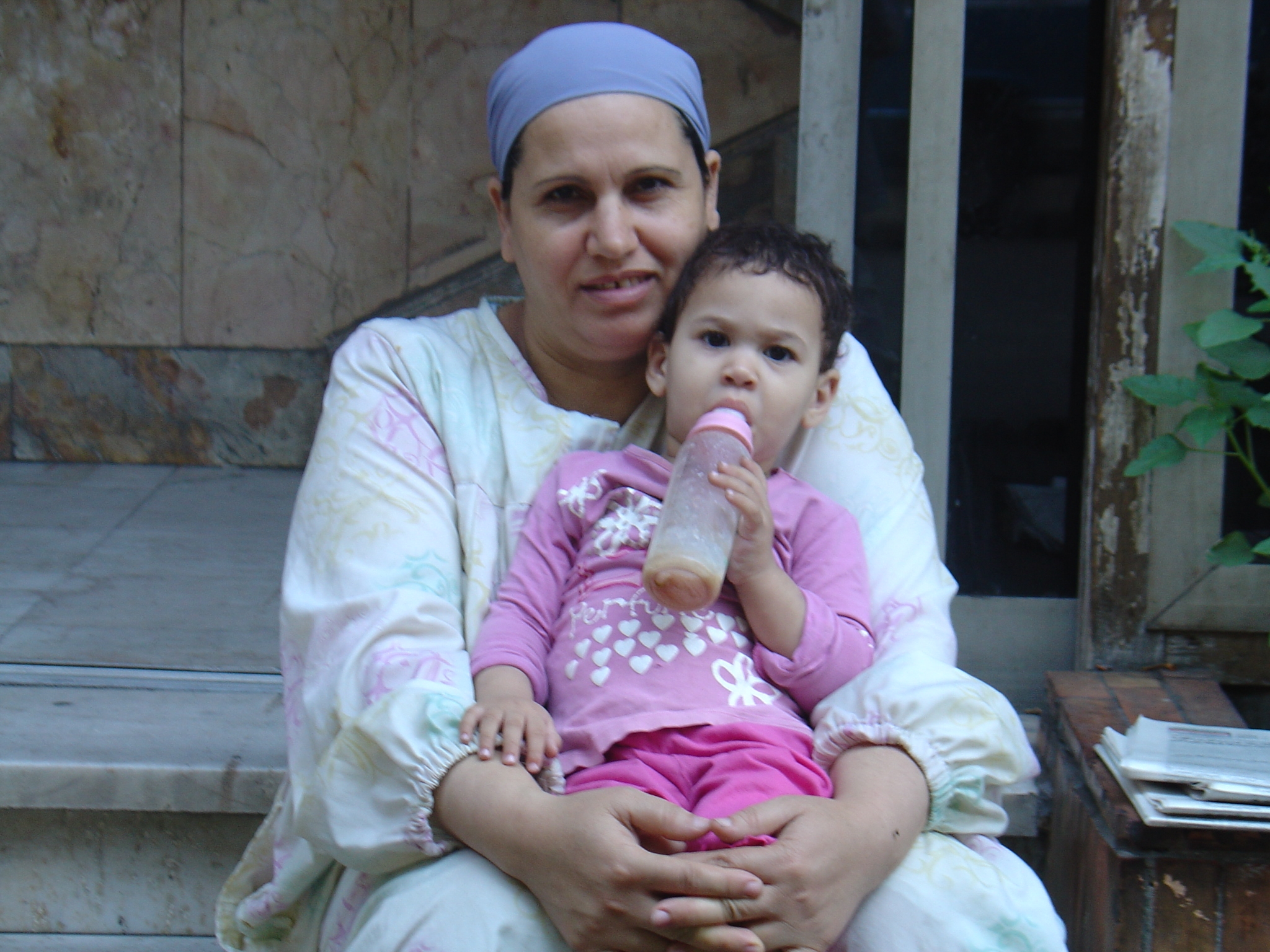
The poor of Egypt, I suspect,don't really believe they will see any of the stolen money in their pockets. But when you live hand-to-mouth, it's fun to imagine how you'd spend a thousand dollars...
On Friday, shortly after his resignation, Switzerland froze assets that might belong to former Egyptian President Hosni Mubarak pending investigation of whether they are legal or not.
The same day Huguette Labelle, the chair of Transparency International, an influential international corruption watchdog with ties to the UN, called on all governments and international banks should seize Hosni Mubarak’s assets and hold them in escrow to be returned to the people of Egypt
“When there is a dictator who appears to have acquired much more wealth than he would warrant as a salary of a head of a corporation or country, they should investigate immediately because you don’t know where those assets are parked,” Labelle said.
“It’s the people’s money,” she said. “It should return to the people assuming there is a government that will look after it.”
In the meantime, Egypt’s high court confirmed an injunction preventing three high-ranking NDP ministers with vast personal fortunes from leaving the country pending investigation into their finances.
A report by think tank Global Financial Integrity released in January found that Egypt is losing more than $6 billion US a year — more than $57.2 billion US between 2000 and 2008 — to illicit financial activities and official government corruption.
A labor leader (whose name I missed) was quoted on Al Jazeera, pointing out that if the reports on just these four men (Mubarak and the three ministers) are true, their combined wealth would be equal to a few thousand dollars for every man, woman and child in Egypt—a truly staggering image to the tens of millions of Egyptians living on less than $2 per day.
Corruption In Mubarak’s Egypt

Cottage industries through which local craftsmen eke out a living are threatened by development projects whose ties to political figures make them untouchable either by law or protest.
A couple of students pointed out that although I mention corruption several times as a reason for the uprising in this blog, it is missing from my list of reasons for the uprising. So here goes:
In 2005, I spoke with some businessmen in Luxur who made their living creating souvenirs for tourists. For generations these families had carved souvenirs out of alabaster and other local stones. In recent years, however, they were watching their lives and livelihoods stolen from them as their houses, shops and open-air “factories” were bulldozed by developers. The goal was apparently a beautiful, self-contained Luxur tourist complex that would allow a single corporation to monopolize tourism, cutting most of the local community out of the revenue stream from visitors to Karnak, the Valleys of the Kings and Queens and other tourism areas.
Arcane regulations akin to “eminent domain” were put forward. People were paid for their land, but it was a pittance, nowhere near enough to buy a new plot of land in Egypt, a river valley surrounded by desert, where land is at a premium.
Efforts at taking the developers to court were futile. Protests were put down by the police. Finally, in a secret meeting in one of the local mosques, a community leader revealed the truth: he had been to Cairo and seen the papers. Several high ranking ministry officials owned shares in the company, and so did Gamal Mubarak.
“Who here is man enough to fight this?” my informant said the local sheykh asked them. “He shamed our manhood, all of us. But he was right. Who can fight these men? To whom could we turn for help against such men who control the laws, the police and the courts?”
(When I asked him where the new tourist complex would get its souvenirs if they put the locals out of business, he took me into the back room of his shop and showed me beautiful resin imitations–made in China. He asked me to guess who owned the company importing them…).
Corruption has long been a part of everyday life in Egypt. From police extortion to the petty bribes one pays bureaucrats to do their jobs to fees that help clear away red tape.
But the rise to power of powerful business men in the National Democratic Party (NDP) and the People’s Assembly–men who popular discourses say bought their rights to run for election with suitcases full of cash, as described in the novel (and film and television series) The Yacoubian Building—took corruption to an entirely new level.
Many of these politicians took advantage of their positions to build vast financial empires. Ahmed Ezz, for example, joined the NDP with an estimated net worth of $300,000 USD, and was able to grow this into a fortune of $300,000,000 by gaining 60 percent of the market share of Egypt’s steel industry, according to the newspaper.
Similarly, the wealth of former Housing Minister Ahmed al-Maghraby is estimated to be more than 11 billion EGP, that of former Minister of Tourism Zuhair Garrana is estimated to be 13 billion EGP, the fortune of former Minister of Trade and Industry, Rashid Mohamed Rashid, is estimated to be 12 billion EGP, and that of former Interior Minister Habib al-Adly is estimated at 8 billion EGP.
The average Egyptian, according to Egyptian government statistics, earns about 300 EGP (~$60 USD) per week. But many people make much less; one estimate claims that as many as 40 percent of Egyptians live on less than 80 EGP (~ $15 USD) per week.
Like many countries, Egypt protects itself against corporate imperialism by insisting that a certain percentage of shares in any company be held by Egyptians. But corporations find it useful to choose as local partners those with strong government connections who can cut through red tape and make things happen–as in Luxur. Much of this wealth then leaves the country in the form of land (such as the palatial Mubarak house in London) or other investments.
Ultimately, all lines of economic advantage flowed up to Mubarak. Aladdin Elaasar, author of The Last Pharaoh: Mubarak and the Uncertain Future of Egypt in the Obama Age, estimates that the Mubarak family is worth from $40 to $70 billion. (This number seems impossible, as it would make him the richest man on earth. I suspect the true figure is in the $4-7 billion range at most. But many Egyptians believe it).
In 2010, Transparency International‘s Corruption Perceptions Index report assessed Egypt with a CPI score of 3.1 (with 10 being completely clean and 0 being totally corrupt).
In the popular imagination, the country has come under a system in which money fuels political power and political power in turn creates wealth–but only for a few thousand people.
One of the turning points in the uprising came when the labor movement began to strike and protest in solidarity with the “Facebook youth” and other groups in the urban centers. It is no coincidence that many were shouting in anger over the reports of how much wealth Mubarak had accumulated.
I do not think most Egyptians believe they will achieve a new society without corruption as a result of the uprising. But they certainly believe that a state without Emergency Laws–in which labor unions can strike and newspapers can publish investigative journalism and social media can spread news and gossip–will have to be more responsive to public pressure.
For More Information:
Al-Jazeera English. 2011. How did Egypt become so corrupt? Feb. 08.
Mitchell, Timothy. 2002. Rule of Experts: Egypt, Techno-Politics, Modernity. Berkeley: University of California Press.
Back to Why Revolution?
Back to Egypt Rising Up
Back to Homepage
Celebrate Like an Egyptian
The following are some songs that Egyptians are singing and sharing through social media as they celebrate the climax of the uprising. Play them in solidarity!
From many, many people this wonderful song about the uprising with Sout Alhoureya Hany Adel, Amir Eid Hawary on guitars and Sherif Mostafa on keyboards.
The video is by Moustafa Fahmy, Mohamed Khalifa and Mohamed Shaker. The lyrics (from Laurie King via Robin Dougherty) are: “I went down and I said I am not coming back, and I wrote on every street wall that I am not coming back. All barriers have been broken down, our weapon was our dream, and the future is crystal clear to us, we have been waiting for a long time, we are still searching for our place, we keep searching for a place we belong.”
From Nura the song Amaloha El Regala by Hamada Hela. Originally created to celebrate Egypt’s victory in the 2006 Africa Cup.
From Shearin and Marwa, this video honoring the martyrs of the uprising
From Shearin this song from an old movie Masr Helwa Baladi el Samra (“Egypt is the most beautiful country in the world”)
And, of course, there’s zaghruta, the classic Arabic women’s ululation in celebration
Egypt Will Never Be The Same

This timeline of Egyptian history at Dr. Rageb’s Pharaonic Village in Cairo, needs a new line to mark a new moment in Egyptian history.
In Egypt, after 18 days of anxiety, camaraderie and hardship, nobody wants to talk much about what comes next. This is the time of celebration. The long road to a new political, social and economic reality can come tomorrow.
The emphasis in most political commentary has been on the capacity of the crowds to overturn the thirty year old Mubarak regime. But Mubarak’s resignation today, in the face of historically unprecedented public outcry, is of far greater historical importance.
If one takes the longue duree, it is clear that the Egyptian people have never had any real voice in their government. The rule of the Pharaohs has been frequently applied to Hosni Mubarak to describe purely autocratic rule.
From around 350 BCE Egypt’s ruling classes were composed of foreigners—foreign both in terms of heritage and languages spoken among them, but also in the perception of the indigenous Egyptian population. These foreign ruling classes (Greeks, Romans, Ottomans, French, Britons) in turn encouraged other foreign groups (Armenians, Greeks, Iranians, Jews, Lebanese, Syrians, Turks) to reside in Cairo and act as intermediaries between the rulers and the indigenous population.
The 1952 revolution finally put Egyptians in power again, but hardly with a representative government. Nasser’s socialism established the concept of a strong central government centered on a paternalistic leader who rules for the good of the people as whole–a legacy Mubarak sought to invoke in his sad, disappointing last speech.
The Egyptians do not have a democratic government yet, but the moment is pregnant with opportunity. The tension of opportunity and risk, as much as the sense of relief and exultation of victory accompanying Mubarak’s resignation, fueled this night’s celebrations.
I do not know if Egyptians will achieve a liberal democracy of the type I would wish for them, and that I know many of my Egyptian friends and former students desire: free and fair elections, independent judiciary, civil society, and rule of law. I do not know if this is the wish of the Egyptian majority, many of whom might be willing to trade liberal democracy for jobs and decent living conditions.
But what I do believe is that the impact of eight million people protesting throughout the country will not be lost on the planners of the new government. I believe the Emergency Law will be scrapped, freedom of expression will expand dramatically, and some form of more responsive government will emerge.
Bukrah, insha’llah (“it will happen tomorrow, God willing”), as we say in Egypt. Except maybe one of the great changes is that we will say it with hope, rather than resignation.
The Bad Never Leave
 I sat in my office tonight with my jaw hanging open, dumbfounded at the words I was hearing coming from the mouth of Hosni Mubarak.
The protesters have consistently made three demands: the resignation of President Mubarak, the lifting of the Emergency Law, and the dissolving of the fraudulently elected Parliament. Of these, the resignation of Mubarak has been the one non-negotiable articulated by everyone from self-appointed spokesmen like Muhammad El Baradei to the random protester in Tahrir Square.
Mubarak addressed the crowds as his children, told them how proud he was of their protests, assured them he would punish those responsible for attacking them, explained which six changes he would make to the constitution for them, and urged them to stop listening to the foreigners who were stirring them up and go home or get back to work.
Along the way he invoked every nationalistic trope imaginable, from military service to the freeing of the Sinai to the flag, his age, how much he feels their pain, the common struggle, the perseverence and honesty of the Egyptian people… the list seemed endless.
It was the classic dissembling doublespeak that the regime has indulged in for decades and should not have surprised me. Just a week ago I had told a group of students that I would not really believe Mubarak was gone until a stake was driven through his heart.
Like the crowds in Tahrir Square, I had been taken in by a series of false signs. A military council met without Mubarak (its titular head) and issued an ambiguous message saying they would step in to “safeguard the country”. General Hassan al-Roueini, the military commander for the Cairo area, told protesters in Tahrir Square, “All your demands will be met today.” The secretary general of the NDP (the job recently vacated by Gamal Mubarak) said that Mubarak should step down. And in the US, CIA director Leon Panetta told Congress today that he expected Mubarak to relinquish power.
“He will never leave,” a disheartened Egyptian friend in Luxur told me by IM this evening. “I have said so from the beginning.”
In Luxur, the people not only protested against Mubarak, they marched on the palace of the Supreme Council General seeking to oust its chair, Dr. Samir Farag (who most people call the governor of Luxur). Many hold Farag responsible for the destruction of dozens of homes and businesses to clear the way for development projects that would take even more of the tourism income from the hands of locals into the pockets of Cairo-based major tourist corporations.
A local business leader told me in 2010 that both the governor and former NDP secretary Gamal Mubarak were shareholders in the companies engaged in the tourism development, which meant police frequently enforced company decisions and court challenges were futile.

Dozens of houses and businesses in Luxur are being arbitrarily destroyed to make way for tourist development projects. The governor of Luxur and former NDP secreatry general Gamal Mubarak are said to be shareholders in the companies
My disappointment is nothing, NOTHING compared to his. Issander is a tour guide in Luxur, whose livelihood depends on tourism. The protests in Luxur have cost himhis livelihood, his savings, and he fears much more. “I have lost everything,” he said.
While there were signs of returning normalcy in Cairo this week, he said there were none in Luxur. Shops are closed. Banks are closed. Schools are closed, and life is at a standstill. It will take months before tourism resumes at even a fraction of normal rates and Issander and other people dependent on tourism don’t know what they will do.
If they felt the protests had accomplished something, the mood might be less dark. At least there would be the hope of a brighter future for themselves and their children.
But neither Mubarak nor the governor of Luxur have left in the face of their peoples’ anger.
“The bad ones never leave,” Issander lamented.
Why I Got It Completely Wrong
There have been a growing number of political protests especially in the last decade. The emergence of the kafir (“enough”) movement, which was able to bring together protestors with different immediate motives under a common focus of ending Hosni Mubarak’s seemingly endless presidency and preventing it from turning into a dynastic succession, was especially influential.
I was in Cairo with my daughter in 2005 when the then largest protests to date were being held. “Enough” {kifaya) was on many peoples’ lips, and some thought revolution was around the corner.
But it wasn’t. Every protest is allowed to ferment for a period of time, then put down harshly by police with truncheons, tear gas and hoses and, if necessary, rubber bullets or even live ammunition.
Predictable Patterns
There is even a clear pattern to protest events. A murmur goes through a community such as a college campus or factory floor. Leaflets are distributed inviting people to a protest. The protesters gather, in the hundreds or thousands. Emboldened by their numbers, they march.
Meanwhile, plainclothes security police or baltigiyya (hired thugs) infiltrate the protesters. They urge violence, throw bricks through windows and harass and assault women (stories were told after the 2005 protests of women being pulled out of the crowd down an alleyway and raped, then being told it’s what they deserve for protesting).
The following day leaders call for more protests, but find a heavy police presence at various staging points. Protests occur in small pockets but are either put down by the police or dissolve on their own when they fail to achieve a critical mass.
Something Different
On the 25th of January, I had no idea something unprecedented was about to happen. Indeed, expect for the unexpectedly high turnout of 20,000 protesters, the sequence of events followed the standard pattern, with the police moving in at around 1am to clear Tahrir Square.
The next day, as predicted, the police closed off Tahrir Square and set out after the pockets of protest that popped up around the city.
Then events left the script. There were far more pockets of protest than anyone would have expected. The numbers of these protesters was greater than one would predicted from past events. And emboldened by their numbers, the protesters regrouped.
After that it was one surprise after another. The creativity, persistence and shrewdness of the protesters in the face of every obstacle has left me speechless. Each time I have felt sure the uprising was doomed–especially the first week–they have proven me wrong.
So now I tell my students, “Who can guess how this will turn out? Watch and learn…”
Like me, Nina knows what’s going on but not what is going to happen next:
For More Information:
Beinin, Joel. 2007. The Militancy of Mahalla al-Kubra. Middle East Report Online, Sept. 29.
Page, John. 2001. Getting Ready for Globalization: A New Privatization Strategy for the Middle East? In State-Owned Enterprises in the Middle East and North Africa: Privatization, Performance and Reform, ed. Merih Celasun. Pp. 63–88. London: Routledge.
Posusney, Marsha Pripstein. 1997. Labor and the State in Egypt: Workers, Unions, and Economic Reconstruction. New York: Columbia University Press.
Pripstein, Marsha. 1995. Egypt’s New Labor Law Removes Worker Provisions. Middle East Report 194–195: 52–53, 64.
Toth, James. 1999. Rural Labor Movements in Egypt and Their Impact on the State, 1961–1992. Gainesville: University Press of Florida.
Striking Egyptian Workers Fuel the Uprising After 10 Years of Labor Organizing. Democracy Now. (includes interview with Joel Beinin)
Antistructure in Tahrir
Tahrir is becoming a small free and happy Egypt.
–Post on the Facebook page We Are All Khaled Said
One protester compared it to Brechtian theater: singing, poetry recitals, philosophical discussions of human rights and the dignity of man(kind), and political arguments about how best to move forward, all happening simultaneously, commenting on one another to create a meaningful cacophony.
Several participants have expressed their astonishment at the way the protesters pooled their skills and pitched in to organize food banks, clinics, waste management, and even the building of a small catapult to chase a sniper from a nearby location.
Others have emphasized the collapse here of class and sectarian distinctions that have long troubled Egypt and provided fuel for the regimes claims that it stood between a stable society and social collapse.
For the protesters and many of those watching and supporting them, Tahrir represents in miniature the free nation they aspire to. Without leaders, elected or otherwise, but with high energy, charismatic organizers, people step forward and offer their skills where and when needed.
Emil Durkheim, the grandfather of social science, called this surging social energy and creativity “effervescence” and claimed it was at the core of what made humans imagine wholes—like tribes, clans or nations—that are greater than the some of their parts. It was also, he claimed, the root of human ritual behavior.
But a more theorized explanation can be found in the works of Victor Turner and his notions of liminality, communitas and antistructure.
Turner borrowed the term “liminality” from ritual studies to refer to the state of being betwixt and between two states. In a rite of passage, for example, as people move from a state of childhood to a state of adulthood, they usually go through a state of liminality.
Turner showed that many social processes including revolutions and uprisings, have liminal stages, in which the structures of everyday life of the immediate past have been disrupted or overturned, but new structures have not yet emerged to replace them, a situation he termed “antistructure.”
The creative energy and camaraderie experienced by the protesters in Tahrir Square is a common social experience in liminal states, what Turner calls “communitas.” This is an intense feeling of community, social equality, solidarity, and togetherness experienced by those who live together in a site in which the normal social statuses and positions have broken down.
According to Turner, these periods of anti-structure can’t last. The fate of any type of antistructure and communitas is an inexorable “decline and fall into structure and law” (Turner 1969a:132). While they last, however, such situations have enormous transformative possibilities. Indeed, it is that sense of possibility that clearly drives the unprecedented popular struggles we are seeing in Egypt.
For More Information
Meandering Around Midan Tahrir
Deflem, Mathieu. 1991. Ritual, Anti-Structure, and Religion: A Discussion of Victor Turner’s Processual Symbolic Analysis. Journal for the Scientific Study of Religion 30(1):1-25
Turner, Victor. 1969. The Ritual Process: Structure and Anti-Structure. Aldine.
Ritual Politics
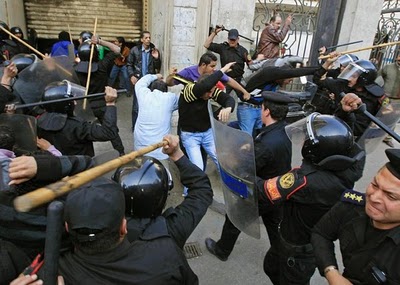
"The police at the service of the people" (ash-shurta fi khidmat ash-sha'ab). Source: unknown.
If Tunisia was the spark, the fuse for the uprising on Jan. 25th was the national holiday known as Police Day.
January 25th was Police Day, a national celebration of the role of ash-shurta fi khidmat ash-sha’ab (“the police at the service of the people.”) Police Day was long celebrated by marches and demonstrations, culminating (in Cairo at least) with a speedboat parade on the Nile.
State television covered the events in great detail, with considerable color commentary, culminating in an interview with the Minister of the Interior.
As the regime came to rely increasingly on police repression to maintain power, it year by year increased the pageantry of the events. Finally, in 2009, President Mubarak raised Police Day to a national holiday, during which banks and government offices would be closed.
Anthropologists, sociologists and culturally-minded political scientists have often noted the important role ritual plays in establishing and maintaining nation states. Most states have ritual calendars similar to—and often running parallel with—the sacred calendars of local religious institutions.
Thus the U.S. has such secular ritual celebrations as New Year’s Day, President’s Day, Martin Luther King Day, St. Patrick’s Day, Independence Day, Columbus Day, Labor Day, Memorial Day, Thanksgiving, and so forth.
And Egypt has Sham al Nasim (April), Sinai Liberation Day (April), Labor Day (May), Revolution Day (July) and Armed Forces Day (October).
Holidays like these help states make our nations real by converting the imagined communities of “America” or “Egypt” into collective action. They do this in at least two ways, through shared symbolic content, and through shared activity. On the one hand, they trot out powerful symbols of national identity like flags and anthems and tie them to the apparatus of the state. But even those who ignore such symbolism participate in the collective ritual by virtue of having the day off. Your participation in the nation becomes real through the disruption of your everyday practices.
The Jan. 25th uprising reminds us of the ways in which holidays like Police Day can be appropriated by anti-state actors and wielded against them.
Police Day commemorates a day in 1952 when British troops massacred Egyptian police officers in Ismailiya, after the police refused to put down anti-British protestors in along the Suez Canal.The event sparked anti-British riots throughout Egypt, and paved the way for the revolution six months later.
The state, of course, has always sought to appropriate the moral authority of these patriotic martyrs, casting the contemporary “free” Egyptian state as the result of their sacrifice.
The protestors, however, successfully appropriated the symbolic content of Police Day by metaphorically linking the Mubarak regime to the Colonial regime: just as the Colonial regime ruled the Egyptians for its own profit, so the NDP government exists for self-profit rather than the good of the people.
Perhaps even more importantly, the planned protest took advantage of the fact that Police Day was a day off from work. Unlike Sham al-Nasim, Revolution Day, or other established holidays, where people have developed habitual practices—watching parades on television, picnics, walks down the Corniche—the newness of Police Day meant that many people were at loose ends (although even before being elevated to a national holiday the day had become a regular time for staging anti-police brutality protests).
The call to protest galvanized them, enabling an estimated 20,000 to gather in Cairo alone. The rest, as they say, is history—albeit, history in the making.
One accomplishment of the protesters, whatever else happens, is that they have in this context stolen the ritual authority of the police, the Interior Ministry and, ultimately, the Mubarak presidency.
Leadership? Who Needs Leadership?
Several of my colleagues have criticized me ( perhaps more gently than I deserve) for the enthusiasm with which I embraced an early list of proposed “Constitutional reformers”, calling them a “dream team.”
Salma Sameh, professor of Arabic literature at Rutgers, complained on Facebook about my characterization of the protester’s dream team: “Sawiris, Ghazali Harb, Moussa and MF Abdel-Nour ARE the regime. Who are these people kidding? I haven’t heard anything from any of the various groups out in Tahrir about support for these people.”
Between us, my wife and I encountered this list by tweet, Facebook and e-mail three times, so we figured it must enjoy fairly wide circulation. It was subsequently published in al-Masry al-Youm—a valuable news source but certainly one with its own political axes to grind (as do they all).
Since her critique, I’ve seen this crowd again and again referred to derisively in news media and in social media as the “committee of wise men”. Sometimes the authors add “self-appointed” as a prefix. Just yesterday an editorial in al-Mesryoon accused “the wise” of acting from their own homes, old men speaking for a youth revolution of which they are not part.”
But there is support—and strong support—for many of the wise.
When Amr Moussa went out to meet with the protesters, a crowd of at least a few hundred began chanting “We want you for president.”
Ash-Sharq al-Awsat carried a story today lauding Ahmed Zewail and even coyly suggesting he might run for president once there are free and fair elections.
A surprising number of people seem to be willing to accept Mubarak’s resignation and let the military and security branches of the regime of which he is figurehead continue to run the country. Rebab, a professor of literature at Ain Shams wrote an angry e-mail to a friend of mine about her belief that the 25 January protest—which she supported—has been hijacked by people with political agendas and wishes the protesters would go home and wait for the reforms.
Even popular blogger Sandmonkey, who has been beaten by security police bringing medical supplies to Tahrir, seems in some of his interviews willing to take a chance Umar Suleiman.
The protests have been largely spontaneous, with planners but without clear leaders. This has been a tremendous strength—a movement without leaders cannot have its head chopped off. But this also means that people can be put forward, or put themselves forward.
And the quest for a leadership that can speak on behalf of the protesters continues. Today al-Masry al-Youm reports that activist Ziad al-Alimy told reporters that a coalition has emerged, including the 6 April protest movement, the Muslim Brotherhood’s youth wing, the Mohamed ElBaradei Support Group, the Young Freedom and Justice Movement and the Democratic Front Party’s youth wing. He said these groups have not yet accepted to meet with the new vice president.
But perhaps nothing so far represents the protesters as much as the traumatized face and strained, rapid-fire voice of Wael Ghonim, released today after 12 days in custody. speaking in an interview on Dream TV just hours after his release, insisting that he is no hero, that he is no leader, that it is the people in the street who planned and carried out the protests, the people cleaning up the garbage and preventing violence who are the real leaders of the Egyptian uprising.
Letter to a Christian Friend

If he watches al-Jazeera, the Muslim preacher sees Muslims and Christians arm in arm to overcome a brutal tyrant kept in power in part by a foreign country whose majority citizens claim to be church-going Christians.
Of course you have fears.
The fear that without proper vigilance we might all somehow come to live under an Islamic theocracy is widespread in the US and Europe, having replaced in the popular imagination the fear I grew up with, that without proper vigilance we might all end up living under a communist regime. Very few people want to live under a theocracy anywhere in the world. Every poll shows that most people in the world—including Middle East states—want freedom and self-determination.
Historical arguments to justify your fears—claims that Islam is a religion of violence and Christianity isn’t— don’t hold up. Yes, the history of Islam is filled with those who conquered in its name, but so is Christianity from Constantine I on. And both histories are filled with violence among and between co-religionists as well.
Since you are addressing this problem from a Christian perspective, let me offer a Christian answer.
Today’s liturgy, read aloud from scripture in hundreds of languages by 1 billion Christians around the world–including in Egypt–are Isaiah 58:7-10, 1 Cor 2:1-5, and Mat 5: 13-16.
Isaiah speaks to the fundamental duties of God’s people to care for others. Do not come to me fasting in sackcloth and ashes and ask me to forgive your wickedness, God says through the prophet, rather “this is the fasting I wish: releasing those bound unjustly, untying the thongs of their yoke; setting free the oppressed, breaking every yoke.”
Matthew’s gospel reminds us that Christians must carry out these duties openly as a people, so that all will see them and they will make the world a better place. “You are the salt of the earth. But if salt loses its flavor, with what can it be seasoned? It is no longer good for anything but to be thrown out and trampled under foot.”
“You are the light of the world. A city set on a mountain cannot be hidden. Nor do they light a lamp and put it under a bushel basket; it is set on a lampstand where it gives light to all in the house. Just so, your light must shine before others that they may see your good deeds and glorify your heavenly Father.”
So let me try to relate these scriptures to the Muslim preacher who shocked you by saying, “Christianity has nothing to offer us.”
What evidence does he have to think otherwise? The United States, the world’s only superpower, proudly proclaims itself as a Judeo-Christian nation and is recognized as a Christian nation by most Muslims. If we are, in fact, a Christian nation, we are supposed to be the salt of the earth, the city on the hill, the light of the world by whose actions others can glorify the heavenly Father, as in today’s scripture.
So what do Muslims see this Christian nation doing? Rather than releasing those bound unjustly, we sell their rulers both yoke and thong. If he watches al-Jazeera, the Muslim preacher sees Muslims and Christians arm in arm to overcome a brutal tyrant kept in power in part by a foreign country whose majority citizens claim to be church-going Christians. If he watches CNN he sees talking heads speculating on whether it is in our national interest to support democracy or whether we should “support this SOB because he’s our SOB.”
US news media talk endlessly about the Muslim Brotherhood as a jihadist organization that might threatens us; the Muslim preacher is more likely to think first about the clinics they run, mosques they build, hospitals they fund and job banks they provide.
Where are our works for Egypt’s poor and oppressed? Certainly not in the tear gas canisters proudly emblazoned “Made in the USA” that were used against peaceful protesters. Last year the US gave Egypt, a country in which millions live on $2 per day or less, $250 million in aid for poverty relief, education and health care. This would be more impressive if we had not also given them $1.5 billion (six times as much) in military aid.
You also quote this Muslim preacher as having said “We plan to use your western democracies to take over the world.” This does sound goofy, as you say; I suspect it is a bad translation of what he meant to say.
I think he meant this: Like Christianity, Islam is a missionizing religion that seeks eventually to convert everyone. I’ve spoken with sheikhs who have asserted to me that the West is spiritually and morally bankrupt, and that these countries therefore cannot long survive. When they collapse, people will inevitably turn to Islam because Christianity will have been proven false. Militant jihad may or may not hasten this process, and may or may not be justified, depending on the theologian.
If we want them to think differently, we cannot do it by suppressing them. Rather, we would need to show them that the West is not spiritually and morally bankrupt, and that Christianity does indeed have something to offer the Islamic world.
Every argument I have heard against supporting freedom and democracy in Egypt is rooted in fear. Fear that Egypt’s democratic experiment will fail, fear that Egypt will get an Islamist government inimicable to US interests, fear that prices will rise at American gas pumps.
Fear drives Christians into behaviors that cannot, by any stretch of the imagination, pass the test of “what would Jesus do?” Fear drove the last administration into the longest, most expensive war in US history because a Muslim-majority nation might develop weapons of mass destruction and then might use these hypothetical weapons on an ally or might pass them on to a terrorist group to use against us.
Fear drove the two administrations before that into crushing sanctions on Iraq that eventually contributed to the death by starvation of some 100,000 people, because without that economic chaos the country might develop weapons of mass destruction which it then might … oh but we’ve covered that.
It seems clear to me that scripture calls on Christians to put aside their fears (variations of “be not afraid” occur more than 100 times in the Bible) and replace fear with faith and hope. They are supposed to do what is right. then deal with any negative consequences.
For if our civilization is “thrown out and trampled underfoot” as Matthew’s gospel warns, it will not be because of the actions of Islamic governments or terrorists; it will be because the US has ceased to heed the scriptures so many Americans claim to live by, and become a hidden light, a tasteless salt, a city of darkness.
For “how does God’s love abide in anyone who has the world’s goods and sees a brother or sister in need and refuses to help?” (1 John 3: 17)

 CONNECTED in CAIRO