“Torture Is Part Of State Policy” In Egypt

Karim Hamdy was arrested at his home and turned up dead in a police station less than 72 hours later. This photograph circulated widely on Twitter.
“Violence and torture are inversely proportional to the expected reaction when the case is publicized.”
That’s a quotation from psychiatrist Aida Seif al-Dawla, founder and executive director of the Nadeem Center for the Rehabilitation of Victims of Violence and Torture.
Her interview with Lina Attalah, editor-in-chief of the independent newspaper Mada Masr, appears in the latest edition of the Middle East Research and Information Project on-line under the title “‘A Beast That Took a Break and Came Back’: Prison Torture in Egypt.”
Here are a few excerpts:
After the June 30, 2013 protests calling for an end to the Muslim Brothers’ rule, torture increased. But the public stopped wanting to see it, and started to label accounts of torture as lies. Some opted instead to acknowledge that torture is happening—and to endorse it. This is the major difference from before. The state will always oppress, but it is no longer so important for the state to hide its crimes of torture as it was in the past.
Sympathy with torture survivors is conditional.
Spreading Alerts in Egypt and Elsewhere
When people keep getting warnings but nothing ever happens… they just start ignoring them.
One of the interesting things about living as an expatriate in Egypt and India was that you received frequent warning messages telling you that the embassy has intelligence that something might happen and so you should limit yourself to necessary travel. We seemed to get one or two of these per week.
And nothing ever seemed to happen.
So travelers and expatriates alike routinely deleted alerts unread because the sheer quantity of them created a lack of credibility.
I was reminded of this recently because someone asked me about the advisability of using social media to send out alerts and warnings about health issues.
And I thought: one of the silly things institutions keep trying to do is to seek to use social media to do the kinds of things that broadcast media do well:
- disseminate information,
- circulate advertising,
- distribute propaganda
In broadcast media, you have a center where messages are created, and a mass audience whose only common feature may be the broadcast media they consume.
When we try to imagine social media performing the functions of a broadcast media, like sending alerts, the process immediately appears to be problematic because:

Of course “foreign hands” seek to influence Egyptian politics. The question is: are they succeeding? Yes but not always the ways they want to, suggests a series of articles in the journal Democracy.
Whenever things are going wrong in Egypt, local political actors and conservative media pundits will blame it on “the invisible hands” of foreign agents–usually the US and Israel’s Zionist agenda, but sometimes Iran, and sometimes Saudi Arabia or Qatar, and every once in awhile a coalition of all of them (seriously–someone on state media offered that to account for the protests in 2011).
But they are not alone, of course. Political scientists are always trying to figure out how exactly events in a country are influenced by the foreign policy of global and regional neighbors.
What happens when “prodemocracy” countries and “antidemocracy” countries duke it out in someplace like, oh…Egypt?
That’s the topic of a special issue of the journal Democracy entitled “Democracy Promotion and the Challenges of Illiberal Regional Powers,” edited by Nelli Babayan and Thomas Risse. The basic argument is that in addition to those countries promoting democracy–liberal powers–there are countervailing “illiberal powers” who want to see that democracy never takes root.
So in this corner, we have the United States and the European Union, championing democracy, and in the other corners we have players like Russia, Saudi Arabia, and China, who are portrayed as working actively to undermine democracy.

I have a chapter in this new book on the Egyptian revolution.
In 2012 I traveled to Oxford University to participate in an interdisciplinary conference on the Egyptian revolution. “The Egyptian Revolution, One Year On: Causes, Characteristics and Fortunes” was a fascinating experience, as I joined scholars from many different disciplines struggling, as I was, for a theoretical language that would effectively describe and explain the revolution.
The conference turned into a book project, and the book “Revolutionary Egypt: Connecting Domestic and International Struggles,” edited by Reem Abou El-Fadl was released today by Routledge.
My own chapter, “Re-Envisioning Tahrir: The Changing Meanings of Tahrir Square in Egypt’s Ongoing Revolution,” is about the ways different political actors have laid claim to Tahrir Square, how they interpreted and articulated its meanings, and how they discursively positioned it within their own visions of the continuing Egyptian revolution.
Did Hosni Mubarak Play the US?
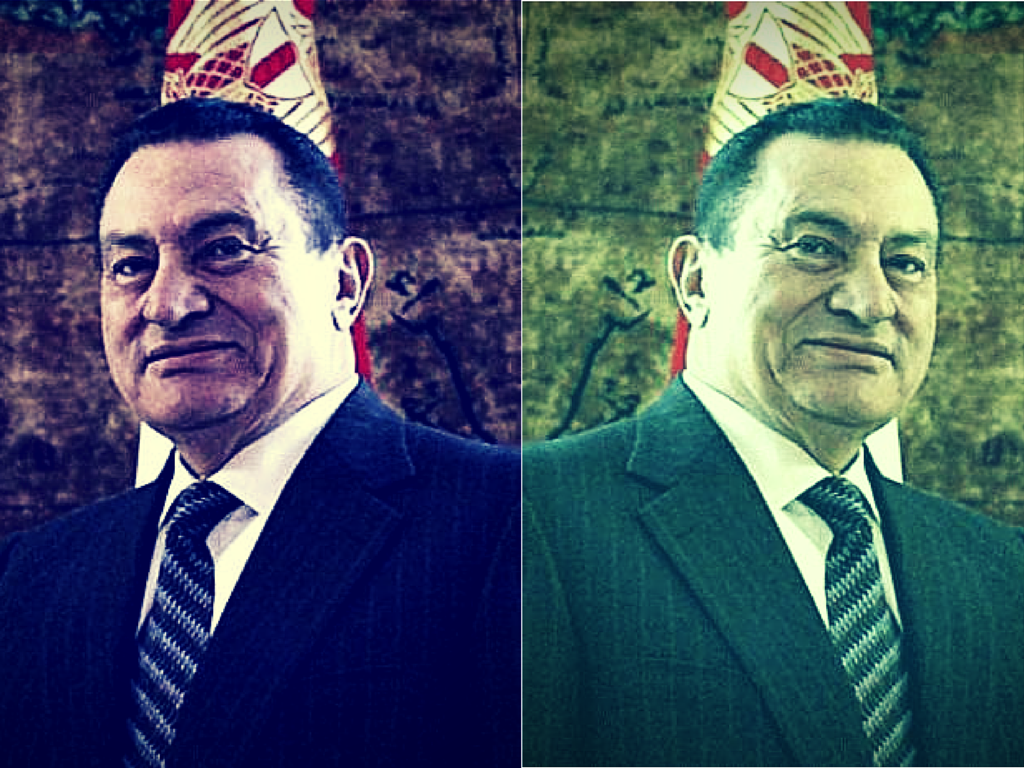
Was Hosni Mubarak a savvy politician who played the Bush administration? A new analysis says “yes.”
Whatever one wants to say about Hosni Mubarak, one has to acknowledge that when it came to dealing with the international community he was a savvy politician (whether you list this on the positive or negative side of the ledger depends on how you feel about politicians).
In a recent article in the Cambridge Review of International Affairs William Youmans argues that one of Mubarak’s successes was resisting the “Freedom Agenda”–the multifaceted push by the George W. Bush to push the Middle East toward greater democracy.
In 2005, the administration intensified efforts pressuring Egypt, a client state, to democratize. However, the US continued pursuing security cooperation with and providing military aid to Egypt.
Youmans claims that President Hosni Mubarak kept US reform efforts at bay by exploiting the inherent inconsistencies between the Bush administration’s democratization program, and its push for security in the war on terror.
Citizenship Versus Denizenship
 What is the difference between people who live in a nation state as members with rights and responsibilities, and those who live there without accepting such rights and responsibilities?
The former is a citizen, the latter a…denizen?
One of the best lessons in citizenship I ever got came from sitting in on a lecture by Dr. John T. Swanson, Egyptologist, classicist and associate provost at American University in Cairo.
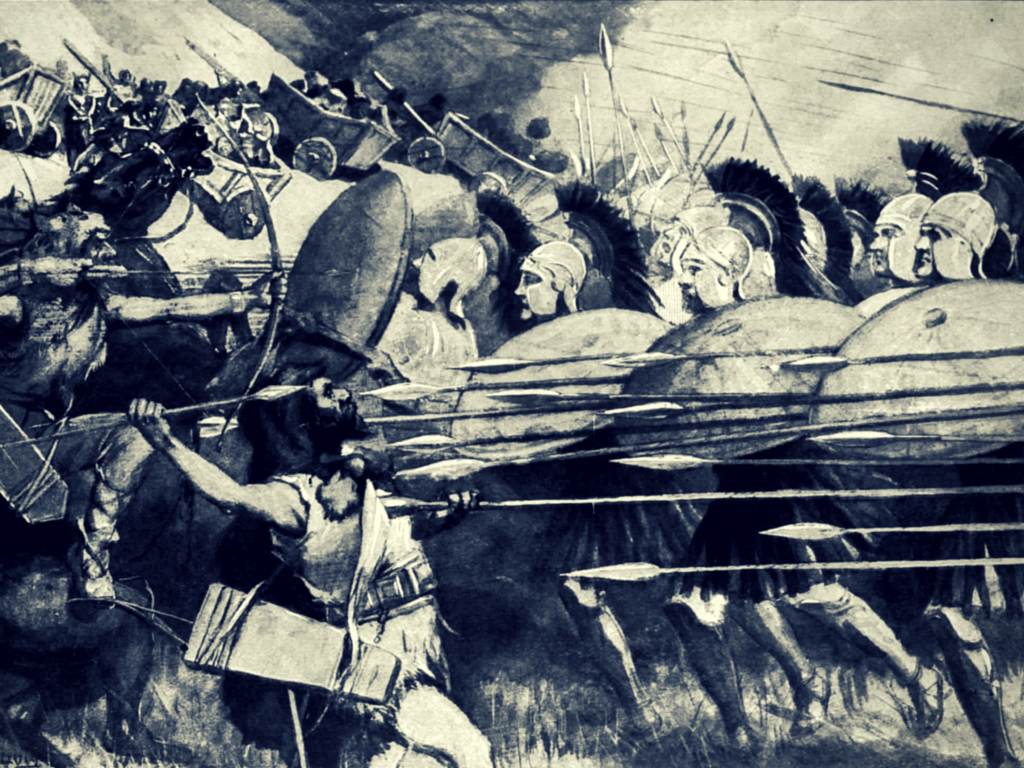
John described the way that Greek citizen soldiers–hoplites–fought during the Archaic and Classical periods (ca. 750–350 BC) in a formation called the phalanx. The hoplites would line up in ranks in close order and lock their shields together, while the first few ranks of soldiers would project their spears out over the first rank of shields. The hoplites thus presented to the enemy a shield wall with a mass of spear points projecting from it, which made frontal assaults against the phalynx difficult.
John pointed out that the structure of the hoplite shields was such that they partially covered the soldier holding them, but also the weapon-holding arm of the next soldier in the formation. Safety required close cooperation and the complete assurance that no man in the phalynx would cut and run.
Citizenship thus required intense loyalty to one another. Your ability to rely on your fellow citizens was thus a matter of life and death.
Citizenship was, of course, gendered. Only adult men could be citizens and enjoy the rights–and fulfill the responsibilities–that came with citizenship.
Al-Sisi On-Line: Egypt’s President On Social Media
In Egypt, President Hosni Mubarak notoriously was anything but sophisticated in his understanding of social media. Seeing it as a toy available only to an educated and relatively affluent few, and failing to recognize the cross-platform capacities of social media with cell phones–which are ubiquitous in Egypt– he failed to engage with social media at all. Aside from the official government web sites, which were handled by technicians and clerks far removed from the president in the hierarchy, the president had no substantive social media presence.
President al-Sisi has certainly learned from the Arab Spring protesters the importance of a wide and robust social media presence. During the presidential campaign he established not only an official web site [www.sisi2014.com], but a Facebook page, a Twitter account, and accounts on Google+, and Instagram as well as a channel on YouTube. All but the campaign web site still exist, and all of these sites contain links to each other, forming a tight web economy.
Corporate Mortality and the Culture of Failure

Sizes of some 30,000 companies traded publicly on US markets from 1950-2009, measured by their sales (controlling for inflation and GDP growth). The relatively rapid growth of smaller companies near the beginnings of their lifespans account for the ragged lower portion of the chart, as well as the relatively steep initial sales increases. As companies reach maturity, their sales tend to level off.
Credit: Marcus Hamilton and Madeleine Daepp
What about failure?
When I was writing my article on entrepreneurship in Egypt (Peterson 2010), which I heavily cannibalized for Chapter Six of Connected in Cairo, one of the things in which I was particularly interested in was failure.
One of my key points was that when US companies fail at home, that’s just business. But when they fail while doing business in Egypt or comment on the failures of Egyptian entrepreneurs–and I suspect this holds in many countries–they blame it on the local “culture.” Egyptian business failure is blamed on a supposed poor work ethic, on institutions like wasta, and on a presumed “lack of entrepreneurial imagination.”
When I sought to contextualize the discourse of these businessmen with some general statistical data, I was shocked to find almost nothing on business failures.
Obviously all businesses dies sometime, and every entrepreneurial adventure is by definition a risk, yet there was not only no theoretical literature on entreprenuerial failure, there were no statistics. And none on business failures generally.
Well now there is (thanks in part to another anthropologist). It turns out the average publicly traded company in the US lasts only ten years.
The Life Span of Companies
Eve n more interesting, the interdisciplinary team of two physicists, an anthropologist and an economist at the Santa Fe Institute in New Mexico discovered that companies die off at roughly the same rate regardless of size, what kinds of products or services they produce, how long they have been in business, or how well-established they are.
This finding runs counter to the few theories that exist in business literature, which either assume that newer, less established companies are more vulnerable, or that more established, less flexible companies are more vulnerable.
Causes of death include:

In September I will be one of the keynote speakers at a conference in Aalborg, Denmark on the Muhammad Cartoon Controversy. We’re looking for people to join us.
Call for papers: Ten Years After-The Muhammad Cartoon Controversy – Perspectives, Reflections and Challenges
Aalborg, September 28-29, 2015
Ten years have gone since the Danish newspaper Morgenavisen Jyllands-Posten decided to publish 12 Muhammad cartoons of the prophet Muhammad as cartoonists ‘imagined him’.
The cartoons and the stories about them led to violence that cost the lives of 150 people. Denmark’s reputation abroad and export to Arab speaking countries were severely impacted.
In addition, the publication of the cartoons and the events following have affected the opportunities of immigrants, who experience being stigmatized and not fully allowed to be Danes. Many Danes have had their ideas of womanhood among Muslims re-enforced, ideas of incompatible values have been strengthened, and the debate about freedom of speech reified.
For many non-Western Muslims, the cartoon story has become an icon of Western arrogance and hatred towards Islam. Their anger came from a deep sense that they are not respected, that they and their most cherished feelings are “fair game.”
New research suggest that increased racial discrimination and enforcement of racial-cultural logics of belonging facilitates mobilization of minority youth groups to crime, violence, political activism, carelessness and terrorism. This development exposes a “schismogenetic” process that merits academic attention analysis and solutions.
Some of the questions for the conference:
“From Arab Spring to Arab Winter”: Special Journal Issue
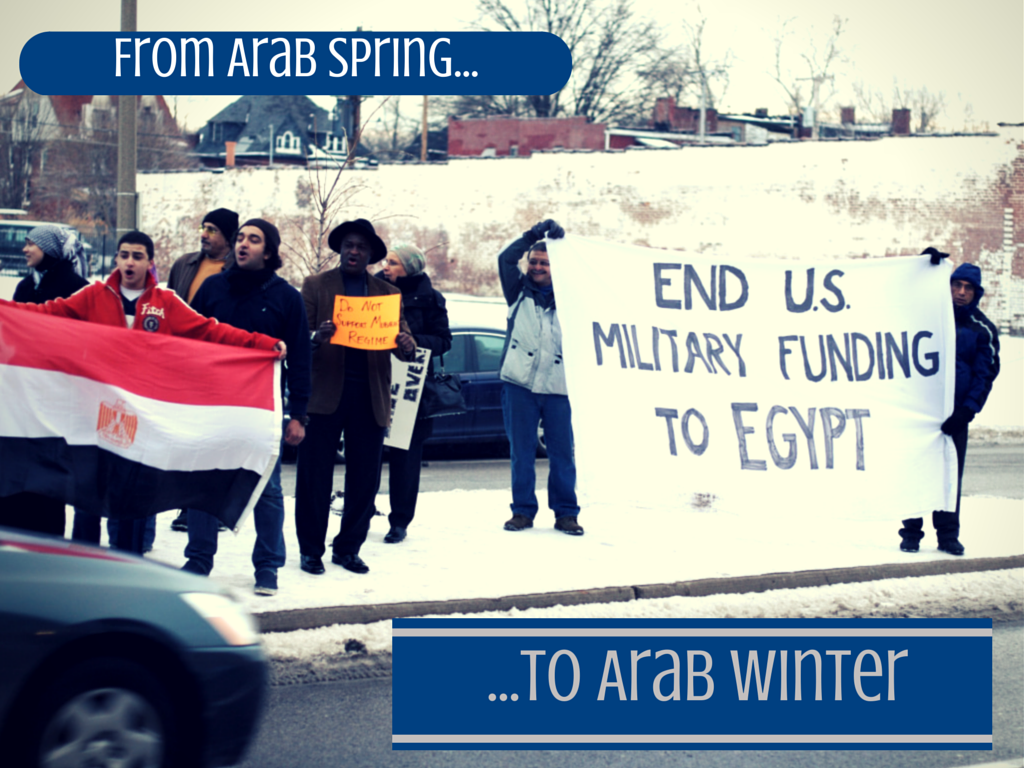
Why didn’t the 2011 uprisings lead to democratization? That’s the question posed by articles in a special issue of the journal Democratization. Photo Credit: tolkien1914 via Compfight cc
“From Arab Spring to Arab Winter” is the title of a special issue of the journal Democratization. Edited by Raymond Hinnebusch, an amazingly prolific international relations professor at the University of St. Andrews, it seeks to examine why democratization has largely failed in the wake of the prodemocratic uprisings, and what patterns can be elicited from the similarities and differences in outcomes from the many Arab Spring protests.
None of the articles focus exclusively on Egypt, but many refer to her in some detail, or make points especially relevant to Egypt’s situation.
This is very much Hinnebusch’s project: he offers an extraordinary synthetic model for looking at the post-uprising phases of the Arab Spring in his introduction, writes an essay comparing Tunisia, Egypt and Syria, and writes an extensive conclusion. Some of the authors are or were his students.
Here are the papers that touch on Egypt:
Hinnebusch, Raymond. 2015. Introduction: understanding the consequences of the Arab uprisings – starting points and divergent trajectories. Democratization 22(2): 205-217.
Abstract:
This introduction sets the context for the following articles by first conceptualizing the divergent post-uprising trajectories taken by varying states: these are distinguished first by whether state capacity collapses or persists, and if it persists, whether the outcome is a hybrid regime or polyarchy. It then assesses how far starting points – the features of the regime and of the uprising – explain these pathways. Specifically, the varying levels of anti-regime mobilization, explained by factors such as levels of grievances, patterns of cleavages, and opportunity structure, determine whether rulers are quickly removed or stalemate sets in. Additionally, the ability of regime and opposition softliners to reach a transition pact greatly shapes democratic prospects. But, also important is the capacity – coercive and co-optative – of the authoritarian rulers to resist, itself a function of factors such as the balance between the patrimonial and bureaucratic features of neo-patrimonial regimes.

 CONNECTED in CAIRO