Participatory Media Among Palestinian Youth
 [Article review by Monica Komer]
Even before the Arab uprisings, citizens have been actively participating in the formation and distribution of media across the region. In a 2009 article entitled “Creative Activism: Youth Media in Palestine,” Julie Norman examines a form of participatory media emerging in Palestine that she calls “youth media.”
Norman uses the term “participatory media” to refer to alternative media produced by individuals and communities that “share personal stories and collective experiences,” and often challenge the dominant narratives of the mainstream media and raise awareness of issues. Participatory media has also served as a tool for creative expression and civic engagement of youth.
This expression and engagement is what Norman means by “youth media.” Norman describes youth media as a means of “amplifying young people’s voices on issues of importance to them.” Youth are confronting local problems and amplifying their voices in many ways.
The Pulse of the Egyptian Revolution: New Journal Issue

How has the Egyptian revolution affected efforts at economic and human rights development? A new journal article offers multiple viewpoints.
The IDS Bulletin, published by the Institute of Development Studies at the University of Sussex, has a new issue out entitled “The Pulse of the Arab Revolt.”
The special issue might as well be called “The Pulse of the Egyptian Revolution” since all of the papers focus on or take their case studies from Egypt, except for the introduction by Mariz Tadros.
Below is a list of the articles, and their abstracts. Most of these have been made available free on-line.
Tadros, Mariz. 2012. Introduction: The Pulse of the Arab Revolt. IDS Bulletin 43(1): 1–15.
This article explores the dynamics of the rupture with the status quo that transformed the face of the Arab world. It examines the meanings of the pathways of social and political change in the light of some of the dominant paradigms that have informed policy and practice in the Arab world. In doing so, this article makes five key postulations that are relevant beyond the Arab context: the first is that we need new lens, new framings and new modes of engagement to capture the pulse of the street. The second postulation is that representing the uprisings as a ‘Facebook revolution’ is highly reductionist and risks promoting the replacement of one development fashion fad with another, without addressing the underlying power dynamics. This is especially so since the uprisings reached tipping point by virtue of a constellation of dynamics involving the youth, the masses and the army’s military coup. Third, the time- and space-bound moral economy of Tahrir Square bears much explanatory power on why the act of revolting should not be confused with its outcome. The fourth contestation suggests that the concept of unruly politics may offer substantial analytical power in understanding the agency, the relationships and spaces through which people mobilized. The fifth argues that there is a need to rethink development policy in the light of a number of paradigm failures outlined below.
Does Middle Eastern Media Studies Need Its Own Paradigm?
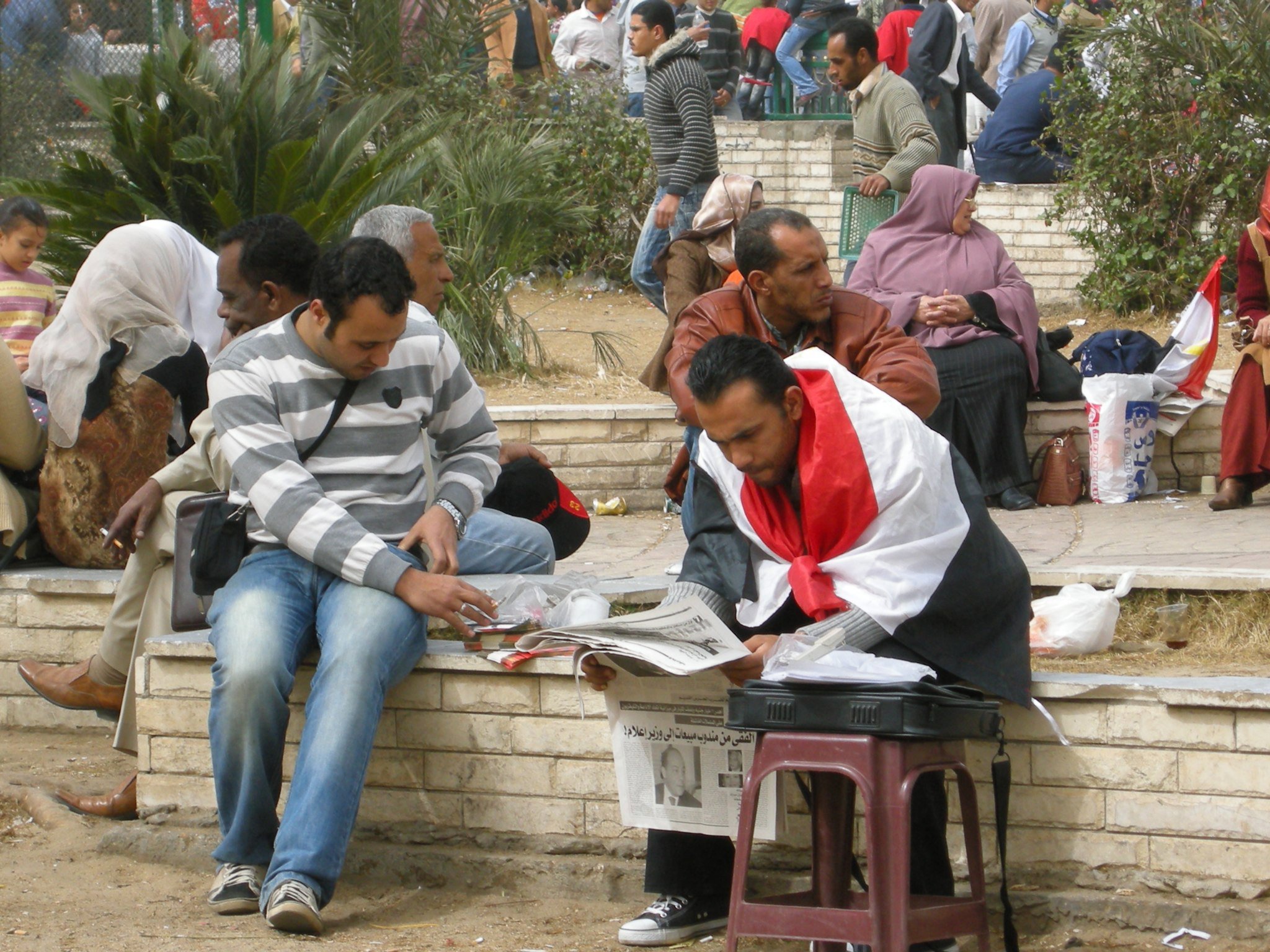
Do the different media environments and contexts of the Middle East require a different set of approaches media studies of the region? Photo: Malek Rouchdy. Used by permission.
[Article review by Monica Komer]
Scholarly work on the rapid expansion of Arab media has grown considerably over the last several year, however this area of study remains undeveloped compared to other regions of the world.
Annabelle Sreberny discusses the factors that impede the field’s development in her article, “The Analytic Challenges of Studying the Middle East and its Evolving Media Environment.”
The normative framework surrounding Western media theory has hindered the study of media in non-Western countries, Sreberny explains. She writes:
“Media Studies, like all the social sciences, is embedded in the historical experiences of Western industrial capitalism, liberal democracy, and bounded nation-states. Even the sub-field of International Communications, perhaps the dominant approach of the late twentieth century, essentially looked out with a scoping gaze from the West toward the rest of the world and proferred a set of assumptions about media dynamics in political, economic and cultural contexts that were for the most part totally ‘foreign’ to the authors.”
Five Anthropological Approaches to the Arab Revolts That Excite Students

The web site Jadaliyya has a pedagogy section that also offers many suggestions for texts, films and approaches to the topic.
How can we engage students in the Arab revolts from an anthropological perspective?
Speaking at a roundtable on “Teaching the Arab Revolts” Nov. 17, sponsored by the Middle East Section of the American Anthropological Association, Dr. Ian Straughn of Brown University suggested the following five categories: Gender, Bodies, Violence, Social Inequality and Material and Visual Culture.
I take each of these separately below. The comments in each category are mine.
1. Gender
One of the first things students wonder about is the participation of women in the revolution. Most US students have been trained by the discourses circulating in US media to see veiling=oppression, so they are often fascinated and perplexed to see women in the niqab, in the higab, and unveiled, all out there protesting together. But gender is not only about women, it is always also about men. Masculinities are very much on display as men exhibit shahm, and courage, and wit in the face of danger, and other valued masculine traits.
Anthropology of Egypt: Stuff I Missed at the Anthropology Meetings
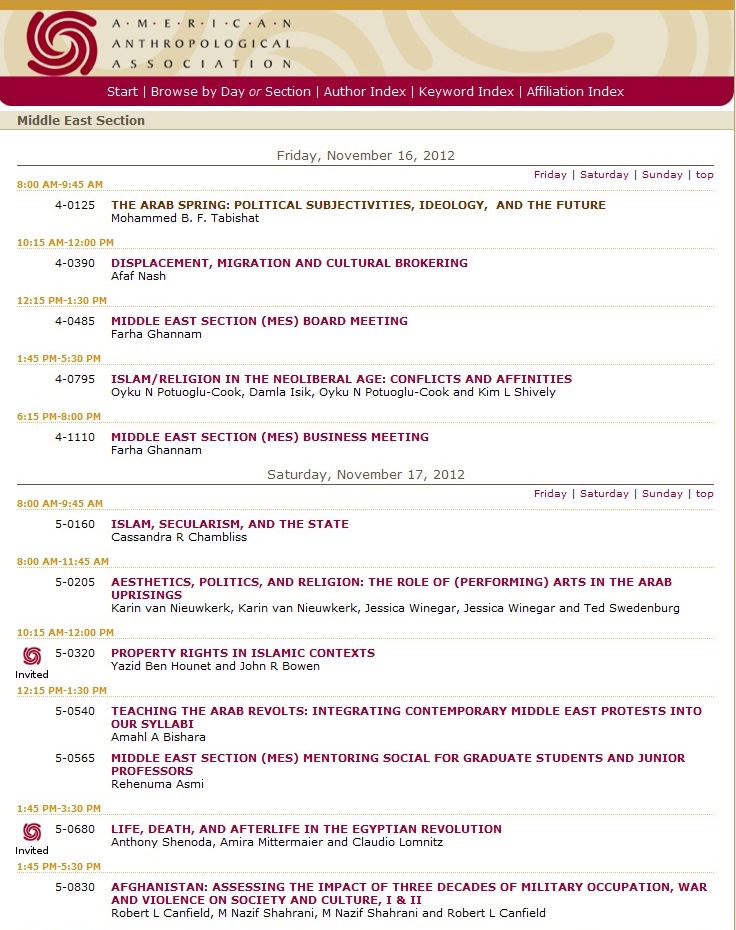
So many papers, so little time
I spent Thursday through Saturday (Nov. 15-17) in rainy San Francisco at the American Anthropological Association meetings. I am trying to concentrate on my news media and globalization in India work, and to network with some other chairs of anthropology departments to whom I could turn for advice as I take up that position, so I could not attend as many panels and papers as I would have liked.
There were a record number of papers and participants, so I missed lots of really good papers, including a lot of good stuff about the Egyptian Revolution.
I’m most bummed about missing a double length program on the art and aesthetics of the revolution, something I’ve blogged a lot about. It had an all star cast but unfortunately it was scheduled opposite first, my roundtable on conversations between journalists and anthropologists and then my Anthropology News editors breakfast–my last, after ten years of serving as a columnist.
The panel was entitled “Aesthetics, Politics, and Religion: The Role of (Performing) Arts in the Arab Uprisings.” It was organized by Karin van Nieuwkerk and Jessica Winegar, with van Nieuwkerk as chair, and Jessica and Ted Swedenburg as discussants.
The papers included:
- “Aesthetics, Politics, and Religion: The Role of (Performing) Arts in the Arab Uprisings” by Karin van Nieuwkerk of Radboud University in the Netherlands, author of the classic A Trade Like Any Other (UTexas Press, 1995) and editor of Muslim Rap, Halal Soaps, and Revolutionary Theater: Artistic Developments in the Muslim World (UTexas Press, 2011), which I bought but haven’t had time to read yet.
- “Can Poetry Change the World? Reading Amal Dunqul in 2011” by Samuli Schielke of the Zentrum Moderner Orient in Berlin.
- “In Praise of Insult: Poetic performance in the Egyptian Revolution” by Elliott Colla of Georgetown University.
- “Off the Stage, Into the Square: Avant-Garde Performers in Revolutionary Egypt” by Sonali Pahwa of Northwestern University-Qatar.
- “Music for All: Aesthetic Shifts in Secular Nationalist Pop Music in Egypt” by Dan Gilman of DePauw University. I got to meet Dan at the Middle East Section business meeting, where he turned out to be buddies with my new Miami colleague John Schaeffer. It took me a minute to realize that he was the guy who wrote the “martyr pop” article, but I got there eventually (the brain still works, it just keeps getting slower–not that I’ve ever been good with names).
- “Breaking Free: The Power of Satire in the Arab Spring” by Abdelghani El Khairat of the University of Utrecht.
There were also papers on topics outside Egypt–one on the Amazigh movement in Morocco, one on poetry and protest in Yemen, one on Syrian dance (dabke), and two on Moroccan protest music.
Another potentially great panel I missed was “The Arab Spring: Political Subjectivities, Ideology, and the Future” organized by Mohammed B. F. Tabishat of the American University in Cairo. These papers included:
700+ Bands and 2700+ Tunes
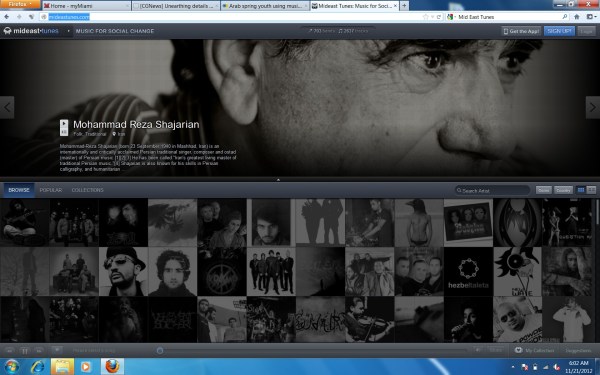 More than 700 bands. Over 2700 tunes.
This makes MidEast Tunes (mideasttunes.com) is one of the largest Arabic music sites in he world.
Founded in Beirut in 2010 by an organization called MidEast Youth, the site is another of the myriad efforts to leverage social media as a tool for progressive social change in the Arab World and beyond.
I first learned about the web site from a column in Common Ground. The author describes the site thus:
It showcases the work of independent artists from across the Middle East, allowing them to submit and update their profiles on a website and mobile application that allows users to stream music as they discover new bands. Mideast Tunes aims to unite “young people committed to fostering constructive discourse in the Middle East through music”. The website promotes bands and musicians “that would otherwise never be given a second glance in the international scene” with the belief that “music can change the world and that the musicians of the Middle East and North Africa will lead the way”.
Whether the site will survive or will eventually collapse into ephemera like so many others remains to be seen. In the meantime, it is an amazing resource for those who enjoy Middle Eastern music (and I use the term Middle Eastern because there’s music in Persian and other regional languages, not just Arabic), as well as those who want to explore it.
UPDATE: The site did not fade away but it did change it’s name from MidEastTunes.org to MidEastTunes.com, The text and links above were updated accordingly on Nov. 29, 2018.
Brown Library Guide to Arab Revolution Resources
 To my existing list of library guides put together, or recommended, by friends and colleagues, I add this one:
The Brown University Library Guide to the Arab Spring 2011-Present by Dr. Ian Straughn, Joukowsky Family Middle East Studies Librarian at Brown University.
I add it for four reasons:
- It was recommended by Amahl Bishara. She’s a media anthropologist who regularly teaches one of my early papers, so she clearly recognizes good material when she sees it.
- It lists this blog as one of thirteen “blogs about the Arab Spring” (again, showing clear-sighted ability to direct students to excellent content)
- Brown is my PhD alma mater.
- Dr. Straughn touted it as part of a presentation on teaching about the revolution at at the American Anthropological Association meetings.
Anthropologists Thinking About Life and Death in Egypt
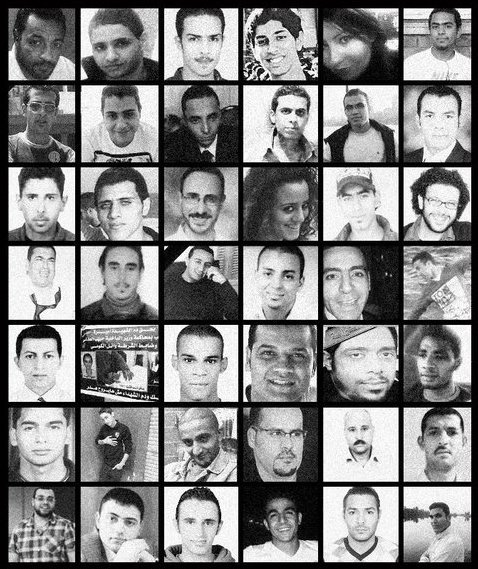
What makes death meaningful? What kind of social action is martyrdom? How are religious and revolutionary forms of martyrdom similar and different? Are martyrs made or do they choose their death? And dos it matter? These are some of the questions considered by anthropologists at their meeting in San francisco.
On Saturday I attended a panel of papers on “Life, Death and the Afterlife in the Egyptian Revolution” which focused on martyrdom and the meanings of dying in–and for–the revolution. It was part of my three day excursion to San Francisco for the American Anthropological Association annual meetings.
Farha Ghannam of Swarthmore College gave a paper entitled “Dying Like a Man: On the Meaning of ‘Good Endings’ in Urban Egypt.” Her paper focused on the death of a 15-year old boy named Anas Mohyeddin in the Feb. 1, 2012 Port Said football massacre. More than 70 people died in less than an hour when Masry fans are said to have stormed the pitch following a victory against Ahly. But most Egyptians believe Egyptian security forces were actually responsible for the massacre, and within a day, the dead were being called martyrs, their photos were posted and their stories were being told on Facebook.
Some, like young Anas, became more famous than others.
Farha began by noting class positionality–that people of the Middle and Upper classes can enlist relatives, friends, teachers and others to record stories and testimonials about fallen victims in ways the poor can’t. These testimonials are performative: they create what they represent. They transform the pointlessness of Anas’s violent death into something meaningful.
Anthony Shenoda of Scripps College presented a paper on “Afterlife Anxieties Performing Martyrdom in the the Coptic Church.” This paper focused on the double claims made for those who died in the Maspero massacre as both martys of the Church, who died for their Christian faith, and martyrs of the revolution, who died in an effort to make Egypt a better place.
Shenoda sees martyrdom as a communicative act through which the meaninglessness of violent death is infused with meaning, but also through which the world is constituted in particular ways.
 The Middle East Journal of Culture and Communication has published a special issue entitled “‘Theorising’ the Arab Revolutions.”
The special issues seeks to respond “to descriptive and facile interpretations of the ‘Arab Spring’, that have failed to articulate the revolutions beyond their chronometric eventfulness.” Instead, the authors (who are mostly affiliated with the School of Oriental and African Studies (SOAS) of the University of London) hope to “develop a coherent and systematic theoretical response to political processes that saw the fall of some of the most powerful Western-backed regimes in the region under relentless pressure and opposition from highly mediated and highly visible modalities of politics that shook the foundations of authoritarian and repressive rule.”
Two of the articles focus specifically on Egypt; all reference Egypt and Tunisia.
In the first article, entitled “Arab Uprisings: Geopolitics, Strategies and Adjustment,” Dina Matar, a former Middle East news correspondent who is now senior lecturer in Arab media and International Political Communication at the Centre for Film and Media Studies at SOAS interviews her co-editor of The Middle East Journal of Culture and Communication, Gilbert Achcar, who is Professor of Development Studies and International Relations at SOAS and the author of the widely read The Clash of Barbarisms (2006, Paradigm Press).
Achcar describes the role of “Washington’s return to playing the Islamic card: the good Muslims versus bad Muslims discourse.”
The good Muslims, or the new good Muslims, or the good again Muslims, are groups like the Muslim Brotherhood, with whom the United States had a close collaboration in the time of (former Egyptian president) Gamal Abdel Nasser. There are now attempts at renewing this kind of collaboration, as these groups have the advantage in Washington’s eyes of having a real popular influence, unlike Washington’s traditional friends of the past decades.
And he points out that Al-Jazeera’s close ties to the Muslim Brotherhood, and the Brotherhood’s economic ties to Qatar, serve as agents for this process.
“The Arab Revolts, Islam and Postmodernity” by Arshin Adib-Moghaddam, Reader in Comparative Politics and International Relations at SOAS, contextualizes the revolts within what he sees as a new stage in Islam. By contrast, most media accounts are structured by what he calls the “clash regime.” rooted in an Islamophobic discourse that constructs Islam as the ultimate “other” to the “West.” Here’s the abstract:

 CONNECTED in CAIRO