“Law and Development” in Post-Revolutionary Egypt
 There’s a new article on the Egyptian revolution in the latest issue of Third World Quarterly. Entitled “Counter-revolution by Ideology? Law and development’s vision(s) for post-revolutionary Egypt”
“Law and development” was a movement promoted in the 1960s by the Ford Foundation and USAID to reform legal systems in developing countries to assist democratization, economic development, and human rights (Trubeck and Santos 2006).
In part thanks to this movement, many contradictory laws, rules and regulations apply to interactions between states and non-state parties like NGOs and international institutions. Dispute settlement mechanisms like international courts have been set up to enforce compliance with some of these laws.
Muslim-Christian Relations After the “Arab Spring”–Disappointing Special Journal Issue

A special issue of an interdisciplinary journal looks at the rising tensions between Muslims and Christians in the wake of the Arab revolts but, alas, provides few new insights.
Muslim-Christian tensions are again volatile in Egypt, following the revelation that the inflammatory anti-Muhammad video was created by a diasporic Copt. Christians accused of criticizing Islam are sitting in jail, their trials fast-tracked, while Salafis who shred the Bible on video walk around free on bail, their trial dates uncertain.
At this timely juncture comes a special issue of the journal Islam and Christian–Muslim Relations focused on the challenges posed to Christian-Muslim relations in the wake of the Arab revolts.
Unfortunately, the issue is diffuse and spotty in the focus and quality of the articles, and has only limited relevance in helping us think about what’s going on in the region right now.
Greg Barton’s opening “reflections” are more reflections on the special issue itself than on the challenges; he leaves the articles to speak to those. And they do, but sometimes only tangentially, addressing the core issue but addressing the revolutionary impetus only in passing, or to set up a more general paper.
My favorite article is by Francesca Comunello and Giuseppe Anzera, “Will the revolution be tweeted? A conceptual framework for understanding the social media and the Arab Spring.” In its effort to find a middle ground between cyberutopianists and cyberpessimists (whom they call “digital evangelists” and “techno-realists”) it breaks no new ground. It does, however, have a nice summing up of ten lessons that can be culled from reviewing the literature so far on the use of social media in the Arab revolts (especially in Tunisia and Egypt).
The editors and publishers must have liked this article too as they have made it freely available on the web here.
The most useful article is clearly the piece by Maher Y. Abu-Munshar of Qatar University. Abu-Munshar begins by acknowledging that clashes between Muslim and Christian groups in the aftermath of the Egyptian revolution have exacerbated prejudices against Islam, providing fuel for those who believe that it is a religion that promotes violence and intolerance. In contrast, he writes,
New Review of Connected in Cairo in Middle East Journal
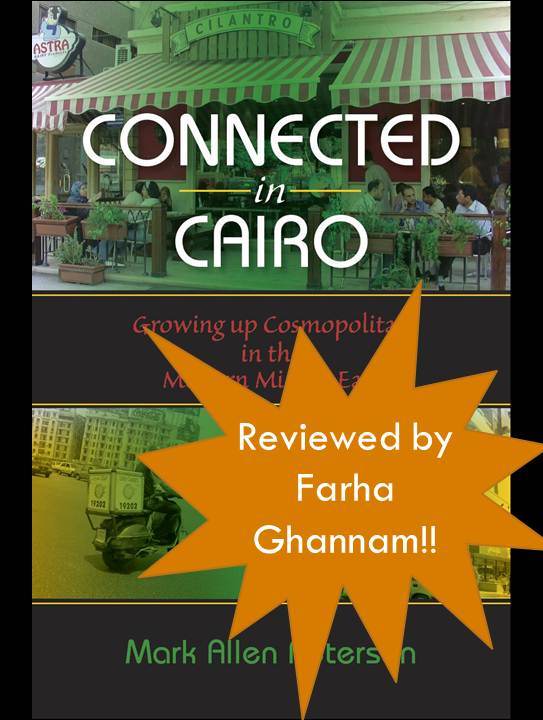 One of the two books that inspired me to stop just drawing on observations of Cairo for class lecture examples and actually begin research and writing was Farha Ghannam’s Remaking the Modern: Space, Relocation, and the Politics of Identity in a Global Cairo (2002, University of California Press) (the other was Walter Armbrust’s Mass Culture and Modernism in Egypt).
So it is a huge pleasure to see my book reviewed by her in a recent issue of Middle East Journal, particularly as it is such a positive review.
She has a very nice summary of my argument that shows that she understood what I was trying to do (it probably helps that she draws quotations from several parts of the book and not only the introduction, as at least one other reviewer did). And she writes:
Connected in Egypt provides scholars and students of globalization, class, and modernity with a timely and much needed glimpse of the struggles, negotiations, and challenges that face elite men and women in their attempts to materialize specific tastes, visions, and ways of being. The book’s focus on the economically privileged classes is a particularly welcomed contribution that bridges an important gap in the anthropology of the Middle East in general and the anthropology of urban Egypt in particular, which tends to focus largely on low-income groups. The array of different experiences, individuals, and products presented in the book gives the reader a sense of the complex desires, visions, and dispositions that structure and challenge key concepts like modernity, identity, and authenticity.
She has one significant criticism:
New Book: More Political Scientists Weigh In
 It’s not just any political scientists who have weighed in on the revolution in this new book, but ones at the American University in Cairo, where they had ringside seats and were, in some cases, participants.
Egypt’s Tahrir Revolution — not, alas, an inspiring title (or book cover, for that matter) was edited by my former colleague Dan Tschirgi, with his colleagues Walid Kazziha and Sean F.McMahon, all political scientist professors at the American University in Cairo.
It’s due out in December, and I may have more to say about it after I’ve read it. It’s on my Amazon wish list.
In the meantime, here are the contents and authors:
PART ONE: THE REVOLUTION
Egypt Under Mubarak by Walid. Kazziha.
What Went Wrong with Mubarak’s Regime by Mustafa Kamal Al-Sayyid.
The Political Economy of the Revolution by Nadia Ramsis Farah.
Youth Power: Egypt’s Future? by Tim Sullivan.
Egyptian Women in Revolt: Ordinary Women, Extraordinary Roles by Manar Shorbagy.
Revolution Without Islamists?by Sherine ElGhatit.PART TWO: THE CONTEXT OF THE REVOLUTION
The Implosion of Patronage Regimes in the Middle East by Ibrahim. Elnur.
Egypt’s Uncertain Transition by Ivan Ivekovic.
Political Theory and the Tahrir Revolution by Sean F. McMahon.PART THREE: IMPLICATIONS OF THE REVOLUTION
Comparing Revolutions: Egypt and East Germany by Nadine Sika.
Israel and the Tahrir Revolution by Amr Yossef.
The US and the Tahrir Revolution by Dan Tschirgi.
You’ll find complete references in the Bibliography.
Men Behaving Badly in the U.S. and Egypt

Symbol for symbol–Egyptians respond to the videotape by tearing down the U.S. flag.
A passionate article by Mustafa Bayoumi entitled “Men Behaving Badly” sees the “Clash of Civilizations” expressed in the “Innocence of Muslims” video and the US embassy attacks as something deliberately created by a handful of Islamophobes in the U.S. and Islamists in Egypt, who hate each other but operate symbiotically to create issues like the current storm.
The sequence of events, he points out, is this:
- The Innocence of Muslims, an amateurish 14-minute video, is produced by a Coptic Egyptian-American named Nakoula Basseley Nakoula, who initially claimed to be “an Israeli American” named Sam Bacile, and
- The video was originally posted months ago on YouTube with no significant outcomes.
- It suddenly began to draw attention when the Islamophobic Coptic American activist Morris Sadek e-mailed hundreds of journalists and associates a link to the video (and posted it on his website) in connection to an “International Judge Muhammad Day” organized by Pastor Terry Jones, scheduled for September 11, 2012.
- Read more…
Reimagining Time and Space in Tahrir Square

Tahrir Square was a “time out of time” and a place that has become a symbol with multiple layers of reference. What language can we use to talk about this?
In her essay “A ‘Time out of Time’: Tahrir, the Political and the Imaginary in the context of the January 25th Revolution in Egypt,” Hanan Sabea reflects on multiple aspects of time in the space of Tahrir Square, and the functions time played in constructing significance.
We all recognize the importance of Tahrir Square as an experience of anomolous time. Yasmine Moll says contemporary Islamic preachers “frame Tahrir Square as an exemplar of a ‘New Egypt,’ a utopian space where free expression, social equality, gender parity, religious harmony and an overall sense of order and organization reigned for 18 days.”
How do we theorize this?
Creating Social Change Through Digital Media II: Earl And Kimport’s “Digitally Enabled Social Change”
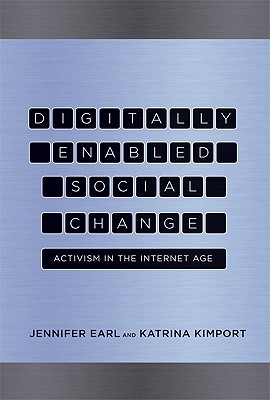 The notion that electronic media–especially the Internet, and Web 2.0–can truly be a game changer that transforms the ways people engage in social and political change remains a compelling belief, one to which the Egyptian uprising and other Arab revolutions have contributed.
The issue of emancipatory media poses two crucial questions:
- Can media be used in emancipatory ways by social movements and
- if so, how is this to be accomplished?
I recently reviewed a two volume series of case studies examining successful as well as not-so-successful efforts at harnessing media to create social change. Since then, my attention has been drawn to several more efforts that answer the first question with a resounding “Yes” and seek to move on to the second. My first installment was an assessment of Dan Gillmor’s Mediactive.
Here’s the second installment, an assessment of Jennifer Earl’s and Katrina Kimport’s Digitally Enabled Social Change: Activism in the Internet Age. Like the others I am reviewing in this series, Earl and Kimport do not question whether new media are, or can be emancipatory, they ask how this is accomplished.
Earl and Kimport emphasize that “it is people’s usage of technology – not technology itself – that can change social processes” (p. 14). At the same time, they want to emphasize that new technologies create new “affordances” which activists can creatively leverage in pursuit of their goals.
Me, Assange, and the Arab Revolutions

Did Julian Assange and Wikileaks inspire the Tunisian revolution and thus contribute to the Arab Spring? I don’t know, and I’m not sure my work speaks to this question. Picture by Age of Chaos. Used under Creative Commons license.
I stumbled–literally–on an on-line paper that cites me to make an argument that I’m not sure my work supports.
The paper is entitled “What has WikiLeaks done for the benefit of the Society as to call it ‘Journalism’?” by C.S.H.N Murthy and Reetamoni Das, and it was published in an on-line journal called Cyborg Subjects: Discourses on Digital Culture.
The basic argument stems from an interview that Assange gave to the Hindu newspaper in which he is said to have claimed
- that wikileaks is a new form of digital journalism and
- wikileaks started the revolutions in North Africa
Murthy and Das assume that these two statements are linked. Journalism is understood as a public good, and initiating the revolution in North Africa is the proof that Wikileaks has contributed to the global public good and can therefore be justified with the claim of being journalism.
If, on the other hand, Wikileaks can be shown to have not started the Arab revolutions or some comparable benefit to human history, it does not deserve the dignity of being labeled “journalism” and, in fact, is probably just troublemaking.
Two of my works, Connected In Cairo and an on-line paper on “Egypt’s Experimental Moment” are marshaled to prove that Assange and Wikileaks did not in fact start the uprisings in the Middle East.
New Article: Changing Political participation By Youths in Egypt
There’s a new essay of youth mobilization in Egypt by Nadine Sika, Assistant Professor of Political Science, American University in Cairo.
Entitled “Youth Political Engagement in Egypt: From Abstention to Uprising” the article appears in the latest issue of the British Journal of Middle Eastern Studies.
The abstract is as follows:
This study analyses the dynamics of youth political engagement in Egypt in the light of ‘dual motivation’ theory, which defines political engagement in terms of both citizens’ interest in changing the outcome of elections and the prevalence of social capital conducive for political engagement. The first part of the article focuses on the dynamics of political mobilzsation in general, prior to the uprising of 25 January 2011. The second part examines the political attitudes and levels of political participation of young people prior to the uprising. The study found that the youth believed in democratic values but did not participate politically. This is explained not by a lack of social capital but rather by an understanding of the dynamics of authoritarian rule and corruption, leading to a general abstention from civic and political engagement. Nevertheless, with the changing international circumstances, especially the Jasmine revolution in Tunisia, youth movements in Egypt have proved capable of framing the issue of regime change effectively, leading ultimately to contention on the streets and the toppling of Mubarak. Dual motivation theory, therefore, might not be applicable in authoritarian regimes but in democratising regimes both elements of the theory appear relevant.
Reference:
Sika, Nadine. 2012. Youth Political Engagement in Egypt: From Abstention to Uprising. British Journal of Middle Eastern Studies 39(2): 181-199
Why Inside-Out Cities Produce Street Politics

Out in the street, says Asef Bayat, a public sphere forms and politics happens apart from the elites and middle-classes who run the formal political apparatuses of the state.
There’s a very interesting article in the latest issue of the journal City & Society by Asef Bayat. Entitled “Politics in the City-Inside-Out,” Bayat argues that the contemporary urban metropolises of neoliberal capitalism–he’s thinking of Cairo, Tehran, Istanbul and so forth–have a structural propensity to produce street politics.
Bayat argues that in addition to the many other aspects of the contemporary “neoliberal” city described in recent sociological, anthropological and urban studies literatures, there’s an often overlooked feature of such cities: they are inside-out.
I propose that a key spatial feature of the neoliberal city relates to double and dialectical processes of “inside-outing” and “enclosure.” In the first place, the neoliberal city is a “city-inside-out,” where a massive number of urban residents, the subaltern, become compelled to operate, subsist, or simply live on the public spaces—in the streets, in a substantial “out-doors economy.” Here public space becomes an indispensable asset, capital, for people to survive, operate and reproduce life. Strolling in the streets of Cairo, Tehran, or Amman in the midst of a working day, one cannot but notice the astonishing presence of so many people operating out-doors in the streets: working, running around, standing, sitting, negotiating, or driving.
The concept of the “neoliberal city” is a powerful and widespread notion in contemporary social theory


