There Are Probably No Real Cyberrevolutions, Not Even In Egypt
I just published a post based on Jillian York’s paper reminding Cyberutopians that the revolution succeeded not because Egyptians had social media but because ten years of revolutionary infrastructure–of which the Internet was a part–had been laid down before the Tahrir Square protests ever happened.
Then I stumbled on this 2009 talk addressing Cyberutopians two years before the Tahrir uprising occurred.
It is a reminder of how much empirical information we still need to be able to understand the social and political localizations of global technologies like these.
It also makes us think about whether the Mubarak regime might have been able to forestall the protests more effectively if they had taken the Internet more seriously as a threat, or dealt with it more creatively, as Iran, Myanmar and China have (unfortunately) done…
“The Digital Vanguard”: Prelude to the Egyptian Revolution
 Last year I sat in on a senior capstone course on international policy. The idea was to assess a particular problem in US policy and make recommendations. One of the student projects recommended that the US could start a revolution in the particular country they were advising on by promoting Internet access in the country.
I was incredulous and had to repeat back to them what I was hearing before I could believe it. Apparently they had read Wael Ghonim’s maxim ” if you want to liberate a society just give them the Internet” as policy rather than exuberant hyperbole.
I had to explain to them just a few of the complexities of the so-called Internet revolution in Egypt–the decades of labor movements, protests, political blogging and other elements that allowed the 18 days in Jan and Feb 2011 to become a tipping point.
The professor was suitably chagrined at how her students had embarrassed her. But to be fair, many professionals have written things almost as naive. That’s why I was gratified to read a recent brief account of the uprisings that focused on the prelude.
“The year 2011 will go down in history as the year that changed the face of the Arab world. From the early triumphs of January and February to the ongoing conflicts in Libya, Yemen, and Syria, and the nascent movements in Algeria and Kuwait, alien observers would not be blamed for thinking that a sudden fever had befallen the region. What to many seemed sudden, however, was in fact the culmination of nearly a decade of efforts.”
That’s the key point of a recent paper by the Electronic Frontier Foundation’s Director of International Freedom of Expression Jillian C. York.
The Egyptian Revolution in Review: Twitter as Historical Documentation
 There’s a very interesting new documentary from Al-Jazeera inspired by the book Tweets From Tahrir.
The video profiles five highly articulate young Egyptian “tweeps” who have been involved in the revolution since its inception–Hossam al-Hamalawy (@arabawy), Gigi Ibrahim (@Gsquare86), Mahmoud Salem (@sandmonkey), Mona Seif (@monasosh) and Tarek Shalaby (@tarekshalaby)–and mixes interviews, news footage and the tweets they were sending at the time to create a very interesting account of the uprising, especially its early days.
Twitter is treated here not as an engine of change–this is not a story of a Twitter revolution–but as documentary texts, supplementing and supporting other kinds of texts such as news stories and personal narratives.
Unlike the book, the documentary takes us well beyond the 18 days to discuss the Maspero massacre of the Copts and the elections, covering the entire first year of the revolution.
It ends with the hopes and plans of the revolutionaries for the future: the removal of the military council and the emergence of a genuinely representative government.

Televangelists like Moez Masoud are calling for Egyptians to rebuild Egypt by rebuilding themselves.
In Chapter Four of Connected In Cairo I write about cosmopolitan Egyptian students at a private international school searching for akhlaq, or ethics as they try to make sense of their lives. Later in the same chapter, I describe how some students find an ethical cosmopolitanism in Islam, especially through the calls to social action of Islamic televangelist Amr Khaled.
Yasmine Moll extends these same two themes into an account of contemporary efforts to make sense of the Egyptian revolution in a fascinating essay titled “Building the New Egypt: Islamic Televangelists, Revolutionary Ethics, and ‘Productive’ Citizenship.”
Moll, a graduate student at New York University, has been conducting fieldwork with both producers and viewers of Islamic televangelist programming for 18 months, so she has a keen sense of how attitudes toward the al-duah al-gudud, or “the new preachers” and their programs have changed.
She writes
Prior to the January 25th revolution, [were characterized as offering Muslim youth a “post-Islamist” religious discourse that was apolitical, with one academic observer calling it an “air-conditioned Islam” (Haenni 2005) far from the everyday realities of the vast majority of Egyptians struggling with poverty, social injustice and political disenfranchisement.
Indeed, much of the disappointment I heard from my friends and hosts was their insistence on individual or small group efforts to help the poor through alms, and distribution of clothes and blankets and such, failed to engage any of the political and economic conditions that created and sustained widespread poverty, unemployment and inadequate distribution of wealth. However,
Anthropologists Write About Revolution and Counter-Revolution in Egypt a Year after January 25th
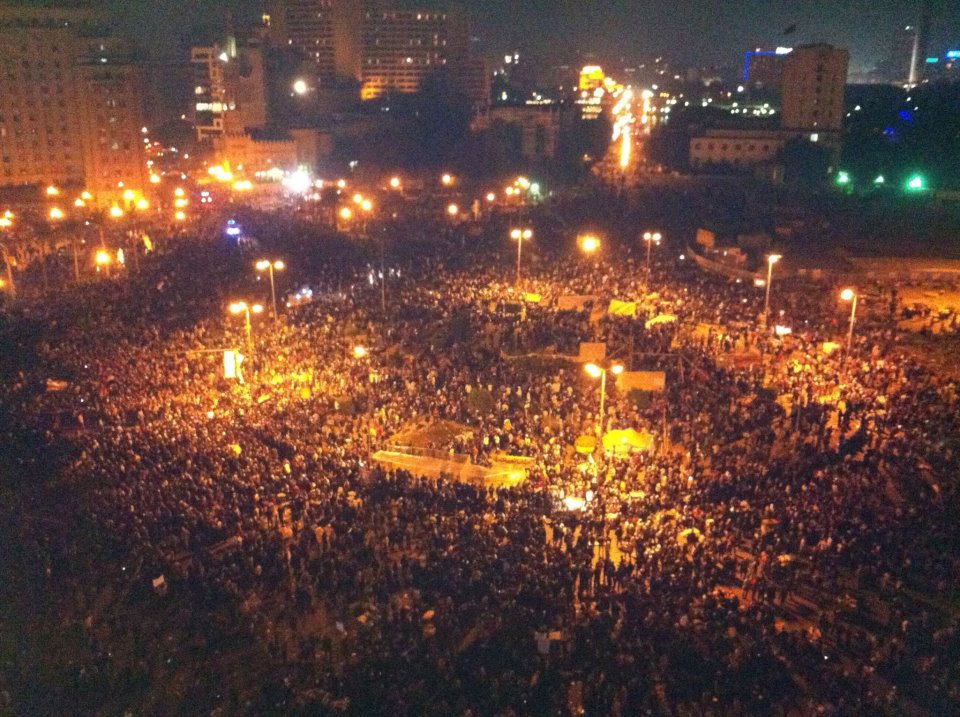
What do the anthropologists have to say about the Egyptian uprisings?
Having shared a number of collections of articles on Egypt’s ongoing struggles by political scientists, geographers and communications scholars, I am happy to report that the anthropologists are finally weighing in, and it was worth the wait.
The Cultural Anthropology web site has just released an on-line set of seventeen short essays (which they call a “Hot Spot”) entitled “Revolution and Counter-Revolution in Egypt a Year after January 25th.”
Editors Julia Elyachar of the University of California, Irvine and Jessica Winegar of Northwestern University have put together a wonderful set of brief, thought provoking essays.
In her brief introduction to the web site, Winegar writes:
The Egyptian revolution neither began nor ended in those 18 days before Mubarak stepped down. As anthropologists struggled, like many Egyptians and academic observers, to make sense of an overwhelming set of events, they drew on their fieldwork experiences from past decades to show how the revolution was rooted in long-standing day-to-day struggles for food, jobs, security, and dignity, as well as in years of organizing and activism among various groups–most notably labor and Islamic collectives.
Jessica is the author of an amazing book on Egyptian artists Creative Reckonings: The Politics of Art and Culture in Contemporary Egypt (Stanford University Press, 2006), which won the Middle East Studies Association’s Albert Hourani Book Award
The table of contents reads like a Who’s Who of anthropologists (and a few fellow travelers) working in Egypt over the past several years, and ranges from seasoned scholars who’ve been working there for decades to graduate students engaged in current fieldwork. See for yourself:
Egyptian Struggles Continue
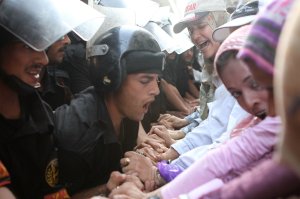
The struggles continue. Sarah Carr's amazing photo of the Information Center for Local Development workers during their sit-in at the Egyptian Federation of Trade Unions.
Contingency, unpredictability, and struggle between various groups continues to be the orders of the day in Egypt. I’ve been reading a lot of news, even if not posting on it, and a narrative seems to be emerging:
The liberal secular revolutionary groups, emboldened by the nearly two million strong showing on the anniversary of the revolution–in spite of military and Muslim Brotherhood efforts to keep it low key–have been protesting loudly against the Brotherhood as well as SCAF.
The Muslim Brotherhood is trying to avoid outright conflict with the secularists, while themselves standing confident in the Freedom and Justice Party’s ten million vote victory.
Pressure from the SCAF on one side and the liberals on the other are pushing the Brotherhood into a tighter alliance with the salafists, with whom they have shared the majority of cabinet posts. They are not natural allies, however, and too close cooperation between them can only help the salafists at the expense of the Brotherhood.
SCAF is reeling from the blow delivered in Washington. The seizure of the heads of several US pro-democracy NGOs was largely seen locally as an attempt to show Washington, DC who was still in charge in Egypt in the face of Washington’s overtures to the elected parliament. According to Al-Hayat newspaper, it backfired. The Obama administration supposedly told them that in the face of the illegal detention of the NGO leaders it could no longer resist pressure from Congress to cut the $1.3 million military allocation we have long given Egypt.
Bodies on the Move in Pre-Revolution Egypt
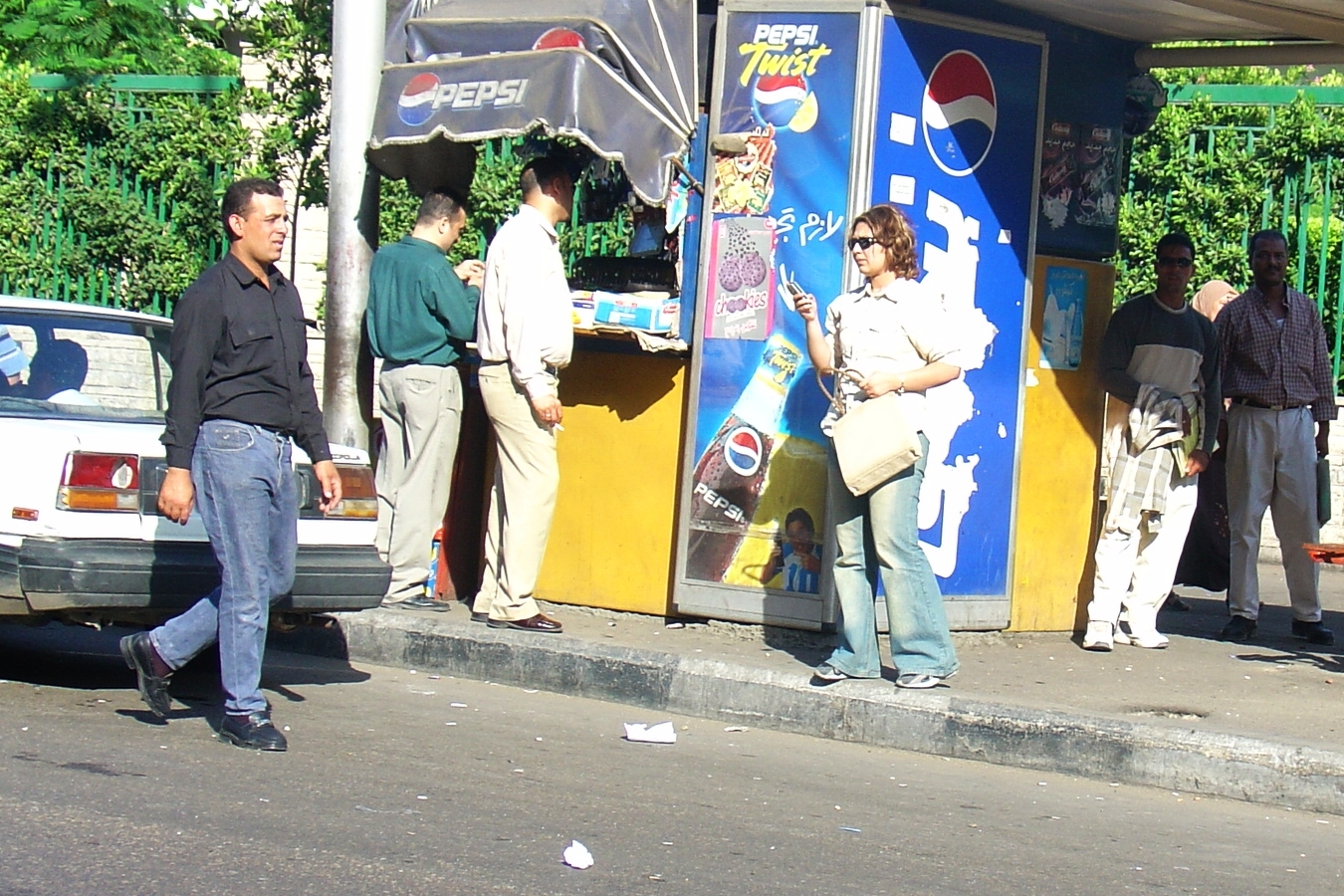
How do "urban mobilities" differ by gender and class? And what are the social outcomes of relatively free and relatively constrained movement?
This is a brief review of “Mobility, liminality, and embodiment in urban Egypt” by Farha Ghannam (Swarthmore) published in the most recent edition of American Ethnologist (Vol. 38, No. 4).
In this article, Ghannam analyzes urban mobilities, that is, the agency through which people can move about the city, describing the factors that enable and constrain capacity to go places and do things. For ethnographic data, she describes the lives of a brother and sister, who she calls Zaki and Zakiya, from the low-income neighborhood of al-Zawyia al-Hamra in Cairo.
Using Victor Turner’s work on liminality and Pierre Bourdieu’s concepts of habitus and bodily hexis, she looks at daily mobilities as “embodied liminal encounters that are open to multiple possibilities.” Not surprisingly, she finds that Zaki suffers from far fewer constraints on movement than his sister.
What IS surprising, however, is this:
Paradoxically, it was his rather free mobility as a youth that restricted his accumulation of cultural capital, limited his career choices, and now constrains his mobility as an adult. His sister, who was carefully monitored and restricted in her movement as a young girl, finished high school and completed two years of additional training in English and basic computing. This training allowed her to land her current job, grow her cultural capital, and now affords her expanded mobility and access to urban spaces outside her neighborhood.
Thus while the liminality of mobility may involve the reproduction of social hierarchies — particularly in this case those of gender and class — it may also create opportunities for questioning and reconfiguring those inequalities.
Rise in Start-Ups After the Arab Spring


I recently wrote about a rise in entrepreneurship among the younger generation who were involved in the social protest. This was inspired in part by a sudden rash of articles in the New York Times, Reuters, Huffington Post and elsewhere claiming that the political revolution in Egypt had spawned an entrepreneurial revolution.
While true, there are two significant objections:
First, there is a tendency toward hyperbole that exaggerates the potential power of dozens, even of hundreds of start-ups in solving economic problems that have been decades in the making. The regime in the last decade used to exaggerate this capacity as well. The fact is, most start-ups fail.
Second, because entrepreneurship creatively overcomes obstacles and gets around resource scarceness, there’s a tendency to blame failure on the lack of ingenuity and creativity of the entrepreneur, rather than looking seriously at the overwhelming infrastructural problems that get in the way.
That said, entrepreneurship is fascinating to watch because it is derived from human energy and creativity. Here I thought I’d list some of the companies I’ve been reading about in these articles:
Currently in Beta testing, Bebasata is a technology e-commerce retailer, hoping to change the ways people in the increasingly connected Middle East and North Africa choose to shop for technology products.
Entrepreneurship As a Revolutionary Resource

Out friend Abdel Rahman Mustafa came to Miami in 2010 to study social entrepreneurship. Now he works for the April 6th Movement!
Here’s a classic definition of entrepreneurship:
Entrepreneurship is the pursuit of opportunity without regard to resources currently controlled.
It’s from Harvard Business School professor Howard Stevenson. It’s more than 20 years old but Inc Magazine editor Eric Schurenberg recently called it the best definition of entrepreneur ever.
Notice that it is about enterprise and not exclusively about business. A mission, an NGO, a revolutionary social movement can be entrepreneurial in this sense. Because it is about finding ways of doing things without much in the way of resources.
Finding ways to use social media to organizer a revolution, for example. Or using long-distance land line calls to get around an Internet shutdown. Creating makeshift hospitals and recruiting heath practioners and supplies through Twitter. Selling gas masks at Tahrir Square in the middle of protester-police clashes. Or… but the list goes on and on.

This cartoon by Latuff is one of dozens of critical and sarcastic images that have appeared following Twitter's announcement that as it expands it will need to censor tweets in countries where the contents of those tweets are illegal.
Even as scholars and activists are considering the role Twitter played in last year’s uprisings, Twitter itself is changing in ways that might make its use as a tool of revolution obsolete, or at least substantively different.
Reuter reported Jan 26 that Twitter can now censor messages on a country-by-country basis.The story was based on a blog post on Twitter’s official site Jan. 26.
In the past, if a Tweet defies the laws of a country in which Twitter operates, and the company is notified, it will censor the tweet. If it doesn’t, and it has employees in that country, they could face arrest. Censored tweets vanished throughout the world.
But with the new technology, the tweet could be taken down in the country where it is illegal, and still appear elsewhere in the world.
Twitter is not yet using the technology, and it usually only censors tweets that violate the US’s very broad freedom of speech laws–which means most of the Tweets it currently censors have to do with child pornography. And of course, Twitter abides by takedown notices from Hollywood and the recording industry that looks to me to amount to as much as a half-dozen a day.

 CONNECTED in CAIRO