Putting Christians in the Middle East Picture

Though their presence in the Middle East predates Islam, Christians are "curiously absent" from the scholarly literature on that part of the world.
“Christians in the Middle East have been curiously absent from Western and Middle Eastern scholarship,” write Julia Droeber and Fiona McCallum in a special issue of Islam and Christian-Muslim Relations. It’s a special issue because all the articles are selected as attempts to change this curious absence by focusing on the presence of Christians at crucial junctures of Middle Eastern social and political life.
Among the more interesting articles are:
“The ‘mediation’ of Muslim–Christian relations in Egypt: the strategies and discourses of the official Egyptian press during Mubarak’s presidency” by Elizabeth Iskander.
This article analyses the representation of Muslim–Coptic relations in the Al-Ahrām newspaper between 2005 and 2010. The primary goal is to assess the strategies and discourses used by this newspaper to represent sectarianism. As scholars note, negative representations of the ‘other’ in the media can contribute to shaping and prolonging conflict. Therefore, Al-Ahrām‘s representation of sectarian incidents is significant for the analysis both of the dynamics of Muslim–Christian relations in Egypt, and of state and church policies towards communal violence. Three are three central discourses. (1) The use of selective narratives of history to construct a collective understanding of national unity as a natural state of relations between Muslims and Christians in Egypt. (2) Displacement of blame, which means constructing inter-religious conflict as alien and external through the use of an ‘us versus them’ paradigm in order to shift responsibility for Egypt’s sectarian incidents to ‘outsiders’. (3) The control of extreme religious views through a discourse of ‘extremists versus moderates’.
Egyptian Activists Look Back At The Role Of Twitter
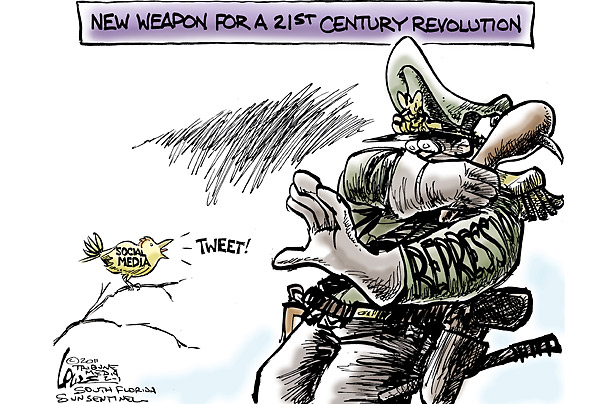 Twitter played an enormously important role in the uprisings by facilitating communication between organizers, and spreading news and slogans.
Yet its influence is clearly limited. Only 27 million of Egypt’s 83 million people have access to the internet, and there are only around 130,000 Egyptian Twitter users.
Looking back one year after the uprisings began, Al-Ahram asked ten of Egypt’s most famous “tweeps” whether Twitter was truly revolutionary, and what its role would be in the future.
The idealistic Alaa Abdel Fattah said
There is nothing isolated in the world; it is circle of relations after all and there are journalists on Twitter who consider it one of the news sources; yet on Twitter you can find one class of Twitter users unlike on Facebook. You can find a mainstream of revolution supporters on Twitter, while on Facebook you will find a different range of groups representing different political powers, classes and backgrounds.
The pragmatic Hossam al-Hamalawy said:
Twitter is a social network that is useful to spread information about actions we organise on the ground. It should not be mistaken as representative of all sectors of society. But at the same time, it should not be ignored at all, and on the contrary it is booming in terms of new usage in Egypt at the moment.
Read the complete account here.
One Year of Revolution in Egypt!
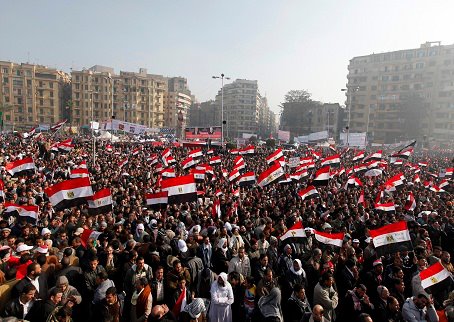
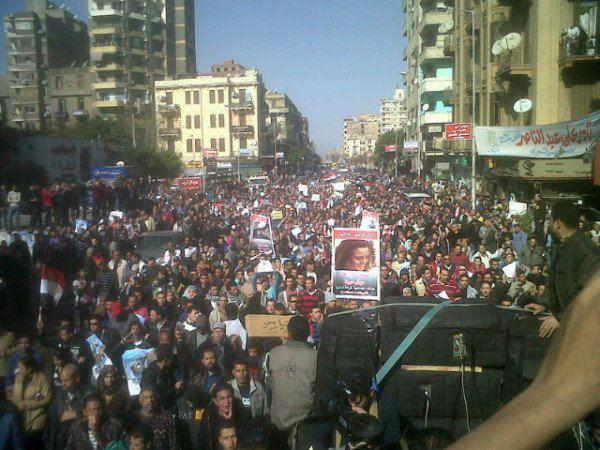

Did what happened in Tunisia and Egypt spark the Arab Spring--or the Mediterranean spring?
A couple of months ago I reported on a conference asking whether what happened in Tunisia and Egypt was part of an “Arab Spring”–or a wider “Mediterranean Spring”?
I’m pleased to report that some of the talks and discussions at that conference are now available as podcasts. Among them are:
Organizer Sara Fregonese’s opening remarks
From Active Citizenship To Activist Citizenship in Egypt and Beyond
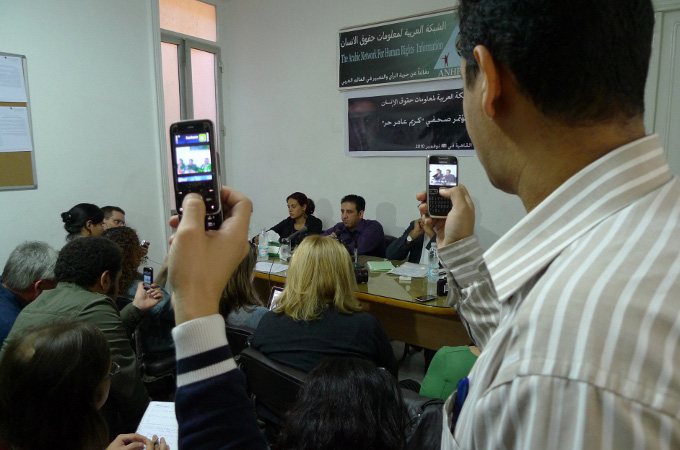
Out of the schools and workshops and into the streets--that's the transition from active to activist described by Geographer Lynn Staeheli.
“What happens off the street is as important as what happens on the street” says Lynn Staeheli, a Geographer at the University of Durham). “They are part of the same process.”
Staeheli asked this question at a conference in Great Britain that challenged academics to find links between the uprisings in North Africa and protest movements happening elsewhere, especially elsewhere in the Mediterranean. Sponsored by the British Academy (aka The National Academy for the Humanities and Social Sciences), it was held in December at the Royal Holiday University of London (RHUL).
In her paper entitled “Youth and citizenship: Struggles on and off the Street,” Staeheli explores the nature of this on and off the street process.
Five Myths About the Arab Spring: Fouad Ajami

Many people in the United States firmly believe the US is a major player in the Egyptian uprising and Arab Spring.
As an anthropologist, US national interests are not one of the primary things I concern myself with when thinking about the Egyptian revolution or the wider set of social protests, uprisings and civil wars commonly labeled the “Arab Spring.”
But journalists can’t get away from that question, and neither can most of my International Studies students.
US national interests frame four out of five of Fouad Ajami’s “Five Myths About the Arab Spring” published Jan. 12 in the Washington Post. It’s useful, because it helps remind me of how differently most people perceive the Arab world apart from the lenses through which I see it.
In order, Ajami’s five myths are:
2012 Field Research Methods Workshop in Egypt

Students taking field notes on tourism in historical/religious sites in the Muhammed Ali mosque in Cairo, 2010.
I am beginning to meet with students and accept applications for our summer ethnographic field methods workshop in Egypt.
In ATH 426 “Changing Egypt: From the Pharaohs to the Revolution” students travel with my wife and son and I from Cairo to Luxur to Alexandria to Siwa oasis in the Western desert to the Red Sea. Along the way, students interact with Egyptians of many different backgrounds, keep detailed ethnographic field journals, and use their field notes to create multimedia projects that will be posted to a public web site.
An important focus this summer will be different stories people tell about the ongoing Egyptian revolution.
The six-credit class will travel to Egypt Saturday June 2 to Sunday June 24, 2012, and it will meet for one week prior on Miami’s campus in Oxford, OH.
You can learn more about the trip, and download a copy of a flyer, the syllabus and the itinerary at the course web site.
You can see some things students learned in the class last year: http://ath426.pbworks.com. Last year the students stuck primarily to hypertext essays with pictures; I’m hoping for a little more edgy media this time.
So far I’ve got three applications… Just 9 more to go!
And just in time, a nice write-up on Huffington Post about why Egyptian tourism is safe.
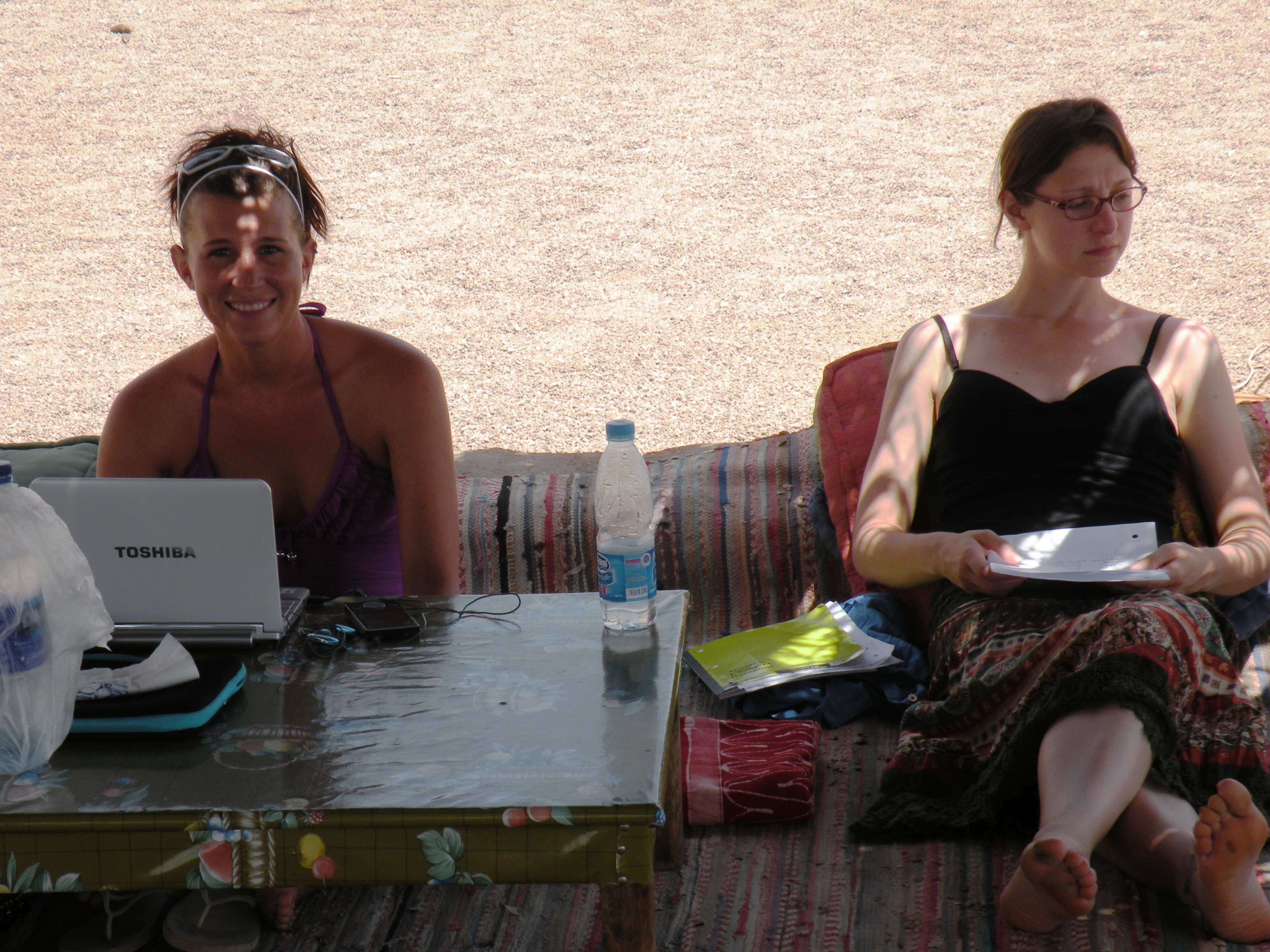
Taking field notes at the Red Sea in 2010.
 I got a great education in anthropology at Brown University back in the 1990s, but the department of anthropology has only gotten better since then (almost the only mis-step was letting William O. Beeman get away to the University of Minnesota). One of the impressive new arrivals is Dr. Sherine Hamdy who has an amazing and disturbing new book out on organ transplants in Egypt
Our Bodies Belong to God: Islam and Medicine in Egypt (University of California 2013) explores the culturally constituted ethics of organ transplanting in Egypt. She focuses on the “crisis of authority” that allows physicians to argues over whether patients who are brain-dead can be sources of organs. Religious scholars issue differing, contradictory opinions as to whether one can donate, receive, buy or sell organs.
People turn to these authorities to advise them on the issue, but at the same time are mistrustful because there is no common opinion and they fear the doctors and sheikhs might abuse their moral positions for their own gain.
There is a great interview with Hamdy in Egypt Independent. Here’s two especially cogent passages:
Counting the Human Cost in Egypt

Photo by M. Davari
The start of a new calendar year, and the rapid approach of the anniversary of the great demonstrations that began Jan. 25, has led to a time of reflection by many groups. Several recent statements have been very pessimistic.
A group of Human Rights lawyers held a a press conference Sunday, January 15, and argued that human rights abuses have risen, not fallen, since Mubarak fell.
The year of revolution ended with elections, they pointed out, but also four-day clashes sparked by Army soldiers beating a peaceful protester at a Dec. 16 sit-in outside the cabinet building in downtown Cairo.
Is There a “Deep State” in Egypt?

Incompetence, the struggle of a "deep state" to reassert itself, or some combination of the two?
I’ve just read two very interesting, very different pieces on the ongoing revolution in Egypt. Both pieces are by freelance journalists/bloggers, and claim that there is a deep embedded, broadly distributed coterie of beneficiaries of the policies of the old regime who are perfectly pleased to see Mubarak ousted but who do not want to change the system that exists.
The analogy drawn by Issandr El-Amrani in his “Sightings of the Egyptian Deep State” is with the concept of a “deep state” often ascribed to Turkey.
In Turkey, “deep state” refers to the existence of a widespread coalition of political actors, mostly affiliated with the military, descended from the secret societies of the Ottoman days, who struggle to maintain autocratic power and to curb the development of real democratic change. This network forms a “state-within-a-state” and uses its power behind the scenes to control international relations and curb democratic changes that might weaken their hold on the states security apparatus and administrative branch of government.
Beginning “[t]he turbulence that has hit Egypt since mid-November seems, at first glance, mostly a testament to the poor performance of the Supreme Council of the Armed Forces (SCAF) in handling the transition away from the rule of Husni Mubarak,” El-Amrani goes on to detail the multiple failures, mis-steps, violations of trust and unexpected brutalities of the various agencies under the authority of SCAF.

 CONNECTED in CAIRO