The Salafi Puzzle
 One of the most interesting things about the elections is the strong salafi showing. In the first round of voting, salafis are estimated to have taken 20-25 percent of the seats–far more than any poll taken prior to the election had anticipated.
As voters return to the polls this week for the run-off elections, they are expected to do well again.
The received wisdom–and I include myself here–has always been that part of the reason mainstream Muslims in Egypt respected salafis was their aloofness from politics. Ewan Stein says:
The source of much of the salafis’ appeal, and ideological power, is arguably their principled opposition to and detachment from the state and what they see as secular politics. The country’s salafi preachers and their followers seem, along with the leadership of the [Jama’a Islamiyya], to have accepted that state power is not worth fighting for. Neoliberalism, in addition to Egypt’s perceived subservience to foreign powers and relative freedom of expression for (the right kind of) Islamists has rendered such a struggle obsolete.
Now the salafis have some four political parties of their own. Clearly they are no longer detached from politics, and they’ve abandoned the position that state power isn’t worth fighting for now that there’s a chance that they might actually get control of some.
And many people are supporting them.
In spite of the apparent hypocrisy of voting for people who have until now claimed to wish no part in politics, aloofness from politics may still be a major reason people vote for the salafi candidates. I remember the 1998 elections in India in which almost everyone I spoke to said they voted for the BJP not because they accepted its religious premises but because they believed that religious people would be more honest in politics than the socialist liberal types who then dominated India.
Or it may be as simple as the fact that salafi networks are more elaborate and effective than those of the hastily assembled secular parties. The salafis have owned their own television channels for many years, including the popular Al-Nas TV (founded in 2006), and Al-Rahma TV (2007).
Is the Power of Social Media Provoking Censorship?
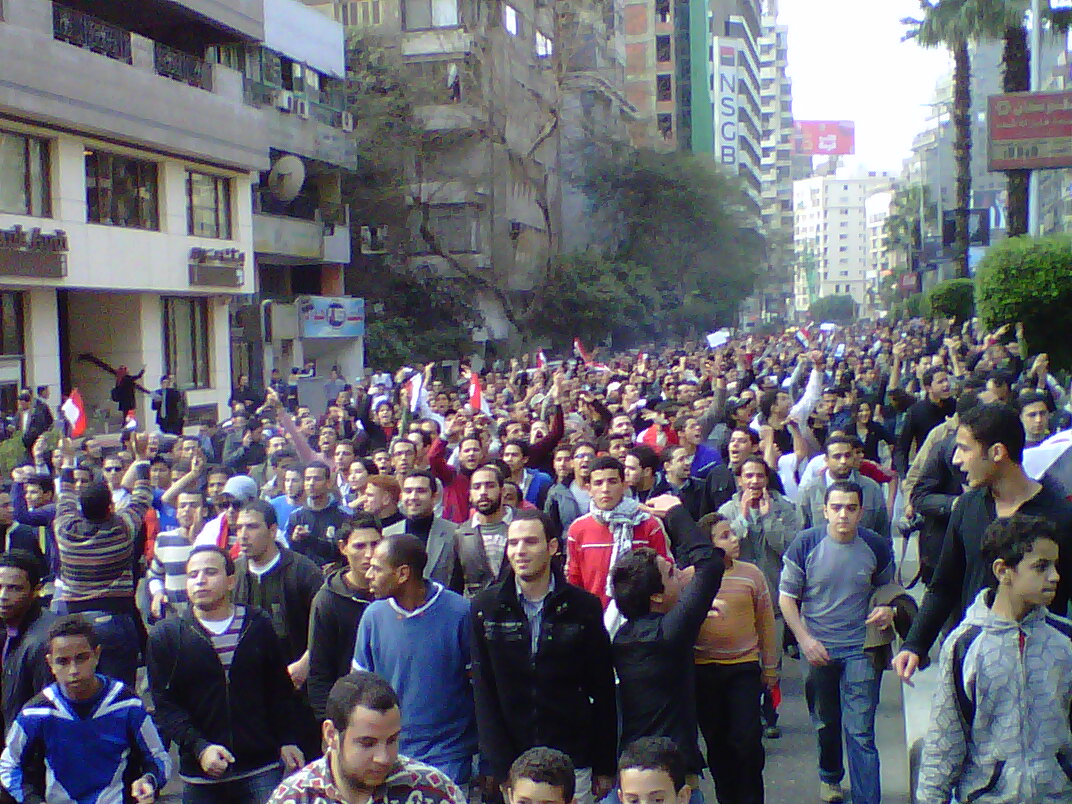
When is civil resistance democratic change and when is it hooliganism? Who gets to decide? And what do they do about it--censor communications?
The desire of both corporations and governments to control what is said through social media has been exacerbated by the Tunisian and Egyptian uprisings.
Governments want to control the content in order to prevent its effective use by anti-government forces, and corporations want to control content in order to profit from it.
People seeking social change in Tunisia and Egypt relied heavily on the free and open nature of social media, and countries concerned about civil unrest–even longtime democratic countries like India and the United Kingdom–are looking for ways to curb this capacity.
The latest blow was a revelation that Kapil Sibal, India’s Minister of Telecommunication and Information, had met with several social media providers to demand that they ban certain kinds of content.
Sibal referred to the need to protect India’s “cultural ethos”–a not unreasonable position. Every society bases what can and cannot be said in various forms of communication on some cultural ethos. In the U.S., for example, it is illegal and unacceptable to post–or even own–child pornography. While I fully endorse this position (child pornography offends my “cultura; ethos”) , I am equally aware that it is based on our cultural predilections of right and wrong. Other societies will necessarily have their own.

This article criticizing Field Marshall Tantawi was banned by the Egyptian government.
The banning of an article criticizing Field Marshall Tantawi has raised all sorts of hackles in Egypt, reinforcing the sense that there is a red line journalists must not cross in criticizing the military.
Entitled “Is Tantawi reading the public pulse correctly?” the article was written by U.S. Egypt specialist Robert Springborg, who teaches in the Department of National Security Affairs at the Naval Postgraduate School, and serves as Program Manager for the Middle East for the Center for Civil-Military Relations. He’s the author of an early book on the regime, Mubarak’s Egypt: Fragmentation of the Political Order (Westview, 1988) and has been writing about Egypt for decades.
In this op-ed for the 1 Dec. issue of the Egypt Independent, an English weekly newspaper, he suggests that Tantawi is walking a risky line in his actions, and that he may be misreading the public mood. He further states that Tantawi is out of step with many of his fellow military leaders, who feel he is hurting the reputation of the military with the Egyptian people. Springborg suggests that discontented military officers might even pull a “coup within a coup” and overthrow Tantawi in order to save themselves.
 Anthropologies — a web journal published by the graduate students at the University of Kentucky’s Anthropology Department–has released a special issue on the Middle East.
It’s an elegant little journal of short, impressionistic essays, ranging about 1000-1500 words.
Only two of the articles are on Egypt. One is mine, the other is by Christine Smith, a graduate student I met when I went to UK to give a talk in October. Christine offers a nice essay on the role(s) of graffiti in the uprisings. She writes:
The built environment of Cairo is marked by the country’s colonial history and by the country’s current political and economic orientations toward the United States and Europe. Buildings within downtown Cairo represent French architecture; malls and several restaurants echo Western leisure ideals, and the city is marked by advertisements and billboards for expensive consumer items. Juxtaposed against this, Informal housing units and the architecture from Cairo’s Ottoman, Fatimid and Pharonic past is patch-worked through the city. Within this mix, graffiti allows Cairenes currently living in the city the opportunity to see themselves reflected in the landscape and presents an opportunity for them to be connected and invested in the built environment in a new way.
Other articles focus on doing fieldwork in Iraq, Turkish nationalism, and poetry inspired by fieldwork on a Tunisian island. There are several essays on Israel: land disputes, race, and archaeology in the Negev desert.
Here is the Table of Contents:
Introduction: Anthropologies of the Middle East
Ryan Anderson
My Field Site is Soaked With Blood
Diane E. King
Toward an Ethnography of Contingency in the Egyptian Uprisings
Mark Allen Peterson
Problems with Prawer: Recent Developments in Negev Land Conflict
Emily McKee
Studying ‘race’ and blackness among Ethiopian Jews in Israel: A commentary
Gabriella Djerrahian
Politics and Art: Graffiti Art in Cairo, Egypt
Christine Smith
A Tale of Tell Halif
Tim Frank
Strangeness, Marvel, and Representation
Nomi Stone

But Mubarak's resignation wasn't just the end. It was also a beginning. How might an anthropology of social action work in this uncertain present with its unpredictable future?
Describing, analyzing and interpreting the ongoing volatility and unpredictability of Egyptian society as they struggle to crate a new order in the wake of the Tahrir protests and Mubarak’s resignation–continued strikes by labor and professional groups, Salafi violence against Coptic, Shi’ite and Sufi groups, Coptic protests, violence by the interim government, frequent returns by people to Tahrir Square, artistic expression, shifting news frames–requires an anthropological approach that is comfortable with contingency.
At least, that’s the argument I make in a short essay I just published in the on-line journal Anthropologies, published by the graduate students at the University of Kentucky, where I gave a talk in October.
The gist of it is that an anthropology of contemporary Egypt needs to be able to grasp the uncertainty of social action in everyday life, as well as political life. And, indeed, there are accepted ways of thinking about this in social theory:
It is well accepted by now in social theory that chance interactions create higher order predictable patterns. Practice theories, in particular, have emphasized the fact that structures are an emergent property of the behavior of millions of social actors pursuing their own strategies, all behaving indeterministically. An ethnographic account of history unfolding must necessarily include description of the outcomes of an aggregate of multitudes of causes, none of which are necessarily uniform with its others.
But that’s almost the easy part. Ethnographic explanations of social change must also grapple with “the native’s point of view,” and that point of view is itself changing in Egypt:
As Egyptians look to a future, it is with a growing recognition that the future is contingent. Even while they plan future events, small or large scale, they do not succumb to the illusion of predictability. The possibility of constructing a new and better Egypt remains amid the tensions and ambiguities that come with uncertainty.
You can read the full essay on-line here.
Cairokee’s “Ya Al-Midan” Celebrates the Meaning of Tahrir Square
Cairokee is an up-and-coming Egyptian band that’s been around since 2003. The band consists of Amir Eid (guitar and vocals), Sherif Hawary (also guitar and vocals), Tamer Hashem (drums), Adam El Alfy (Bass Guitar) and Ahmed Bahaa (Oriental percussion).
The name, with its word play on karaoke is meant to mean “Sing along with Cairo.” It was created when Eid and Hawary, who had an English cover band called Black Star, decided to sing in Arabic and see where it took them.
They have a web site that doesn’t appear to have been updated since 2007 and a Facebook page that is much more current. Cairokee has a profile on Last.fm and
The woman with the beautiful voice is Aida al-Ayouby, a singer, songwriter and guitarist. She graduated from the Deutsche Evangelische Oberschule Cairo (“the German School”) in 1984, then attended the American University in Cairo where she majored in Computer Engineering.
Egyptian Youth in Urban and Virtual Spaces
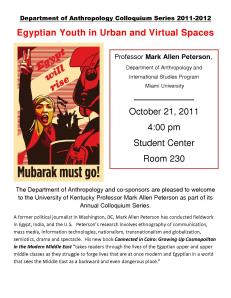 I have finally had a chance to upload an edited copy of the remarks I made last month at the University of Kentucky’s anthropology colloquium. You can download the text as a pdf file by clicking on the picture to the left, or on this link:
Egyptian Youth in Urban and Virtual Spaces
And you can view the accompanying slideshow via Slideshare:
or you can download the slideshow here:
Egyptian Youth in Urban and Virtual Spaces
Although it focuses on Tahrir, the basic point is not contradicted by current events–quite the contrary. So this talk is not (yet) outdated.
As for the slides, I’m afraid they do not stand alone. If you’ve read the talk, you will see what sections each slide goes with; if you haven’t, the slides won’t help much.
Making Sense of Egypt’s Revolution 2.0

Tahrir Square, Nov. 21. Photo by Malak Rouchdy.
As we enter the fifth day of mass protests, we are all seeking to make sense of it. As always, anthropologists (including me) are mulling it all over, while the political scientists are offering commentary and analysis so quickly you wonder how they do it. Here are a few recent efforts:
The way Marc Lynch tells the story, this whole uprising is the military’s fault, for acting against the (symbolically) wrong people with abusive levels of force:
The Islamists and most other participants in the demonstration left Tahrir at the end of the rally [on Friday]. A few hundred people, mostly (it seems) families of the martyrs of the January 25 revolution and veterans of past Tahrir occupations, decided to launch a new sit-in. … But then Egyptian security forces, acting on authority which remains murky, moved in with extreme force to drive out the small group attempting to occupy Tahrir. Their over the top violence, including massive tear gas and highly abusive police behavior, seems to have then attracted the attention of the core of Egyptian activists who came running to join the fight. Instead of rapidly clearing the square, the security forces found themselves locked in an epic running battle with thousands of protestors. …
Steven A. Cook argues in his Foreign Policy blog that the SCAF has no one to blame but itself. Hard to argue with that. He says:
Over the past nine months, SCAF’s attempt at governing has faltered at every conceivable step, alienating former allies and laying the ground for the current unrest. SCAF chairman Field Marshal Mohamed Tantawi and his officers have never offered Egyptians a political horizon, never empowered civilian ministers, and favored fleeting tactical agreements with political groups over serious negotiations. That’s how you get stunning ironies like the 26-year-old Asmaa Mahfouz — a prominent activist — dragged before a military tribunal for merely insulting Tantawi and the SCAF, while Mubarak regime stalwarts like former Interior Minister Habib al-Adly, a man responsible for actually killing Egyptians, goes before civilian judges who are suspected of being sympathetic to him. Read more…
Return to the Republic of Tahrir
Once again the people of Egypt surprise and humble me. I am in awe of their willingness to once again put their lives and bodies on the line, again and again, in pursuit of a vision of a better Egypt.
This is surreal to watch. I know these streets, Falaki and Mohamed Mahmoud and Talaat Harb. I walked them and ate in them every day for five years
There was a joke circulating after Hosni Mubarak’s resignation. It went around as a tweet or e-mail message:
Dear Egypt: Congratulations. Don’t trust the military. Sincerely, Pakistan.
Of course,”the military” in Egypt is not a monolithic institution. The army the people trust is that of the soldiers themselves. Egypt’s army is a conscript army, made up of young men like their brothers and sons and cousins. Every young man is required to serve in the armed forces unless they are physically unfit or are the only male heir in a family. People thus imagine the soldiers as being people like themselves.
The generals are another matter. Being a general is a good gig in Egypt, or has been. You never have to fight a war, and there’s so much money floating around–especially $1.3 billion from the U.S., that its easy to end up with a little. The generals invest this in shopping malls, apartment buildings, tourist businesses and manufacturing companies.
Some of the generals are ideologues, certainly, and some almost certainly would love to replace Mubarak and wield power. Others would probably just like to see stability established so they can go back to their clubs and enjoy the fruits of their investments.
Overall though, the people of Egypt, elated with their success in ousting Mubarak, were willing to trust the military to serve as an interim government.
And they blew it. They failed to follow through on their promises, and have done miserably on everything from the economy to security.
And the people actually returned to Tahrir to tell them that their time in power is over.
Tantawi’s speech was reminiscent of Mubarak’s first speech–too little, too late, pretending that the situation is other than it is, as if his words coming authoritatively across the state-controlled airwaves will persuade injured, gassed protesters that it is so.
I don’t know what will happen next. I don’t know how long this can continue. I won’t pretend to be able to predict the next stage. But I remain mesmerized by the bravery and persistence of the Egyptians.
Special Journal Issue on the Arab Revolutions
 The interdisciplinary journal Globalizations, published by the Global Studies Association of North America, has just released a special issue featuring a “Special Forum on the Arab Revolutions.”
The issue, edited by Anna Agathangelou (York-Toronto) and Nevzat Soguk (University of Hawai’i at Mānoa) includes seventeen articles on the uprisings across the Arab world.
This special issue contains the following articles:
Introduction: Rocking the Kasbah: Insurrectional Politics, the “Arab Streets”, and Global Revolution in the 21st Century
Anna M. Agathangelou & Nevzat Soguk
Pages: 551-558
An African Reflection on Tahrir Square
Mahmood Mamdani
Pages: 559-566
Looking Beyond Spring for the Season: An African Perspective on the World Order after the Arab Revolt
Siba N. Grovogui
Pages: 567-572
The Global Street: Making the Political
Saskia Sassen
Pages: 573-579

 CONNECTED in CAIRO