Protest Video Against SCAF
And So the Revolution Continues…
The battle between police and protesters Friday and Saturday answers one very important question: Is the spirit of Tahrir still vibrant enough among the Egyptian people to resist a silent coup by the military? And it looks as if the answer is yes.
Beginning with the breaking of their promises to turn power over to a civilian government, and to lift the emergency law, the military has bit by bit become more entrenched. The assault on the Coptic protesters last month suggested that they would use violence to maintain order as they increasingly sought to co-opt the revolution.
Then, when a timetable for elections was finally released, it delayed presidential elections–the one office that might challenge military power–until 2013.
Finally, last week, the Supreme Council of the Armed Forces released a statement that it would choose 80 of the 100 constitutional delegates, and that any new government would not be permitted to have supervision over military budgets–ever.
Discussion Questions for Connected in Cairo
 The following discussion questions were written by the author for a course on the anthropology of the Middle East taught at Miami University.
They are designed to
1) ensure students have done the reading,
2) provide material for class discussion, and
3) offer questions for short essay answers on exams.
Click here to download as a handout (pdf format):
At War in Afghanistan
“Why do they hate us?” was a continual question I got teaching about the Middle East on my return to the U.S. in 2002.
Unpacking what is meant by “they” is a very useful and interesting project, to be followed by a parsing of what is meant by “us.”
But in the end, we are still left with a question: what do people in the Middle East think about people in the United States? I usually turn this into a question of representation. If US media overrepresents people in the Middle East as terrorists and religious fanatics, how do their media portray us?
This is a lecture using Egyptian political cartoons to illustrate how the US was being represented in Middle Eastern popular discourse after the beginning of the war in Afghanistan. I first gave it in 2002, and I’ve used it on and off ever since. It’s getting a little long in the tooth now, but it’s still useful if properly contextualized.
Egyptian Music and the Uprising
 Today I gave a guest lecture entitled “Music and the Egyptian Revolution” for Prof. Tom Garcia’s MUS 186 “Global Music for the iPod Generation” here at Miami.
The idea was to give a little account of traditional Egyptian music, and the shebabi and sha’bi music of the Mubarak era, then discuss some of the ferment since then. I created the lecture on Prezi, so you can access it here.
My resources are listed below:
Additional Music that didn’t make the lecture (but probably should have):
Who’s Who in Egyptian Political Parties (A Very Partial List)

From former NDP members to people made famous by the uprisings, there are thousands running in the elections. Here we list a few.
To accompany the post on political parties, this is an alphabetical listing of some of the current leaders of political parties in Egypt, compiled by my student Mikael Ashley and I. It is part of a larger “Who’s Who” we hope to publish at the end of the semester.
Abdel Aziz, Hisham Mustafa. Religious writer Hiham Mustafa Abdel Aziz is the leader of the Reform and Rennaissance Party.
Abdel Ghaffour, Emad Eddin. Emad Eddin Abdel Ghaffour is the leader of the Salafist An-Nour party.
Abdel Nour, Monir Fakhri. Monir Fakhri Abdel Nour is a leader of the New Wafd Party opposition group and an Egyptian delegate to the Pan-African Parliament.
Abu Ismail, Hazem. Hazem Salah Abu Ismail an Egyptian Muslim representing the pragmatic Islamo-liberal movement in Egypt, is currently a candidate for the Egyptian presidency. Ismail obtained his law degree from Cairo University in 1982. He is not a member of the Muslim Brotherhood but, is affiliated.
Afify, Adel Abd al-Maqsud. Founder and president of the Salafist Al-Asala Party, Adel Abd al-Maqsud Affify has been a government official since the late 1960s, primarily in the Immigration and Citizenship Department, of which he was director for 5 years.
al-‘Al, Ashraf Abd. Ashraf Abd al-‘Al is the vice president of Al-Harakah al-Insaniyyah Li al-Islah wa al-Taghier (Human Movement for Reform and Change Party), a newly established political party by an al-Jama‘ah al-Islamiyyah offshoot group.
al-A’sar, Abdel Moneim. Dr. Abdel Moneim al-A’sar is the president of the Green party (Hizb Al-Khodr) and serves in the Shura Council.
al-Gamal, Yehina. Yehina al-Gamal is a former Mubarak cabinet minister and co-founder of the Democratic Front Party (Hizb al-Gabha ad-Democrati)
Al-Katatni, Saad. A former university professor ,Saad al-Katatni was chosen Feb. 10 as Secretary-General of the Muslim Brotherhood’s proposed new political party, the Freedom and Justice Party. He previously headed the Muslim Brotherhood’s parliamentary bloc from 2005 until 2010.
Alphraouni, Mahmoud. Alphraouni Mahmoud is the founder of the secular nationalist Mother Egypt Party (Hizb Masr al-Omm), renamed the Liberal Egyptian Party (Al-Hizb al-Masri al-Liberali) after the success of the uprisings.
Az-Zumr, Tariq. Tariq az-Zumr spent thirty years in prison for helping plan the assassination of foremer President Anwar Sadat. He was released from prison following the revolution. He is a founder of the Building and Development Party (al-Banna’ wa al-Tanmiyya), the official party of the Al-Gama’a al-Islamiyya.
Badrwi, Hossam. Hossam Badrwi, former NDP secretary-general, created the Renaissance Egypt party (Misr Al-Nahda).
A Partial Guide to the Egyptian Political Parties
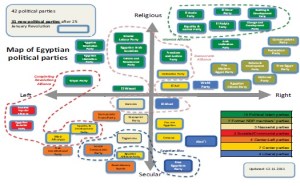
Updated Nov. 17, this chart and diagram by Jacopo Carbonari, an intern at the EU Delegation to Egypt, and posted on The Arabist Blog, is the best summary I've seen. Click on the picture to download the pdf version.
With the elections in Egypt almost upon us, my student Sarah Sterner and I offer the following list of political parties participating in the elections for the People’s Assembly. This is part of a larger page describing Egyptian political and social institutions that Sarah is preparing, and which I hope to publish at the end of this semester.
Al-Ghad Party: See Hizb al-Ghad
Al-Harakah al-Insaniyyah Li al-Islah wa al-Taghier (Human Movement for Reform and Change Party): A political partyestablished by an al-Jama‘ah al-Islamiyyah offshoot group led by Ahmad Subh (president) and Ashraf Abd al-‘Al (vice president).
Al-Hizb al-Arabi al-Democrati al-Nasseri (Arab Democratic Nasserist Party): Left-leaning secular party founded 19 April 1992. Successor to Nasser’s Arab Socialist Union party. Based on the ideologies of Arab nationalism and pan-Arabism. Its platform also includes renouncing violence and combating terrorism, protecting public freedoms, enhancing the public sector, and inter-Arab economic integration. Al-Arabi is the party’s official weekly newspaper.
Al-Hizb Al-Ishtiraki Al-Misri (Socialist Party of Egypt): Left-leaning secular party founded in 2011 after the Egyptian uprising. Entered the Coalition of Socialist Forces with four other left-leaning Egyptian political groups in May 2011.
Al Hizb al Masri al Liberali (Liberal Egyptian Party): Formerly Mother Egypt Party (Hizb Masr el-Omm). Founded by Mahmoud Alphraouni, prior to the Egyptian uprising. A grassroots secular Egyptian nationalist party, based on the ideals of a secular and democratic government, as well as a capitalist economy. It also calls for stronger and more stable relations with Israel and the West.
Al-Hizb Al-Sheyoo’ey Al-Masry (Egyptian Communist Party): Far-left secular party founded in 1975. Faced repression by the state and was banned from running in elections under the Mubarak regime. Joined the Coalition of Socialist Forces in May 2011 with four other leftist Egyptian political groups.
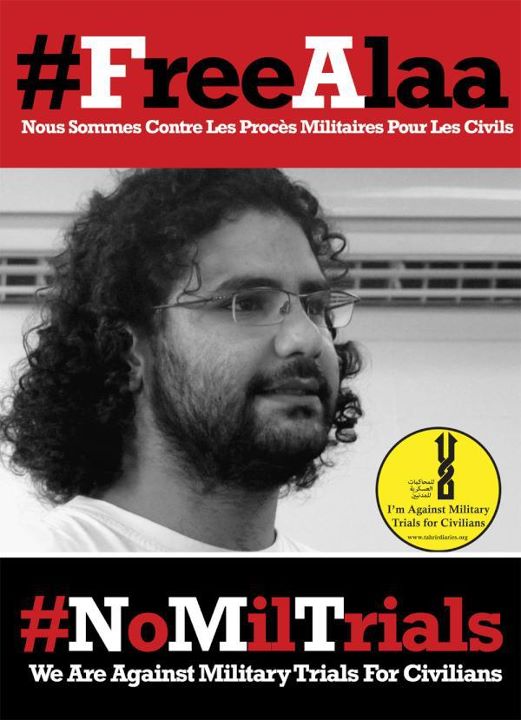
A new video posted to YouTube Nov. 10 entitled “The Maspero Massacre | 9/10/11 | What Really Happened” is more than just a description of the horrors of Oct. 9, it is an account of the deterioration of the relationship between protesters and the army dating back to the beginning of the uprisings.
The video was created by the “No Military Trials For Civilians” protest group.
Additional anti-military trial media:
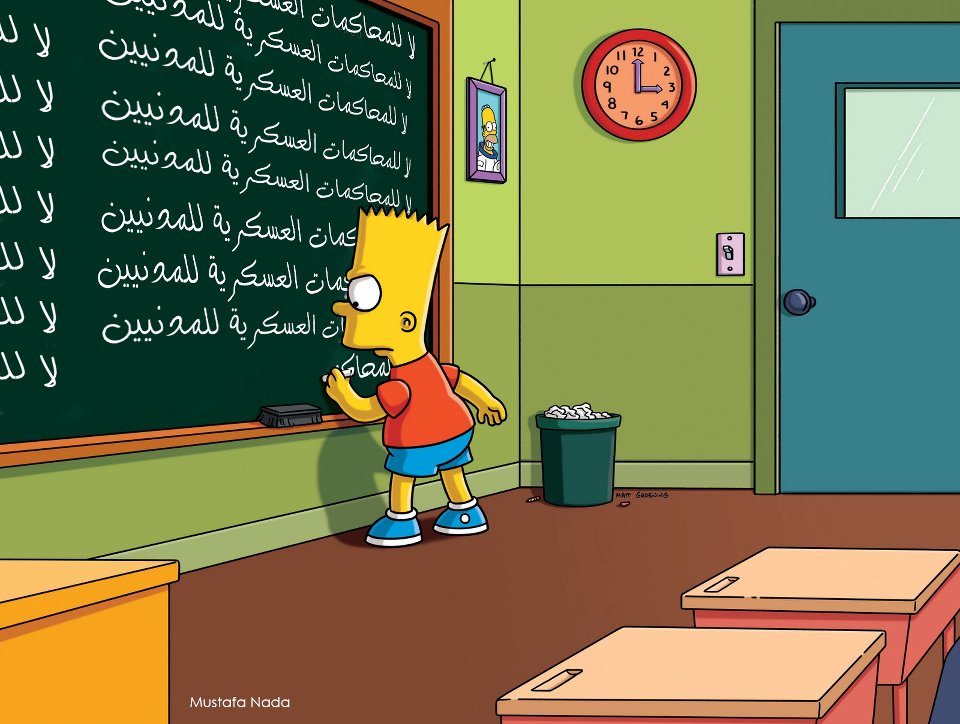
Bart Simpson is writing "No Military Trials for Civilians" one hundred times...
Frenetic Activity on the Eve of Egypt’s Elections

An Egyptian casts his ballot in the last elections. Photo: BikyaMasr.
Elections for the lower house of Parliament are set to begin Nov. 28, but the election season activities just getting under way.
There is confusion and chaos everywhere as dozens of new, hastily-formed parties try to project their views to a public that has never before experienced real multiparty elections.
In a fascinating account in Middle East Report On-Line, journalist Nate Wright offers a detailed description of amateur politicians trying to appeal to a new electorate. It is entitled, aptly, “Egypt’s Intense Election Eve.” Here is a sample:
At 10 pm, when Cairo begins to wake up, al-‘Adl’s top candidate in the Qasr al-Nil district, Ahmad Saqr, picks up the microphone to introduce his party to a crowd of 75 men, young and old, that spills out onto the street. “Our project is justice,” he says. “Justice and security.” (‘Adl is the Arabic word for justice.) He speaks of street children and unemployment, of his vision for a parliamentary authority empowered to monitor the executive and hold its leaders accountable. He speaks of reforming education and the state’s sprawling security apparatus, the abolition of monopolies. When he finishes, the audience is invited to ask questions. “You are offering problems but there are no solutions,” one man says, and the crowd responds with applause.
Many observers expect that, like Tunisia last month, Islamists will win the bulk of the seats in the new Parliament–not because most Egyptians want an islamic government but because the Muslim Brotherhood is the best organized political body in Egypt. If its “Freedom and Justice party” wins the most seats but not a clear majority, coalitions with more hard line Islamists are inevitable.
But nothing is certain until the votes are counted. There is hope and anxiety, fear and excitement everywhere.
Whatever Became of Sandmonkey?


In mid-October, the blog “Rantings of a Sandmonkey” disappeared.
There was little fear that he’d been arrested because his Twitterfeed was still active. I got no response from an e-mail, but he Tweeted one follower who asked about the blog to say that it was being “updated.”
And so it was. The “Rantings of a Sandmonkey” blog has been replaced by the web site of Mahmoud Salem–Parliamentary Candidate: http://www.mahmoudsalem.org. Salem is running for the Heliopolis seat, although he is one of many candidates who have suspended their campaigning in support of the current protests.
The blog is still available, or at least parts of it (presumably those that portray him in the best light for his new identity), in an archive on the new site.
But the familiar green logo with tarbush-clad monkeys and Jonny Bravo is gone, replaced by a slick site of black, white, red and silver, as Mahmoud Salem remakes himself from a ranting trickster into a responsible, high-tech politician.
It’s a wise move–I am reminded of William Lloyd Warner’s classic Yankee City studies in one of which he tells the story of a politician who made a political career as a kind of trickster figure representing the common man against the politicians, but could not change his style when he was elected to public office (Warner 1959).
Or maybe it’s just maturity.
Reference
Warner, William Lloyd. 1959. The Living and the Dead: A Study of the Symbolic Life of Americans. New Haven: Yale University Press.
UPDATE:
Mahmoud Salem did not win his bid for a seat representing Heliopolis in the first round of Egypt’s parliamentary elections, standing in a Cairo district. There’s a great podcast interview with him on the Arabist blog in which he describes his experience campaigning in Cairo, and then serving as an electoral campaign manager in the second round in Suez. He also discusses the most recent clashes between protestors and the army in Tahrir.

 CONNECTED in CAIRO