Essay on the Poetics of the Tahrir Protests Wins Prize
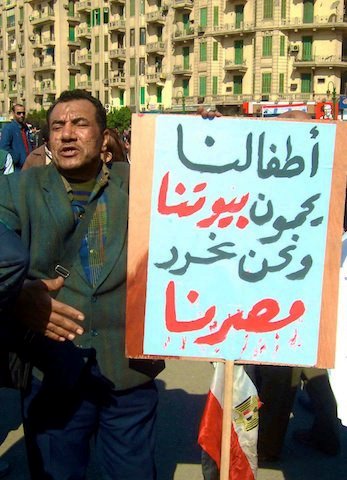
Elliott Colla’s essay on “The Poetry of Revolt” took third place in the 2011 “Three Quark’s Daily Arts and Literature Prize” web writing award. The essay was originally posted in Jadaliyya on Jan. 31, 2011.
It was gratifying to see this brilliant essay given the recognition it deserved, especially given my interest in the ways verbal poetry, music and art contributed to the communitas of Tahrir Square during the 18 days of intense protest.
Colla, Associate Professor and Chair of the Department of Arabic and Islamic Studies at Georgetown University, describes in his post the poetic elements in the revolutionary slogans that don’t survive the translations we read or hear in the news:
The slogans the protesters are chanting are couplets—and they are as loud as they are sharp. The diwan of this revolt began to be written as soon as Ben Ali fled Tunis, in pithy lines like “Yâ Mubârak! Yâ Mubârak! Is-Sa‘ûdiyya fi-ntizârak!,” (“Mubarak, O Mabarak, Saudi Arabia awaits!”). In the streets themselves, there are scores of other verses, ranging from the caustic “Shurtat Masr, yâ shurtat Masr, intû ba’aytû kilâb al-’asr” (“Egypt’s Police, Egypt’s Police, You’ve become nothing but Palace dogs”), to the defiant “Idrab idrab yâ Habîb, mahma tadrab mish hansîb!” (Hit us, beat us, O Habib [al-Adly, now-former Minister of the Interior], hit all you want—we’re not going to leave!). This last couplet is particularly clever, since it plays on the old Egyptian colloquial saying, “Darb al-habib zayy akl al-zabib” (The beloved’s fist is as sweet as raisins). This poetry is not an ornament to the uprising—it is its soundtrack and also composes a significant part of the action itself.
He goes on to emphasize the longstanding role poetry has played in Arabic political and revolutionary activity.
In awarding the prize, judge, Laila Lalami wrote:
Elliot Colla’s analysis of Egyptian revolutionary slogans for Jadaliyya is both sensitive and original. In discussing how poetry is created, performed, andremembered—not just right now in Tahrir Square, but also during earlier historicalperiods—he reminds us that literature and life are not distinct or divergent spheres,but indivisible aspects of the human experience.
Elliott Colla is author of Conflicted Antiquities: Egyptology, Egyptomania, Egyptian Modernity (Duke University Press, 2007), and has translated many works of Arabic literature, including Ibrahim Al-Koni’s Gold Dust (Arabia Books, 2008).
Three Quarks Daily is a site that aggregates some of the best writing on the web, as well as offering original content. It’s prizes are notable in that they are not merely virtual but include a cash award (3rd place gets $200).
Will the New Egypt Play a Greater Role in Africa?
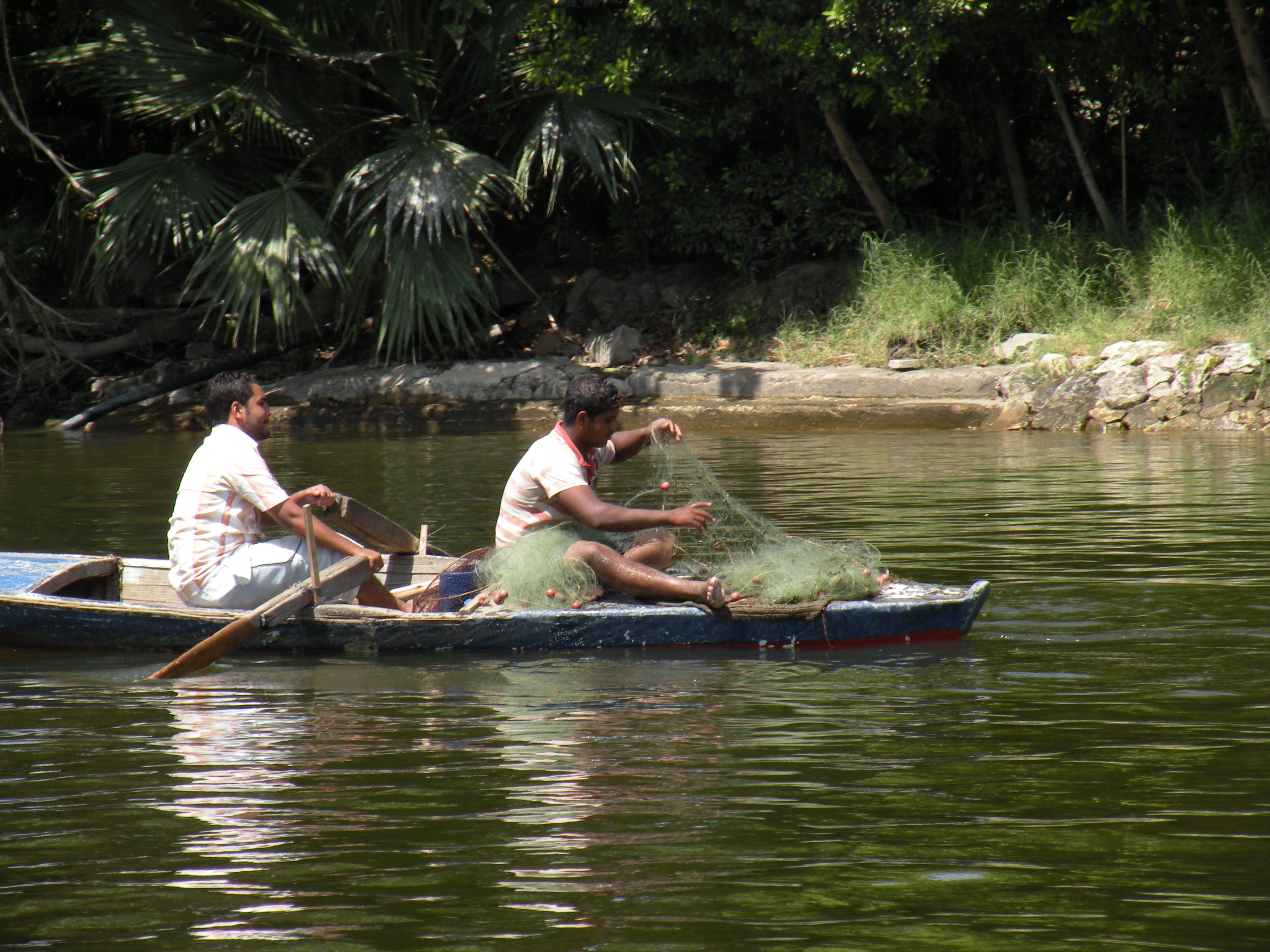
The Nile is central to the life of Egypt. But it is an African river, a fact Egypt must deal with.
Egypt has long downplayed its location in Africa in favor of emphasizing its connections with the Arab world. But a recent report says the new Egyptian state may get more involved in Africa as it seeks to protect its share of the Nile River.
Back in 2006, one of the teams in my International Studies capstone course “Issues in the Middle East” wrote a policy analysis on Egypt’s water crisis, which they described thus:
[E]xtreme population growth and corresponding rise in demand, combined with decreasing supply due to environmental degradation, pollution and desertification will lead Egypt to a point where there will not be enough water to support the basic needs of its people or economy.
This blog post in honor of World Water Week
More recently, the conditions described in the student’s report have been exacerbated by worries that the Nile countries in sub-Saharan Africa will vitiate the treaty made back in 1929 (when most of that part of Africa was under British rule) that gives the lion’s share of the water to Egypt.
In 1999 under the auspices of the World Bank, the nine countries that share the river Burundi, the Democratic Republic of Congo (DRC), Egypt, Ethiopia, Kenya, Rwanda,
Sudan, Tanzania, and Uganda formed the Nile Basin Initiative to “achieve sustainable socioeconomic development through the equitable utilization of, and benefit from, the common Nile Basin water resources.”
The NBI did not change the water allocation regulations from the 1929 treaty, and the southern countries have been growing restive at having to ask Egypt’s permission every time they wanted to divert any water from the Nile, for irrigation, for instance. So last year, Ethiopia, Kenya, Uganda, Rwanda and Tanzania signed a Cooperative Framework Agreement to seek more water from the River Nile. Although this move has been opposed by by Egypt and Sudan in the strongest possible language (Mubarak said the Nile was one of the few issues over which Egypt would go to war), Burundi and the DRC have said they will also sign.
Concerns over the Nile continue in spite of the uprisings. An article in the UAE newspaper Al-Khaleej reported Mar. 18:
An official Egyptian diplomatic source stressed that the issue of Nile water for Egypt is not prone to bargains and it is unacceptable for any country of the Nile source to touch on the Egyptian rights, because Egypt is actually suffering from a water shortage unlike all the basin countries.
According to the article in Al Khaleej, Nilotic countries seeking development assistance will be able to turn to Egypt for resources and expertise. As parliament and civil society come to play a new role in society, Egypt will be able to play a stronger role in Africa, the source told Al Khaleej.
The source called for a larger role for civil society organizations and the new parliament after its elections in order to support the official Egyptian role in Africa as well as the Nile basin countries. He said that Egypt currently enjoys a good reputation in the world and we must take advantage of that and all the parts of the Egyptian people must unite in order to achieve a quick return to Africa. … The increase of the influence must be achieved through increasing the Egyptian participation on all levels in finding solutions to all the problems that the continent is suffering from. In other words, there must be a strong Egyptian role that must be restored when it comes to all the problems on the continent.
Al Khaleej‘s source said he hoped that the first visit of the Egyptian president after his election will be paid to an African country.
Why Egypt’s Uprising Remains Important: My Model UN Address
 On Sunday, March 21st I gave the closing address to the High School Conference of Miami University’s Model UN. This conference brought four region high school Model UN clubs together to participate in a simulation of United Nations activities. I spoke after the final session, just before the conference was dismissed. I was a last minute replacement, so parts of this are cobbled together from blog posts or earlier speeches. And I was asked to pitch it to high school students–I was told that in some previous years the offerings, though excellent in scholarship, left the poor delegates glassy eyed (I was told I hit the right tone, but then, I was a volunteer so what else could they say?)
Here is the text of my address: Read more…
Vote “No” For Democracy?
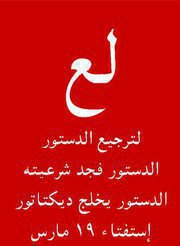
This sign represents a written version of the way they say "no" in southern Egyptian dialect rather than the Modern Standard Arabic you learn in school.
The Constitutional referendum is Mar. 19 and la! (No!) is the slogan I’m hearing everywhere as the debates heat up–some of my friends on Facebook have even changed their photo to a red field calling for “No”
The title of this post is meant to be a pun. Is a “no” vote a vote for democracy, as activists would say, or are they saying “no” to democratic reform, as their opponents insist?
45 million people are eligible to vote today in a straight up-or-down decision on nine changes to the currently suspended 1971 constitution.Most of my friends and colleagues–educated, middle and upper class–want people to vote no. It may seem counterintuitive to vote against changes to the Constituion after having fought so hard for them, but there are many reasons.
While many of the amendments are exactly what was called for in the protests–judicial oversight of elections to prevent fraud, term limits for the president, and so forth–some of my friends and informants in Egypt are unhappy with the amendment that would ban not only anyone with dual citizenship but anyone with a non-Egyptian parent or wife (the latter term suggests that the presidency will only be open to men until the next time they change the Constitution).
Others are concerned that the reforms do not go far enough. They don’t want to tinker with a bad constitution, they want a new constitution altogether, or at least a major rewrite.
Mostly, though, voting “no” seems to be a matter of principle. While it may be commendable that the military wants to move quickly to the election of a civilian government, having the constitution revised by hand-picked people, and sending them to the public for a straight up-or-down vote without time for public debate or comment seems to violate the point of democratic reform.
Both the NDP and the Muslim Brotherhood are urging citizens to vote “Yes” in order to bring order to the country and move forward. But most of the planners of the uprisings, as well as political leaders like Amr Moussa and Mohamed ElBaradei who aligned themselves with the protesters, are urging boycotts or No votes.
An attractive video on Youtube calling on people to vote no vote is circulating widely thanks to tweets, SMS and Facebook posts.
The real question is, how many will vote today, and how many will heed the calls to either boycott or vote “no”? Or will the silent majority argue — through their votes–that these amendments are enough reform?
For More Information
The Marshall Plan, Again

My wife hopes something will really come of talk about a Marshall Plan for the Middle East
For a couple of years my wife has complained that instead of trying to impose democracy through war peacekeeping missions, we should revive the Marshall Plan. Imagine what Afghanistan would have looked like if after defeating the Soviet Union with the billion dollars a year we gave the Mujahideen, we’d continued to pour that billion a year for another five years to build schools, rebuild infrastructure and support a shift to democratic modes of government. While it’s impossible to say how it would have changed Afghanistan, it’s a cinch Al-Qaida and the Taliban would never have gotten enterenched in the ways they did. No 9/11.
So it was interesting to read an AP story claiming that many Europeans are now calling for a Marshall Plan for the Middle East to support the transition to democracy and decrease the chances the societies will descend into chaos:
[s]ome European officials on Monday proposed a Marshall Plan for the Middle East, drawing an explicit parallel to the continent’s U.S.-funded reconstruction after World War II that testifies to the magnitude of the drama unfolding across the Mediterranean.
Of course, the hitch is the expense:
European Investment Bank President Philippe Maystadt estimated Tuesday that to support a transition to democracy in Tunisia, Egypt and other countries in the region it would need to lend euro6 billion ($8.2 billion) over the next three years.
The call for an ambitious reconstruction program, however, comes at a time when EU countries are already smarting from having to bail out both Greece and Ireland from the verge of bankruptcy. Protracted wrangling over those rescues shows how difficult it will be to achieve any meaningful plan for the Middle East.
Maybe the Saudis would pay for it if we promised not to include them as one of the beneficiaries?
Will the US Offer More Than Platitudes to Nurture Democracy?
The January 25 Revolution Youth Coalition–made up of six youth groups who planned the uprising–refused to meet Hillary Clinton during her visit to Egypt this week because of the U.S.’s longtime support for Hosni Mubarak.
According to Al Ahram,
the coalition said it did not welcome Clinton’s visit to Egypt and demanded that the US administration make a formal apology to Egypt’s people for its foreign policy towards the country in the past decades. They added that “the Egyptian people are the masters of their own land and destiny and will only accept equal relations of friendship and respect between the people of Egypt and the people of America.”
The coalition’s declaration as almost certainly influenced by advance media reports about what Clinton was going to say to the youth leaders. A Reuters story published in several Middle Eastern newspapers said that a US official summarized Clinton’s message as:
“What happens next is as important as what came before. Transitions to democracy are difficult and they don’t produce results overnight or end with the first successful election.
One can understand why the planners of the uprising, who paid with their bodies and blood, and that of their friends, followers and fellow travelers, might not wish to listen to these kinds of platitudes from a spokeswoman for the country that paid for, and manufactured, the tear gas and rifle shells used against them by the regime they overthrew.
But media reports also say that Clinton will urge the military rulers to follow through on their promises to lay the ground for a genuine transition to democracy and offer support to the citizens that toppled Hosni Mubarak from power.
The risk that the revolution will be hijacked–whether directly or via hasty elections–remains very real. The US, because it is Egypt’s primary source of foreign aid, especially to the military, has real power to influence change and push the governing military council toward nurturing real democratic change.

What will scholars of the Middle East write and teach now that Arabs have asserted themselves against authoritative regimes?
“Scholars who work on the Middle East have been furiously updating their syllabi and revising their book proposals in the past month and a half, says Ursula Lindsey in an article in the Chronicle of Higher Education because “[t]he events in Tunisia, Egypt, and now Libya have upended conventional academic wisdom about the region.”
Specifically, she says,the obsession most Middle Easternists have with state authoritarianism, and Islamist politics has led to a tendency to ignore many of the social, political and economic issues that suddenly manifest themselves in the pro-democracy uprisings.
She writes: “Other topics of obvious interest to Egypt specialists include military-civilian relations; the role of new media; youth culture; transitional political periods; and the extent to which Arab countries are connected to and influenced by one another.”
The interesting thing is, these are issues anthropologists have already been looking at. Indeed, one could argue that many of these topics are at the center of what we do. If political scientists and economists and sociologists have really been ignoring these issues, they could do worse than read some of the anthropology of Egypt over the last decade.
(I say if because while I don’t doubt Ms. Lindsay is mostly right, there are multiple exceptions, political scientists and sociologists whose work has focused on these elements–Mona Abaza, Asef Bayat, Joel Beinin and Timothy Mitchell, to name a few).
So as a public service, here’s a few books they might consider putting on their revised syllabi:
- Abdalla, Mustafa. 2007. Beach Politics: Gender and Sexuality in Dahab. American University in Cairo Press.
- Abu-Lughod, Lila. 2005. Dramas of Nationhood: The Politics of Television in Egypt. Chicago: University of Chicago Press, 2005.
- Armbrust. Walter. 2000. Mass Culture and Modernism in Egypt. Cambridge University Press.
- Barsoum, Ghada. 2003. Employment Crisis of Female Graduates in Egypt: An Ethnographic Account, American University in Cairo Press.
- Cole, Donald and Soraya Altorki. 1998. Bedouin, Settlers, and Holiday-Makers: Egypt’s Changing Northwest Coast. Cairo: American University in Cairo Press.
- El-Aswad, El-Sayed 2002. Religion and Folk Cosmology: Scenarios of the Visible and Invisible in Rural Egypt. Westport, CT: Praeger.
- El Kholy, Heba Aziz. 2003. Defiance and Compliance: Negotiating Gender in Low-Income Cairo. Berghahn Books.
- Ghannam, Farha. 2002. Remaking the Modern: Space, Relocation and the Politics of Identity in a Global Cairo. Berkeley: University of California Press.
- Haeri, Niloofar. 2003. Sacred Language, Ordinary People: Dilemmas of Culture and Politics in Egypt. Palgrave MacMillan.
- Hafez, Sherine. 2003. The Terms of Empowerment: Islamic Women Activists in Egypt. Cairo: American University in Cairo Press.
- Hirschkind, Charles. 2006. The Ethical Soundscape: Cassette Sermons and Islamic Counterpublics. New York: Columbia University Press.
- Hopkins, Nicholas S. 2003. The New Arab Family. Cairo: American University in Cairo Press.
- Mostafa, Dalia A. 2008. Roses in Salty Soil: Women and Depression in Egypt Today. American University in Cairo Press.
- Peterson, Mark Allen. 2011. Connected in Cairo: Growing Up Cosmopolitan in the Modern Middle East. Indiana University Press.
- Singerman, Diane. 1995. Avenues of Participation: Family, Politics and Networks in Urban Quarters of Cairo. Princeton: Princeton University Press.
- Starrett, Gregory. 1998. Putting Islam to Work: Education, Politics and Religious Transformation in Egypt. Berkeley: University of California Press.
- Winegar, Jessica. 2006. Creative Reckonings: The Politics of Art and Culture in Contemporary Egypt. Stanford: Stanford University Press.
- Wynn, L.L. 2009. Pyramids and Nightclubs: A Travel Ethnography of Arab and Western Imaginations of Egypt, from King Tut and a Colony of Atlantis to Rumors of Sex Orgies, a Marauding Prince, and Blonde Belly Dancers. University of Texas Press.
And this is just for Egypt!
Anthropologists Not Keen on Human Terrain Systems
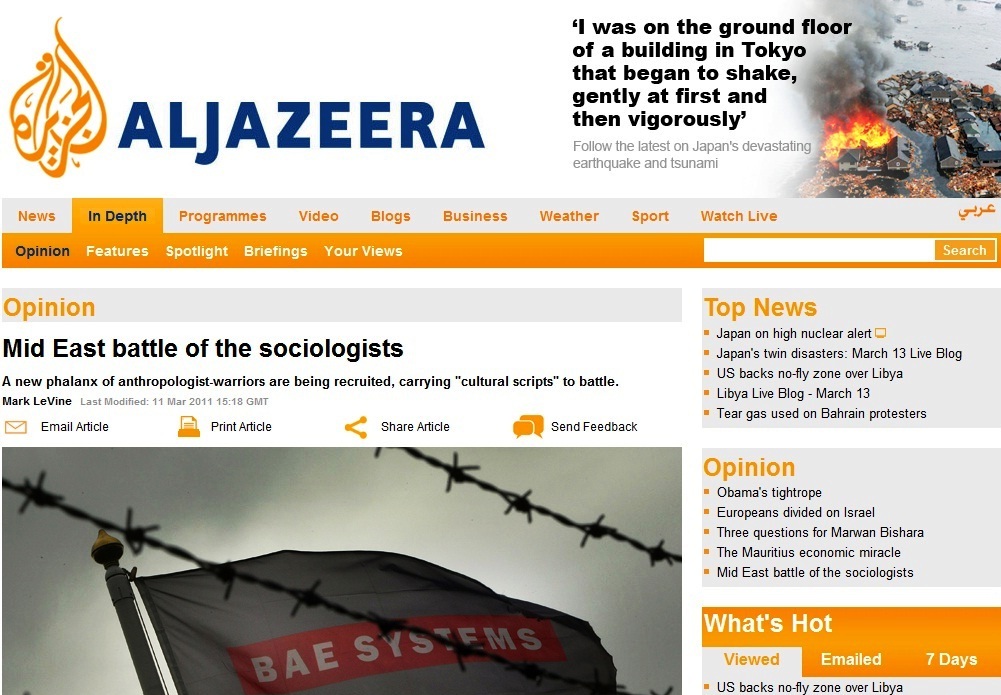 Al-Jazeera English is the latest media outlet to run an article on Human Terrain Systems (HTS) claiming “A new phalanx of anthropologist-warriors are being recruited, carrying ‘cultural scripts’ to battle”. Written by historian Mark LeVine, the article describes a brochure he received asking him to send job-hungry social scientists this way.
In fact, as an article by Maximilian Forte in the most recent issue of American Anthropologist points out, although HTS was originally pitched to the powers that be as a kind of military anthropology–and though most media accounts in Europe and the US pitch it as such–HTS has had little success recruiting anthropologists. Forte writes:
Several individuals with ties to HTS have admitted that the combined efforts of the AAA, NCA, and media have had an impact on severely limiting the number of anthropologists willing to join HTS, forcing the program to look elsewhere for recruits.
Forte offers a series of reasons for this:
- First, such research is seen by most anthropologists as violating key ethical principles, especially those concerned with doing no harm to our informants and those concerned with making our research publicly available.
- Second, a concern that this is an effort to restore the role of anthropological research to its 19th century status of “handmaiden of empire.” Most anthropologists regard this with calamitous concern.
- Third, there is fear that militarization could do further harm to the reputation of the discipline, and jeopardize anthropological fieldworkers, who could be mistaken as U.S. spies.
Advocates for HTS “claim that it is not unethical, that it helps to save lives, is not involved in collecting intelligence or targeting, and is a key way for anthropology to become relevant.” As a result, the bulk of the HTS recruits are actually political scientists these days.
Mid East battle of the sociologists – Opinion – Al Jazeera English.
Forte, Maximilian C. 2011 The Human Terrain System and Anthropology: A Review of Ongoing Public Debates. American Anthropologist 113(1): 149-153.
Off the Wall and On to Facebook
Graffiti are part of the art of the revolution.
Another site to add to my list of digital archives of the art, photographs and texts of the revolution is the Facebook page Revolution Graffiti.
The brainchild of Egyptian Maya Gowaily the site hosts a project to archive the graffiti coming out of the revolution in Egypt, Libya and elsewhere. Gowaily seeks to archive those of the current uprisings as an important part of the current watershed in North African history.
Graffiti images have always been central to Middle Eastern protest movements, but they are also always ephemeral. As order returns to Cairo, more and more graffiti is washed away or painted over. Gowaily urges people to submit their photos of graffiti. She also asks people not to be offended by graffiti, as the purpose is documentation not passing judgment.
Al-Ahram has featured several of Gowaily’s collection of Libyan wall art in an on-line gallery. You can also read about her project on beenaproject.com
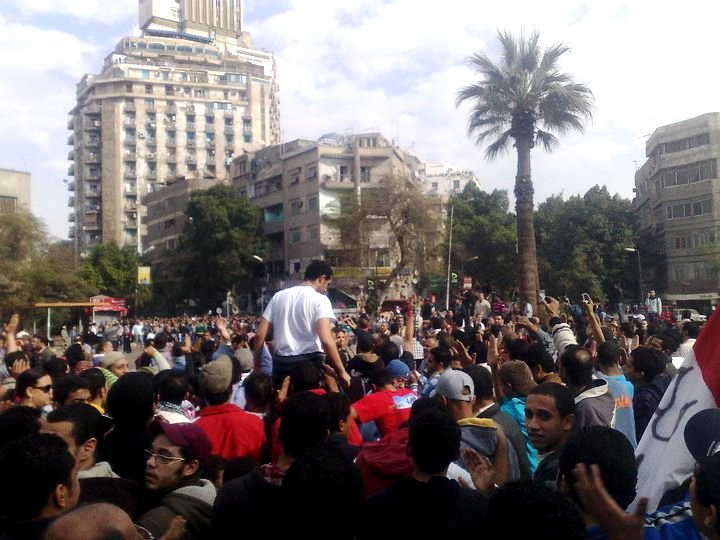
Does it mean anything that some of the protest leaders took US sponsored democracy courses? And if so, what? Tahrir Square photo by Abdelrahman Mostafa.
Who is responsible for the revolution? Can the U.S. claim partial credit for the uprising because some of the protest leaders have attended democracy workshops? Even though we gave billions of dollars to help the dictator maintain stability?
And if the US does make such a claim, will anyone believe it? Or is such a narrative just meant for domestic US audiences?
An Associated Press story entitled “US training quietly nurtured young Arab democrats” by Charles Grassley ran in the Washington Post Mar. 12. It offers the claim that
The revolutionary roar from the Arab street, shaking the palaces of the privileged, toppling presidents, has echoed around the globe, dominating the headlines and airwaves for weeks. But behind this story of political upheaval lies another, quieter story of outside organizations that, with U.S. government and other money, tutored a young Arab generation in the ways of winning in a political world.
There is no doubt that the basic facts in the case are true: while giving billions to dictatorial regimes, the US was also funding workshops on democracy. The larger claim remains to be tested: did they do any good? This article is essentially based on remarks by 3 Egyptians. It is okay as journalism, but it wouldn’t pass muster in a social science class. It would be nice to see a good network analysis that tracked who among the planners of the uprising had training, and who knew someone who had training, and so on.
Journalism expresses the values of the people for whom it constructs its stories. As I have written elsewhere, this is not so much because newspapers are “biased” in the usual sense of that term, as that newspapers operate from a common sense approach–and common sense, as Michael Herzfeld points out, is a cultural construction. The common sense that grounds a particular newspaper is different for different historical experiences, national interests, cultural expectations, geographical proximities and economic interconnections.
From a U.S. perspective, it’s easy enough to see why this particular story is news. The U.S. was far more riveted by Egypt’s protests than Tunisia’s because Egypt was “our” stable regime in the Middle East. The protests pitted a long-time U.S. backed dictator against pro-democracy activists, thus literally pitting our political-economic interests against our values, with the fears of an Islamic takeover lurking in the background (a fear that got a lot of play in US media where it has enormous symbolic valence but much less in the media of most other countries).
As public fears about an Islamic takeover gave way increasingly to optimism about a genuinely democratic Egypt, it became advantageous for the U.S. to find narratives in which it was not simply the foreign country that propped up a brutal dictator for 30 years. This article allows the U.S. to claim the high ground: sure, we were propping up an evil dictator to ensure stability, but all the time we were also training a cadre of democratic leaders for the day he would fall.
Egyptians–based on comments when Ted Swedenburg and I posted this story to our Facebook pages–are more likely to read this as a pathetic (or infuriating, or both) attempt by the U.S. to lay claim to their revolution. They cast it in the junk drawer with columns by Thomas Friedman claiming they were inspired by Obama’s Cairo speech, or by Charles Krauthammer saying that they’ve all belatedly bought into George W. Bush’s democratic agenda.
Russians, on the other hand, may be likely to read a story like this as proof of the U.S. meddling in the affairs of other countries. I assign students in my International Studies class to read at least one foreign newspaper, and one of them has been following Pravda all semester. He reports that this trope of the US meddling in the affairs of other countries is a regular and recurring theme.
Rashomon has nothing on global journalism.

 CONNECTED in CAIRO