Counter-Dramas of Nation
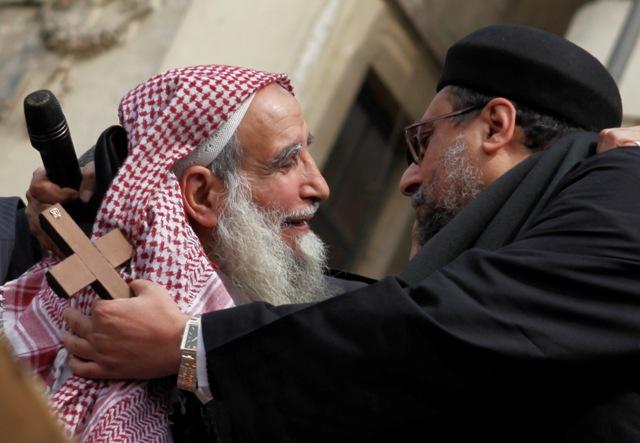
Rituals of Unity. Photo: Al-Masry al-Youm
In response to the wave of violence against Copts in Cairo, leaders of the Gama’at Islamiyya, the Muslim Brotherhood and Sufi shaykhs have begun saying evening prayers at at St. Mary’s Coptic church in Assiyut. This is not merely dramatic for Egyptians; it’s stunning. In the 1990s, the Gama’at were attacking and killing Christians in Assiyut.
As at Tahrir Square, these events are an important kind of national theater. Unlike the ritual performances of the state–parades of police, celebrations of the revolutions of the past–in which the state attempts to appropriate the signs of national communitas to shore up its own legitimacy and authority, these are attempts to enact, in this liminal period between state structures, the kind of nation religious leaders are trying to create.
There is a large literature on the ways states mobilize symbolic resources to lay claim to the loyalties of people, but little on rituals like this, in which non-state actors seek to symbolize the nation in ways counter to the narratives of the state.
Many Coptic leaders and others are accusing the remnants of the regime, and especially state security, for fomenting the anti-Coptic violence, According to the story in Al-Masry al-Youm, Pastor Reza warned the congregation and its guests that “the remnants of the old regime are trying to create a new sedition, so we lost the joy of our revolution.” Ritual performances like this are efforts to recreate the communitas of the 25 Jan. uprising.
Egypt’s Piggipedia: Transparency as Resistance

The Piggipedia group pool is only one of many sites to which protesters are uploading names and photographs of hated state security personnel.
The power of the Internet as a platform for creative resistance continues to be demonstrated in Egypt. One of the latest manifestations is the Piggipedia, a flickr “group pool” to which are being uploaded the photographs and names of members of the state security forces “so that they can be brought to trial.”
Piggipedia began before the Jan. 25 uprisings, one of several initiatives intended to disrupt the practices through which the regime put down protests and anti-regime activities. The idea, according to one of the organization’s founders, was that “in every single event, demonstration or strike we have to snap at least one photo of the police officers, corporals, and plainclothes thugs present. We have to profile them, put their faces on the web and circulate their photos.”
He continues:
A State Security officer cannot spend the day electrocuting the balls of a detainee and inserting a stick up someone else’s ass and then just simply go out in the weekend with his kids to the park peacefully, or have shisha in a public coffee shop, while those around think of him as a “normal” human being. These are dangerous torturers and rapists whom we do not want as neighbors or friends. They have to be exposed in front of their children, parents, neighbors and peers.
The invasion of the state security offices last weekend produced a treasure trove. On another flickr page, an author explains:
When we stormed State Security Police headquarters in Nasr City, which hosted one of Mubarak’s largest torture facilities, on Saturday I found two DVDs in one of the offices, both titled “أرشيف السادة ضباط الجهاز ” The Agency Officers’ Archive.” The DVDs included profile pictures of State Security officers, organized in folders.
While the prime minister calls for state security to be restructured, and promises it will only be used to combat terrorism and drug trafficking, these activists insist that “[e]ach member of SS has to be brought to justice. This was an agency devoted to spying, surveillance, torture and murder. Every member of this organization from the informer all the way up to the generals should be prosecuted. SS has to be dissolved.”
This is an act of resistance on several levels.
First, it is turnabout. Members of the state security apparatus who spied on, and kept files on the people of Egypt on behalf of the regime, are now themselves the subjects of a gaze.And it kept a lot of files on a lot of people. The New York Times reported today,
Even for young activists who knew they were being monitored, the level of detail has been sobering: one found a picture of herself at a party; another discovered transcripts of text messages exchanged with her husband; a third leafed through a biography of his famous grandfather, a former Brotherhood leader.
But Piggipedia and its ilk offer an inverted turning of the tables, since it replaces secrecy with public scrutiny, or at least the possibility of it. Nor was the security apparatus unaware of this; among the documents seized in state security offices was one describing the “piggipedia threat.” It is posted on 3arabawy’s blog here.
Finally, this is an act of resistance against efforts by the current regime to “restructure” state security and reincorporate it back into the government structure. Not only does it raise a voice in protest, but by exposing the officers, it makes it more difficult for such a restructuring to work, since the experienced officers who would need to be reintegrated into the new command structure are identifiable and, in some cases, accused of specific heinous acts (one cannot call them crimes as the government has not yet lifted the emergency laws).
Predicting Uprisings Is Like Predicting the Weather–You Get It Right, Until You Don’t
A story on NPR today makes the same point I made a month ago in my blog post Feb 11, to whit:
Analysts inside and outside government sometimes get caught flat-footed by changing circumstances.It might have been impossible for intelligence agencies to predict that the current season of protests and regime changes in North Africa and the Middle East was about to occur.
Some things are easy to predict because the data is clear. Many of us made predictions about the Iraq War that dumbfounded our students not because they weren’t obvious–they were, and even people in the Bush administration were making them (but not being heard)–but because they were completely at odds with what they were hearing on the media.
(To be completely honest, although I knew there could not be anything substantial by way of “weapons of mass destruction”, I was suckered by the absolute certainty of the administration and thought there must be something that their intelligence was misinterpreting as wmds. To my knowledge, William Beeman was the only person who came right out, from the very beginning, and said publicly that we would not find any wmds. For which he was branded as unpatriotic in many quarters).
But as social scientists/analysts, we have to work from actual data, which means historical precedent and awareness of factors that might change the pattern. Some people had made predictions that “nothing will be the same after 2005” only to watch things return to “the same”. Even as events got underway Jan. 25th, there was little evidence that the protests would break the precedents of 2008, 2005, etc.
Fortunately, I love surprises.And the people of Egypt continue to surprise me in the most interesting ways.
Already, it is possible to see struggles over the appropriation of the uprising/revolution. For example, if you follow the video above back to youtube, you will find a series of comments (98 in the six hours between when it was first published to youtube and when I wrote this post). The person who posted the video argues that the army appears to be protecting the thugs and demands an explanation:
the thugs attacked went through the defenses of the protesters and arrived at the round about . The Army also arrived at the same time. To me it looked as if the army was protecting the thugs. But within the Chaos down there , details could not be taken in logically. WE NEED EXPLANATIONS [A]lso I heard the thugs went on attacking normal people going to buy their vegetables and went as far ar Midan Bab El Louk, and Talaat Harb on the other side.
The first post in response took a very different stance, arguing (in Arabic) that the leaders of the “real youth rebellion” suspended it for two weeks, that these so-called protesters are just people seeking to disrupt the honor of the new government. He concludes (my quick and dirty gloss):
The sit-in at the moment has no meaning, it only distorts the public image of the revolution ….. And any attempt to topple the honor of the government is an effort to help the Zionist entity that initiated the attack on the government … Wake up and understand
This writer clearly distinguishes between a “real” protest which overthrew the Mubarak regime and initiated political change and a continuing “fake” protest that is not merely disruptive but seditious. At the time of this posting, the comment had 40 “likes”.
It was followed by a brief post (in Arabic) supporting the army:
All praise to the armed forces for carrying out the demands of thepeople to evacuate the field [in Tahrir Square].
This post had 18 “likes”. Other posts include:
Revolution turned to chaos in the street … Incidents of theft killed … ….. …. Islamic terrorist groups I woke up again …. Escape of prisoners, destruction of hospitals ….. …. the destruction of tourism …. Spies belonging to Iran and the CIA is now in Cairo are working freely.
People’s well aware of the dirty game …… Must now provide terrorists to trial and expelled the U.S. ambassador in Cairo …. Cut off all diplomatic relations with Israel and security
The Egyptian Protesters are CHANGING HISTORY!!! The whole world give them support!!! 😀 …. well except for dictators and their brainwashed slaves.
These protesters are taking a stand for what is sacred in life. This is solid evidence of basic Human Right Violations. Corruption continues……
I noticed that abuse of power and money ALWAYS leads to Human Right Violations. The United Nations should support the voice of the protesters. They stand for what is sacred in life. Suppression is evil. No philosophical rationalization can justify human right violations!
Protesters in the square of terrorist groups, threatening the security of citizens and the community and tourists. Tried to steal the Egyptian Museum and harassment of girls., the police arrested them. Spread chaos among the Muslims and the Christians and killed children in Egypt. Must bring these terrorists to justice urgent
None of these posts had more than 4 “likes”
Clearly, both the revolution and the discourses that seek to comment on it and sort out its meanings remain contingent processes. Although the ongoing protests continue to bring about successes–most recently the change of governments and the invasions of the state security buildings–at each stage there are many voices who insist that the uprising must stop here, that further protests are unnecessary and do more harm than good,
Another Effort to Dislodge Tahrir Protesters
After disrupting the march in support of International Women’s Day yesterday, Mar. 9, armed thugs returned to attack Tahrir Square around 9pm, and then again after midnight. News reports say molotov cocktails were thrown in the direction of the protesters.
Several small groups of attackers appeared again today, Mar. 10, around 10 am. A larger mob arrived in the evening and attacked the several hundred protesters in Tahrir Square, apparently in an attempt to eject them. The thugs threw stones at the peaceful protesters, and some attacked with knives. At least 12 were injured, and two are said to be in critical condition
Most of the protesters assume the thugs are sent by groups within the government who want to end the protests completely. The protesters are maintaining their presence as a reminder that several key demands of the Jan. 25 uprising–particularly the lifting of the Emergency Law, release of detained protesters, and the dissolution of the State Security agency. The protesters gather daily in the square. Some are camped out. The numbers rarely exceed two thousand, and they do not disrupt traffic.
In Cairo, Communitas Is Shattered

Photograph by Jenna Krajeski; taken from Al-Masry al-Youm report.
The sense of unity from which the liberation protests drew much of their strength showed fractures yesterday in the face of separate Coptic and International Woman’s Day demonstrations which were met with ridicule and violence.
The discourse in response has followed three basic threads: those who feel the revolution just lost something important, those who see this as part of a counterrevolution, and those who are just tired of demonstrations and disruptions.
“Shame on the democracy of Tahrir” posted one of my Egyptian informants, angry and saddened by the failure of the pro-democracy protesters to support the protests of women.
One the other hand, several claimed the crowds were being infiltrated in order to provoke violence. If the protests turn violent, the army will finally have an excuse to put them down, goes this line of reasoning.
One of the most interesting posts was by my colleague Ted Swedenburg, who posted, “So is the lesson, it’s okay for ‘Egyptians’ to demonstrate but it’s not okay for ‘women’ or for ‘Copts’?” I think that, irony aside, Ted is right on the mark. One of the most powerful symbols of Tahrir Square has been men and women (veiled, scarfed and uncovered), and Muslims and Christians all demonstrating together. When the Christians mobilize as Christians, and women as women, that symbolism is fragmented.
I’m not sure that it matters much whether the violence was deliberately provoked by agents provocateur or whether it was a result of people tired of disruptions and uncomfortable/angry with the positions taken–the capacity to exploit this violence toward a counterrevolutionary narrative will be much the same either way.
Teaching the Uprising
 I was directed to three on-line lesson plans on the Egyptian uprisings by the latest issue of the Brown Alumni Newsletter. The lessons are offered by the Watson Institute for International Studies. The first, Egypt’s Uprising, offers basic information about the causes of the uprising, the role of new media, and the U.S response. The second, After Mubarak, asks students to consider the possible positive and negative effects of a Mubarak ouster. The third, Protests, Revolutions, and Democratic Change, puts the Egyptian uprising into the larger context and considers the potential effects of the protests on democracy and stability in the Middle East and North Africa.
All three lessons offer course objectives, teaching resources (powerpoints, maps and handouts), video lectures cleverly times to contemporary student attention spans (i.e. the person in the vid talks for three minutes, then you have a class discussion; then you play the second video, then have a discussion, and so on). There are also plenty of resources for expanding the lesson.
It’s mostly out of date now, and biased toward political science–as so much of international studies is, alas–but still impressive. The sheer quantity of resources on the internet continues to amaze me–even as it dismays me how we always find this stuff a couple of weeks after you could have used it the most…
The Revolution Is Being Digitalized
 All revolutions create art, and archives of historical documents. Traditionally, you have to wait at least a few years–if not decades–to see the first collections in galleries. But this revolution is completely digitalized, and so is it’s documentation, and so is its art.
A web site called “I Am #Jan 25” is hosting an on-line archive of videos and photographs. There are nearly 3,000 videos already archived across 85 pages, and over 4,000 photographs across 130 pages (and growing). Each photo and video lists the url from which it came.
Meanwhile, a web site called “I Am Tahrir” is now documenting and collecting art produced during, inspired by or dedicated to the January 25 Revolution from around the world. At the “I Am Tahrir” web site, there’s a call for art work:
Please send your submissions, be it music, chants, slogans, humor, photography, poetry, comics, to tahrir.art@gmail.com. All art forms are welcome, and authors/creators will be fully credited for their work.
As yet, there’s no art work posted. But a lot of art can be seen on their Facebook page, “I Am Tahrir The Art of Revolution.”
Also linked to the I AM #Jan 25″ site is Egypt Remembers, which carries photographs and brief biographies of many of those killed in Tahrir Square during the protests.
Connected in Cairo: New Preface on the Uprisings

The title page of the book.
The fine folks at Indiana University Press (especially my editor Rebecca Tolen and my production manager Marvin Keenan) have graciously allowed me to write a new preface for the book. I just finished proofing the galleys.
While I welcomed the opportunity to reflect on current issues in the light of a book completed almost a year before the uprisings began, it was no easy task, since it is not clear what the ultimate outcome of this revolution will be, or even what will have happened over the next few months before readers hold the book in their hands.
Here’s a teaser:
I wish I could say that the book you are holding was prescient, that it anticipates the uprising, which occurred as the book was about to go to press. It does not. I wish I could say that this book clearly points to the directions the revolution might go. It does not. It does, however, offer a description of Egyptian identity on the cusp of the revolution.
And here’s another:
In Chapter Four, I describe a conversation with Hassan, a young man who speaks about the highly successful Egyptian film Nasser 56. The film created in him a nostalgia for an era he never experienced, one in which, he said, “Everyone was willing to make sacrifices, not like today.” Even as he planned to leave Egypt to study and perhaps pursue a career abroad, he wished his homeland could be one worth living in, one in which citizens were willing to work together for the common good. Others I describe sought the same thing in an Islamic activism that is about changing and improving oneself and one’s community, while still others turned to social media in search of an Egyptian nationalism that might transcend presidents and parties and link people together into a new public sphere. Part of the power of Tahrir Square was that it brought all these elements together in a single place and time.
(It’s a short preface so that’s all I can share here without violating copyright!)
In Egypt, Television Confronts State; TV Wins
On March 2nd Prime Minister Ahmed Shafiq appeared on the television show Baladna bil Masry where he was grilled mercilessly by novelist Ala’ Aswani. The four hour show spawned a public debate in the blogosphere as to whether Aswani, and the television show went too far: how much respect do people owe office holders? what is the place of decorum in public debate? The debate was cut short the next day, when the Supreme Council of the Armed Forces announced that it had accepted Shafiq’s resignation.
ON-TV originally announced that Baladna bil Masry would feature host Reem Maged with Prime Minister Ahmed Shafiq, billionaire Naguib Sawiris (owner of the network), political scientist Amr Hamzawy and lawyer Kamel Abu El-Maged. At midnight, MC Yosri Fouda was to host journalist Hamdi Qandil and novelist Ala’ Aswani (author of The Yacoubian Building) on the program Akher Kalam.
But the event didn’t go as planned.
For the first two hours, Shafiq used the opportunity provided him by his friend Sawiris to spin the uprising from his own point of view. Questions were mild, and Shafiq answered them with confidence, unfolding a classic counterrevolutionary narrative.
Furious tweets, text messages, Facebook and blog posts spread rapidly, furiously condemning Shafiq’s claims as counterrevolutionary lies, propaganda, and a betrayal of the blood of the martyrs of Tahrir Square. Many said they were turning off the TV.
But the blogosphere suddenly came alive again when Shafiq agreed to stay on and speak with the new guests. Aswani had no restraint in his questioning of Shafiq, who seemed to grow quickly irritated. Then Aswani got personal, saying “If your son had been one of those who got run over by the police cars, you would not have remained silent like that.” Shafiq lost his temper and the debate spiraled beyond the capacity of hosts Fouda and Maged to contain.
(The prime minister on the left wearing a white shirt and black suit. Author Ala’ Aswany is wearing a pink tie).
So Ahmed Shafiq became the first Egyptian politician to face a real attack during a televised debate. A public debate immediately broke out about whether the exchange had gone too far.
Several people criticized Aswani for his aggressive attack on the Prime Minister:
- There is a gr8 gap between democracy and vulgarity. Whoever shows respect, respects himself. It is a matter of morals that many Egyptians lack.
- First am against Shafi2 staying & after today’s talk show he’s a big NO, [but] 2nd i was raised by my parents to respect whom ever is speaking & to hear his point of view before raising my voice.!
- [T]he writter alaa al aswany was speaking in an inpolite way with the prime minister and actually i repect dr.ahmed shafick for not leaving the meeting because it is not accepted to have such a person like this one who speaks rational about events that happened in a previous regime and accuse the prime minster with such things…
- [W]ell,somehow it was a perfect show but we need to know the difference between being RUDE and being HONEST …he(elaswani)has taken it so far that’s not even a way of discussion…but other than that democracy is great…..and yes democracy doesn’t mean humiliating others and disrespecting them at all that’s what we should learn to 🙂
Others felt Aswani took the right approach:
- I don’t think Dr. Aswany was rude.. He was only trying to make the PM understand the exact horrific feeling for a mother lost her child and the killers are not charged yet.. Expressing that the PM was blindly following Mubarak… killing his own people and he’s still blindly leading the country where he’s unwanted by the majority of the people.. The PM did NOT give Dr. Aswany a chance to run a civilized conversation fearing to face the responsibilities and to take the blame for the horror events on air… Simply, all the people are still mad that Mubarak’s regime is still in power.. Revolution means changes from the roots.. Which will be a fact starting Friday!!
- Any man, regardless of his post, whether a garbage man or a prime minister, has to EARN respect. The fatherly behavior u preach is none sense and is what got us into this status in the first place. …A PM is a Civil Servant who gets his salary from MY tax money. Also a PM is a politician, and he shouldn’t automatically expect Holy behavior as if he’s a God that i have to worship. This is true Democracy and the basics of Human rights and the freedom of expression. But still, i can understand that after living as slaves for 30 years, it would be hard for some to understand and practice freedom. sad but true.
- Mr. Shafiq was the one who started with all the yelling, patronizing and from the first question on. Good manners require that he also respects the one in front of him even if he was younger, not say “I was flying fighter jets… before you were even born!!!” Please re-watch the show and let’s all learn that, in politics, you’re not addressing the person, instead you’re scrutinizing the executive in charge, and in Mr. Shafiq’s case, in charge of your safety and well-being. You know what, my dear? why don’t you send him a bonobnya (a piece of candy) the same kind he wanted to pass around at Tahrir square – and give him a sweet pat on the shoulder while you’re at it!? This man and his gang are responsible for the Deaths and Injuries of your follow Egyptians (or your fellow humans) and so he doesn’t deserve yours or any ones’ sweetness for that matter.
- I just watched part of it.. in which shafik attacked Alaa Alaswany. Well, again shafik is using the same attitude of “I am better than you all and you are nothing” the same attitude of feeling greatness and feeling like a king and the rest …are slaves. This is what Mubark and his family and all his regime are feeling. This is why mubark regime should be out. They can never change. They feel they are better than everyone else. This mode of thinking can never change. They must be out NOW. The people who will build the new Egypt are modest, are hard-workering, are not into gaining money or gaining privileges or feeling greatness about themselves.
This debate on the proper decorum in television interviews did not last for long because later that day Shafiq’s resignation was announced. The TV show was suddenly reframed from “the episode in which Aswani attacked Shafiq” to “the episode that made Shafiq resign.”
It seems likely other television show will learn from this experience—as will Egypt’s politicians, old and new.
On March 2nd Prime Minister Ahmed Shafiq appeared on the television show Baladna bil Masry where he was grilled mercilessly by novelist Ala’ Aswani. The four hour show spawned a public debate in the blogosphere as to whether Aswani, and the television show went too far: how much respect do people owe office holders? what is the place of decorum in public debate? The debate was cut short the next day, when the Supreme Council of the Armed Forces announced that it had accepted Shawfiq’s resignation.
ON-TV originally announced that Baladna bil Masry would feature host Reem Maged with Prime Minister Ahmed Shafiq, billionaire Naguib Sawiris (owner of the network), political scientist Amr Hamzawy and lawyer Kamel Abu El-Maged. At midnight, MC Yosri Fouda was to host journalist Hamdi Qandil and novelist Ala’ Aswani on the program Akher Kalam.
But the event didn’t go as planned.
On March 2nd Prime Minister Ahmed Shafiq appeared on the television show Baladna bil Masry where he was grilled mercilessly by novelist Ala’ Aswani. The four hour show spawned a public debate in the blogosphere as to whether Aswani, and the television show went too far: how much respect do people owe office holders? what is the place of decorum in public debate? The debate was cut short the next day, when the Supreme Council of the Armed Forces announced that it had accepted Shawfiq’s resignation.
ON-TV originally announced that Baladna bil Masry would feature host Reem Maged with Prime Minister Ahmed Shafiq, billionaire Naguib Sawiris (owner of the network), political scientist Amr Hamzawy and lawyer Kamel Abu El-Maged. At midnight, MC Yosri Fouda was to host journalist Hamdi Qandil and novelist Ala’ Aswani on the program Akher Kalam.
But the event didn’t go as planned.
For the first two hours, Shafiq used the opportunity provided him by his friend Sawiris to spin the uprising from his own point of view. Questions were mild, and Shafiq answered them with confidence, unfolding a classic counterrevolutionary narrative.
Furious tweets, text messages, Facebook and blog posts spread rapidly, furiously condemning Shafiq’s claims as counterrevolutionary lies, propaganda, and a betrayal of the blood of the martyrs of Tahrir Square. Many said they were turning off the TV.
But the blogosphere suddenly came alive again when Shafiq agreed to stay on and speak with the new guests. Aswani had no restraint in his questioning of Shafiq, who seemed to grow quickly irritated. Then Aswani got personal, saying “If your son had been one of those who got run over by the police cars, you would not have remained silent like that.” Shafiq lost his temper and the debate spiraled beyond the capacity of hosts Fouda and Maged to contain.

 CONNECTED in CAIRO