Whatever Happened to Democratization in Egypt?
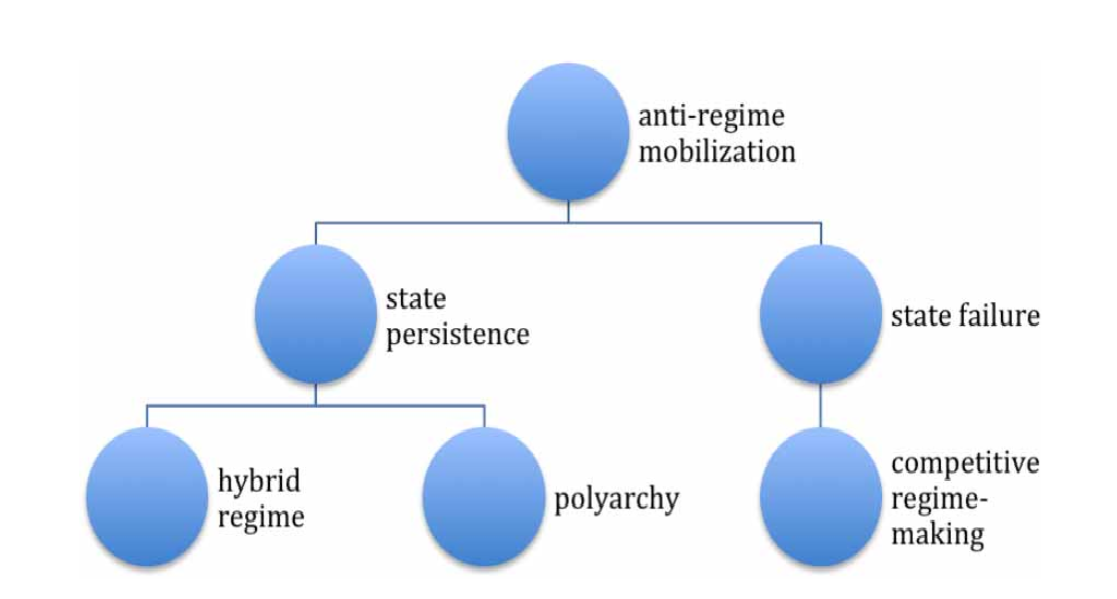
“Pathways of Post-Uprising States” according to Ray Hinnebusch’s article in the most recent issue of the journal Democratization.
Democratization theory–a continually developing effort to understand the stages of transformation of nondemocratic states to democracy–has not proved successful in analyzing Egypt’s political revolution because Egypt has certainly not become a democracy, nor is it clearly in any of the stages typically predicted by this theory.
On the other hand, writes Ray Hinnebusch in the most recent issue of the journal Democratization, neither has there been a uniform restoration of authoritarianism, as would be predicted by what he calls “postdemocracy theory.”
Instead, he states, in his article “Introduction: understanding the consequences of the Arab uprisings – starting points and divergent trajectories,” Hinnebusch argues that following the Arab Spring we find either state collapse–which leads to what he calls “competitive state making,” or state persistence, which leads either to “hybrid regimes” or “polyarchies.”
By state collapse, of course, he means states like Syria, Yemen and Libya, in which democratic uprisings so weakened the state that it collapsed or nearly collapsed, and “democratic prospects appear to be foreclosed for the near future.”
Competitive regime making occurs in collapsed states as Islamic groups, charismatic (and patrimonial) leaders, and the “remnants of bureaucratic state institutions vie to create order out of chaos.
States that do not collapse (like Egypt), Hinnebusch writes, fall into one of two other conditions:
Whither Media in Egypt?

The latest issue of Arab media & Society offers five essays on the future of Egyptian media–and it doesn’t look very bright.
The latest issue of the on-line journal Arab Media and Society, published by the Kamal Adham Center for Television and Digital Journalism at the American University in Cairo, has a slew of essays (five of six) on media in Egypt.
One is analytical–a look at international press coverage of Morsi’s ouster. The other four are essays offering bleak and bleaker outlooks on the future of Egyptian media.
The mildest is an account of the failure of Egypt to keep up with translation technology in the modern era. The bleakest sees all media in the Arab world as essentially under the control of the power and money elites–the digital dream is dead.
Here’s a quick round-up:
News, Truth and Verification in Egypt and the US

Answering questions after my talk Jan. 29 at the University of Cincinnati, I got onto the topic of truth, culture, and verification. Photo: Madison Schultz.
As more and more people get their news from digital media, including social media, many question the reliability of these new sources of news, as opposed to newspapers and television news. Are truth and verifiability disappearing from the news and, if so, does it matter?
I addressed this during a public lecture recently at the University of Cincinnati entitled “Toward an Anthropology of New Media.”
I suggested that there were at least five crucial problems facing scholarship on new media, and described what I saw as anthropology’s contributions to dealing with these problems.
During the Question and Answer period after the talk, an archaeology colleague asked me about whether one of the biggest problems with new media wasn’t the inability of news consumers to verify, and thus rely on, the news they read in their myriad on-line sources.
I responded:
First, there is very little evidence that people ever verify the news. Rather, they tend to decide whether or not the news is true and reliable, based on
- Their relationship to the news source (whether the news is expressed in language they find reassuring, whether or not it is one they visit frequently, how long they have received their news from that source, etc.), and
- The degree to which the news agrees with what they already know (i.e. believe) to be true.
How Social Media Networked The Egyptian Revolution
 Could Egypt’s experience of Internet activism leading to revolution serve as a model for social movements everywhere?
That seems to be one of the take-aways of David Faris’s book Dissent and Revolution in a Digital Age: Social Media, Blogging and Activism in Egypt which offers a detailed case study of Egyptian media activism from 2005 to 2011, and draws from it a general model for what works and what doesn’t.
While the author argues for the importance of local contexts and situations in setting the stage for digitally mediated resistance to the Egyptian regime, he also makes much larger claims about the ways digital media operate in social protest movements, and why outcomes vary from one revolutionary effort to another.
The core of his argument seems to be that social media networks “can trigger informational cascades through the effects of their interaction with independent media outlets and on-the ground organizers” (p. 22). In turn, these informational cascades “can make it difficult for regimes to maintain their control of information hegemony” and can stimulate collective action “by lowering the ‘revolutionary thresholds’ of individuals embedded in social networks” (p. 22).
The idea of a “revolutionary threshold” apparently comes from political science and is rooted in a homo economicus theory of humans in which we are all posited as rational calculators seeking to maximize our rewards while minimizing our risks. The idea seems to be that different people are more or less likely to join a revolutionary movement based on how they evaluate the potential risks and rewards to themselves. For example, the risk of joining a particular protest declines with the size of the protest, since the probability of getting caught declines as the number of protesters rises. Instead of looking at how people act from values, this model essentially takes the values as read and asks what prevents people from acting on values in particular (contingent) situations and what lowers this threshold enough that they weight the rewards of participation as exceeding the risks–their “tipping point.”
Until We Meet Again–The Shahada in Everyday Speech
 Long before the presidency of Muhammed Morsi, or the rise of Salafi parties following the uprisings, people in Egypt used to draw my attention to the “Islamization” of public life. The things that raised the most attention hit the news–the re-veiling of movies stars, for example, and the emergence of religious teachers such as Amr Khaled as media superstars.
But there were also changes in everyday language.
Older men and women in Egypt pointed out to me, for example, that there have been changes in such things as phone greetings and farewells over the past twenty years. People used to answer the phone with “’Alo” or “Na’am” (yes). By 2000 “Salaamu alaikum” (“Peace be with you”) had become common. Where people used to end conversations with “bye bye,” many now end with either “Salaamu alaikum wa akram Allah,” or, sometimes, with the two halves of the shahada.
The shahada, or declaration of the oneness of God, is a particularly interesting case. The utterance “La illaha ill Allah, wa Muhammad rasul Allah” (“There is no god but the God and Muhammad is his prophet”) is one of the central elements in Islam. It is the phrase uttered before witnesses when a convert submits to God and becomes a Muslim. As such, it is a performative utterance in Austin’s sense, a phrase that once spoken under the correct conditions, transforms one’s social (and in this case, spiritual) life forever.
But what does it mean when, at the end of a phone conversation, one person will say, “La illaha ill Allah” and the other respond “Wa Muhammad rasul Allah”?

Were the Egyptian uprisings a revolution or just regime change? Is there genuine transformation or has the deep state re-emerged fully intact and in charge?
The latest issue of the British Journal of Middle Eastern Studies has a special issue on “Continuity and change before and after the Arab uprisings in Morocco, Tunisia and Egypt.”
Arguing that few studies have looked at the North African protest movements in terms of the relationships between continuity and change, the authors in this special issue seek to amend this lacunae.
Six of the ten articles in this new issue refer, at least comparatively, with Egypt (while there are two articles that focus specifically on Morocco, and one on Tunisa, there are oddly no studies specifically focused on Egypt).
Here are the abstracts:
Rivetti, Paola. 2015. Continuity and Change before and after the Uprisings in Tunisia, Egypt and Morocco: Regime Reconfiguration and Policymaking in North Africa. British Journal of Middle Eastern Studies 42(1): 1-11
While the scholarship on the Arab uprisings is increasingly complex and intellectually refined, this special issue considers an aspect that so far has failed to attract sustained scholarly attention, namely continuity and change. This introduction provides the framework underpinning the special issue as a whole and discusses all the articles composing it, while elaborating on the scientific contribution that the examination of continuity and change before and after the uprisings can make to our understanding of politics in the region.
On Not Televising The Revolution
The importance of media–both “traditional broadcast” and new media–in the Egyptian revolution and other revolutionary activities of the last four years is often framed as having refuted Gil Scott-Heron’s performance poem, “The Revolution Will Not Be Televised.”
But it doesn’t. Not really.
A friend recently sent me a short article about Scott-Heron which led me to actually listen to his performance of the poem for the first time in years.
“The Revolution Will Not Be Televised” is not about the technology, but about content. It was about what was on television in the 1960s and 1970s as the Civil Rights movement was getting underway. It contrasts the commodified worlds of desire, and the pablum of television shows–including supposedly “ground breaking” shows like Julia–with the idea of struggle and sacrifice.
In other words, the revolution is not a commercially-sponsored TV show you can switch on and off for your viewing pleasure. You have to live the revolution.
That’s not the message many of us are using Scott-Heron’s phrase to convey when we write about the Egyptian Revolution.
Catchphrase and Revolution
Before we had memes, we had catchphrases.
The idea of a catchphrase is that it arrests your attention, and is extremely memorable, while capturing some essential message of the discourse of which it is a part. Commercials have catch phrases, and do do poems.
Revolutions often get their catch phrases from poetry and protest songs.
And these catch phrases continue to do work in their original meaning. The boy in Ferguson who shouted “the revolution will not be televised” was, through this phrase, linking Ferguson to the larger Civil Rights movement.
Top Ten Posts of 2014

1. Bibliography of the Egyptian Uprisings
The bibliography, now in excess of 750 references, was updated twice this year. A page, rather than technically a post, it remains the blog’s single most popular site for visitors.
2. Aliaa’s Naked Body: What Did It Matter Anyway?
The combination of rebellion and naked pictures turn out to be a strong draw. This post reviewed an article interpreting the public response to Aliaa al-Mahdy’s “naked pictures as protest” activities back in 2011. It received over 1080 visits in 2014.
When I put my curriculum vitae on the blog, it was meant to be a way for people to check out the credentials (such as they are) of the person writing these blog posts about Egypt. To my surprise, it has become a site that people search for and visit. There were 895 visits last year.
4. Farha Ghannam on Masculinity in Egypt
More than 675 people checked out my review of Farha Ghannam’s new book Live and Die Like a Man: Gender Dynamics in Urban Egypt (Stanford, 2014), This extended ethnographic exploration of masculinity in the Middle East is a wonderful, readable account that will become a standard work on gender in Egypt (and is fully consonant with my discussion of masculinity in Connected in Cairo.
2014 In Review

The WordPress.com stats helper monkeys prepared a 2014 annual report on how this blog was generated, followed, commented on and used over the past year.
I can’t imagine why anyone but me would be interested, but on the off chance that someone might, I share the link below..
Here’s an excerpt:
The concert hall at the Sydney Opera House holds 2,700 people. This blog was viewed about 29,000 times in 2014. If it were a concert at Sydney Opera House, it would take about 11 sold-out performances for that many people to see it.
Freedom Technologists and Protest Formulas in Egypt

What can formulaic expression tell us about media and social change? For one thing, to study technology users rather than technologies, says John Postill in a recent article.
There’s a new article out from John Postill in the latest issue of Convergence that may be relevant to the study of the roles digital media played (and continue to play) in the Egyptian revolution.
John’s project is to study the relationship between Internet activism and post-2008 protest movements generally.
John does not look at Egypt, alas. Instead he draws on his own anthropological fieldwork in Spain, and on secondary literature about uprisings in Tunisia and Iceland.
Key to his analysis are two new terms he has coined: ‘freedom technologists’ and ‘protest formulas’:
- Freedom technologist refers to social actors who combine technological and political skills to pursue greater Internet and democratic freedoms (which they typically see as inextricably linked).
- Protest formulas refers to the unique compound of societal forces and outcomes that characterizes each protest movement – as well as each phase or initiative within a movement.

 CONNECTED in CAIRO