New Article: The Rise of Egypt’s Workers
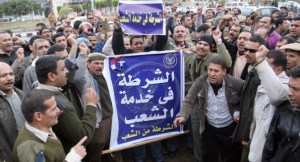
Joel Beinin argues that Egyptian labor still has a major role to play in the evolution of the Egyptian state after Mubarak.
While most people are arguing about the old regime and SCAF versus the Muslim Brotherhood, and wondering whatever happened to the secular democratic revolutionaries, Joel Beinin is urging us not to forget about a fourth major player in Egyptian politics: Egyptian labor.
Workers, he says, deserve more credit for Mubarak’s ouster than they are typically given, and as they struggle to find a common voice in post-Mubarak Egypt, they may become a major political force to reckon with.
Beinin makes these arguments in a new Carnegie paper entitled “The Rise of Egypt’s Workers.”
The main thesis is that
Independent trade unions remain the strongest nationally organized force confronting the autocratic tendencies of the old order. If they can solidify and expand their gains, they could be an important force leading Egypt toward a more democratic future.
He concludes that:
Moving beyond street protests over immediate grievances, independent trade unionists will need to strengthen the new institutions they have established, train enterprise-level leaderships, and forge political coalitions with sympathetic sections of the intelligentsia in order to achieve the goals articulated in the January 25 slogan–“Bread, Freedom, Social Justice.”
Click here for a free .pdf copy
References:
Beinin, Joel. 2012. The Rise of Egypt’s Workers. Carnegie Papers. Carnegie Endowment for International Peace. <http://carnegieendowment.org/files/egypt_labor.pdf>
Establishing My Political Science Bona Fides
 In the interests of understanding the roles social media has played in the Egyptian revolution, I blog critically not only about the work being done in my own field, but in communications, political science and other disciplines.
At last I have some genuine bona fides for my critical analyses of political science, and especially political communications papers and books.
This just out:
And if I need any more proof, the new edition of my co-authored textbook International Studies: An Interdisciplinary Approach to Global Issues was ranked 46th on Amazon’s list of the top 100 hot new releases in political science.
Not that I would ever want to be a political scientist when I can be an anthropologist, of course. But it’s nice to know my interdisciplinary meanderings are not totally without merit.
(or maybe this is just more shameless self-promotion).
A Cyberskeptics Handbook
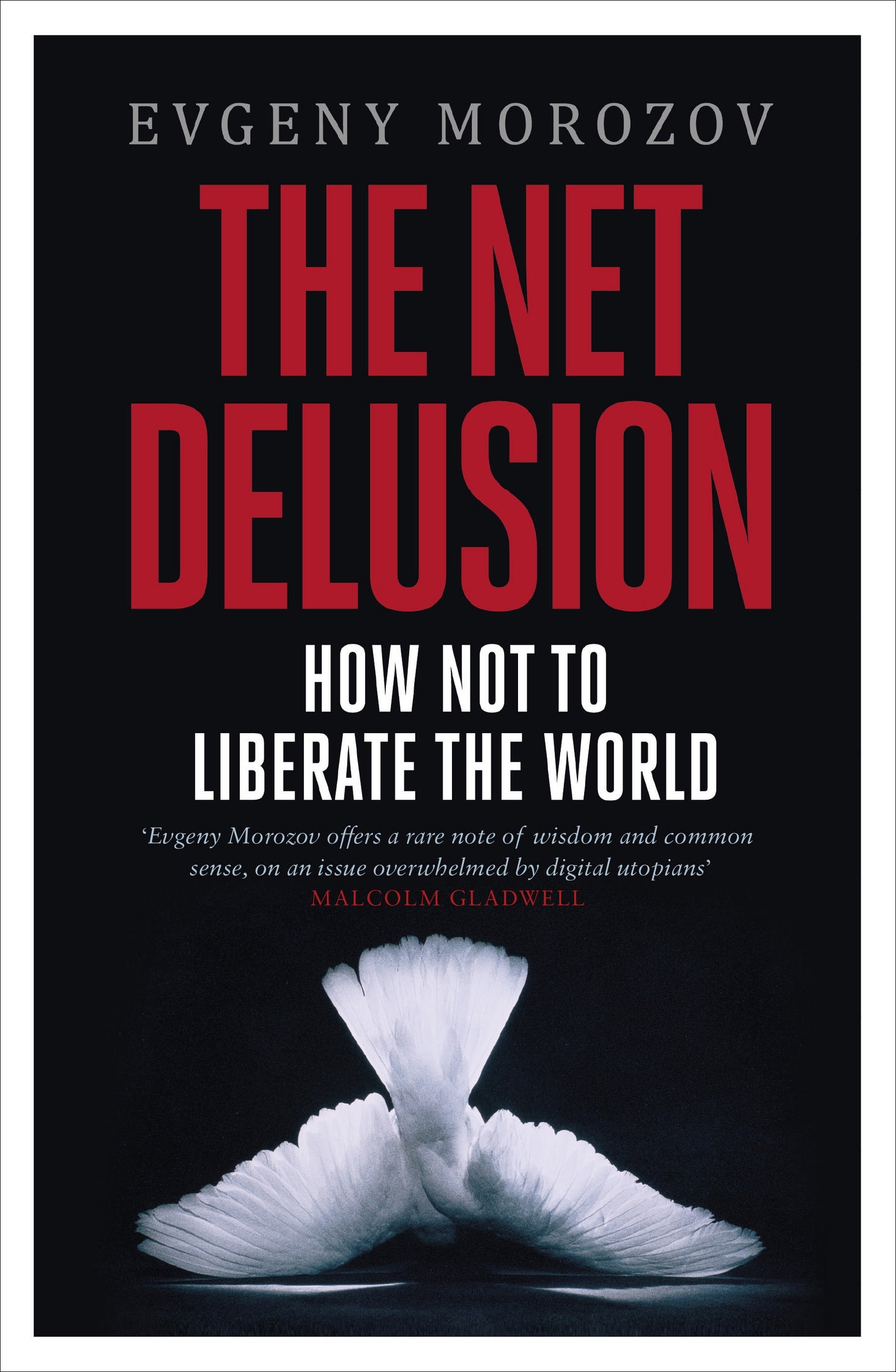
Although it does not address the Egyptian uprisings directly, this book offers cautionary tales and correctives for those with a tendency to ascribe revolutionary agency to technologies themselves.
The uprisings and revolutions in the Middle East continue to be largely characterized by their use of digital media, and the debate remains heavily binary, between cyberutopians and cyberskeptics. As a “media anthropologist” who has done more than ten years fieldwork on-and-off in Egypt, one of the things I want to know are the role(s) new media played in the Egyptian uprisings, so I thought it might be useful to review some of the scholarly literature on the subject..
So it was with interest that I read through Evgeny Morozov’s new book The Net Delusion: How Not to Liberate the World. This book is definitely in the cyberskeptic camp, and marshals considerable evidence to support its thesis that while Western media, NGOs and government institutions love stories about people empowered to resist statist oppression by social media, social media are also used by the state to strengthen their power, and to put activists under surveillance. Social media is also used by extreme nationalists, terrorists and racists to organize, mobilize and spread their values.
If cyberskeptics need a handbook, here it is.
Egyptian Activists Comment on Morsi’s Presidency
 “So where do the youth revolutionaries stand on the election?” is perhaps the most common question I get since the presidential run-off.
The answer of course is, “It depends.” I mean, if “secular” and “democratic” all meant the same things to everybody, the secular democratic folks would have won the election. The most underreported story of the election is the fact that Sabahi Hamdin received the third largest number of votes; if the Parliamentary edict that former regime members could not run for president had been upheld by the court, the run-off election would have been Morsi versus Hamdin.
But I digress.
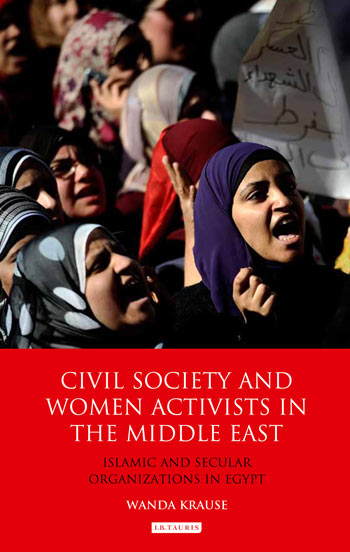
A new book by Wendy Krause makes a case for the importance of women in civil society in Middle Eastern politics, especially in Egypt.
“Yeah, but where are the women in this revolution?”
Students have asked me this question since the beginning of the uprisings. I am always stunned. They are everywhere. How can you have done any reading on this topic and not see them?
I used to blame the media for perhaps not making women visible–although I’d be hard pressed to prove it; my own dipping into the media cesspool shows lots of representations of women.
In a new book, “Civil Society and Women Activists in the Middle East: Islamic and Secular Organizations in Egypt,” Wanda Krause suggests that the problem may be that women are simply framed as seperate from, and powerless in the face of the state, and hence “invisible” to serious discussions. It’s a view the book sets out to dispute, not only in Egypt but throughout the Gulf states as well.
Visualization of meme diffusion related to the Arab Spring and the 2011 uprisings from the #Egypt hashtag, which shows strong connectivity and many users linked to one another to form a dense cluster. Credit: Indiana University
“Connective Action” is a term being used to describe the uses of social media in contemporary protest movements. Drawing examples from the Arab Uprisings, Put People First (PPF) in England, 15M in Spain, and the Occupy movement in the U.S., a recent article entitled “The Logic of Connected Action” by W. Lance Bennett and Alexandra Segerberg in the journal Information, Communication and Society seeks to explore the DNA of connective action.
DNA, here is an acronym that in their work stands for “Digitally Networked Action” and is what they argue differentiates connective action social movements from collective action social movements.
Connective and collective action refer to two different logics that organize protest movements. The term “connective action” resonates with the more classic term “collective action,” with which it has many parallels and similarities, but with which it diverges in important ways, according to these authors. In connective action:
- Social actors sustain and even building strength over time, using a mix of online media and offline activities that included (among others) face-to-face organizing, occupations of city centers, marches and demonstrations.
- Participants communicate a collective identity of being leaderless, signaling that labor unions, political parties, and organized radical movement groups should stay at the margins.
- Many participants are previously unaffiliated with political movements, and even among those that are affiliation tends to be five years or less.
 The modern Arabic-speaking Middle East is incomprehensible without taking into account the central importance of mass media. Yet existing literature on media in the Middle East often falls into one (or both) of two errors.
First, existing scholarly literature on media in the Arab Middle East tends to clump (with some important exceptions) at either end of a historical spectrum. They describe and analyze the adoption of the printing press in the late nineteenth and early twentieth centuries, or they focus on “new” (primarily digital) media as they have unfolded over the past two decades.
Second, much of the work on contemporary “new media” suffers from an implicit technological determinism (historical studies are generally more sound, but not necessarily well focused on media as a phenomenon that deserves analysis in its own right).
In his paper “Toward a History of New Media in the New Middle East,” Walter Armbrust argues that “new media,” stripped of its technological determinism, is a useful concept, and that a history of new media over the past hundred and fifty years or so will make media an object of study on par with “economy” or “society,” or “culture.” He warns, however, that scholars must be careful not to fall into the trap of assuming the existence of such an object as a given.
Daily News Egypt Review of Connected in Cairo
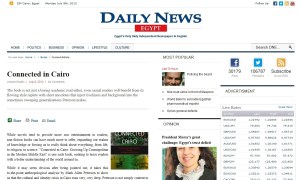 There’s a review of Connected in Cairo by Ahmed Khalifa in the July 9 issue of Daily News Egypt.
He does not care for the introduction, with its anthropological jargon and scholarly framing but the review is in the main pretty flattering. Khalifa writes:
While it may seem obvious after being pointed out, it takes this to-the-point anthropological analysis by Mark Allen Peterson to show us that the cultural and identity crisis in Cairo runs very, very deep. Peterson is not simply content to tell us this, he meticulously traces the origins of the multifaceted Cairene society, from infancy through adolescence to adulthood, exploring factors and variables that eventually decide whether spending weekends at the neighbourhood ahwa really makes one any more Egyptian than weekends in Tamarai.
He states several times that the best part of the book is the ethnographic anecdotes:
A personal favourite was the image of two young boys walking down the street, so coincidentally close, yet light-years apart culturally, as evidenced by their manner of dress, their choice of reading material and the schools they emerged from. The scene appears so innocuous and everyday, yet Peterson dissects it thoroughly and constantly refers to it throughout the rest of the book as an example of the amazing panorama of parallel cultural motifs Cairo contains within its boundaries.
In the end, though, Khalifa would have it that nobody could write a book that fully captures Egyptian culture:
The attempt is a valiant one and gains several secure footholds but, in my opinion, the koshary that is this culture, with its American, European and uniquely Oriental roots, will forever remain enigmatic and indecipherable.
I’m cool with that. I’m not really trying to capture the koshary that is Egyptian culture–just one aspect to fit alongside all the other excellent works that explore Egyptian culture.
New Web Documentary: The Music of Tahrir
 One thing to which plenty of attention is definitely being paid since the revolution is Egyptian music. There have been dozens of articles, documentaries, and radio programs about Egyptian music since the revolution
The latest is a web documentary called “Egypt: The Music of Tahrir Square – Music that Toppled a Regime.” Each page of the web site has a piece of the documentary, and you navigate through it in places creating your own documentary by watching the clips in different order.
Some of the other recent discussions of Egyptian music I’ve blogged about include:
The 5-part, Hip Deep series on Egypt from the acclaimed public broadcasting radio series Afropop Worldwide.
On NPR Banning Eyre started a new series on Afropop with a look at Egyptian street music.
An op-ed in the New York Times by Arab American composer Mohammed Fairouz.
The documentary The Noise of Cairo.
And then there’s my own lecture “Music and the Egyptian Revolution” I gave as a guest lecture in Prof. Tom Garcia’s MUS 186 “Global Music for the iPod Generation” here at Miami, and my student Andrew Underwood’s multimedia project on “Underground Music and the Tunisian Revolution.
 Steven Cook’s recent book on the political development of Egypt, The Struggle for Egypt: From Nasser to Tahrir Square, (Oxford University Press, 2011) traces political change from the pre-Nasser era to the Egyptian Revolution and fall of Hosni Mubarak in 2011. To do so, he divides Egyptian political history into three main eras:
1. the rise of the Free Officer’s movement and the Nasser era,
2. the rise of Sadat and the transition to a more liberalized economy and the peace treaty with Israel, and
3. the Mubarak era and the demonstrations that led to his fall.
While describing the histories of each of the three regimes, Cook attends to the key theme of nationalism running like a leitmotif through Egypt’s political history, as well as the changing role(s) of the Muslim Brotherhood as an alternative and opposite organization to the state, with a very different vision of Egypt, and he articulated the impacts of both nationalist discourse and Muslim Brotherhood actions to the struggles with the state epitomized in Tahrir Square.
Nationalism
All three leaders sought to appeal to Egyptians’ sense of nationalism, Cook argues, as a reaction to England’s long colonial rule and the efforts by Egyptians to overcome foreign control. However, the only one who could convincingly pull off this stance was Nasser in the immediate aftermath of World War II and the era of de-colonization.
While Sadat and Mubarak both tried to paint themselves as nationalists, the fact that so much of their economic and foreign policies were closely tied to the United States and multi-national institutions meant that they were seen by many Egyptians as tools of foreign interests, and thus as compromising Egyptian sovereignty. This proved deeply unpopular with the Egyptian people, whose experience of foreign interaction has historically been one of subjugation, first under the Persian Empire, then the Ottoman, and finally the British. Egyptians in general tend to be deeply suspicious of any foreign power that seeks to influence events in Egypt.

 CONNECTED in CAIRO