The Case for an Islamic Egypt
 At the beginning of the uprisings, and after the resignation of Mubarak, I wrote and said on several occasions that I thought that an Islamic Egypt as the outcome of the revolution was unlikely. I’ve been questioned about that by several students, as well as some Egyptian readers of my blog.
While I continue to hold that opinion, the situation has changed and an Islamic government is certainly more plausible than it was, although only under certain circumstances.
The crux lies in the fact that the Supreme Council of the Armed Forces implemented only a small, though significant, set of constitutional reforms, and had these approved in a national referendum. The SCAF refused to supervise the revision of the Egyptian constitution, leaving that for the first elected government.
The fear, then, is that should an Islamic party, or a coalition of such parties, gain the majority of seats in parliament and form a government, they would be able to establish the conditions under which constitutional reform went forward, and dominate the process by which it is written. In a worst case scenario, the new constitution would root itself in interpretations of Shari’a law that would undermine aspects of free speech, reduce religious minorities to second class citizens, and subordinate secular courts to religious courts.
While this is a very real possibility, there are also a large number of factors that mitigate against it: the fissions within the Muslim Brotherhood, the disagreements between various political groups claiming an “Islamic” way forward, the relative unity of purpose among many of the secular, “liberal” parties, and the efforts by some in the current government to prepare the way for an equitable process in writing the new constitution in advance of elections.
Here’s a brief explication of each of these four factors:
Representing Egypt’s Last Revolution for US Kids
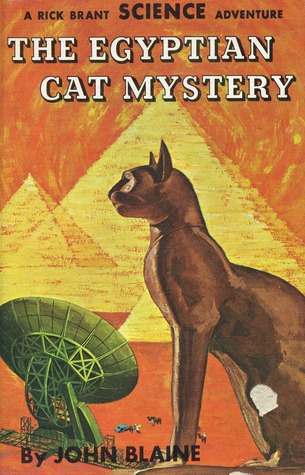 In 1961, Rick Brant and his friend Scotty went to Egypt, got involved with smugglers and helped the Egyptian police capture a band of revolutionaries. It was all in a day’s work for Rick, whose father runs the Spindrift Research Foundation and who has had encounters with crooks and spies all over the U.S. and Europe.
The Rick Brant series consists of 23 novels, written by Harold Goodwin (under the pseudonym John Blaine) and published by Grossett and Dunlap between 1947 and 1968. It was written for a slightly older audience than more popular juvenile series like The Hardy Boys. It was said to be distinctive in two ways:
- The science is absolutely accurate (for the period), unlike other popular science adventures like Tom Swift, Jr. or Tom Corbett, Space Cadet. Goodwin was a writer of popular science articles in addition to this series and kept his science up-to-date and not too speculative.
- Descriptions of the locales in which the stories take place are carefully researched.
It was the latter that intrigued me when I ran across The Egyptian Cat Mystery at Project Gutenberg. How would Cairo–the city, the people, and the politics–be represented for juvenile readers in 1961–the year I was born! So I downloaded it into my kindle and read it during the long hours between events at my kids’ swim meets this summer.
Review of Connected in Cairo in the Jordan Times
 The English-daily Jordan Times has a very nice review of Connected in Cairo in today’s issue. Entitled ‘Locals who make it happen’ , the review by Sally Bland points out that many of the things I write about in Cairo–children’s magazines, fast-food restaurants, new-style cafes, malls, social media, exclusive private schools–are also prominent in Jordan, and asks whether comparisons can be drawn.
The review also points to similarities and differences between my book and Diane Singerman and Paul Amar’s excellent Cairo Cosmopolitan (AUC Press, 2006), noting that:
Both emphasise class, but while “Cairo Cosmopolitan” focuses on the effects of state policy and city planning on the city’s character and the lower classes, Peterson zooms in on the consumer habits of the upper class and what these signify in terms of status and aspirations. Here, cosmopolitanism is seen as “a style for managing difference that allows one to move easily across political, social, cultural, and economic boundaries.”
The title of the review is drawn from a quotation from Chapter Six, and emphasizes the reviewers interest in my argument that (in her words):
globalisation is not a one-way street or an abstract supernational process, but the sum of myriad localisations which occur when capital, commodities, technologies, styles or discourses from abroad are adjusted to fit into a particular local context and integrated into social relationships.
The Egyptian Uprising in Pictures
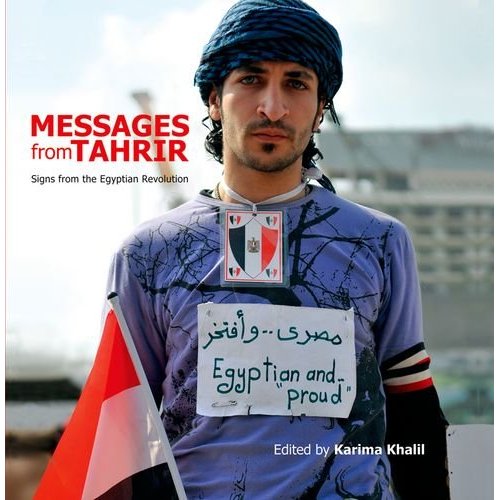 The Egyptian uprising was an iconically rich event, and efforts to preserve these images are taking place in social media, in art journals, and of course, inevitably, in books.
No fewer than three recent books from American University in Cairo Press collect and comment on these images.
Messages from Tahrir: Signs from Egypt’s Revolution is a collection of photographs of the written signs of the uprising, edited by Karima Khalil. Khalil is a medical doctor and amateur photographer who took most of the pictures in the book.
AUC Press says the purpose of the book is to reflect “the imagination and creativity of the posters, placards, and signs that the protesters wore, waved, or hung from buildings, fences, and lampposts day by day throughout the demonstrations.”
New Yorker Features Slide Show of Egyptians

"Pictures from a Revolution" in the August New Yorker magaazine features elegant photos and videos of activists.
The Tahrir Uprising produced art, music, and wit; and it was one of the most photographed (and photogenic) political revolutions in history.
One of the most elegant and aesthetically beautiful accounts of the revolution was not shot during the uprisings themselves, but a few months after Hosni Mubarak resigned and published in The New Yorker magazine. It’s entitled “Pictures from a Revolution.”
The photographs are by Platon and, while posed, they are lovingly lit and arranged to speak more than a thousand words about the characters of the activists they portray.
But for those of us who are more verbal than visual, the words are there too, in the form of short videos by Francisco Fagan of Human Rights Watch. Like the photos, these are carefully edited with an eye to aesthetics. Each is less than two minutes in length, elegantly photographed, featuring pithy quotations and merging the interviews with historical footage
Here’s what you will see:
- Musician Ramy Essam talks about being tortured, and making a song of it.
- Sondos Shabayek, Sarrah Abdel Rahman and Tarek Shalaby talk about the uses of social media, as does Wael Ghoneim, creator of the influential We Are All Khaled Said web site.
- Union leaders Kamal Abbas and Kamal Abu Eita and human rights lawyer Khaled Ali Omar talk about the decision Jan. 30th to announce the support of the labor organizations for the revolution.
- Feminist author Nawal al-Saadawy enthuses about the participation of women in the revolution.
- Coptic Youth Leader Sally Moore and Muslim Youth leader Mohammed Abbas speak about the dissolution of sectarian tensions as the two groups worked together toward a common goal.
- Hossam Bahgat, the Egyptian Initiative for Human Rights talks about being teargassed.
Middle East Edition of Connected in Cairo
 The American University in Cairo Press has listed Connected in Cairo among forthcoming books in its current catalog and on its web site.
It has a brand new cover, and corrects the errata that slipped into the first IUP printing of the book (all entirely my fault, not IUP I should hasten to add!).
It will be published in English, as a paperback, and cost 120.00 Egyptian pounds (about $20). It will be sold by AUC Press exclusively in the Middle East.
You can visit AUC Press’s web page about the book here.
Errata
Connected In Cairo – Errata
In preparation for the new AUC Press edition and the reprinting of the IUP edition, I have (with help from both presses) compiled a list or typos and other errors that slipped into the text.
Pg. ix, 1st par. Irhab wal-Kabab should be al-Irhab wal-Kabab
Pg. ix, 1st par. The date of Egyptian Revolution is given as 1958. It should be 1952.
Pg. ix, 4th par. The date of the Bread Riots is given as 1981. It should be 1977. (It is given correctly in Chapter Six)
Pg. 30, 1st par. Akbar al Yom should be Akhbar al Yom [and in index, p. 253]
Pg. 30, 1st par. Der Zeitung should be Die Zeit [and in index, p. 255]
Pg. 68, 1st par. mudaris tagribiya should be madaris tagribiya
Pg. 100, 2nd par. Hamam fil Amsterdam should be Hamam fi Amsterdam [and in index, p. 257]
Pg. 105, 3rd par. Al walad da akhla’a should be Al walad da akhla’ [and in index, p. 253]
Pg.107, 3rd par. wilad al-baladi should be wilad al-balad [and in index, p. 263]
Pg. 147, 1st par. khalawati should be khawalati [and in index, p. 258]
Pg. 157, 3rd par. The date of the founding of Café Riche is given as 1914, which is taken from the source I cite (Bieber-Roberts, Peggy and Elisa Pierandrei 2002). However, several other sources give the date as 1908, and this is the date the current owners of Café Riche themselves claim. In fact, it’s etched on the glass of their front door.
Pg. 161, 3rd par. LePoire should be La Poire [and in index, p. 261]
and last, but certainly not least,
Pg. 176, 4th par. The dates of the Mubarak regime should be updated from “1981-present” to “1981-2011”!
Rustom and al-Shannawy Together
Just for nostalgia’s sake, here’s a clip from a film starring both 1950s Egyptian film greats who died this month, Kemal al-Shennawy and Hind Rustom. I’ve never seen it before, but apparently he’s an uptight teacher and she’s a mischevious student and somehow love blossoms as they team up to defeat some crooks.
Egyptian Screen legend Kamal al-Shennawy Dies
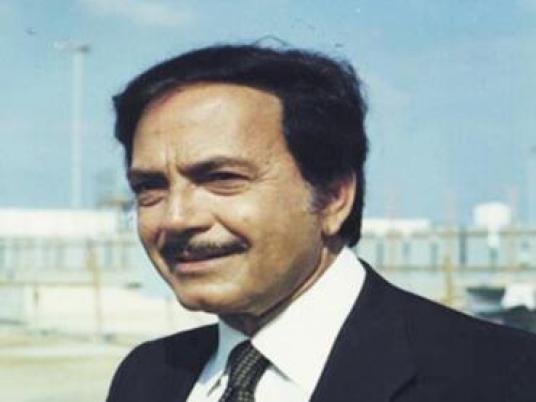
Kamal Al-Shannawy
Egyptian cinema icon Kamal al-Shennawy, who played the Egyptian Minister of the Interior in my all-time favorite Egyptian movie, Al-Irhab Wal-Kebab (Terrorism and Kebab) died Aug. 22nd.
Al-Shennawy acted in more than 200 films and TV dramas in a career that spanned 62 years. He was 89. An artist and high school art teacher, he began acting in films in the early 1940s, often as a straight man for the great comic actor Ismail Yassin.
The Passing of Hind Rustom
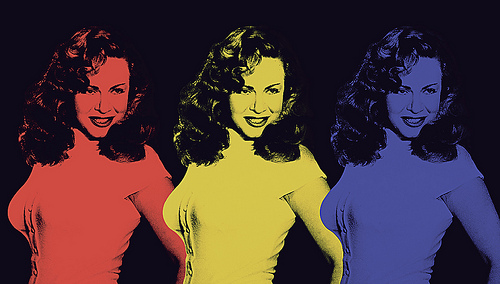
This piece of art utilizing iconic images of Hind Rustom is by By Ali Cha'aban. http://www.flickr.com/photos/cul-de-sac/
Egyptian actress Hind Rustom passed away Aug. 9. The star of more than 70 films, she was a cultural icon in Egypt, dominating the film industry from the mid-1950s to the mid-1960s. She has a channel on YouTube here.
Rustom was sometimes called (somewhat patronizingly) “the Marilyn Monroe of the East”, and like Monroe in the US she became a favorite subject for artists in Egypt. You can see some of this art here at Ladashia.com.
I know Rustom best for her role as Hanuma, the beautiful soft drink seller in Youssef Chahine’s 1958 classic Cairo Station (Bab al-Hadid). Occupied with attracting the attention of the handsome Abu Sri (Farid Shawqi), who is trying to unionize the porters, Hanuma jests with the crippled news dealer Qinawi (played by Chahine himself) but doesn’t take him seriously.
Eventually, he kidnaps her, stuffing her unconscious body into a crate with the intention of taking her back to his village.
Cairo Station (the actual Arabic title means The Iron Gate) is one of the films I put on reserve during my Peoples and Cultures of the Middle East course. It appeals to Western collegiate audiences in part because it is about sexual obsession, repression, violence and the tragic results of terrible choices that one can’t take back once they are made.
But I like it because it is about one of the central themes of Egyptian society, how to make one’s way in a world being transformed by Western ideas, media and commerce. Themes like nationalism, socialism and Islamist activism are also exhibited in interesting ways.

 CONNECTED in CAIRO