Out of Stock – Printing More Copies
 I haven’t posted anything for twelve days, not because there isn’t a lot to write about in Egypt these days but because I’ve been traveling with only minimal Internet availability.
On Wednesday I briefly accessed my e-mail, and received the exciting news that Connected in Cairo is out of stock, and more copies are being printed.
A lot of colleagues are using this text in their classes this year. In a sense, this is a gift from the Egyptian people: their overthrow of President Mubarak made my book extremely timely.
The real test will be next year, when we find out if professors liked it well enough to use a second time. “People who bought this book” on Amazon “also bought” Laura Deeb’s An Enchanted Modern: Gender and Public Piety in Shi’i Lebanon (Princeton, 2006), Christa Salamandra’s A New Old Damascus: Authenticity and Distinction in Urban Syria (Indiana University Press, 2004) and Donna Lee Bowen and Evelyn Early’s edited volume Everyday Life in the Modern Middle East (Indiana University Press, 2002).
If people are still using my book for classes 5, 7 or 9 years from now, as they are these authors, that will feel really good.
Bassem Youssef Leaps From Social Media to Television
 “We couldn’t find a better name,” complained Dr. Bassem Youssef, “…or a worse one.”
He was talking about El Bernameg (“The Show”), his new show that began airing the first day of Ramadan (Ramadan is the traditional time to launch new TV shows).
For those who don’t know, Dr. Bassem Youssef is a medical doctor who participated in the Jan. 25th uprising, and was appalled by the performance of the Egyptian official media. His ability to deliver sarcasm is superb even in Egypt, where this has long been a performance art, and with the assistance of several friends, he created Bassem Youssef’s B+, a five-minute broadcast on the model of the US Daily Show. You can read my earlier post about Bassem Youssef here.
The show was an unparalleled success, and Egyptian TV networks supposedly fought over a contract with him. At any rate, his show now airs on ONTV, one of the two major independent networks.
The new half-hour show started with a criticism of Syrian official media for operating the same way Egyptian official media does, and just kept being funny all week long, mocking such things as the Arab world’s silence over the ongoing atrocities in Syria, the inability of Egypt to get convicted businessman Hussein Salem extradited from Spain, the ongoing ambiguity of the interim government, and more. He even tackled the controversy surrounding billionaire tycoon Naguib Sawiris, who owns the ONTV network airing Bassem Youssef’s show.
Like its models, the US Daily Show and The Colbert Report, Youssef also features new books on the show and interviews guests.
So far, the show is being very well received. In her review on the Cairo Lifestyle blog Cairo360, Rehab Loay writes:
The crux of the show isn’t his straight-faced humour, charisma and sarcasm, or even in the actual production of the show; the draw is Youssef’s unique take on and dissection of Egyptian politics. It’s difficult not to be charmed and swept away by him, and you’ll soon find yourself thinking in the same playfully sardonic way.
Except for fans of President Mubarak. “I wish that my show angers you,” he told them.
Here’s a ten minute sample of the show in which he mocks conspiracy theorist and counterrevolutionary pundit Tawfiq Okasha, owner of Al-Faraeen Television. I wish I could find someone to subtitle these for the English language audience…
Internet and Political Mobilization in Egypt and Tunisia

Egyptian and Tunisian Internet Use Compared
One of the difficulties with efforts to understand the role of social media in the successful North Africa uprisings (Tunisia and Egypt) is a paucity of theory.
The most common account is that the Internet offers alternative sources of information and alternative narratives for understanding events than the media controlled by the state.
There are several problems with this.
- It theorizes new media using theories that have been shown to be unsophisticated even when applied to old media, that is, seeing media primarily as a vehicle for the more or less passive receipt of information. It fails to theorize the specific elements that make new media “new.”
- In doing (1) it ignores the active ingenuity, creativity and agency of users, who not only receive but write new narratives, and generate such things as the Bassem Youssef Show and Pigipedia.
- Only about 20 percent of people in Egypt are on-line, and they fall into pretty distinct age, income, and education demographics–yet the resistance movement itself clearly extends into many other walks of society.
Johanne Kubler addresses some of these issues in a recent article entitled (somewhat misleadingly) “Overcoming the Digital Divide” in a recent issue of CyberOrient.
She argues that while it is true that “the Internet as a relatively free space can be a vital factor in opening windows and expanding the realm of what can be said in public” (thuse resonating with the recent articles on the role of civility in Middle Eastern power structures), “rates of Internet penetration show that this is insufficient to radically transform the public as seen during the 18 days in Tahrir beginning Jan 25th.”
Connected in Cairo: 30 Percent Off!
 You can buy Connected in Cairo through Indiana University Press’s web site and save 30% beginning next week (Aug. 8th) and through the rest of the year.
That means you can get the paperback for a mere $17.47 (saving more than $7) and the hardback for only $49 (a savings of $21)!
My publicist tells me that this 30% sale applies to all Indiana University Press books. Just go to the web site here, and click “Add to Cart”. Then click “Checkout”. Enter the information and proceed to checkout, where you will have the opportunity to enter a promotional code.
Enter the following code: IUE30
The continue through checkout and payment, following the instructions.
The deal is only offered through the Indiana University Press web site.
The Friday of Disunity
The Friday, July 29th, gatherings in Tahrir Square were announced as a “Friday of Unity” but it turned out to be anything but as thousands of Salafists sought to use the day to denounce secularists and call for the new Egypt to be under (their interpretation of) Shar’ia.
In a blog post covering the tense, angry day, 3arabawy writes:
The Islamist forces, whose leaders, also without any exceptions, are in one way or another allied to the SCAF awaiting their shares of the booties in the coming parliamentary elections and constitutional reform, decided to escalate their moves against the Tahrir revolutionaries by announcing roughly two weeks ago they were calling for mass protests in the square, to “assert Egypt’s Islamic identity, denounce supra-constitutional principles, and to demand the application of Islamic sharia.” Such announcement was coupled with an agitation campaign that spoke of “purging Tahrir from the secularists.”
I can offer nothing at this point to go beyond what he has written. I urge you to read it here.
On Monday, with the main groups of protesters having left Tahrir Square, the military entered and cleared its “tent city” of hundreds of remaining protesters. Ramadan Karim!
Zenobia, author of the Egyptian Chronicles blog, offers a thoughtful and critical reflection on how the revolutionaries are losing public support, and what they need to do to win it back here. She writes:
The revolutionaries do not rule in Egypt , in fact we do not really have a centralized body for revolutionaries in this revolution. In the golden 18 days of Tahrir square we had protesters at the tent city in the square from all over the country, from all political powers and from all classes.
and
The revolution is not made by internet users or leftists or Islamists or liberals or poor or middle class or rich only.
and
Tahrir square is not a holy land and it is not only land in Egypt full of martyrs’ blood with my respect to the martyrs who had fallen there, think outside of Tahrir square. Think about farmers across the Nile Delta and Upper Egypt , think about the people in Matrouh and in Sinai , think about th
Everyday Civility in Egypt–Before and After Mubarak
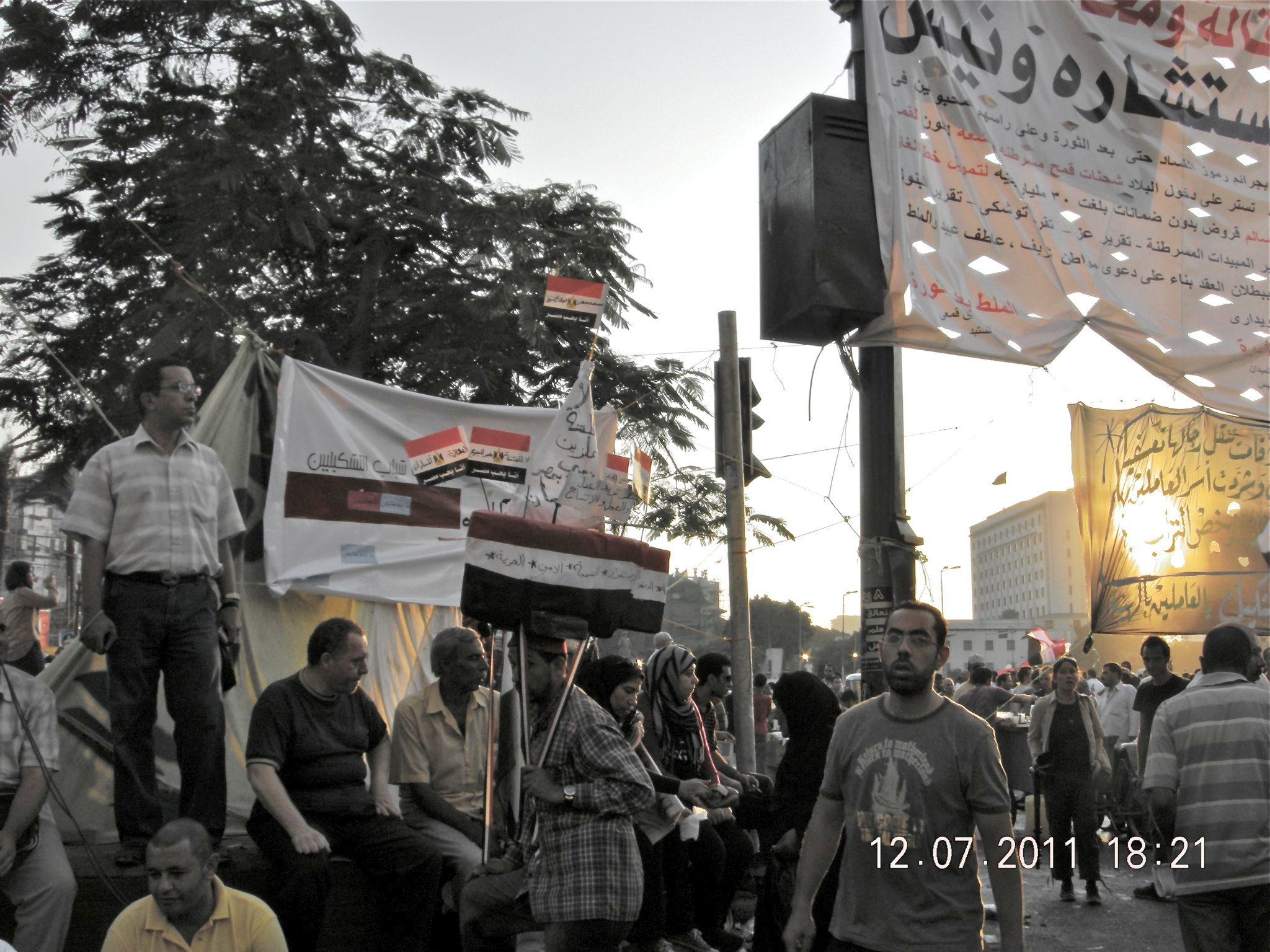
Are the ongoing protests in part efforts to create new civilities in Egypt? Photo by Malak Rouchdy.
On the one hand, civility–that mutual deference that allows people’s natural inclination to sympathy for one another to express itself in social ways–serves as a foundation for active citizenship in the public sphere. On the other hand, civility can be used as a tool to reduce confrontation and reinforce existing structures of power.
The civility displayed during the Tahrir protests offers a nice example of the former, while the debate over the propriety of Ala’ Aswani’s aggressive questioning of Prime Minister Ahmed Shafiq offers an example of the latter.
In “Authoritarian Government, Neoliberalism and Everyday Civilities in Egypt,” Salwa Ismail explores this complex relationship between civility as the basis for political activity and civility as a mask for power by looking at how citizens cultivate “everyday civilities”–that is, manners and forms of interaction relating to political action–through their routine interactions with the state and with fellow subject-citizens.
Civility, she writes, is an “economy of manners” in which “specific modes of conduct, norms of interaction and scales of judgment are deemed appropriate.”According to Ismail, the forms of government and techniques of control deployed by the Mubarak regime “gave rise to particular modes of action, norms of interaction and socio-political dispositions among the citizenry.”
While Ismail’s paper is (like my book!) now a fin de siecle work whose concrete data is now out of date, her model of creating civilities through social interaction is interesting and useful.
Ismail presupposes “that political civilities are tied up with processes of power relations in society.” That is, the rules that structure political debate–what is appropriate to talk about and what isn’t, and how–both enables and constrains political activity.
More importantly, Ismail emphasizes that the state, conceived as existing above and apart from the public, is an idealized abstraction that gets in the way of our understanding how power really operates, and that what we should be looking at is how people interact with officials and agents of the state in real life.
In other words, the task is to investigate the state as it comes down to the people by focusing on the practices of power that are deployed at the micro level of everyday life. By looking at the quotidian practices of officials and agents of the state and at the ways in which citizens negotiate their relations with them, we get a sense of what is done in the name of the state and what is experienced by individuals in relation to it.
Civility in the Middle East: Eleven Scholars Weigh In

Civility is the mutual deference and self-restraint people pay to one another that enables active citizenship to come into play.
As the Arab Spring breaks into Civil War in Libya but continues as a dialogue between people and interim regimes in Egypt and Tunis, Third World Quarterly offers a new and timely special issue on “civility” in the Middle East.
In Chapter Four of Connected In Cairo I describe a bunch of students talking about Egypt as a “shitty society” (mugtama zibala) or a “chaotic society” (mugtama hamagy). They complain that their parents want them to live their lives by Egyptian traditional values like adab (good manners/moral values) or shahama (gallantry), but it is impossible to live by such ethical codes when no one else does.
Incivility, in other words, breeds incivility, according to these young people trying to figure out how to be Arab and Modern in Egypt.
I don’t use “civility” as an organizing concept in my book, being focused on identities, but there is no question that ideas about civility play a crucial role in the imaginations of the teens I’m describing. But I think it is even more useful in understanding what is happening in Egypt now.
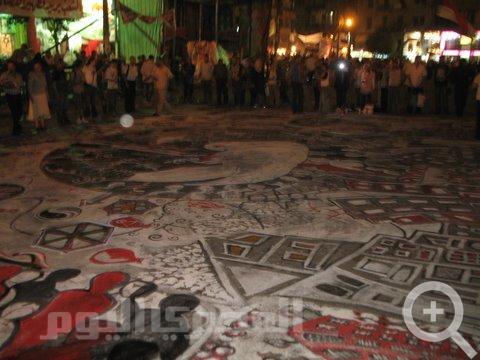
New street art in Tahrir Square. Photo: Al Masry Al Youm.
Graffiti has been as central to the Egyptian uprisings as social media. There are many reasons for this.
- Globally, graffiti and street art generally have been a revolutionary art form. In places where individuals own the buildings, street art reclaims it in the name of the people, symbolically asking the question, “Why should private persons control the appearance of public space?” In places where the buildings, streets and sidewalks are controlled by the state, street art questions the extent to which they actually operate in the name of the people.
- Second, in Islam, a common interpretation of the second commandment requires that no representation of God’s creation is appropriate in art. Word-based art forms (called khatalyid I believe) have long been regarded as one of the highest art forms.
- Third, there is a longstanding Arabic tradition of verbal poetics–both chanted and written–in revolutionary activity in the Arabic world.
Such work is being archived, and analyzed by art critics.
An article in Al Masry Al Youm July 17 by Youssef Tadros describes the work of graffiti and street artists during the current gatherings in Tahrir.
About a dozen artists were hard at work on Wednesday evening, painting a 100-square-meter section of asphalt nearby the KFC at Tahrir Square. From 7:00 to 10:00 that night, a crowd watched closely from just outside the tape-delineated boundaries of the painters’ “canvas”.
The finished product was a beautiful, vividly colored medley of revolutionary graffiti, centered on a large representation of a dove being stabbed by a giant, bloody knife. It’s expected to be a central feature of Tahrir Square society while the sit-ins last, showing the world that “the people at Tahrir Square are peaceful artists and well-cultured people, not thugs,” according to Mostafa al-Banna, one of the project’s organizers.
The project is the work of a group of artists formed during the Jan 25th occupation of Tahrir, calling itself “The Young Artist Coalition.” They have been engaged in street art throughout Cairo since the uprising.
Tadros writes:
Onlooker Ahmed Abdel Ghany optimistically asserted that during the time of repression, “the good and bad alike were repressed. With our new freedom of self-expression, you’ll find now it’s mostly good things that come out, and this is because we are naturally a good people.
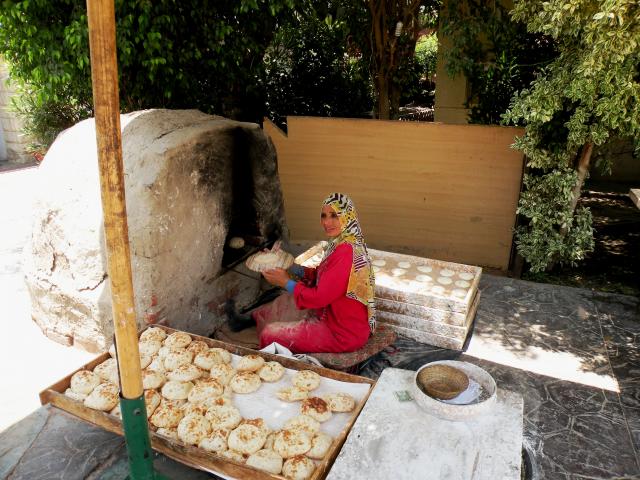
The food of the poor: One of the Egyptian Arabic terms for bread, 'aish, literally means "life." (Although this photo was actually taken at an upscale restaurant that bakes its own bread...)
Although I am as interested as anyone in the Egyptian uprisings as a social movement and a form of cultural production, I keep emphasizing to my students that there are crucial economic issues underlying these issues.
An op-ed piece by Rami Zurayk entitled “Use Your Loaf” in the UK newspaper Observer does a very nice job of linking the global food economy to the so-called “Arab Spring.”
Zurayk’s main argument is that under globalization, the staple foods of the poor have become more and more expensive, and this served as an important element in the uprisings. He focuses on grain as a case in point. Egypt, once the grainery of the Roman Empire is now the world’s largest importer of wheat.
One of his key points:
When grain prices spiked in 2007-2008, Egypt’s bread prices rose 37%. With unemployment rising as well, more people depended on subsidised bread – but the government did not make any more available. Egypt’s annual food price inflation continued and had hit 18.9% before the fall of President Mubarak.

 CONNECTED in CAIRO